KFF designs, conducts and analyzes original public opinion and survey research on Americans’ attitudes, knowledge, and experiences with the health care system to help amplify the public’s voice in major national debates.
This paper provides an overview of Medicaid eligibility policy and examines two groups of Americans in particular – low-income children and nondisabled adults under 65 – and summarizes the statutory and regulatory pathways to Medicaid eligibility available to them as individuals. The paper concludes with a discussion of policy options available to states under current law for increasing Medicaid eligibility for these two groups.
How Well Does the Employment-Based Health Insurance System Work for Low-Income Families?
September 1998
Most Americans receive health insurance coverage through the workplace. Unfortunately, however, many workers are left out, especially low-wage workers and their families. Being a low paid worker does not mean just that wages are low. It also means a lower likelihood of receiving health insurance protection on the job. Low-wage workers have never been as likely as the better paid to get coverage from their employers. And, as employers try to limit what they spend on coverage, the gap is growing worse. Although recent employer actions have reduced coverage for workers at all wage levels, low-wage workers have been the hardest hit.
Medicaid has made an enormous difference to health insurance protection for low-income families. But Medicaid eligibility is limited to the poorest of the poor, especially mothers and children. Although Medicaid has been expanded in recent years to reach near-poor pregnant women and children, many low-income working families have not been eligible for coverage. Employer protection is therefore critical for workers with low and modest incomes.
The purpose of this Issue Paper is to describe the nature of employer coverage; its decline, especially among low-wage workers and low-income families; and the factors that are undermining its reach. In summary, this paper documents the following:
Low wage workers are least likely to have employer coverage.
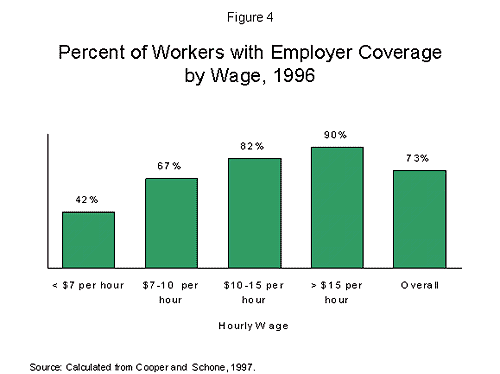
Whether they work in large or small firms, low-wage workers are far less likely than the better paid to have employer coverage. Although 90% of the highest wage workers had employment-based health insurance in 1996, only 42% of the lowest wage workers were covered.
The primary reason low-wage workers lack coverage is that their employers do not offer them health insurance benefits. Despite substantial costs, most low-wage workers (76% in 1996) participate in employer plans to which they have access.
As coverage has declined, the gap between high wage and low wage workers has grown.
Between 1987 and 1996, the proportion of workers with employer coverage fell by 3 percentage points, with the decline in coverage concentrated on the lowest wage workers. Coverage declined by 12 percentage points among the lowest wage workers, while coverage among the top wage earners increased by 3 percentage points. As a result, the gap in coverage between high-wage and low-wage workers has grown.
The decline in coverage for low-wage workers is a function of the decline in employer offerings and participation.
The proportion of low-wage workers with access to employer coverage declined 5 percentage points between 1987 and 1996 and the participation rate dropped by 13 percentage points. By contrast, access for high-wage workers improved.
The fall in participation for the lowest wage workers coincided with the deterioration in wages for these workers. From 1989 to 1996, the real hourly wage of the typical (median) worker fell 5.2%. Among low-wage men (20th percentile), wages declined even more- by 6.4%. Increases in employees’ contributions to premiums have therefore had a disproportionate effect on low wage workers.
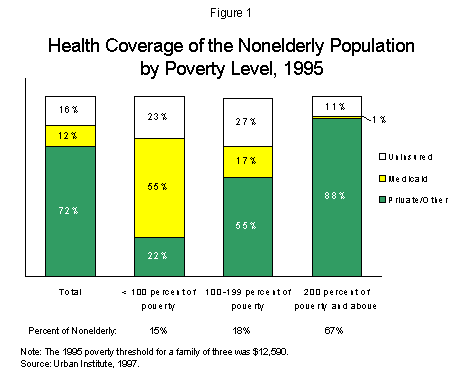
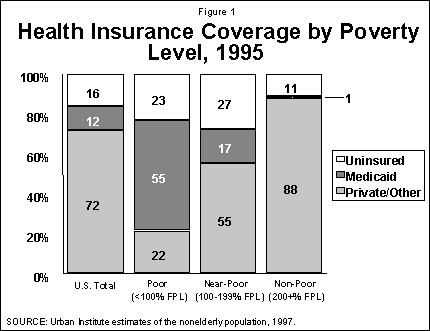
Who’s Covered and Who’s Left Out? The large majority of Americans have some kind of private or public health insurance, but more than 41 million nonelderly Americans are uninsured. Since almost all Americans over age 65 are covered by Medicare, lack of insurance is primarily a problem for working age adults and for children. In 1995, about 72% of the nonelderly had private health insurance (mostly employer coverage and some private, nongroup coverage) and 12% were covered by Medicaid. Approximately 16% of the nonelderly were uninsured [Figure 1].1
Whether individuals have any insurance coverage and what kind of insurance they have are closely related to family income. Over half of the uninsured are in families with incomes below 200% of poverty. In 1995, 88% of individuals in families with incomes above 200% of poverty had private (primarily employer-sponsored) health insurance and only 11% were uninsured. Not surprisingly, health insurance coverage for poor families looks very different. Only a small proportion of poor families (with incomes below 100% of the federal poverty level) have employer coverage. A large proportion are covered by Medicaid, but a substantial proportion remain uninsured. In 1995, 55% of individuals in poor families were covered by Medicaid and only 22% had private insurance. Despite Medicaid’s substantial contribution, however, 23% of the poor lacked health insurance [See Figure 1].
Near-poor families (those with incomes between 100-199% of poverty) are somewhat worse off than poor families with respect to health insurance coverage. Affordable private health insurance is only available to individuals in near-poor families if it is employer-sponsored. Only 55% of individuals in near-poor families had private (primarily employer-sponsored) insurance in 1995, compared to 88% of individuals in families with incomes above 200% of poverty. For certain groups, such as pregnant women and children, Medicaid has played a strong role, but Medicaid’s income and categorical restrictions result in limited coverage of the near-poor–only 17% of individuals in near-poor families had Medicaid coverage. As a result, 27% were uninsured [See Figure 1].
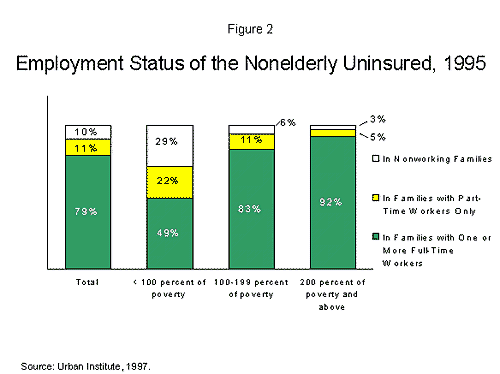
Lack of insurance does not mean that the poor and near-poor are not working. Rather, the vast majority of the uninsured are workers or are in working families. In 1995, most uninsured adults and children–79 percent–lived in families where there was at least one full-time worker. Another 11% lived in families where there was at least one part-time worker. Only 10% of the uninsured lived in families where there were no employed adults [Figure 2]. The same is true even of the poor and near-poor uninsured. Among the near-poor, the proportion of uninsured who are in full-time workers’ families (83 percent) is nearly as high as among higher income workers (92 percent). The differences in their insurance coverage are therefore not explained by substantially different levels of employment.
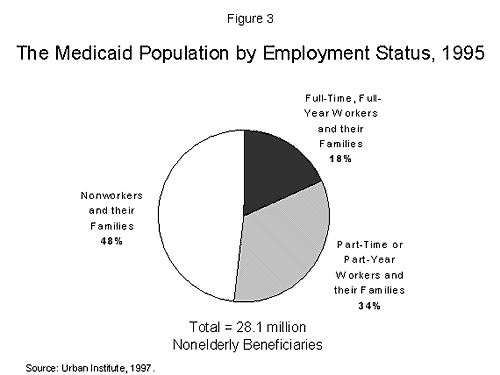
Although Medicaid’s coverage of the near-poor is limited by its eligibility criteria, many working families do qualify for Medicaid. About half of Medicaid’s nonelderly beneficiaries (low-income, working age adults and children) are in working families. In 1995, 18% of Medicaid’s nonelderly beneficiaries were in families where the family head worked full-time and full-year, while 34% were in families where at least one adult worked part-time or part-year [Figure 3].
Why Don’t Low-Income Families Have Employer Coverage?
Since most of the uninsured and half of low-income adults and children with Medicaid coverage are in working families, an important question is why so many low-income working families lack employer coverage. There are a number of factors associated with jobs without health care coverage, but a key factor is low wages. Figure 4 presents data on employer coverage rates for workers differentiated by wage.2 These data show there is a strong positive relationship between wages and health insurance coverage. In 1996, 90% of workers who earned more than $15 per hour had employer coverage, while only 42% of workers who earned less than $7 per hour had employment-related health insurance.
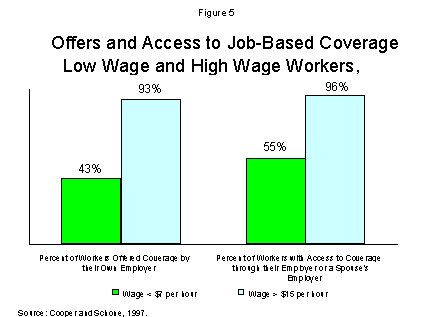
The primary problem for low-wage workers is that their employers not only pay them low wages, but they also offer them lower nonwage compensation-including health insurance and pensions.3 In 1996, only 43% of workers who earned less than $7 per hour were offered health benefits by their employer, compared to 93% of workers who earned more than $15 per hour [Figure 5].
Uninsured low wage workers, like all uninsured workers, are in large as well as small firms, and are in firms that offer coverage to none of their workers as well as firms that offer coverage to some. Although data make it difficult to distinguish precisely between these categories, an estimate from available data suggests that uninsured workers are about equally split between firms that do not offer coverage and firms that offer coverage to some workers.4
Unfortunately, many low-wage employees offered limited benefits do not have alternative access to employment-based coverage through a spouse or other family member. Even when other sources of insurance are taken into account, the gap between low and high-wage workers is still quite large. In 1996, 55% of low-wage workers had access (through their own employer or a family member’s employer) to employer coverage, compared to 96% of high-wage workers [See Figure 5].
Measured by enrollment, Medicaid is the largest health insurer in the country. According to the Urban Institute’s estimates, Medicaid covered 41.3 million Americans in 1996; Medicare, in comparison, covered 38 million. Moreover, millions of low-income Americans without private health insurance coverage are eligible for Medicaid but are not enrolled in the program. For example, researchers at the Agency for Health Care Policy Research recently estimated that in 1996 about 4.7 million uninsured children were eligible for Medicaid but not enrolled.1 If all of these children were enrolled in Medicaid, the number of children without some form of health insurance coverage would drop by 40 percent.
There are numerous reasons why Medicaid does not cover all of the children or adults who qualify. This Issue Paper focuses on one of those reasons: the complexity of Medicaid eligibility policy. This complexity makes the program difficult for low-income Americans to understand and for state Medicaid officials to administer. Yet within this complexity are options that enable states, if they so choose, to use their Medicaid programs as a policy tool to reduce — potentially dramatically — the number of children and adults without basic health care coverage.
This paper begins with an overview of Medicaid eligibility policy. It then turns to two groups of Americans — low-income children and nondisabled adults under 65 — and summarizes the statutory and regulatory “pathways” to Medicaid eligibility available to individuals to them.2 The paper concludes with a discussion of policy options available to states under current law for increasing Medicaid eligibility for these two groups. It also reviews the policy options available to the federal government for altering current law to expand Medicaid eligibility.
The complexity of Medicaid eligibility policy is just one reason why Medicaid does not cover all of the children or adults who qualify. Other reasons include burdensome application forms and procedures, lack of outreach efforts, and negative perceptions of Medicaid among low-income families.3 These issues are the subject of other analyses and are being explored in related Kaiser Commission projects.4
As CBO has recognized, states have Aa great deal of flexibility in operating the Medicaid program.5 For this reason, Medicaid eligibility policy, like Medicaid coverage policy and Medicaid payment policy, varies from state to state. This paper does not attempt to describe Medicaid eligibility policy in each state.6 Instead, the focus is on the federal policies that structure the eligibility choices that states make.
I. Overview of Medicaid Eligibility Policy
Medicaid eligibility policy reflects the basic structure of the program. Medicaid is a means-tested, federal-state, individual entitlement program with historical ties to the Aid to Families with Dependent Children (AFDC) and Supplemental Security Income (SSI) cash assistance programs. Medicaid’s policy premise of means-testing explains much about its income and resource rules. Medicaid’s association with AFDC and SSI has guided Medicaid’s historical eligibility categories. Finally, because Medicaid is an individual entitlement, both the states and the federal government have relied on eligibility policy as a tool for limiting their financial exposure for the cost of covered benefits.
Medicaid’s role is to cover basic health and long-term care services for low-income Americans. However, being poor does not assure Medicaid coverage. As shown in Figure 1, Medicaid in 1995 covered only about 55 percent of the nonelderly poor, earning less than $12,590 for a family of three. Medicaid’s reach to individuals with incomes just above the poverty line is even more limited, covering only 17 percent of the near-poor. Despite Medicaid, low-income people are considerably more likely to be uninsured than those with higher incomes. While a portion of the low-income uninsured are eligible for Medicaid but not enrolled, a substantial share are excluded from Medicaid coverage by program eligibility rules that reflect policy choices at both the federal and state level.
At the federal level, eligibility policy choices are reflected in the authorization of federal Medicaid matching funds (on an open-ended basis) for the costs incurred by a state in paying for covered services on behalf of certain low-income individuals. Federal Medicaid matching funds are available to states for the costs of covering some categories of individuals but not others. If federal matching funds are not available for a particular category, it is unlikely that a state will extend Medicaid coverage to those categories of individuals, because the state would then bear the costs of care entirely at its own expense.
At the state level, eligibility policy choices are reflected in state decisions as to which optional eligibility categories and which income and resource criteria to adopt. There are certain eligibility groups — for example, pregnant women with family incomes at or below 133 percent of the federal poverty level ($1,513 per month for a family of three in 1998) — that all states opting to participate in Medicaid must cover. In addition, there are other categories for which states may receive federal matching funds if they choose to extend Medicaid coverage. However, the availability of federal matching funds for a particular category of individuals does not necessarily mean that a state will cover that category, since the state must still contribute its own matching funds toward the costs of coverage.
The terms on which federal Medicaid matching funds are available to states include five broad requirements relating to eligibility: categorical; income; resources; immigration status; and residency. Two of these broad requirements — income and resources — are financial in nature. The other three — categorical, immigration status, and residency — are non-financial. In order to qualify for Medicaid, an individual must meet both its financial and non-financial requirements.
Within each of these five broad requirements are “mandatory” and “optional” elements. It is important to understand the context in which these terms are used. State participation in Medicaid is voluntary, not mandatory. The federal government makes Medicaid matching funds available on an open-ended, entitlement basis to states that elect to participate in the program. In order to participate, states must offer coverage for basic benefits to certain populations — e.g., medically necessary physician and hospital services to certain low-income families and children.
States receive federal Medicaid matching funds for at least 50 percent and as much as 80 percent of the costs of this mandatory coverage, depending on the state. In exchange, states are also able to draw down federal Medicaid matching funds at the same rate for optional populations and services such as the low-income elderly and disabled at risk of nursing home and other expensive long-term care services. Similarly, within each of the five major eligibility requirements there are minimum policies states must follow and there are more expansive policies that states may adopt. According to the Health Care Financing Administration, 55 percent of all Medicaid spending paid for optional populations or optional services.7
A child or adult who establishes Medicaid eligibility is not, on the basis of that initial determination, entitled to maintain eligibility indefinitely. Federal Medicaid regulations require that states redetermine eligibility of a Medicaid beneficiary at least once every 12 months. This redetermination, like the original determination, is designed to ensure that a beneficiary continues to meet each of the financial and non-financial requirements for eligibility. Those beneficiaries, who due to a change in income, resources, or family composition no longer meet the eligibility requirements of their state through any pathway, lose their entitlement to Medicaid. There are some limited exceptions for certain categories such as pregnant women, who are entitled to continue Medicaid coverage for 60 days post-partum regardless of any change in financial or non-financial circumstances.
Fluctuations in monthly income are common among low-income families. These changes can lead to the loss of Medicaid coverage by a child or family whose income may spike during one part of the year but spends most of the year earning under the federal poverty level. This occurs commonly in states that use 1-month, 3-month, and 6-month redetermination periods. To address eligibility “churning,” the Balance Budget Act of 1997 gave states the option of extending Medicaid coverage with federal matching funds to children under 19 for a period of up to 12 months after the initial determination of eligibility regardless of any change in financial or non-financial circumstances that would otherwise make them ineligible. This option does not extend to low-income adults with dependent children.
Medicaid does not require that an individual who meets its categorical, income, resource, immigration status, and residency requirements also be uninsured. Medicaid treats insurance coverage as a payment source, not as an eligibility criterion. More specifically, private insurance coverage under Medicaid is a type of “third party liability” that the program uses to reduce its costs of coverage. In most cases, when a Medicaid beneficiary also has private coverage, the private insurer must pay first. Then Medicaid will pay for Medicaid-covered services for which the private insurer is not obligated to pay. This policy stands in sharp contrast to the approach taken under the new Child Health Insurance Program (CHIP), under which states are expressly prohibited from using federal CHIP matching funds to pay for services to children with private health insurance.8
Unlike employer-based insurance coverage, Medicaid eligibility is not directly tied to employment for many of the Medicaid coverage categories. For example, a pregnant woman whose income is equal to or less than 133 percent of the federal poverty level is eligible for Medicaid coverage in every state whether or not she worked before or during her pregnancy. On the other hand, as a result of the 1996 welfare law, a state has the option to deny Medicaid eligibility to non-pregnant women with dependent children with respect to whom the state has terminated cash assistance for refusal to work (states are not permitted to terminate Medicaid coverage to children for this reason).
The earnings flowing to an individual or a family from work will affect income eligibility for Medicaid. At income levels near Medicaid eligibility thresholds, a small increase in earnings can result in a loss in Medicaid eligibility even though the increase in earnings may not be sufficient to enable the worker to afford private health insurance coverage. To mitigate this disincentive to work or to increase the hours worked, states are required to extend “transitional” Medicaid coverage for up to one year to women (and their dependent children) who lose cash assistance due to earnings.
Figure 2: Major Medicaid Eligibility Pathways for Selected GroupsMandatory CoverageOptional CoverageLow-income ChildrenPrimary Pathways Infants under age 1 with income < 133% FPL Infants under age 1 with income < 185% FPL Children age 1 to 6 with income < 133% FPL Children age 1 to 6 with income < 185% FPL Children age 6 to 15 with income < 100% FPL Children age 6 to 15 with income < 133% or 185% FPL Section 1931 children Targeted low-income children (CHIP children) Children in welfare-to-work families Transitional coverage for children in welfare-to-work families Title IV-E foster care children Non-Title IV-E foster care children Title IV-E adoption assistance children Non-Title IV-E adoption assistance children Other Pathways Medically needy Ribicoff children Children with DisabilitiesPrimary Pathways Supplemental Security Income (SSI) recipients Katie Beckett children Home or community-based waiver children Other Pathways SSI recipients as of 8/22/96 Medically needy Pregnant WomenPrimary Pathways Pregnant women with income < 133% FPL Pregnant women with income < 185% FPL Other Pathways Medically needy Low-Income AdultsPrimary Pathways Certain adults in low-income families with children Adults in two-parent households with dependent children Other Pathways Medically needy COBRA continuation beneficiaries Return to top
HIPAA Compliance Strategies In California: Reforming the State’s Individual Health Insurance Market — Policy Brief
A policy brief on reform of the individual insurance market and implementation of the Health Insurance Portability and Accountability Act (HIPAA) in California. The brief is based, in part, on discussion at a California Health Policy Roundtable held in Sacramento, California on March 12, 1998.
Note: This publication is no longer in circulation. However, a copy may still exist in the Foundation’s internal library that could be reproduced. Please email order@kff.org if you would like to pursue this option.
The July/August 1998 edition of the Kaiser Family Foundation/Harvard Health News Index includes questions about major health stories covered in the news, including questions about Patients’ Rights and Medicare. The survey is based on a national random sample of 1,200 Americans which measures public knowledge of health stories covered by the news media during the previous month. The Health News Index is designed to help the news media and people in the health field gain a better understanding of which health stories in the news Americans are following and what they understand about those health issues. Every two months, Kaiser/Harvard issues a new index report.
This policy paper describes key requirements of consumer protection regulation under Medicare, Medicaid and federal and state laws as they apply to private health insurance. These include choice and availability of plans, disclosure of information, marketing, access, quality, and the grievance and appeals process. The discussion highlights differences and similarities across public programs and private insurance and compares public and private insurance protection with provisions of the Consumer Bill of Rights (CBRR) developed by the President’s Advisory Commission on Consumer Protection and Quality in the Health Care Industry.
Report: Protection For Consumers In Managed Care Plans: A Comparison
This chartbook provides an overview of health care spending and trends in health plan enrollment. It highlights health insurance premiums and costs, health insurance benefits, the structure of the health care market. Data on the stock markets role within the health care industry and implications of health insurance trends for consumers and the safety net is also included.
This report presents findings based upon the KPMG health benefits survey of private and public employers and explores the extent of ERISA preemption on health plans covering U.S. workers. Included is estimated data on the total number of workers covered by fully and partly self-insured health plans in 1993 and 1995, a summary of the ERISA provisions and case law dealing with health plans and an analysis of potential changes to ERISA.
Note: This publication is no longer in circulation. However, a few copies may still exist in the Foundation’s internal library that could be xeroxed. Please contact us if you would like to pursue this option.
A national survey of 800 African Americans, plus an additional general population sample of 800 Americans, examining perceptions about the media’s coverage of health issues that most concern and impact African Americans. This survey was conducted jointly by the Foundation and the National Association of Black Journalists (NABJ) for presentation at the NABJ’s annual conference being held in Washington, DC on Friday, July 31st, 1998.