Will 1999 Be The Year For Mifepristone (RU-486) And, An Update on Women’s Other Options for Very Early Abortion

Published: Aug 31, 1998

While there has been much attention to the few abortions that occur late in pregnancy, there has been little focus on what options are available during the early weeks, even days, of pregnancy, when most women seek abortions. The drugs mifepristone (also known as RU-486) and misoprostol have been available in France, England, and Sweden for much of the last decade as an earlier medical alternative to surgical abortion. Since becoming available, an estimated one-half million women in Europe have used the drugs to end unintended pregnancies. In the United States, mifepristone, is still undergoing the Food and Drug Administration’s (FDA) approval process, and has been available only to a limited group of women participating in clinical trials.

In this Emerging Issues in Reproductive Health Briefing a panel of experts including Janet Benshoof, JD, President, Center for Reproductive Law and Policy and Beverly Winikoff, MD, Senior Medical associate, the Population Council discussed the availibility of mifeprestone, methotrexate, and other very early methods of abortion in this country, as well as what is currently available, what is on the horizon, who provides these options today, and who is likely to in the future. A companion survey also released at this briefing is available separately as #1431 Two National Surveys: Views of Americans and Health Care Providers on Medical Abortion.

Will 1999 Be The Year For Mifepristone (Ru-486)? And, An Update on Women’s Other Options for Very Early Abortion

Published: Aug 31, 1998

National Survey of Women’s Health Care Providers on Medical Abortion

September 16, 1998

One in Two Ob/Gyns Say They are Likely to Offer Mifepristone (RU-486) If Approved by FDA, And Almost Half Who Do Not Now Provide Abortions Say They Would Provide the Medical Alternative

Many Family Practice Physicians, Nurse Practitioners and Physician AssistantsAlso Report Interest

Menlo Park, CA – In the coming year, the Food and Drug Administration (FDA) is expected to complete its review of mifepristone (sometimes referred to as RU-486 or the “French abortion pill”), a medical alternative to early surgical abortion. If approved, a national survey of obstetrician/gynecologists (ob/gyns) finds that more than half (54%) say they are “very” or “somewhat” likely to prescribe the drug for patients seeking abortions, including almost as many (35%) who do not now provide surgical abortions.

In addition, many family practice physicians (45%) and nurse practitioners and physician assistants (54%) also express interest in offering mifepristone if approved, potentially significantly expanding the number of providers offering some form of abortion. In this survey, 3 percent of family practice physicians, and 2 percent of nurse practitioners and physician assistants, reported “ever performing” surgical abortion.

Available in France, England and Sweden for much of the last decade, mifepristone has been used by more than one half million women in Europe. In the United States, it has so far only been available to a limited number of women participating in clinical trials. Methotrexate, a FDA approved cancer drug which has also been found effective in ending pregnancy, is currently available in the United States, although information about how widely it is being offered is limited.

“The level of provider interest in mifepristone, especially among those not now providing abortions, could mean expanded access for women,” says Felicia H. Stewart, MD, Director of Reproductive Health Programs, Kaiser Family Foundation.

The survey findings are being presented today at a briefing in New York that provides an update on the availability of mifepristone and other medical alternatives to surgical abortion in the U.S. The briefing is part of an ongoing series, Emerging Issues in Reproductive Health, sponsored by The Henry J. Kaiser Family Foundation, The Alan Guttmacher Institute, and the National Press Foundation.

When this survey was conducted in the Spring of 1997, fewer providers expected to offer methotrexate over the coming year, even though it is already available here, than said they would likely prescribe mifepristone if approved: 19 percent of ob/gyns, 11 percent of family practice physicians, and 13 percent of nurse practitioners and physician assistants. In fact, more providers say if a choice were available they would choose mifepristone over methotrexate for their patients.

A companion survey of Americans between the ages of 18-44 conducted at the same time as the survey of providers finds that about half have heard of either mifepristone or methotrexate (43% of women, 51% of men). Among women of “reproductive age” who are aware of the medications, 72 percent know they can be used to end a pregnancy.


Methodology

The Kaiser Family Foundation’s National Survey of Health Care Providers on Medical Abortion is a national random-sample telephone survey of 756 health care providers, including 305 obstetrician/gynecologists, 238 family practice physicians, and 229 nurse practitioners and physician assistants practicing in the United States. It was designed by staff at the Kaiser Family Foundation and Fact Finders, Inc. and conducted by Fact Finders, Inc. between March 5 and June 12, 1997. The margin of error ranges from plus or minus two to seven percent for particular questions.

The Kaiser Family Foundation’s National Survey of Americans on Medical Abortion is a random-sample telephone survey of 1,000 women and 300 men aged 18-44 years old living in the continental United States. It was designed by staff at the Foundation and Princeton Survey Research Associates (PSRA) and conducted by PSRA between May 13 and June 8, 1997. The margin of sampling error is plus or minus three percent for women and plus or minus six percent for men.

A summary report on the findings, including the questionnaire and top line data, are available by calling the Kaiser Family Foundation’s publication request line at 1-800-656-4533 (Ask for #1431).

Kaiser/Harvard Survey of Americans on the Consumer Protection Debate – News Release

Published: Aug 31, 1998

New Survey Finds The Public More Worried About Managed Care And More Supportive Of Patient Protection Legislation, But Criticisms Still Register

September 17 1998

Most Say Congress is Playing Politics with Patients Rights in an Election Year

Washington, D.C. – A new survey released today shows that Americans are increasingly concerned about managed care and support for consumer protection proposals has grown. However, criticisms by opponents that regulation will drive up costs and cause employers to drop coverage continue to register with the public. In addition, most people believe that politicians have been using the issue to gain political advantage in an election year, rather than making a serious attempt to pass laws to protect consumers.

The Kaiser/Harvard Survey on Americans’ Views on the Consumer Protection Debate found that since last fall more people are following the managed care debate, and the increased scrutiny has taken a toll on the managed care industry. Compared with previous Kaiser/Harvard surveys, more Americans see managed care plans as doing a “bad job” in serving consumers and worry that their plans are more concerned about profits than about their health care. More people are also reporting that they or someone they know has had problems with their health plans.

In addition, at a time when the public has been wary of “big government” and opponents of managed care regulation have taken to the airwaves, when presented with the arguments for and against regulation, respondents’ support for government involvement to protect consumers in managed care plans has risen from 52 percent in September 1997 to 65 percent.

“The President’s troubles may have sidetracked legislative action for now, but this issue is likely to return to the legislative agenda because the public’s underlying concerns are still there,” said Drew Altman, Ph.D., President of the Kaiser Family Foundation.

Attitudes Towards Health Plans

More Americans now see managed care plans as doing a bad job serving consumers (36 percent, up from 21 percent a year ago) than a good job (30 percent, down from 34 percent). The public also appears to be increasingly worried about how their health plan will treat them, with 33 percent “very” worried that their plan is more interested in saving money than in providing them with the best treatment if they are sick, up from 18 percent just a year ago.

Such worries are most common for those in the most restrictive forms of managed care (43 percent very worried). At the same time, the percentage of those reporting that they or someone they know has had at least one problem with their health plan rose from 48 percent to 57 percent in an eight-month period.

And although managed care issues have been prominent in the news, those who hold unfavorable views continue to report that they base their opinions more on their own experience (37 percent) or the experience of friends and family (35 percent) than on media coverage (18 percent). In fact, 30 percent of Americans report that they or someone they know has had an HMO or other managed care plan deny treatment or payment for something a doctor recommended.

Attitudes Towards Regulation

The number of Americans supporting government regulation of health plans has risen significantly in the past year. When presented with arguments for and against regulation, 65 percent say “government needs to protect consumers from being treated unfairly and not getting the care they need” versus 28 percent who say “additional government regulation is a bad idea and would raise the cost of health insurance.” By comparison, 52 percent responded favorably towards government regulation when presented with this tradeoff in September 1997.

Support has also risen for the most controversial and hotly debated consumer protection measure – the right of consumers to sue their health plans – from 64 percent in December 1997 to 73 percent.

However, as with our earlier surveys, support for consumer protection drops substantially when possible consequences are raised:

  • Support for comprehensive consumer protection legislation drops from 78 to 40 percent (with 40 percent opposed) when people are told that it could raise the cost of a typical family health insurance policy by $200 per year (approximately the cost estimated by the Congressional Budget Office for a leading patient protection proposal).
  • While an overwhelming majority support specific consumer protection measures, support for these also drop substantially when respondents are presented with criticisms made by opponents that they may get the government too involved in the health care system, raise costs, or cause employers to drop health coverage.

Politics and Patient Rights

When asked how important candidates’ stands on specific issues will be in the upcoming election, 47 percent cited education, 42 percent taxes, and 40 percent Social Security as important factors to their vote. Managed care regulation was cited by 34 percent, as was Medicare, ahead of two other major issues that have been hotly contested by the Congress: tobacco regulation (17 percent) and campaign finance reform (15 percent).

Republicans (77 percent), Democrats (78 percent) and Independents (79 percent) are equally supportive of consumer protection legislation, including controversial measures like allowing consumers to sue health plans. While support for the right to sue plans has increased slightly among Democrats (increasing from 70 percent to 75 percent in eight months), it has increased more significantly among Republicans, rising from 56 percent to 74 percent over the same period.

“Regulation of managed care ranks higher as an issue for the public than others currently being debated by the Congress, such as regulation of tobacco and campaign finance reform,” said Robert J. Blendon, Sc.D., Professor of Health Policy and Political Analysis at Harvard University.

The increasingly combative nature of the managed care debate has also registered with the public. Forty-one percent of those surveyed said they have seen, heard or read television, radio and print ads that are being used by candidates and interest groups to influence the debate. The public is cynical, however, about the motives of elected officials, with 66 percent saying that Members of Congress are using the debate over consumer protection to gain political advantage in an election year, and only 25 percent saying that they are serious about consumer protection.

In terms of trust in handling this issue, the public gives neither party a big edge. However, should the Congress fail to pass consumer protection legislation, those surveyed would be more likely to hold Republicans responsible (35 percent) than Democrats (20 percent). Seventeen percent would blame both parties equally.

Consumer Protection Legislation Generally Includes Five Broad Measures

Proposals before Congress to expand the regulation of health plans include a number of consumer protection measures, including:

  • Requiring plans to provide more information to enrollees
  • Making it easier for people to obtain coverage for an emergency room visit
  • Providing easier access to ob-gyns, pediatricians, and other medical specialists
  • Allowing consumers to appeal a health plan’s decision to an independent reviewer
  • Giving consumers with employer-sponsored health coverage expanded rights to sue their health plans

Methodology

This Kaiser Family Foundation/Harvard University Survey of Americans’ Views on the Consumer Protection Debate was designed and analyzed by researchers at the Kaiser Family Foundation and Harvard University. The survey was conducted by telephone by Princeton Survey Research Associates with 1,200 adults, 18 years and older, nationwide between August 6 and August 20, 1998. The margin of error is plus or minus 3 percent for the national sample. The margin of sampling error may be higher for some of the sub-sets in this analysis.

Because many people are unsure – or don’t know – what kind of health insurance they have, insured respondents under age 65 in this survey (715 respondents) were asked a series of questions about their health plan to establish what kind of coverage they have. They were asked if they were required to do any of the following by their plan: choose doctors from a list and pay more for doctors not on the list; select a primary care doctor or medical group; and/or obtain a referral before seeing a medical specialist or doctor outside the plan. Respondents were listed as being in “heavy” managed care if they reported their plans had all of the characteristics described above. Respondents were listed as being in “light” managed care if they reported their plans had some but not all of the characteristics listed above. And, respondents were listed as having “traditional” insurance if they reported their plans as having none of the characteristics.

Previous Kaiser/Harvard surveys are cited for the purpose of comparison. They are: the Kaiser/Harvard National Survey of Americans’ Views on Consumer Protections in Managed Care with 1,204 adults (age 18 or older) between December 12-30, 1997 (margin of error plus or minus 3 percent); and the Kaiser/Harvard 1997 National Survey of Americans’ Views on Managed Care with 1,204 adults nationwide between August 22 and September 23, 1997 (margin of error plus or minus 3 percent). Additional comparisons are made with preliminary data from a new Kaiser/Harvard national survey.

The Kaiser Family Foundation, based in Menlo Park, California, is a non-profit, independent national health care philanthropy and is not associated with Kaiser Permanente or Kaiser Industries.

Copies of the questionnaire and top line data for the findings reported in this release are available by calling the Kaiser Family Foundation’s publications request line at 1-800-656-4533 (Ask for publication #1438). Also available are the top line data from the Kaiser/Harvard National Survey of Americans’ Views on Consumer Protections in Managed Care (#1356) and the Kaiser/Harvard 1997 National Survey of Americans on Managed Care (#1328).

Return to top

New Survey Finds The Public More Worried About Managed Care And More Supportive Of Patient Protection Legislation, But Criticisms Still RegisterPress Release Survey (PDF Format Only) Chart Pack (PDF Format Only)
Will 1999 Be The Year For Mifepristone (RU-486) And, An Update on Women’s Other Options for Very Early Abortion – Fact Sheet

Published: Aug 31, 1998

Abortion in the U.S.

  • Most abortions in the U.S. today are performed surgically, typically using vacuum aspiration (VA).
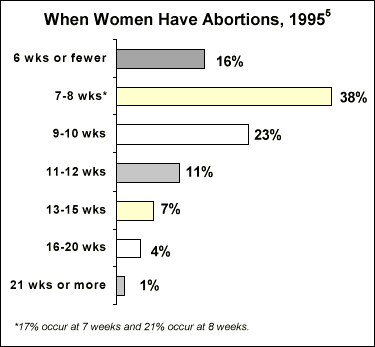
  • 9 in 10 abortions occur within the first 12 weeks of pregnancy.5
  • Surgical abortions can be performed as early as pregnancy is first detected, using electric VA or manual vacuum aspiration (MVA).21
  • Medical abortions are procedures using medications to induce abortion, such as mifepristone (also called RU-486) or methotrexate in combination with misoprostol.

Unintended Pregnancy And Surgical Abortion

  • Almost half (49%) of the 6.3 million pregnancies each year are unintended; 54% of unintended pregnancies end in abortion.
  • In 1994, there were about 1.43 million abortions in the United States; the abortion rate was 24.2 per 1,000 women aged 15-44.10
  • The U.S. abortion rate and the percent of pregnancies ending in abortion have declined slightly but steadily since 1980. Since 1990, all measures of abortion, including the annual incidence, have declined.6
  • About 15,000 women have abortions each year because they became pregnant after rape or incest.6
  • 48% of women 15*44 have at least one unplanned pregnancy sometime in their lives; 28% have one or more unplanned births, 30% have one or more abortions and 11% have both.9
  • An estimated 43% of women will have an abortion by the time they are 45, given current abortion rates.9

Who Has Abortions

  • 55% of women having abortions are younger than 25; 33% are aged 20-24 and 22% are teenagers.8
  • Six in 10 abortions occur to white women; however, their abortion rate is below that of minority women. Black women are nearly 3 times as likely as white women to have an abortion and Hispanic women are about twice as likely.8
  • Two-thirds of all abortions are to never-married women.8
1432-fig1.gif

Who Provides Surgical Abortions

  • 93% of abortions take place in clinics or doctors’ offices.6
  • The number of known current abortion providers (hospitals, abortion clinics, family planning clinics that offer surgical services, and physicians’ offices) declined by 8% between 1988 and 1992 (from 2,582 to 2,380).6
  • In 1992, just 12% of all ob/gyn residency programs provided routine first-trimester abortion training; three in 10 programs offered no first-trimester training.12
  • According to a national survey of ob/gyns in 1997, 36% of ob/gyns say they “ever perform” surgical abortions.18

Barriers & Access To Surgical Abortion Services

  • 84% of all U.S. counties lacked an abortion provider in 1992.6V52% of all abortion facilities provide services only through the 12th week of pregnancy.7
  • In 1992, 4 in 10 clinics and physicians’ practices would not perform surgical abortions before 6 weeks since the beginning of a woman’s last menstrual period (LMP). Another quarter of facilities do not perform abortions until even later in pregnancy.7
  • One-quarter of women who have non-hospital abortions travel at least 50 miles from their home to the abortion facility.7
  • From 1996 to 1997, the number of arsons doubled and bombings tripled against abortion providers.13

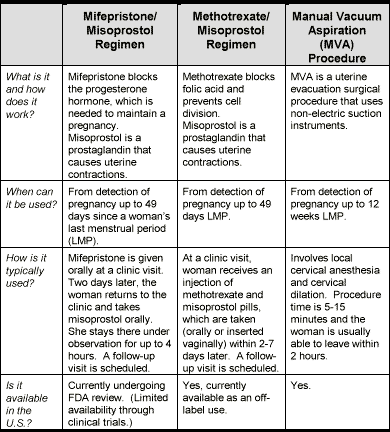
Very Early Abortion Methods3,14,21

1432-fig2.gif

Medical Abortion

  • Among women participating in the U.S. clinical trials who underwent an abortion within 49 days (7 weeks) LMP, the use of mifepristone (with misoprostol) was 92% effective in terminating pregnancy.16
  • Two percent of women who had a mifepristone abortion 49 days LMP in clinical trials required hospitalization, surgical intervention, and/or intravenous-fluid administration.16
  • Several published studies on the use of methotrexate (with misoprostol) for abortion have found the drug to be up to 96% effective in terminating pregnancy within 63 days LMP.1,2,4
  • Of 178 women who underwent pregnancy termination with methotrexate within 63 days LMP in one study, 7 required surgical intervention.1
  • A review of 12 international published studies conducted between 1979 and 1993 of patient attitudes and reactions to early first-trimester medical abortion found that 60-70% of women chose medical abortion when offered a choice between surgical and medical abortion.19
  • Over 2,000 U.S. women, who had a medical abortion with mifepristone and misoprostol during the U.S. clinical trials (1994-1995), found the method highly acceptable: 96% would recommend it to others, 91% would choose it again and 88% found it very or moderately satisfactory.20

Who Pays For Surgical Abortions

  • In 1993, the average amount paid for a non-hospital abortion at 10 weeks was $296; however, the cost ranged from $140 to more than $1,700.7
  • About 13% of all abortions are paid for with public funds, virtually all of which are state funds. Currently, 16 states pay for all or some abortions for poor women.15
  • In the private sector, over two-thirds of typical fee-for-service and managed care plans routinely cover abortions.17

Provider & Public Opinion On Medical Abortion

  • As of 1997, most providers said they were at least somewhat familiar with mifepristone; fewer were familiar with methotrexate.18
  • About half of all ob/gyns (54%) said they would offer mifepristone abortions if approved in the U.S., including 35% of ob/gyns who do not perform surgical abortions.18
  • Among providers familiar with mifepristone, most said they considered it safe (96% of ob/gyns) and effective (94% of ob/gyns).18
  • As of 1997, 43% of women and 51% of men had heard of either mifepristone or methotrexate; among women who had heard of the methods, 72% knew they could be used to end a pregnancy.18

References

1. Creinin M, Darney P. “Methotrexate and Misoprostol for Early Abortion.” Contraception. 1993; 48:339-348.

2. Creinin M. “Methotrexate for Abortion at 42 Days Gestation.” Contraception. 1993; 48:519-525.

3. Expanding Options For Early Abortions Packet. Overview and Fact Sheets. Reproductive Health Technologies Project, Washington D.C.: 1998.

4. Hausknecht R. “Methotrexate and Misoprostol to Terminate Early Pregnancy.” The New England Journal of Medicine. 1995;333:537-540.

5. Henshaw S. “Abortion Services in the United States, 1995-1996.” Family Planning Perspectives. (Forthcoming, Nov/Dec 1998).

6. Henshaw S, Van Vort J. “Abortion Services in the United States, 1991 and 1992.” Family Planning Perspectives. 1994; 26:100-106, 112.

7. Henshaw S. “Factors Hindering Access to Abortion Services.” Family Planning Perspectives. 1995; 27:54-59, 87.

8. Henshaw S, Kost K. “Abortion Patients in 1994-1995: Characteristics and Contraceptive Use.” Family Planning Perspectives. 1996; 28:140-147, 158.

9. Henshaw S. “Unintended Pregnancy in the United States.” Family Planning Perspectives. 1998; 30:24-29.

10. “Induced Abortion.” Facts in Brief. Jan. 1997, New York, N.Y. The Alan Guttmacher Institute.

11. Forrest JD. “Timing of Reproductive Life Stages.” Family Planning Perspectives. 1993; 82.

12. MacKay H, Trent MacKay A. “Abortion Training in Obstetrics and Gynecology Residency Programs in the United States, 1991-1992.” Family Planning Perspectives. 1995; 27:112-115.

13. National Abortion Federation Website (http://www.prochoice.org)

14. Schaff E, Eisinger S, Franks P, Kim S. “Methotrexate and Misoprostol for Early Abortion.” Fam Med. 1996;28:198-203.

15. Sollom T, Gold R, Saul R. “Public Funding for Contraceptive, Sterilization and Abortion Services, 1994.” Family Planning Perspectives. 1996; 28:166-173.v

16. Spitz I, Benton L, Bardin W, Robbins A. “The Safety and Efficacy of Early Pregnancy Termination with Mifepristone and Misoprostol: Results from the First Multicenter U.S. Trial.” The New England Journal of Medicine. 1998; 338:1241-1247.

17. Uneven & Unequal: Insurance Coverage and Reproductive Health Services. 1994, New York, N.Y. The Alan Guttmacher Institute.

18. Views of Americans and Health Care Providers on Medical Abortion: What They Know, What They Think, and What They Want.. 1998, Menlo Park, CA. Kaiser Family Foundation.

19. Winikoff B. “Acceptability of Medical Abortion in Early Pregnancy.” Family Planning Perspectives. 1995;27:142-148 & 185.

20. Winikoff B, Ellertson C, Elul B, Sivin I. “Acceptability and Feasibility of Early Pregnancy Termination by Mifepristone-Misoprostol.” Archives of Family Medicine. 1998; 7:360-366.

21. Winkler J, Blumenthal P, Greenslade F. “Early Abortion Services: New Choices for Providers and Women.” Advances in Abortion Care. 1996; 5. Carrboro, NC. IPAS.

Poll Finding

Summary of Findings: Privatization of Public Hospitals

Published: Aug 30, 1998

This Summary presents background, findings, and data from the Economic and Social Research Institute’s (ESRI) full report, Privatization of Public Hospitals. Section I provides background about public hospital conversions, including the role of public hospitals, reasons for conversion, the mechanisms of conversion and new ownership entities, and analysis of national and regional public hospital data. Section II provides a discussion of the five case studies of public hospital conversions and the key findings from the case studies. Attachment A is a table of public hospital conversions and closures by region and state.

Privatization of Public Hospitals

Published: Aug 30, 1998

This report examines the trends in the closure of public hospitals and their conversion to private ownership. It also provides case studies of communities where major privatizations have occurred.

Report (.pdf)

Summary of Findings (.pdf)

Report and Summary of Findings

Published: Aug 30, 1998

Privatization of Public Hospitals

Full Report available in PDF format.Summary available in PDF format.Return to top

Privatization of Public HospitalsReport

Sex in the 90s: 1998 National Survey of Americans on Sex and Sexual Health – Toplines/Survey

Published: Aug 30, 1998

Sex In The 90s:Kaiser Family Foundation/ABC Television 1998 National Survey of Americans on Sex and Sexual Health

Methodology:The Kaiser Family Foundation and ABC Television 1998 National Survey of Americans on Sex and Sexual Health is a random-sample telephone survey of 1,204 adults 18 and older living in the United States. It was designed by staff at the Foundation and Princeton Survey Research Associates (PSRA) and conducted by PSRA between April 24 and May 10, 1998. The margin of sampling error is plus or minus 3 percentage points.

Questionnaire and Toplines

INTRODUCTION: Hello, my name is _______ and I’m calling for Princeton Survey Research of Princeton, New Jersey. We are conducting a national opinion survey about some important social issues, like health and family.

First, I have some questions about some social issues in this country . . .

1. Unplanned pregnancy and sexually transmitted diseases are bigger problems in the United States than in many other Western countries, and people have many different explanations for why this is so. Please tell me whether YOU think each of the following contributes a lot, some, only a little or not at all to these problems in the U.S.

A lot Some Only a little Not at all DK/Ref. a. A lack of openness about sex and sexual issues 35 34 15 12 4 =100 b. Poverty and poor education 46 29 15 8 2 =100 c. A decline in moral values 65 20 8 5 2 =100 d. Too much casual sex in the movies and on TV 55 25 13 6 1 =100 e. Inadequate sex education in the schools 32 32 20 13 3 =100 2. Do you think the way TV programs show sex and nudity tends to ENCOURAGE irresponsible sexual behavior, DISCOURAGE irresponsible sexual behavior, or don’t you think it has much effect on people’s sexual behavior?

74 Encourages irresponsible sexual behavior 3 Discourages irresponsible sexual behavior 20 No effect 3 Don’t know/Refused 100 3. In your opinion, if TV characters in entertainment programs are talking about or engaging in sexual activity, should they talk about condoms or make other references to “safer sex,” or NOT?

77 Should 18 Should not 5 Don’t know/Refused 100

4. How well do you think the way sex is usually shown on TV and in the movies reflects your own sex life?Would you say . . .

3 Very well 16 Somewhat well 23 Not too well 50 Not well at all 8 Don’t know/Refused 100

5. To what extent do you think TV and movies send the message that. . . (INSERT). Do you think TV and movies send this message a lot, somewhat, only a little, or not at all?

A lot Some Only a little Not at all DK/Ref. a. To have a great sex life you must changepartners often 41 29 14 14 2 =100 b. You can have spontaneous sex without worryingabout the consequences 53 25 11 9 2 =100 c. Only thin, beautiful people can have great sex 53 22 8 14 3 =100 d. Older adults can have great sex 14 31 33 19 3 =100 e. To have a “normal” sex drive means alwaysbeing in the mood for sex 41 31 13 12 3 =100 READ: On a different topic . . .

6. Do you have any children — either adult children or children who are still growing up?

70 Yes, have children 30 No children * Refused 100

7. Are any of your children age 18 or under?

40 Yes, have children age 18 or under 30 No children under 18 0 Don’t know/Refused 30 Have no children at all/DK/Ref 100

8. Starting with the older, please tell me the ages of your children who are age 18 or under.RESULTS NOT REPORTED

AGE OF TARGET CHILD:

49 8-12 51 13-18 100 READ: Please answer the next few questions thinking about your (AGE) year old . . .

9. Have you ever had a conversation about a sexual issue with your (AGE) year old because of something one or both of you saw . . .

Based on parents with at least one child age 8 to 18, (target child chosen randomly for those with more than one child in age range); n=329

Yes No DK/Ref. a. On the news 63 36 1 =100 b. On a television show 70 30 0 =100

10. Thinking about the last time you had a conversation because of something you saw on television, which comes closer to how you felt …

Based on parents who had a conversation about a sexual topic with target child because of something on TV; n=257

65 It was a good opportunity for you and your child to talk about sexual issues 31 It raised a sexual issue you did not want to talk about with your child at that time 4 Don’t know/Refused 100 11. Thinking about sexual content on television. . . Have you ever (INSERT) because of sexual content you saw (on TV)?

Yes No DK/Ref. a. Q11a based on parents with at least one child age 18 or under; n=491Not allowed (one of your children/your child) to watch a certain show 76 24 * =100 b. Q11b-f based on totalTurned off the television 60 39 1 =100 c. Talked to a health care provider about a sexual topic 46 52 2 =100 d. Talked to a health care provider about a sexual topic 9 91 0 =100 e. Had a conversation with a sexual partner about a sexual topic 44 54 2 =100 f. Tried something new sexually 13 85 2 =100

READ: Next I have some questions about sex education . . .

12. In general would you say that young people today get information about sex and birth control at…

22 About the right time 24 Too soon 47 Too late 7 Don’t know/Refused 100

13. In general do you SUPPORT or OPPOSE sex education courses being taught to . . .

Support Oppose DK/Ref. a. High school age students — that is children age 15 to 18 85 12 3 =100 b. Junior high school age students — that is children age 12 to 14 76 21 3 =100 c. Elementary school age students — that is children 6 to 12 35 60 5 =100

14. If sex education is taught in HIGH SCHOOLS, do you think it should or should not…

Should Should Not DK/Ref. Sex education should not be taught at all a. Tell young people NOT to have sexualintercourse before marriage? 68 27 4 1 =100 b. Tell young people who ARE sexually activeto use protection, such as condoms, to prevent against pregnancy and disease? 92 5 2 1 =100 c. Teach the basic facts of human reproduction? 94 4 4 1 =100 d. Discuss how to know when you are readyto have sex? 74 19 6 1 =100 e. Discuss how to talk about sex with a partner? 74 21 4 1 =100

15. Some people believe that whether or not young people are sexually active, they should be given information to protect themselves from unplanned pregnancies and sexually transmitted diseases. Others believe that telling young people about birth control and sexually transmitted diseases only encourages them to have sex. Which come closer to your view?

83 They should be given information 14 Information only encourages them to have sex 3 Don’t know/Refused 100

Return to top

Sex In The 90s:Kaiser Family Foundation/ABC Television 1998 National Survey of Americanson Sex and Sexual Health:Survey Part One Part Two Part Three ABC Television

Poll Finding

Sex in the 90s: 1998 National Survey of Americans on Sex and Sexual Health

Published: Aug 30, 1998

This survey takes an in-depth look at Americans’ attitudes about sex and sexual health issues in the 90s, including sex education, sex in the media, sexually transmitted disease and unintended pregnancy, and how we talk (or not) about sexual issues with children and partners.

How Well Does the Employment-Based Health Insurance System Work for Low-Income Families?

Published: Aug 30, 1998

This paper describes the nature of employer coverage; its decline, especially among low-wage workers and low-income families; and the factors that are undermining its reach.