KFF designs, conducts and analyzes original public opinion and survey research on Americans’ attitudes, knowledge, and experiences with the health care system to help amplify the public’s voice in major national debates.
This report contains the toplines from the 2009 Survey of Americans on HIV/AIDS. The survey was designed and analyzed by public opinion researchers at the Kaiser Family Foundation and was conducted January 26 through March 8, 2009, among a nationally representative random sample of 2,554 adults ages 18 and older. Telephone interviews conducted by landline (N=1,951) and cell phone (N=603, including 214 who had no landline telephone) were carried out in English and Spanish. The survey includes oversamples of African American and Latino respondents as well as respondents ages 18– 29. Results for all groups have been weighted to reflect their actual distribution in the nation. The margin of sampling error for the overall survey is plus or minus 3 percentage points, for whites it is plus or minus 4 percentage points, for African Americans it is plus or minus 5 percentage points, and for Latinos it is plus or minus 6 percentage points.
This report contains the key findings and charts from the 2009 Survey of Americans on HIV/AIDS. The survey was designed and analyzed by public opinion researchers at the Kaiser Family Foundation and was conducted January 26 through March 8, 2009, among a nationally representative random sample of 2,554 adults ages 18 and older. Telephone interviews conducted by landline (N=1,951) and cell phone (N=603, including 214 who had no landline telephone) were carried out in English and Spanish. The survey includes oversamples of African American and Latino respondents as well as respondents ages 18-29. Results for all groups have been weighted to reflect their actual distribution in the nation. The margin of sampling error for the overall survey is plus or minus 3 percentage points, for whites it is plus or minus 4 percentage points, for African Americans it is plus or minus 5 percentage points, and for Latinos it is plus or minus 6 percentage points.
This document contains the toplines from the April Health Tracking Poll. The survey was designed and analyzed by public opinion researchers at the Kaiser Family Foundation and was conducted April 2 through April 8, 2009, among a nationally representative random sample of 1,203 adults ages 18 and older. Telephone interviews conducted by landline (902) and cell phone (301, including 98 who had no landline telephone) were carried out in English and Spanish. The margin of sampling error for the total sample is plus or minus 3 percentage points. For results based on subgroups, the margin of sampling error is higher.
The Kaiser Family Foundation and the National Conference of State Legislatures co-sponsored a webinar, or interactive Web-based seminar, that examined key health policy aspects of the American Recovery and Reinvestment Act (ARRA) of 2009. The webinar for state legislative health chairs provided an overview of the stimulus law with a focus on provisions dealing with Medicaid, COBRA and health information technology.
Kaiser has had a focus on HIV/AIDS since we remade the Foundation in the early nineties. It cuts across all of our program activities, from policy analysis, to our large scale media campaigns in the U.S. and around the world, to our web initiatives, to our public opinion research program. We have just completed a major survey of the American people on HIV/AIDS and global health. As new health priorities take shape in Washington, one set of findings deserves early attention while we continue to analyze the overall survey for release.
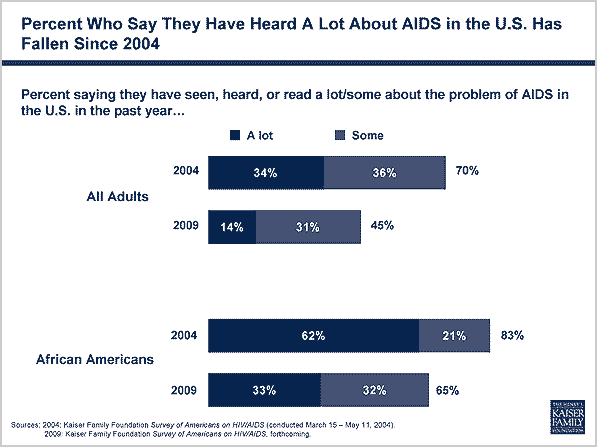
We found that the percentage of the American people who say that they have seen, heard or read a lot about HIV/AIDS in the U.S. has fallen from 34% five years ago to just 14% today. The percentage of African Americans reporting this has fallen from 62% to 33%.
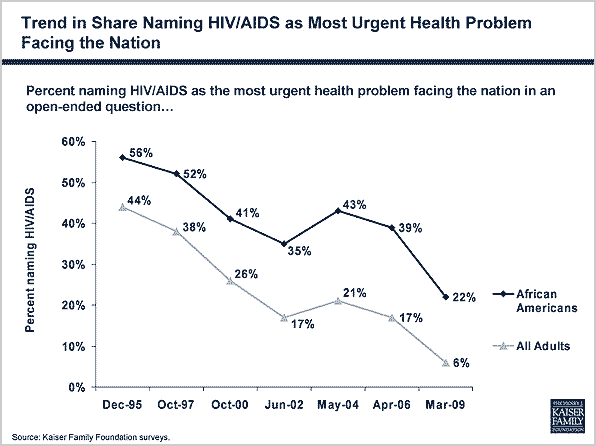
The dropoff in attention to HIV/AIDS could partly be a response to the current focus on the economy, but related findings suggest it’s a longer term trend. As this next chart shows, the percentage of the overall public and of African Americans naming HIV/AIDS the most urgent health problem facing the nation has declined steadily and has fallen precipitously since 1995.
Today’s relative state of quiet and apparent lessened concern about HIV/AIDS has occurred despite the fact that in August 2008, the CDC announced that the number of new HIV infections each year in the U.S. is 40% higher than we previously thought. The CDC also underscored that our epidemic continues to be concentrated in familiar higher risk communities and groups: gay and bisexual men, African Americans, and teens and young adults.
The media, and in particular the news media, clearly has a role to play in bringing greater attention to the U.S.’s continuing HIV/AIDS epidemic. In our survey 62% of the American people named media as their main source of information on HIV/AIDS. However, while the news media can do more to cover HIV/AIDS, the media, appropriately, follows more than leads when it comes to agenda setting. Its primary job is to report the news, not to set the agenda. The main message here is simple: the CDC says we have a much bigger epidemic than we thought we had at exactly the time when the public is hearing much less about it and seems less concerned. It’s time for renewed national, state, and community leadership if the domestic HIV/AIDS epidemic is to get back on the public agenda.
This broadcast-quality animation commissioned by the Kaiser Family Foundation illustrates how HIV infects a cell and how antiretroviral treatments combat the virus. It is being provided on a rights-free basis
This series of implementation briefs called “CHIP Tips” examines new opportunities for covering children following the reauthorization and expansion of CHIP in February 2009. Together Medicaid and CHIP provide coverage for more than one in four children in the U.S., yet many others remain eligible but uninsured.
The series, which explores a range of topics, is jointly produced by the Kaiser Family Foundation’s Commission on Medicaid and the Uninsured and the Center for Children and Families at the Georgetown University Health Policy Institute.
This brief, the second in a series, examines the requirements that states must meet to be eligible for the new “performance bonus” available to states that do an especially good job of signing up eligible children for Medicaid. The bonus, created by a provision in the Children’s Health Insurance Program Reauthorization Act of 2009, is designed to help states cover the added costs that result when states are very successful in enrolling eligible children in Medicaid above target levels specified in the law. It reflects an understanding that aggressive state outreach efforts for CHIP tend also to drive up enrollment in state Medicaid programs.
This report provides the latest data on state AIDS Drug Assistance Programs (ADAPs). It is 13th in a series of National ADAP Monitoring Project Reports authored jointly by the Kaiser Family Foundation and the National Alliance of State and Territorial AIDS Directors.
This brief, the first in a series, examines the new federal “performance bonus” available to states that do an especially good job of signing up eligible children for Medicaid. The bonus, created by a provision in the Children’s Health Insurance Program Reauthorization Act of 2009, is designed to help states cover the added costs that result when states are very successful in enrolling eligible children in Medicaid above target levels specified in the law. It reflects an understanding that aggressive state outreach efforts for CHIP tend also to drive up enrollment in state Medicaid programs.