KFF designs, conducts and analyzes original public opinion and survey research on Americans’ attitudes, knowledge, and experiences with the health care system to help amplify the public’s voice in major national debates.
Faced with an unsustainable growth in health care costs, both employers and policymakers have begun to consider the potential savings that might be achieved by investments in health promotion and better access to preventive care. There has also been public discussion about the potential of building financial incentives for healthy behaviors and the use of prevention services into health plans.
Creating the right incentives is a challenge however, because experience is so limited and healthy behaviors among workers vary widely. To illustrate the range of differences, this issue brief specifically describes the variation among workers across large industry groups in these key areas: family income, health risk factors, education, language, and access to basic health care where preventive services are provided.
This report draws on interviews and focus groups in four communities to examine at the grassroots levels the experiences of families, employers, safety-net providers and community organizations in four U.S. communities hard hit by the recession. The communities are Beloit, Wisc.; Tampa-St. Petersburg, Fla.; Long Island, N.Y.; and Sonoma, Calif.
The report explores the financial and personal struggles of families who have suffered economic reversals and lost health coverage, forcing many to juggle bills and postpone visits to the doctor while they scramble to find a new job. It reveals that many people who have lost jobs are exhausting their savings and collecting limited unemployment benefits, and yet still do not qualify for public safety net programs such as Medicaid.
As the nation considers national health reform, this brief provides an overview of opportunities to realign federal and state policy for the dual eligibles to promote a more rational, cost-efficient system for 9 million of the poorest, sickest and highest-cost people covered by both Medicaid and Medicare.
Navigating two programs with different rules and financing incentives is complex for beneficiaries and providers, impedes efforts to improve care coordination and results in cost-shifting between programs that does not promote better outcomes.
Policy options examined in the brief include establishing a national route to provide financial assistance for low-income Medicare beneficiaries; developing systems that provide integrated acute and long-term services and supports; increasing the availability of home and community-based services; and providing more stable financing for coverage of this population.
This issue brief relies on interviews with practicing clinicians to explore the impact of the recession on hospital emergency departments that are under growing pressure as patient volume increases, health coverage declines and medical costs present new challenges to unemployed families.
This issue brief examines some of the challenges associated with employment, daily life and access to health care among racial minorities, who tend to be disproportionately affected by many of the consequences of economic hard times. High unemployment rates, coupled with vast differences in savings and wealth, have left many individuals struggling to afford such basic necessities as housing and food, and have resulted in lapses in health coverage and difficulties paying for needed medical care.
This video, a companion to the report, “Rising Health Pressures in an Economic Recession: A 360-Degree Look at Four Communities,” explores the financial and personal struggles of families who have suffered economic reversals and lost jobs and job-based health coverage during the recession. The video profiles people in three of the communities hard hit by the recession: St. Petersburg, FL.; Beloit, WI.; and Long Island, N.Y. It examines at the grassroots level the experiences of families, employers, safety-net providers and community organizations during these economic hard times.
It’s no secret that the response to the HIV epidemic domestically has not kept pace with the response to the global epidemic. And in an earlier column called America Has Gone Quiet on HIV/AIDS I wrote about the growing complacency towards the domestic epidemic revealed in our recent survey of the American people.
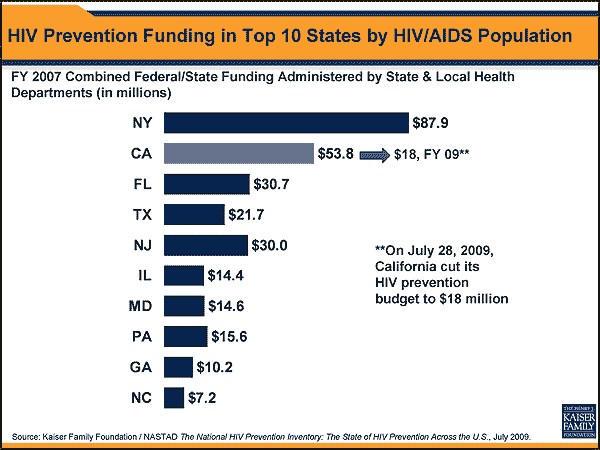
Last Friday, we released a new study with the National Alliance of State and Territorial AIDS Directors that documents the level of spending, state-by-state, for HIV prevention, looking at both federal and state funds combined that are administered by state and local health departments – where the rubber meets the road and HIV prevention is actually delivered in the U.S. The results were striking in two respects.
First, the overall level of spending for HIV prevention in the U.S. has been essentially flat since fiscal year (FY) 2004, the last year for which we have state-by-state data, except for one-time federal funding of $35 million for HIV testing in FY 2007. This is despite the fact that the CDC determined in August of 2008 that the number of new HIV infections in the U.S. is 40% higher than we thought it was – at about 56,000 per year.
Second, and more striking, the absolute amount of money we spend on HIV prevention is quite small nationally and on a state-by-state basis. Nationally we spend less than $600 million in combined state and federal dollars for states to deliver HIV prevention services. But as the chart shows, the absolute amount of spending in the ten states with the largest numbers of people living with HIV/AIDS is modest, ranging from about $7 million in North Carolina to a high of $88 million in New York. These are the latest comprehensive state-by-state data, but they are from FY 2007 and many states have faced serious budget shortfalls since then and have cutback or may soon cutback programs. The most glaring example is California which just this week cut its HIV prevention spending drastically – by more than 80% in state funds – in the middle of its widely reported budget debacle, bringing total HIV prevention spending in California from about $50 million to $18 million, a tiny number in a state larger than most nations.
There are a few simple points to be made here. First, while more needs to be done to target and fine tune prevention interventions (we have to improve prevention not just spend on it), scale and intensity are always important; these amounts are not big enough in most states for a prevention strategy to operate at scale or to reach high risk groups with sustained interventions of the intensity needed. Second, while treatment is inherently more expensive than prevention – and it is not appropriate to directly compare spending on treatment with spending on prevention – it is obvious that the treatment agenda has driven out prevention in recent years. Partly this is because it required funding to ramp up treatment services and partly this is because prevention became ensnarled in broader controversies about social issues.
Virtually every issue we work on in health makes a claim for more money and usually a valid one. In the real world of budget priorities there are many legitimate needs that have to compete for scarce dollars and not all needs can be met, especially in today’s economy and the budget environment at the federal and state levels. But even in a world of competing needs, the small size of the investment we are making in HIV prevention revealed in this report stands out.
As part of the National Newspaper Publishers Association’s commitment to the CDC’s Act Against AIDS campaign, and as a member of the Black AIDS Media Partnership (BAMP), the NNPA is pleased to bring you a multi-media series by award-winning journalist George Curry that takes an up-close and personal look at HIV/AIDS in Black America.
The NNPA is working with the Kaiser Family Foundation, a BAMP organizing partner, to produce corresponding video interviews to accompany the editorial series. These articles and accompanying videos have been made available rights-free for NNPA print and online editorial.
We hope that you will find these interviews useful in bringing your readers’ attention to the HIV/AIDS epidemic in the United States.
The Black AIDS Media Partnership (BAMP) is a sustained commitment among major U.S. media companies to work together to address the AIDS crisis facing Black Americans. Organized as part of Act Against AIDS, the effort is helping refocus national attention on the HIV/AIDS crisis in the U.S., the Partnership is undertaking a coordinated campaign presented under a common brand – GREATER THAN AIDS – to reach Black Americans with lifesaving information about HIV and AIDS and confront the stigma surrounding the disease.
Donor governments, including the United States and European nations, provide the bulk of international funding for health in low- and middle- income countries each year. Despite significant increases in such funding, however, it still falls short of need as estimated by the World Health Organization’s Commission on Macroeconomics and Health. This report provides an analysis of donor commitments for health and includes detailed tables and charts.
This fact sheet provides state-level data from a Kaiser survey that found that a large number of states are using state funds to provide health coverage to legal immigrant children and pregnant women through Medicaid, CHIP or another state program.
Under the Children’s Health Insurance Program Reauthorization Act of 2009, states now have the option to provide federally matched Medicaid or CHIP to some or all of the legal immigrants they have been covering solely with state funds.
Also, states that have not previously covered the lawfully residing children and pregnant women who had been ineligible for federal coverage can now expand Medicaid and CHIP coverage to these groups with the benefit of federal matching funds.