
988 Enters Its Fourth Year as Demand Grows and the Mental Health and Substance Use Landscape Shifts
On July 16, 2022, the federally mandated crisis number, 988, became available to all phone users at no charge. This three-digit number connects users–via phone, text, or chat–to a network of over 200 local and state-funded crisis call centers that provide access to crisis counseling, resources, and referrals through the 988 Suicide & Crisis Lifeline. The introduction of 988 came against the backdrop of rising suicide rates. Between 2014 and 2024, more than half a million lives (516,790) were lost to suicide, and over half of those involved firearms. In 2024, suicide and substance-related deaths, combined, were the third leading cause of death in the U.S., behind heart disease and cancer.
Data as of March 2026 show that demand for 988 continues to rise, with the volume of calls, texts, and chats 15% higher than a year earlier and nearly 50% higher than two years ago. States are also answering more calls in-state, where counselors are more likely to be familiar with local resources. The broader crisis continuum, including mobile crisis and crisis stabilization services, has expanded across states. Suicide deaths declined modestly in 2024, and remained relatively stable in provisional 2025 data. Research examining 988’s relationship to suicides found lower-than-expected deaths among people ages 15 to 34 after 988 launched, suggesting that 988 may have contributed to improved outcomes for some populations.
Despite some positive signs, sustaining momentum may become more difficult as demand grows and fiscal pressures increase. Relatively few states have adopted telecom fees intended to provide dedicated funding for 988 call centers and other crisis services, leaving many states to rely on other funding mechanisms, which vary widely. Uneven or uncertain funding may affect call center capacity, and staffing is already a challenge, with many call centers reporting staffing shortages. Further, federal changes to Medicaid and the ACA Marketplaces, along with other federal policy changes, are expected to increase the number of people without health coverage. Coverage losses stemming from these changes could disrupt access to behavioral health care and increase demand on 988, just as federal cuts are likely to place greater pressure on state budgets.
Taken together, 988 is reaching more people and early suicide-related outcome data show some signs of improvement, but sustaining call center capacity and community-based crisis services may become more difficult as demand grows and state resources become more limited. This policy watch examines 988 on its fourth anniversary, drawing from the latest Lifeline data available through May 2026 for state call data and through March 2026 for national call, text, and chat data.
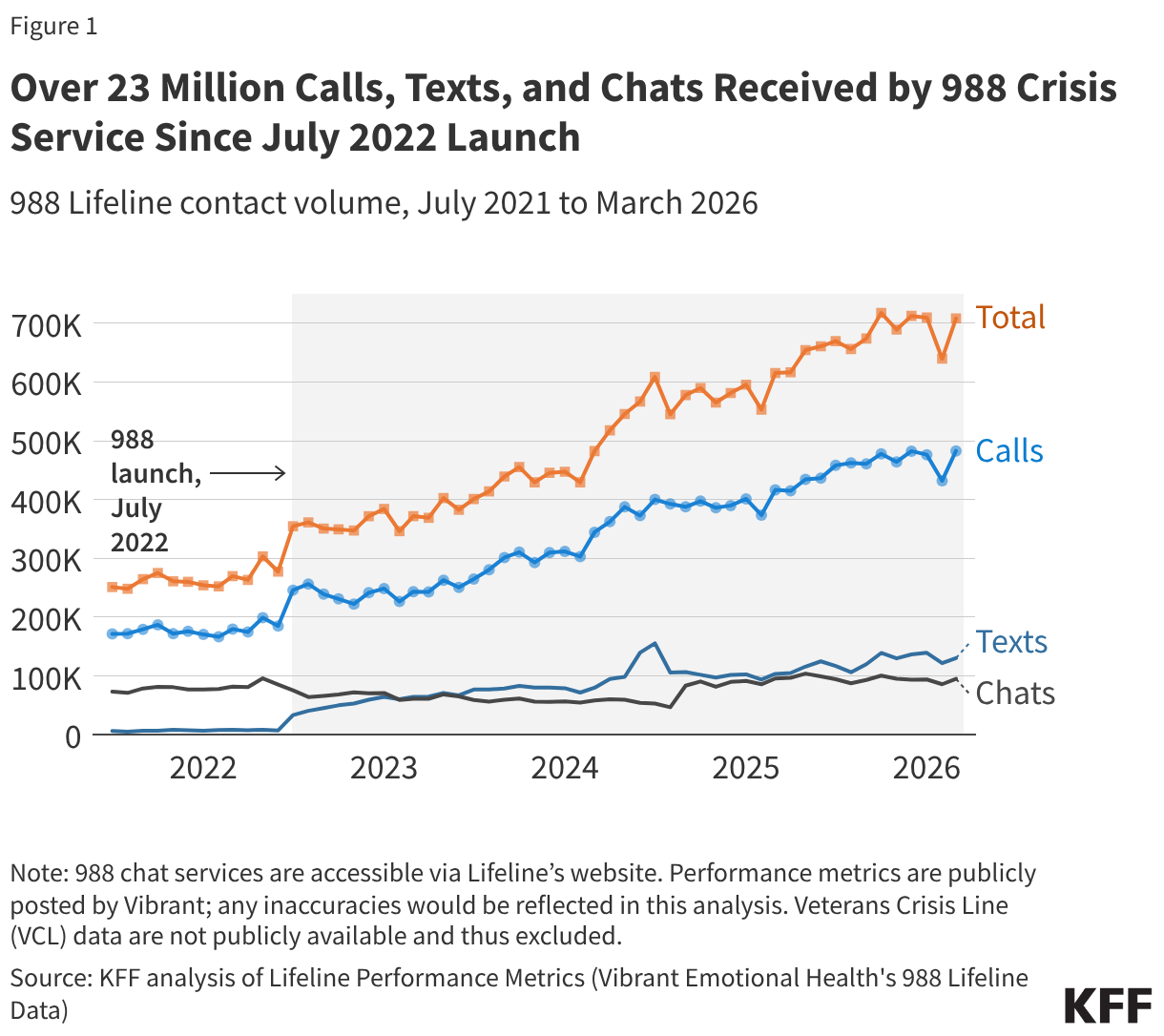
988 received 23.3 million contacts since its launch in July 2022, including 15.8 million calls, 4.2 million texts, and 3.4 million chats. Monthly contact volume has steadily increased, consistently surpassing 600,000 contacts per month over the past year and often approaching or exceeding 700,000 per month since late 2025—more than double the contacts recorded before launch (277,407 in June 2022) (Figure 1). Growing public awareness of 988 likely contributed to this increase, though contact volume may have been slowed by the 2025 elimination of the specialized LGBTQ+ service for young people, which had accounted for 10% of all 988 contacts. Recent reporting suggests that the specialized service may be restored. 988 data excludes calls routed from 988 to the Veteran’s Crisis Line (VCL), which has received an additional 3 million calls since launch, because monthly breakouts and other details are not publicly available. They also exclude suicide hotline contacts from centers operating outside of the 988 network. As of 2024, fewer than half of all hotline call centers (about 200 of 573) participated in the 988 network.
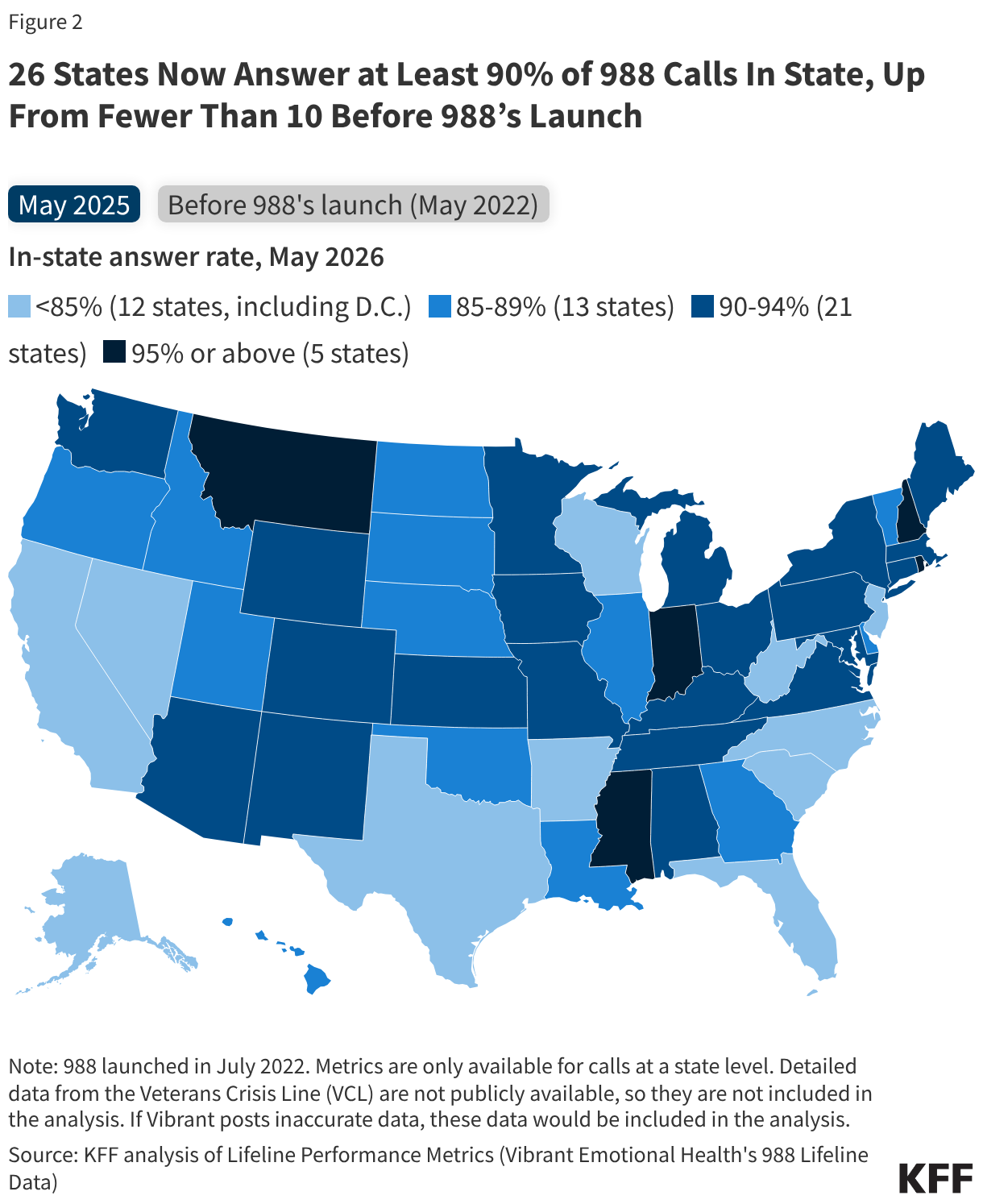
Local 988 response has improved, with 26 states answering at least 90% of calls in-state, but uneven and uncertain funding may pose challenges for sustaining call center capacity. In May 2026, 26 states answered at least 90% of calls in-state, up from just 8 states before 988’s launch (Figure 2). In-state answer rates ranged from 62% (District of Columbia) to 99% (Mississippi and Rhode Island). 988 is now facilitating more local response by routing callers to the call center nearest to their location, while protecting privacy. Calls not answered in-state are redirected to national backup centers, where counselors can respond to the crisis call but may be less familiar with local resources. Ongoing financing remains a challenge. Federal funding helped launch 988 and continues to support some local call centers, but ongoing center financing largely falls to states. As of 2026, 12 states have passed legislation to help sustainably fund 988 through telecom fees, similar to how 911 is financed, with many assessing flat monthly charges of less than 45 cents per line. Other states rely on mechanisms that may be less stable or vary from year to year. Limited or uncertain funding can affect staffing, quality, and operations. In a 2025 survey of call center leaders, about 3 in 4 call centers reported staffing shortages and 89% reported some level of difficulty acquiring resources to hire staff. As states enter a period of tighter budgets, questions about the long-term funding to sustain local 988 crisis call centers are likely to persist.
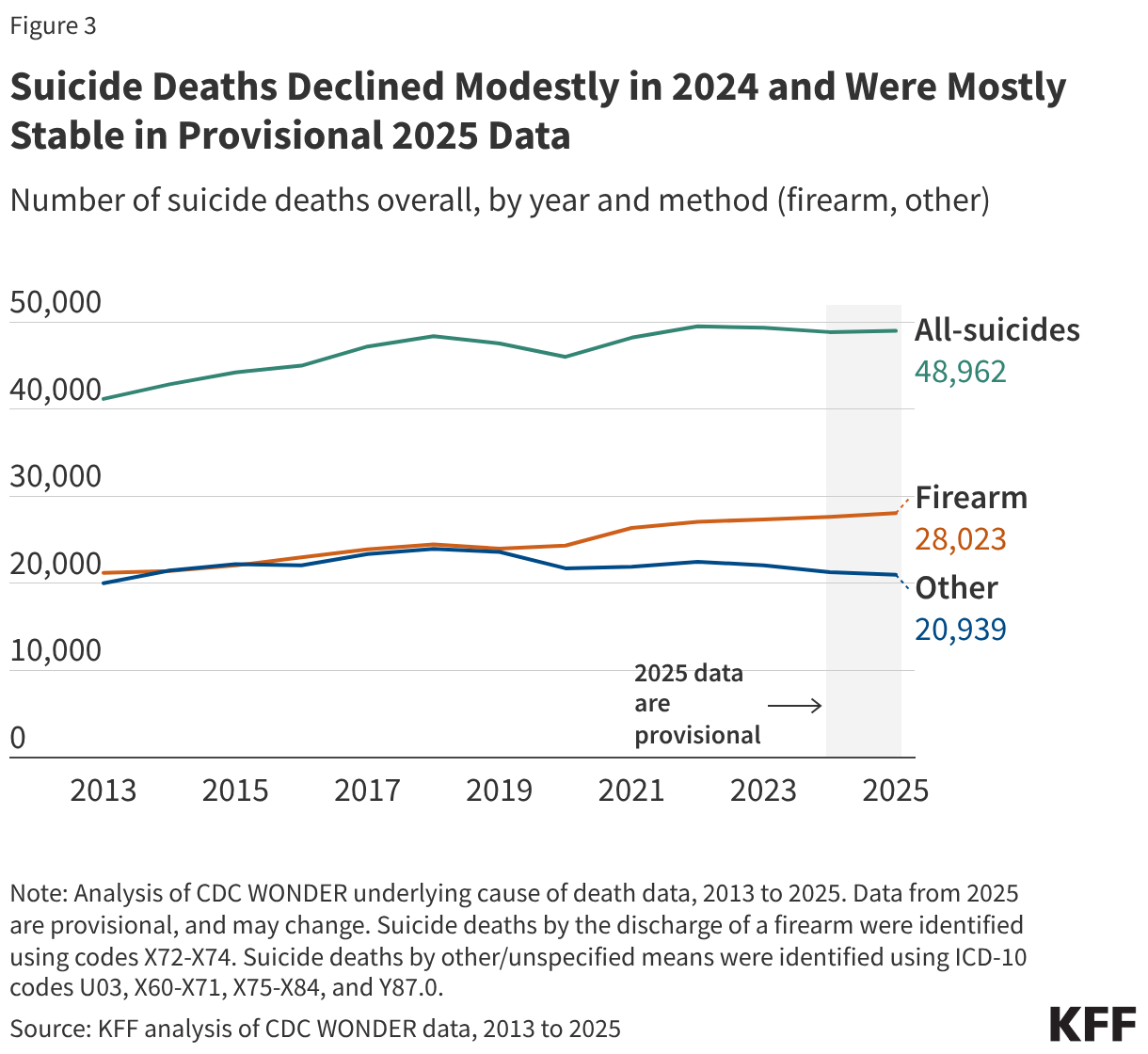
988, along with other investments in the crisis continuum, may have helped to contribute to some recent improvement in suicide-related outcomes. Suicide deaths declined modestly in 2024, and remained relatively stable in provisional 2025 data. Most of the decline has been among non-firearm suicides, which have fallen each year since 2022, while firearm suicides have risen each year since 2019 (Figure 3). Other research also shows declines in suicides or related measures among certain populations. The share of emergency department (ED) visits for suspected suicide attempts decreased by about 7% in 2025 compared with 2021, and a separate study found that, in the years following 988’s launch, suicide deaths among people ages 15 to 34 were about 11% lower than expected if 988 had not launched. These trends have occurred as states continue to build out the broader crisis continuum, which also includes mobile crisis and crisis stabilization services. According to a survey of state behavioral health agencies, mobile crisis volume increased by 40%, and crisis stabilization center volume more than doubled, relative to 2022. As of 2024, 34 states reported statewide availability of mobile crisis teams, and 25 states reported the same for crisis stabilization services. This expansion may face future financing challenges, as enhanced federal Medicaid funding that supported mobile crisis expansion in some communities expires in 2027, leaving states responsible for more of the cost. States are also making crisis-system data more public, with 21 states now displaying public-facing crisis contact data dashboards.
If you or someone you know is considering suicide, call or text the 988 Suicide & Crisis Lifeline at 988