Poll Finding

Survey of Detroit Area Residents — Summary Brief

Published: Dec 30, 2009

The Washington Post/Kaiser Family Foundation/Harvard University Survey of Detroit Area Residents reveals a population that is facing some of the worst effects of the current economic recession. Home of the nation’s domestic auto industry, Detroit’s residents have been at the forefront of the country’s economic woes. The survey illuminates the experiences and needs of those living in the midst of this economic catastrophe, including questions about job loss and job security, views about the future of the Detroit area, the U.S. auto industry, and the future for American workers more generally. It looks at the stark differences in experiences and attitudes of those living in the city of Detroit compared with the surrounding suburbs. It also explores how Detroiters feel about their local, state, and federal governments, particularly in light of recent federal government action such as the economic stimulus and the aid provided to General Motors.

The survey is part of an ongoing three-way partnership between The Washington Post, the Kaiser Family Foundation and Harvard University. The partners worked together to pick the survey topics, design the survey instruments, and analyze the results. The Washington Post featured a collection of articles built upon the findings from the survey.

Survey Report (.pdf)

News Release

States Sustain and Expand Coverage For Low-Income Children and Families Despite Recession, But Gains Are Threatened By Impending End of Federal Assistance

Published: Dec 8, 2009

New 50-State Survey Illustrates Key Role of CHIP Reauthorization and the Federal Stimulus Law in Safeguarding Coverage   

WASHINGTON  – Despite the deep recession, most states have managed to safeguard and, in some cases, expand health coverage for children and parents in their Medicaid and Children’s Health Insurance Programs in 2009, according to a new survey from the Kaiser Family Foundation’s Commission on Medicaid and the Uninsured.  But the gains, which could serve as a base for covering millions more people under health reform, are threatened by the impending end of key federal assistance at the end of 2010 and before health reform coverage would begin.

The annual 50-state survey of eligibility rules, enrollment and renewal procedures and cost-sharing practices in Medicaid and CHIP for children and parents found that, overall, most states in 2009 continued to expand and simplify their Medicaid and CHIP programs, the main vehicles for providing coverage to low-income children and families, even as they faced the bleakest economic picture in years and severe budget pressures.  However, budget shortfalls did result in cutbacks in some states.

“The renewal of CHIP and the fiscal relief and eligibility and enrollment protections for Medicaid in the American Recovery and Reinvestment Act (ARRA) proved critical to enable states to continue their commitment to providing coverage to millions of low-income families,” said Diane Rowland, Executive Vice President of the Foundation and Executive Director of the KCMU.  “However, even with signs of economic recovery, state revenues are still mired in a severe slump and, faced with the end of enhanced federal money after 2010, fiscal shortfalls are likely to cause states to consider significant cuts to Medicaid and CHIP.”

Despite National Gains, Prominent Disparities Remain 

While the survey reveals significant overall progress nationally in expanding public coverage or making it easier to access, wide variations in coverage persist.  Among the survey findings:

  • Currently, 47 states cover children in families with an annual income at or higher than 200 percent of the federal poverty level ($36,620 for a family of three), with half (24 states) covering children in families with incomes at or greater than 250 percent of poverty ($45,775 for a family of three).
  • Parent eligibility levels continue to lag far behind, and the disparity between children and parents is growing.  Currently, the median income eligibility limit for children is 235 percent of the federal poverty level ($43,029 for a family of three) compared to the median for a working parent at 64 percent of the federal poverty level ($11,718 for a family of three).
  • More than half of states (26, shown below) bolstered coverage for low income children, parents and pregnant women, either by expanding eligibility, simplifying enrollment procedures or reducing financial barriers. Children were the chief beneficiaries of expansions in 2009, with 19 of those 26 states improving access to coverage for children by increasing eligibility, simplifying procedures and eliminating premiums.  These 26 states included Alabama, Alaska, California, Connecticut, Florida, Idaho, Iowa, Indiana, Kansas, Louisiana, Maryland, Montana, North Dakota, Nebraska, New Mexico, New Jersey, New York, Ohio, Oregon, Rhode Island, South Carolina, South Dakota, Tennessee, Virginia, Washington and West Virginia.
  • Fifteen states, shown below, scaled back coverage in their CHIP programs during 2009.  Although no state reduced eligibility for children, two states (California and Tennessee) froze CHIP enrollment for some period of time in 2009 and one state reduced eligibility for parents.  Other actions included increases in waiting periods, retractions in eligibility simplifications, and relatively modest increases in CHIP premiums. Even after recent increases, the median CHIP premium payment for two children in a family with income at 200 percent of poverty remains modest at $480 annually, representing 1.3 percent of family income.  These 15 states included Arizona, California, Montana, Tennessee, Florida, Maine, Maryland, Missouri, North Carolina, New Hampshire, New York, Pennsylvania, Utah, Washington and Wisconsin. Arizona also eliminated parent coverage, and Montana retracted its simplified income verification procedures in CHIP.

Gains Could Be Eroded By The Recession, Weakening the Coverage Base for Health Reform

States’ commitment to providing Medicaid and CHIP coverage to low-income children and families will continue to be tested in 2010 as dismal state budget circumstances persist. Recent forecasts indicate states will face even bigger shortfalls in the upcoming fiscal year. At the same time, the federal assistance that states have relied on under ARRA is scheduled to expire at the end of the 2010 calendar year, and along with it the requirement that states maintain eligibility levels and refrain from imposing enrollment barriers. That raises the prospect of substantial state cuts in Medicaid and CHIP that could reverse recent expansions and undermine the base of coverage for low-income families upon which broader health reform efforts seek to build.

The leading reform bills in Congress build on Medicaid to expand health coverage to millions of people, but differ in the scope of the expansion they envision, the level of federal support they would provide to states, and in how they treat coverage for children.  These survey findings provide a baseline against which future progress can be measured.  Further, as policymakers attempt to craft final legislation, they can draw on what states have learned about the importance of simplifying enrollment and renewal procedures, covering parents, and limiting cost sharing.  The simple and coordinated procedures that have helped assure that eligible children and parents secure and retain coverage, and that have enabled families to transition smoothly between programs when family circumstances change, will be essential in a new health insurance system.

Today’s report, A Foundation for Health Reform: Findings of a 50-State Survey of Eligibility Rules, Enrollment and Renewal Procedures, and Cost-Sharing Practices in Medicaid and CHIP for Children and Parents During 2009, and related materials, including a new issue paper on key issues to consider in health reform regarding coverage of low-income children, are available online here. In addition, an audio press briefing on the release will be available after 6 p.m. ET today.

# # #

The Kaiser Family Foundation is a non-profit private operating foundation, based in Menlo Park, California, dedicated to producing and communicating the best possible information and analysis on health issues. 

The Kaiser Commission on Medicaid and the Uninsured provides information and analysis on health care coverage and access for the low-income population, with a special focus on Medicaid’s role and coverage of the uninsured. Begun in 1991 and based in the Kaiser Family Foundation’s Washington, D.C. office, the Commission is the largest operating program of the Foundation. The Commission’s work is conducted by Foundation staff under the guidance of a bipartisan group of national leaders and experts in health care and public policy.
Pulling it Together: A Holiday Reminder on the Economy and Health Care

Published: Dec 2, 2009

With so much of the focus on the political dynamics of the health reform debate and a few hot button issues, I wonder if we have lost track of what propelled health care to the top domestic issue in the first place—people’s concerns about paying for health care in the middle of a deep recession. This gave health greater traction as a national issue and brought us our best chance at national health reform legislation in fifteen years if not ever. It wasn’t only that health care costs were going up or that people were paying more out of pocket each year, it was also that people’s economic circumstances were deteriorating, making it much tougher and more painful to pay their health care bills. The holidays are an appropriate time to remember these underlying economic concerns which are still with us today and their close connection to health care.

I wrote a column about a year and a half ago called Health IN the Economy. At the time, economic worries were rising, and it was clear that they were linked to concerns about health care. The unemployment rate was 5.5% in May 2008 when I wrote that column. It’s 10% now (and 12.5% here in our home state of California).

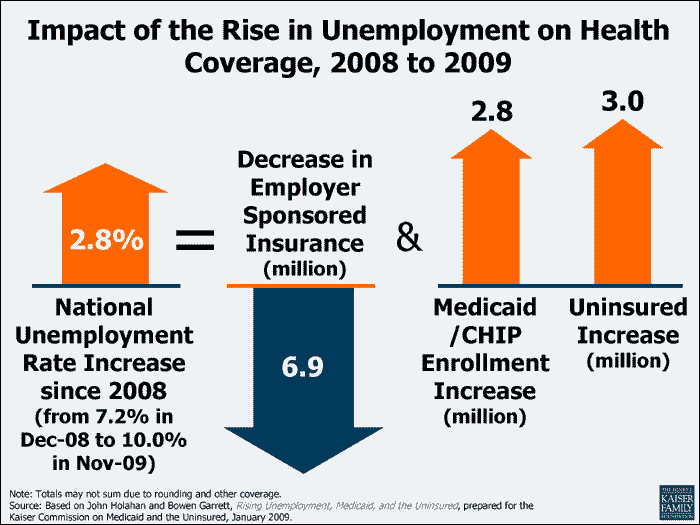
We know that as the number of unemployed goes up, the number of uninsured goes up as well. As this chart shows, for every 1 percentage point increase in the unemployment rate we estimate that there is about a 1.1 million person increase in the ranks of the uninsured. With unemployment rising 2.8 percentage points since the latest Census figures on health insurance coverage (for 2008), that suggests about 3 million more people uninsured.

pit120409gif.gif

The latest quarterly earnings reports for health insurance companies illustrate the decline in private insurance coverage. Looking at the SEC filings of the six largest publicly-held insurers—which collectively represented over half of all the privately insured in 2008—enrollment has dropped by 2.2 million people since the end of 2008. If the rest of the industry exhibited the same trend, 4.2 million lost private insurance over this period.These numbers would all be far worse if not for the counter-cyclical role Medicaid plays in cushioning the impact of people who lose employer coverage when they lose their jobs, particularly for children.But the impact of underlying economic conditions on people extends well beyond growth in the uninsured. One of our surveys found that 50% of lower wage workers reported that they themselves or someone in their family had been laid off or lost their job in the last year or had overtime or hours cut back or experienced both. Other surveys have found similar results, including a recent ABC News/Washington Post survey that found 30% of the American people as a whole reported they or someone in their household had lost a job or been laid off.  Moreover, wages are stagnant—average weekly earnings are up just 1.6% over the last 12 months.

We don’t make the connection between employment data and health care often enough, but what numbers like these should signal is that many more Americans will have problems paying for health care and health insurance and delay or forego care while the economy rebounds. This is why we consistently see in our tracking polls that between 50% and 60% of the American people report that they or a family member have put off health care of one kind or another because of cost. As a field, we recognize the impact of unemployment on the number of uninsured, but the impact of weak labor markets on people’s ability to pay their health care bills is the broader and more politically telling effect.

Since the primary financial protections of reform under current proposals would not kick in until at least 2013 and possibly 2014, there is a window of several years before the jobs picture improves and tangible help arrives. Our polls show the public expects help from health reform years earlier than that.  It seems clear that greater efforts need to be made to inform the public about what the actual timetable is so that the law is not met by a big expectations gap.

The current employment numbers also underscore what a dramatic change health reform would bring in cushioning the impact of economic downturns in the future. While Medicaid and CHIP do that now, the impact is limited by categorical requirements and eligibility thresholds that are in some states very low. Under the current House and Senate bills, people covered in the exchange with incomes up to 400% of the poverty level (about $88,000 a year for a family of four) would be eligible for subsidies, providing a new safety net for working families and the middle class. The adequacy of those subsidies in an ultimate health reform bill—both how much people have to pay in premiums and the scope of their coverage and amount of their out of pocket costs—will be central to how people perceive reform if and when it goes into effect.

There are also implications for research.  The health services research community has made a seminal contribution documenting the implications of being uninsured. That issue, once hotly debated, is no longer disputed in the same way thanks to research. Instead the debate is about how best to solve the problem. We now need to do more to document the problems insured people are having as well paying their health care bills—the impact not only on their access to care, but also on their overall economic security and their ability to buy food or clothes, pay the rent or the mortgage, pay for gas, or send a kid to college.  It is health care tunnel vision simply to document impact on access to care because people experience the impact of health care costs on their family budgets more broadly.

As we emerge from this economic downturn and unemployment starts to fall, Medicaid and CHIP will continue to be immensely important in preserving health coverage for people who are out of work or who enter low-wage jobs without health insurance. But Federal help to the states provided under the economic stimulus package will soon expire and many states will remain in a precarious financial position for several years. A new study from our Commission on Medicaid and the Uninsured out just yesterday examines these issues and underscores that the ability of states to sustain current eligibility levels as reform gets implemented will need to be carefully monitored.

And businesses and individuals can ill afford big premium increases right now, so recent (though unscientific) reports of pre-health reform premium spikes are concerning. We will track them closely in future Kaiser surveys to help policymakers consider whether they need to respond and how.

As we all focus on the health reform debate, in this holiday season it is appropriate to remember that more people are struggling with health care bills than when we began this debate. While the jobs picture is starting to brighten, with the latest government report showing the unemployment rate actually falling from 10.2 % to 10%, improvement is expected to be slow. This is a reminder of why people need the kind of help health reform can deliver. But it is also a reminder of why for the next several years, while the country may be gearing up to implement health reform, we can’t take our eyes off of the problems people are having today, or of the role that the existing programs that serve them will continue to play.

Health Insurance Coverage for Older Adults: Implications of a Medicare Buy-In

Published: Nov 30, 2009

As the Senate debates comprehensive health reform legislation, the idea of a Medicare buy-in option for uninsured adults aged 55-64 has re-emerged as a potential component of a reform plan.

This Kaiser Family Foundation policy brief provides an updated profile of the more than 4 million uninsured people between ages 55 and 64 and examines historical proposals to allow uninsured older adults to purchase Medicare coverage. It also examines barriers to securing affordable coverage in the current marketplace, and the effect of premiums and eligibility criteria on the potential uptake of a Medicare buy-in.

Issue Brief (.pdf)

Previous version:

Issue Brief – May 2009 (.pdf)

Poll Finding

Key Findings: Kaiser Health Tracking Poll — December 2009

Published: Nov 30, 2009

This document contains the key findings from the December Health Tracking Poll. The survey was designed and analyzed by public opinion researchers at the Kaiser Family Foundation and was conducted December 7 through December 13, 2009, among a nationally representative random sample of 1,204 adults ages 18 and older. Telephone interviews conducted by landline (801) and cell phone (403, including 111 who had no landline telephone) were carried out in English and Spanish. The margin of sampling error for the total sample is plus or minus 3 percentage points. For results based on subgroups, the margin of sampling error is higher.

Key Findings (.pdf)

Alternatives for Financing Medicaid Expansions in Health Reform

Published: Nov 30, 2009

Expanding Medicaid to cover low-income populations has been a fundamental component of leading health reform proposals. The House Leadership Bill would expand Medicaid to 150 percent of the federal poverty level and the Senate Leadership Bill would expand Medicaid to 133 percent of the federal poverty level. In both scenarios the federal government would finance a substantial share of costs for the expansion groups. 

This analysis, however, shows that it is possible to distribute increased federal payments in multiple alternative ways that could be less complicated and would avoid perpetuation of inequities that would be associated with providing higher matching rates just for new eligible Medicaid enrollees.

Report (.pdf)

Poll Finding

Toplines: Kaiser Health Tracking Poll — December 2009

Published: Nov 30, 2009

This document contains the toplines from the December Health Tracking Poll. The survey was designed and analyzed by public opinion researchers at the Kaiser Family Foundation and was conducted December 7 through December 13, 2009, among a nationally representative random sample of 1,204 adults ages 18 and older. Telephone interviews conducted by landline (801) and cell phone (403, including 111 who had no landline telephone) were carried out in English and Spanish. The margin of sampling error for the total sample is plus or minus 3 percentage points. For results based on subgroups, the margin of sampling error is higher.

Toplines (.pdf)

Immigrants’ Health Coverage and Health Reform: Key Questions and Answers

Published: Nov 30, 2009

As health reform discussions continue, there has been some focus on health coverage for immigrants and how immigrants will be treated under reform plans being considered on Capitol Hill.

This issue brief provides an overview of key questions related to immigrants’ health coverage and health reform, addressing subjects such as how immigrants receive health coverage, how many of the uninsured are non-citizen immigrants and what would happen to coverage for non-citizen immigrants under current health reform proposals.

Issue Brief (.pdf)

Medicare Part D 2010 Data Spotlight: Benefit Design and Cost Sharing

Authors: Elizabeth Hargrave, Jack Hoadley, Laura Summer, Juliette Cubanski, and Tricia Neuman
Published: Nov 30, 2009

The Medicare Modernization Act established a defined standard drug benefit for Part D stand-alone Prescription Drug Plans (PDPs) and Medicare Advantage Prescription Drug (MA-PD) plans, while giving plans flexibility to offer alternative benefit designs. Only about one in 10 PDPs offer the standard benefit in 2010. Plan sponsors can offer alternative benefit designs that are, at a minimum, actuarially equivalent to the defined standard and can also offer enhanced benefits. This Medicare Part D data spotlight examines the benefit designs of Medicare stand-alone PDPs in 2010. 

The spotlight is one in a series analyzing key aspects of the Medicare Part D drug plans that will be available to beneficiaries in 2010. The analysis was conducted jointed by Jack Hoadley and Laura Summer of Georgetown University, Elizabeth Hargrave of NORC at the University of Chicago, and Juliette Cubanski and Tricia Neuman of the Kaiser Family Foundation.

Data Spotlight (.pdf)