KFF designs, conducts and analyzes original public opinion and survey research on Americans’ attitudes, knowledge, and experiences with the health care system to help amplify the public’s voice in major national debates.
The health reform law contains provisions that aim to improve the delivery and coordination of services for persons enrolled in both Medicaid and Medicare, known as the dual eligibles. This population includes individuals with some of the most severely disabling chronic conditions. While the higher costs associated with services to dual eligibles is well-known, information on how spending is distributed across these programs is less understood.
This study uses linked Medicare and Medicaid data to examine the chronic physical and mental conditions and multiple co-morbidities that create substantial needs for medical and long-term services among dual eligibles, and provides information about the financial contributions of Medicare and Medicaid in meeting these needs.
The health reform law will expand Medicaid to millions of low-income adults, including many childless adults who have historically been ineligible for the program, necessitating one of the largest enrollment efforts in the program’s history. This report, based on interviews with officials in seven states and the District of Columbia and national experts, examines lessons learned from past state experience covering childless adults through waiver and state-funded programs and profiles the programs included in the study.
The report finds that many best practices for enrolling parents and children in Medicaid will apply to childless adults, but successful efforts will also require new strategies and messages given their historic ineligibility for Medicaid, limited connection to public programs, fluctuating incomes and language and cultural barriers. Further, more needs to be learned about the health needs of this group and how best to deliver and manage their care. Given the significance and size of the expansion, it will be imperative for states to be ready and prepared with the necessary systems, technology, and administrative capacity in place to process enrollments and coordinate coverage and care with the new Health Insurance Exchanges.
The Global HIV Prevention Working Group is a panel of nearly 50 leading public health experts, clinicians, biomedical, and behavioral researchers, and people affected by HIV/AIDS, convened by the Bill & Melinda Gates Foundation and the Kaiser Family Foundation.
Foundation Establishes Fellowship in Recognition of Former New York Times Health Journalist
WASHINGTON, D.C.–National Journal health care and welfare reporter Marilyn Werber Serafini has been selected as the inaugural Robin Toner Distinguished Fellow of the Kaiser Family Foundation.
Serafini is a veteran, award-winning journalist who has covered the U.S. Congress since 1985 writing about health care, tax, trade, welfare, pension and banking legislation. She covered the health reform debate during the Clinton Administration and the recent debate that led to the Patient Protection and Affordable Care Act. Serafini will begin her fellowship later this summer and work closely with the editors of Kaiser Health News (KHN) and KHN news organization partners on a series of articles on health policy and politics, as well as stories that explore the intricacies of health reform implementation. KHN is an editorially independent news service of the Foundation.
The fellowship honors the late Robin Toner, The New York Times‘ long-time health and politics reporter whose work so often framed the public debate on health issues and the intersection of these debates with the politics of Washington and the nation.
Noted for her relentless approach, meticulous work and elegant delivery, Toner was the first woman to be the national political correspondent for The New York Times. She led the newspaper’s coverage of the 1992 presidential election, and was central to its subsequent reporting on President Clinton’s health reform effort. In a Times career of nearly a quarter century, she reported on almost every domestic issue and had a significant role in the coverage of five presidential election cycles.
Toner started her journalism career at the Charleston, West Virginia Daily Mail, then worked for The Atlanta Journal Constitution before joining The New York Times. She died of cancer in 2008 at the age of 54.
“Robin Toner set the standard for reporting on health policy and politics. This Fellowship will honor Robin and allow Toner fellows for years to come to bring a greater understanding of health policy issues to the American people,” said Kaiser Family Foundation President and CEO Drew Altman.
The Robin Toner Distinguished Fellowship continues the Kaiser Family Foundation’s longstanding commitment to health care journalism, recognizing the critical role the media plays in explaining complex health issues to the nation. This commitment has included media fellowship and internship programs on health, survey partnerships with media organizations, and most recently, the establishment of KHN.
Public opinion played a prominent role during the recent health care reform debate. In a published Health Affairs article, Kaiser researchers examine past and present polling and show that opinion tracked with historic patterns and was relatively stable, even if the contentious public debate suggested a volatile public mood in 2009 and 2010.
Going forward, the public will begin reacting to reform implementation, primarily by judging it in terms of their perceptions of and experiences with what the new law does and does not do for people. These opinions could in turn influence implementation or future legislation.
The start of summer finds Americans remain divided on the health reform law, but favorable views of the new law increased seven percentage points over the past month to 48 percent, compared to 41 percent who have “generally unfavorable” views and 10 percent who have yet to make up their minds, according to the Kaiser Family Foundation’s newly released June Health Tracking Poll.
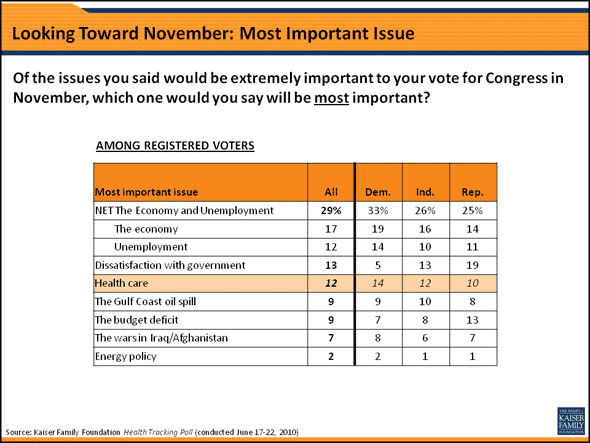
With four months remaining until the midterm congressional elections, an early look suggests that the contests could be impacted by a number of different issues, with the economy in the lead but health care also in the mix. When voters were pressed to choose the one issue that would be most important to their vote, economic concerns came out on top, with 29 percent naming either the economy or unemployment. In the next tier, 13 percent mentioned dissatisfaction with government, 12 percent mentioned health care, 9 percent each mentioned the Gulf Coast oil spill and the budget deficit, and 7 percent mentioned the wars in Iraq or Afghanistan.
For further information contact:Craig Palosky, (202) 347-5270 or cpalosky@kff.orgRakesh Singh, (650) 854-9400 or rsingh@kff.org
Recent Premium Increases Imposed by Insurers Averaged 20% for People Who Buy Their Own Health Insurance, Kaiser Survey Finds
Facing Such Increases, Some Enrollees Switched To Lower-Cost Coverage
People With Pre-Existing Conditions Much More Likely To Report Problems
MENLO PARK, CA — People who buy their own insurance report that their insurers most recently requested premium increases averaging 20 percent, according to a new Kaiser survey examining the experiences and views of people who buy health coverage in the non-group or individual market.
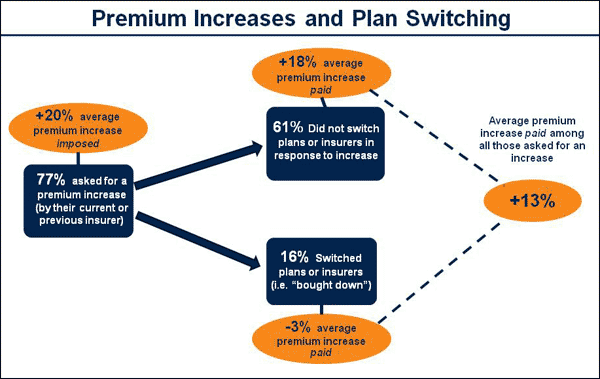
Overall roughly three in four people (77 percent) with non-group coverage report facing a premium increase with a current or previous insurer. Most say they paid the increase, but 16 percent of all policyholders say they switched plans, either buying a less expensive policy from their current insurer or switching companies altogether. After these so-called “buy downs” are taken into account, people who faced a premium increase ended up paying 13 percent more than before.
Many of those facing a premium increase who switched to a cheaper policy are now getting less comprehensive coverage than they were before. The survey found that those who switched are more than four times as likely to say their new plan offers worse benefits than their previous plan (49 percent) as they are to say their new plan’s benefits are better (11 percent).
“With people in the individual market being hit with average increases of 20%, the survey shows that the steep increases we have been reading about over the last several months are not just extreme cases,” Kaiser Family Foundation President and CEO Drew Altman said.
While most people in the U.S. get health insurance through their employer, about 14 million people under age 65 have coverage through the non-group or individual market, which has faced scrutiny recently in news reports about some insurers’ steep rate increases and in the market reforms in the new health reform law that will take effect in 2014. Kaiser’s Survey of People Who Purchase Their Own Insurance provides insight into the current state of the non-group market. It is based on a nationally representative random sample of 1,038 people ages 18-64 who purchase their own health coverage and was conducted between March 19 and April 2, during the final congressional debate and enactment of health reform legislation.
Premiums and deductiblesMore than half (57 percent) of those with non-group insurance say that they are the only ones covered by their policy. This group reports average annual premiums of $3,606, less than the average $4,824 premium reported in 2009 for employer-sponsored coverage (which typically provides more comprehensive insurance). Among those whose policies cover not only themselves but also other family members, the average annual premiums are $7,102. With insurers generally varying premiums by age in the non-group market, older people report paying higher premiums than younger people, both for individual policies and for family policies.
Many people report being in plans with high deductibles, including one in four (26 percent) with an annual deductible of $5,000 or more and 6 percent with a deductible of $10,000 or more.
Overall, the average deductible reported for single coverage is $2,498, almost four times the $634 deductible reported on average for employer-sponsored PPO coverage. Those with family coverage whose deductibles must be met on a per-person basis report an average deductible of $2,959, while those with a family deductible (the total spending required across the entire family before coverage kicks in) report an average of $5,149.
Cost concerns among policyholders
Those who purchase their own coverage are much more likely to worry about being able to pay for health care than those with employer coverage.
For example, 40 percent of those who buy their own coverage say they are “not too confident” or “not at all confident” that they will be able to pay their usual medical bills, twice the share of those with employer coverage who said so in another Kaiser survey. Only 17 percent say they are “very confident” they could pay these usual bills, compared to 36 percent of those with employer coverage.
A similar disparity exists when asked about their ability to pay for a major illness or injury that requires hospitalization. Half (51 percent) of those who purchase their own coverage say they are “not confident” they could pay their bills in such circumstances, compared with a quarter (26 percent) of those with employer coverage.
This lack of confidence may reflect real problems policyholders have experienced. More than one in five (22 percent) say over the past year they or a family member covered by their plan did not get needed medical care because of the cost, and a similar share (20 percent) say they skipped filling a prescription due to cost. Those who report a pre-existing condition are twice as likely as those without to report skipping needed medical care because of the cost (31 percent vs. 15 percent) or not filling a prescription because of the cost (28 percent vs. 14 percent).
Nearly four in ten policyholders (38 percent) report at least one problem getting their insurer to pay a bill, either because the plan paid less than they expected (31 percent), the plan would not pay anything for a bill they thought was covered (22 percent), or they reached the limit of what the plan would pay for a specific illness or injury (7 percent).
Pre-existing conditions
Nearly half (47 percent) of those in non-group plans say that they or someone covered by their policy have what could be considered a pre-existing condition. This group is more likely than other policyholders to report difficulty in finding a plan that met their needs (49 percent vs. 27 percent) and are more likely to worry about losing that coverage if they become seriously ill (62 percent vs. 48 percent). These findings do not reflect the experiences of people with pre-existing conditions who could not find affordable coverage on their own at all — as the survey only captures the experiences of current policyholders.
Within this group, nearly half (49 percent) say they have had at least one problem getting their insurer to pay bills and one in five (21 percent) of those in the pre-existing group report that an insurance company denied them coverage in the past, compared to just 3 percent of other policyholders. The group is also more likely to say they are worried about the future stability of their insurance coverage.
Who buys individual coverage?
The survey finds that people who buy their own insurance on average are somewhat older than those with employer-sponsored coverage, but with similar incomes and health status.
When asked why they buy their own health coverage, nearly half (45 percent) say it is because they are self-employed and small business owners. One in four (25 percent) say they or their spouse work for an employer, but the employer either does not offer coverage or they are not eligible for, or cannot afford, the employer coverage.
When purchasing their current policy, eight in ten (79 percent) say they shopped around at different insurance companies — though fewer than half ended up applying to more than one insurer: 13 percent say they applied to two insurers, 28 percent to three or four, and 7 percent to 5 or more. Fifteen percent of those who shopped around (accounting for 12 percent of all those who purchase their own insurance) say that at least one insurance company refused to offer them a policy.
The vast majority (74 percent) of those who buy their own insurance say they’re likely to keep purchasing coverage on their own one year from now. Just over half (54 percent) think it would be difficult for them to switch plans if they wanted to. The most common reasons people think it would be difficult to switch is that they or someone else on their plan has a pre-existing condition (42 percent of those who say it would be difficult), they wouldn’t be able to find a price as low as they have now (26 percent), and it would be too complicated to look for a new plan (18 percent).
Methodology
The Survey of People Who Purchase Their Own Insurance was designed, analyzed, and conducted by researchers at the Kaiser Family Foundation. In order to identify people who purchase their own insurance, screening interviews were completed with a nationally representative sample of 8,499 people ages 18-64. Respondents were drawn from the Knowledge Networks Panel, a large-randomly drawn representative national panel of households recruited by telephone and mail. A web-based survey among the 1,038 randomly selected individuals was conducted between March 19 and April 2, 2010. The margin of sampling error for results based on the full sample is plus or minus 4 percentage points. The full question wording, results, charts and a brief on the poll can be viewed online.
The Kaiser Family Foundation is a non-profit private operating foundation, based in Menlo Park, California, dedicated to producing and communicating the best possible analysis and information on health issues.
Facing Such Increases, Some Enrollees Switched To Lower-Cost Coverage
People With Pre-Existing Conditions Much More Likely To Report Problems
MENLO PARK, CA — People who buy their own insurance report that their insurers most recently requested premium increases averaging 20 percent, according to a new Kaiser survey examining the experiences and views of people who buy health coverage in the non-group or individual market.
Overall roughly three in four people (77 percent) with non-group coverage report facing a premium increase with a current or previous insurer. Most say they paid the increase, but 16 percent of all policyholders say they switched plans, either buying a less expensive policy from their current insurer or switching companies altogether. After these so-called “buy downs” are taken into account, people who faced a premium increase ended up paying 13 percent more than before.
Many of those facing a premium increase who switched to a cheaper policy are now getting less comprehensive coverage than they were before. The survey found that those who switched are more than four times as likely to say their new plan offers worse benefits than their previous plan (49 percent) as they are to say their new plan’s benefits are better (11 percent).
“With people in the individual market being hit with average increases of 20%, the survey shows that the steep increases we have been reading about over the last several months are not just extreme cases,” Kaiser Family Foundation President and CEO Drew Altman said.
While most people in the U.S. get health insurance through their employer, about 14 million people under age 65 have coverage through the non-group or individual market, which has faced scrutiny recently in news reports about some insurers’ steep rate increases and in the market reforms in the new health reform law that will take effect in 2014. Kaiser’s Survey of People Who Purchase Their Own Insurance provides insight into the current state of the non-group market. It is based on a nationally representative random sample of 1,038 people ages 18-64 who purchase their own health coverage and was conducted between March 19 and April 2, during the final congressional debate and enactment of health reform legislation.
Premiums and deductiblesMore than half (57 percent) of those with non-group insurance say that they are the only ones covered by their policy. This group reports average annual premiums of $3,606, less than the average $4,824 premium reported in 2009 for employer-sponsored coverage (which typically provides more comprehensive insurance). Among those whose policies cover not only themselves but also other family members, the average annual premiums are $7,102. With insurers generally varying premiums by age in the non-group market, older people report paying higher premiums than younger people, both for individual policies and for family policies.
Many people report being in plans with high deductibles, including one in four (26 percent) with an annual deductible of $5,000 or more and 6 percent with a deductible of $10,000 or more.
Overall, the average deductible reported for single coverage is $2,498, almost four times the $634 deductible reported on average for employer-sponsored PPO coverage. Those with family coverage whose deductibles must be met on a per-person basis report an average deductible of $2,959, while those with a family deductible (the total spending required across the entire family before coverage kicks in) report an average of $5,149.
Cost concerns among policyholders
Those who purchase their own coverage are much more likely to worry about being able to pay for health care than those with employer coverage.
For example, 40 percent of those who buy their own coverage say they are “not too confident” or “not at all confident” that they will be able to pay their usual medical bills, twice the share of those with employer coverage who said so in another Kaiser survey. Only 17 percent say they are “very confident” they could pay these usual bills, compared to 36 percent of those with employer coverage.
A similar disparity exists when asked about their ability to pay for a major illness or injury that requires hospitalization. Half (51 percent) of those who purchase their own coverage say they are “not confident” they could pay their bills in such circumstances, compared with a quarter (26 percent) of those with employer coverage.
This lack of confidence may reflect real problems policyholders have experienced. More than one in five (22 percent) say over the past year they or a family member covered by their plan did not get needed medical care because of the cost, and a similar share (20 percent) say they skipped filling a prescription due to cost. Those who report a pre-existing condition are twice as likely as those without to report skipping needed medical care because of the cost (31 percent vs. 15 percent) or not filling a prescription because of the cost (28 percent vs. 14 percent).
Nearly four in ten policyholders (38 percent) report at least one problem getting their insurer to pay a bill, either because the plan paid less than they expected (31 percent), the plan would not pay anything for a bill they thought was covered (22 percent), or they reached the limit of what the plan would pay for a specific illness or injury (7 percent).
Pre-existing conditions
Nearly half (47 percent) of those in non-group plans say that they or someone covered by their policy have what could be considered a pre-existing condition. This group is more likely than other policyholders to report difficulty in finding a plan that met their needs (49 percent vs. 27 percent) and are more likely to worry about losing that coverage if they become seriously ill (62 percent vs. 48 percent). These findings do not reflect the experiences of people with pre-existing conditions who could not find affordable coverage on their own at all — as the survey only captures the experiences of current policyholders.
Within this group, nearly half (49 percent) say they have had at least one problem getting their insurer to pay bills and one in five (21 percent) of those in the pre-existing group report that an insurance company denied them coverage in the past, compared to just 3 percent of other policyholders. The group is also more likely to say they are worried about the future stability of their insurance coverage.
Who buys individual coverage?
The survey finds that people who buy their own insurance on average are somewhat older than those with employer-sponsored coverage, but with similar incomes and health status.
When asked why they buy their own health coverage, nearly half (45 percent) say it is because they are self-employed and small business owners. One in four (25 percent) say they or their spouse work for an employer, but the employer either does not offer coverage or they are not eligible for, or cannot afford, the employer coverage.
When purchasing their current policy, eight in ten (79 percent) say they shopped around at different insurance companies — though fewer than half ended up applying to more than one insurer: 13 percent say they applied to two insurers, 28 percent to three or four, and 7 percent to 5 or more. Fifteen percent of those who shopped around (accounting for 12 percent of all those who purchase their own insurance) say that at least one insurance company refused to offer them a policy.
The vast majority (74 percent) of those who buy their own insurance say they’re likely to keep purchasing coverage on their own one year from now. Just over half (54 percent) think it would be difficult for them to switch plans if they wanted to. The most common reasons people think it would be difficult to switch is that they or someone else on their plan has a pre-existing condition (42 percent of those who say it would be difficult), they wouldn’t be able to find a price as low as they have now (26 percent), and it would be too complicated to look for a new plan (18 percent).
Methodology
The Survey of People Who Purchase Their Own Insurance was designed, analyzed, and conducted by researchers at the Kaiser Family Foundation. In order to identify people who purchase their own insurance, screening interviews were completed with a nationally representative sample of 8,499 people ages 18-64. Respondents were drawn from the Knowledge Networks Panel, a large-randomly drawn representative national panel of households recruited by telephone and mail. A web-based survey among the 1,038 randomly selected individuals was conducted between March 19 and April 2, 2010. The margin of sampling error for results based on the full sample is plus or minus 4 percentage points. The full question wording, results, charts and a brief on the poll can be viewed online.
The Kaiser Family Foundation is a non-profit private operating foundation, based in Menlo Park, California, dedicated to producing and communicating the best possible analysis and information on health issues.
People who buy their own insurance report that their insurers most recently requested premium increases averaging 20 percent, according to a new Kaiser survey examining the experiences and views of people who buy health coverage in the non-group or individual market. Overall roughly three in four people (77 percent) with non-group coverage report facing a premium increase with a current or previous insurer. Most say they paid the increase, but 16 percent of all policyholders say they switched plans, either buying a less expensive policy from their current insurer or switching companies altogether. After these so-called “buy downs” are taken into account, people who faced a premium increase ended up paying 13 percent more than before.
This fact sheet provides a brief overview of Wisconsin’s BadgerCare Plus Program, a three-year-old initiative that merged the state’s three distinct Medicaid programs for children, parents and pregnant women into a single comprehensive health coverage program. It also expanded eligibility to provide near-universal coverage for children and greater coverage for parents and childless adults. As of April 2010, the program provided coverage to 770,000 state residents, including 445,000 children.