Poll Finding

Kaiser Health Tracking Poll — July 2010

Published: Jul 29, 2010

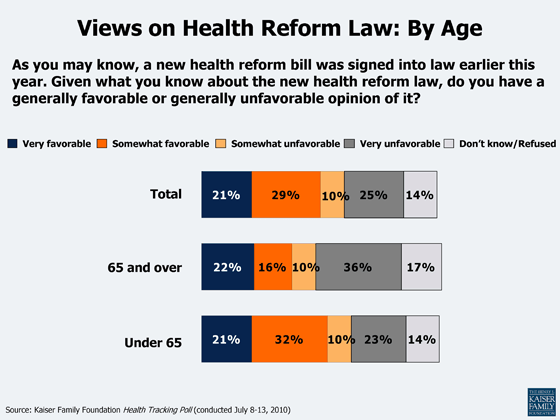
The July Health Tracking Poll indicates overall public support for the health reform law is steady from June, while unfavorable views of the law have trended downward.  Half the public (50%) now expresses a favorable view of the law, while 35 percent say they have an unfavorable opinion (down from 41% in June).

The poll also took a closer look at the views of seniors since they are often assumed to have a uniform view about issues.  Below are some of the poll’s key findings about seniors’ views:

While seniors’ views of the new law are more negative than those of their younger counterparts, they remain roughly split about the law with 46 percent of seniors holding an unfavorable view of the law and 38 percent holding a favorable one. While 35 percent of seniors think they will be worse off under reform, a greater share (57%) say they will be better off (20%) or it will make no difference (37%).

Seniors’ awareness about the specific provisions of the health reform law that affect Medicare is mixed.  For example, about half are aware that the new law will result in premium increases for some higher income Medicare beneficiaries (52%) and gradually close Medicare’s “doughnut hole” (50%).  However, just a third (33% ) know the law will eliminate Medicare’s co-pays and deductibles for some preventive services.

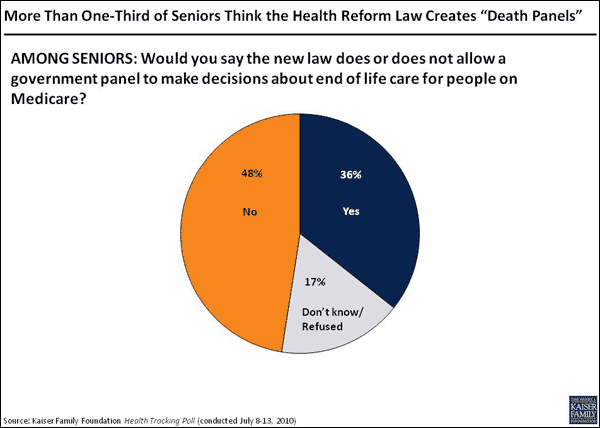
On the other hand, large shares of seniors mistakenly believe the law includes provisions that cut some previously universal Medicare benefits and creates “death panels.”  Half of seniors (50%) say the law will cut benefits that were previously provided to all people on Medicare, and more than a third (36%) incorrectly believe the law will “allow a government panel to make decisions about end-of-life care for people on Medicare.”

Despite the fact that Medicare’s actuaries predict the health reform law will extend the life of the Medicare Part A Trust Fund by 12 years (from 2017 to 2029), only 14 percent of seniors know this and nearly half (45%) of seniors think the health reform law will weaken the financial condition of the fund.

In general, seniors with a favorable view of the law are more likely to be aware of some of the law’s benefit improvements for Medicare, while those with an unfavorable view are more likely to be aware of increases in taxes and premiums that occur under the law.

Findings (.pdf)

Chartpack (.pdf)

Toplines (.pdf)

Overall Public Support for the Health Reform Law Is Steady from June

Published: Jul 29, 2010

The July Kaiser Health Tracking Poll indicates overall public support for the health reform law is steady from June, while unfavorable views of the law have trended downward somewhat. Half the public (50%) now expresses a favorable view of the law, while 35 percent say they have an unfavorable opinion (down from 41% in June). Seniors’ views of the new law remain more negative than those of their younger counterparts; they tilt towards unfavorable views, 46 percent compared to 38 percent. Meanwhile, Seniors’ awareness of specific reform provisions that affect Medicare is mixed. For example, about half are aware that the new law will result in premium increases for some higher income Medicare beneficiaries (52%) and gradually close Medicare’s “doughnut hole” (50%). However, just a third (33%) know the law will eliminate Medicare’s co-pays and deductibles for some preventive services. And 36 percent believe the law allows a government panel to make descisions about end-of-life care for Medicare recipients.

july2010_tracking_poll_updated_for_source

Pulling it Together: Seniors and Health Reform

Published: Jul 27, 2010

It is widely believed that seniors are antsy about the new health reform law. And there is heightened interest in how seniors feel about the law in the political world because they are more likely to vote in midterm elections.  About 48% of the electorate said they voted in the 2006 midterms while about 63% of seniors said the same.  Our June and July tracking polls shed light on seniors’ views on health reform and their implications.

First, while seniors are in fact more negative towards health reform than the rest of the public, the difference is not huge on key questions.  For example, in our July poll 35% of seniors said they or their families would be worse off as a result of the law compared with 27% of people under 65 who said the same thing.  Fifty seven percent of seniors either said they would be better off (20%) or that the law would make no difference to them (37%).  Seniors split along partisan lines on the health reform law just like the rest of the public.

In our June poll 45% of seniors who said they were most likely to vote in the midterm election said they were either much more likely or somewhat more likely to vote against a candidate who voted for the law.  That compared with 28% who said they were more likely to support a candidate who voted for it, a notable 17 percentage point difference.  But many other factors come into play in local races other than seniors views on health reform.  Seniors said the candidates’ personal qualities (cited by 31%); the direction of the nation as a whole (31%); and the candidates’ stands on the issues (29%) all would influence their votes.  That last category includes all issues and significantly, only 13% of seniors said health care would be the most important issue to their vote (11% of people under 65 said the same thing).  A district would have to have a very close race, lots of seniors who vote, few other competing issues, and a candidate who succeeds in making his or her opponent’s vote on health reform a hot issue for senior’s votes on health reform to play a significant role in a race.

The emphasis on seniors’ opposition to health reform is at least somewhat over played.  Seniors certainly are more negative than the under-65 population, but only a small percentage sees health reform as a voting issue for them.  It is more accurate to say that seniors are split on the legislation like the rest of the country but leaning somewhat more negative, and it would take a perfect storm of factors in a local race for seniors’ views of health reform to swing a race.

The second big finding in the tracking poll — the huge misconceptions many seniors have about elements of the legislation, some of them manufactured during the debate.  A year after the town meeting wars of last summer, a striking 36% of seniors said that the law “allowed a government panel to make decisions about end of life care for people on Medicare”, and another 17% said they didn’t know.

PIT0729_4.gif

But the misperceptions were not limited to death panels. Fifty percent said the law cut benefits previously provided to all people on Medicare when it does not, and another 16% didn’t know.  Only 33% knew that it eliminated copays and deductibles for many preventive services under Medicare, 26% that it provided bonus payments to doctors who provide primary care services under Medicare and 14% that it would extend the life of the Medicare Trust Fund (by twelve years according to government estimates).  Higher percentages, but still not big majorities, knew about some other features of the law.  For example, 50% knew that the law would gradually fill the donut hole.  The big question: how would seniors’ views about the law change if they did not have these misperceptions and were better informed?  We can’t say for sure.  What we can say is that as we move from a combative legislative debate to what is likely to be an equally heated election season; seniors’ misperceptions and lack of knowledge about some key elements of the law remain profound.  A poll released this week by the National Council on Aging also showed high levels of misperception by seniors.

It is the finding in our July tracking poll that more than one-in-three seniors still believe there are death panels in the health reform law that we should worry about most.  It’s not only that it is the most egregious misconception, but it shows how debate about public policy can be manipulated in the echo chamber of the 24-second news cycle with apparent lasting effect.  Seniors’ opinions and votes could be targets again as we move beyond the midterms to a potential debate about deficit reduction and changes to Medicare and Social Security.  These issues are even more salient and personal to seniors so we could see similar dynamics play out in another policy debate soon.

Fraud Alert

Published: Jul 19, 2010

Beware of Scams Implying Association with the Henry J. Kaiser Family Foundation

The Kaiser Family Foundation has been made aware of various correspondences, being circulated via e-mail, from Internet websites, and via regular mail or facsimile, falsely stating that they are issued by, or in associate with the Henry J. Kaiser Family Foundation and/or its officials. These scams, which may seek to obtain money and/or in many cases personal details from the recipients of such correspondence, are fraudulent.The Kaiser Family Foundation wishes to alert the public at large about these fraudulent activities being perpetrated purportedly in the name of the Foundation, and would appreciate your bringing suspect communications to its attention.

Please note that:

•The Kaiser Family Foundation does not charge a fee at any stage of its recruitment process.

•The Kaiser Family Foundation does not request any information related to bank accounts or other private information.

•The Kaiser Family Foundation does not offer prizes, awards, funds, certificates, scholarships or conduct lotteries through e-mail, mail, or facsimile.

The Kaiser Family Foundation strongly recommends that the recipients of solicitations such as those described above exercise extreme caution in respect of such solicitations. Financial loss and identity theft could result from the transfer of money or personal information to those issuing such fraudulent correspondence. Victims of such scams may also report them to their local law enforcement authorities for appropriate action.

Should you have any doubts about the authenticity of an e-mail, letter or telephone communication purportedly from, for, or on behalf of the Kaiser Family Foundation, please send us an e-mail query before taking any further action in relation to the correspondence.

SUCH USE OF THE KAISER FAMILY FOUNDATION NAME AND LOGO OR OTHER NAMES OR INDICIA IN THESE SCHEMES IS UNAUTHORIZED AND ILLEGAL. THE RELEVANT AUTHORITIES WILL BE INFORMED OF ANY SUCH ACTIVITIES, OF WHICH THE KAISER FAMILY FOUNDATION BECOMES AWARE, FOR APPROPRIATE ACTION TO BE TAKEN BY THOSE AUTHORITIES.

EXTREME CAUTION SHOULD BE EXERCISED IN RELATION TO ANY SUSPICIOUS COMMUNICATION AS FINANCIAL LOSS AND IDENTITY THEFT COULD RESULT FROM THE SENDING OF MONEY OR PERSONAL INFORMATION TO THOSE ISSUING SUCH FRAUDULENT CORRESPONDENCE.

Financing the Response to AIDS in Low- and Middle-Income Countries: International Assistance from the G8, European Commission and Other Donor Governments in 2009

Authors: Jennifer Kates, Kim Boortz, Eric Lief, Carlos Avila, and Benjamin Gobet
Published: Jul 19, 2010

Introduction

Financing a sufficient and sustained response to the HIV epidemic in low- and middle- income countries has emerged as one of the world’s greatest health and development challenges, and one that will be with us for the foreseeable future. International assistance from donor governments, through bilateral aid and contributions to the Global Fund to Fight AIDS, Tuberculosis and Malaria (the Global Fund) and other financing channels such as UNITAID (the international drug purchase facility) is a critical part of this response. Other funding sources include multilateral institutions, the private sector, and domestic spending by many affected-country governments and the households and individuals within them. Although funding from all these sources has risen significantly over the past decade, the gap between UNAIDS’ estimate of resources needed to combat the HIV epidemic and resources available was approximately $7.7 billion in 2009, up from a $6.5 billion gap in 2008. Moreover, after years of funding increases for AIDS from donor governments, this report finds that funding was essentially flat between 2008 and 2009. While this finding generally mirrors the larger trend in overall official development assistance over the same period, and is in part due to exchange rate fluctuations, it also reflects real decreases among some donors, and raises concerns about the ability to fill the AIDS funding gap going forward. Tracking donor funding to combat the epidemic, therefore, is critical.

Each year, UNAIDS and the Kaiser Family Foundation collect and analyze data to document international assistance for AIDS in low- and middle- income countries. This latest report provides data from 2009, the most recent year available. As such, it represents funding levels reflecting budgeting decisions that occurred during the current global economic crisis. The analysis is based on data provided by governments — including the Group of Eight (G8), Australia, Denmark, Ireland, The Netherlands, Norway, Spain, Sweden, and other donor government members of the Organisation for Economic Co-operation and Development (OECD)’s Development Assistance Committee (DAC) — as well as from the European Commission (EC). It includes bilateral assistance and contributions to the Global Fund and UNITAID. Data were collected and analyzed as part of a collaborative effort between UNAIDS and the Kaiser Family Foundation, with research assistance provided by the Stimson Center.

Key Highlights

After years of significant increases for international AIDS assistance provided by the G8, EC, and other donor governments, funding remained essentially flat over the 2008-2009 period:

  • Disbursements (actual resources available in a given year) were US$7.6 billion in 2009, compared to $7.7 billion in 2008 (see Chart 4). The observed decrease in disbursements between 2008 and 2009 is difficult to interpret due to currency fluctuations and reporting cycles.
  • Identified new commitments (enacted amounts by governments, not all of which are necessarily disbursed in a given year) totalled US$8.7 billion, the same as in 2008 (see Chart 4).
  • Level funding for the AIDS response between 2008 and 2009, follows years of significant increases: disbursements to combat the epidemic rose more than six-fold between 2002 and 2008 (see Chart 4).
  • In 2009, funding provided to the Global Fund totalled US$2.7 billion in 2009, of which US$1.6 billion represents an adjusted “AIDS share” (see Chart 7). Funding for UNITAID totalled $250 million, of which $123 million represents an adjusted “AIDS share”.

A subset of G8 Members and, notably, a few non-G8 Members, account for the majority of international AIDS assistance from donor governments:

  • In 2009, the United States was the largest donor in the world, accounting for more than half (58.0%) of disbursements by governments. In fact, without U.S. funding, international AIDS assistance from donor governments would have significantly declined between 2008 and 2009.
  • The United Kingdom accounted for the second largest share of disbursements in 2009 (10.2%), followed by Germany (5.2%), the Netherlands (5.0%), and France (4.4%). Denmark accounted for 2.5% (see Chart 5).
  • After adjusting for exchange rate fluctuations, real changes in international AIDS assistance were observed among some donors between 2008 and 2009. Funding provided by the U.S., Sweden, and the European Commission increased in real terms, while funding from Canada, France, Germany, Ireland, Italy, and the Netherlands decreased; funding provided by Australia, Japan, and Norway was essentially flat. Further analysis is required to assess the extent to which changes in funding provided by the UK were the result of currency exchange rates or other factors.

Most international assistance to combat the epidemic is provided bilaterally, although funding channels vary by donor:

  • Bilateral assistance as identified for purposes of this analysis (which includes funding earmarked for AIDS through multilateral instruments, such as UNAIDS), accounted for 77% of disbursements in 2009; the remainder was provided multilaterally through the Global Fund and UNITAID.
  • Funding channel patterns vary significantly by donor (see Chart 8).
  • Other international financing sources — not documented in this report — include multilateral institutions such as U.N. agencies, multilateral development banks such as the World Bank, and the private sector.

UNAIDS estimates that US$23.6 billion was needed to address the epidemic in low- and middle- income countries in 2009:

  • Of this, an estimated US$15.9 billion was available from all sources (public and private), with bilateral international assistance accounting for 37% (US$5.9 billion in disbursements).
  • The U.S., U.K., and the Netherlands accounted for the largest shares of such assistance funding.
  • Still, there was a gap of US$7.7 billion between resources available from all sources and resources needed in 2009, as estimated by UNAIDS (see Chart 9).

Assessing “fair share” in the context of international assistance is complex and there is no single, agreed upon methodology for doing so. Two different methodologies used in this analysis indicate that, in 2009:

  • The U.S. provided 27% of the funding available for AIDS from all sources (donor governments, multilaterals, the private sector, and domestic sources), the largest share of any donor and just below its share of the world’s economy as measured by gross domestic product or GDP (25% in 2009). The U.K. and the Netherlands each provided greater shares of total AIDS resources than their shares of GDP (see Chart 10).
  • When standardized by GDP per US$1 million, to account for differences in the sizes of government economies, Denmark provided the highest amount of resources for AIDS in 2009, followed by the Netherlands, Sweden, the United Kingdom, and Ireland (see Chart 11).
News Release

KFF/UNAIDS Report Finds Donor Nation Support for AIDS Relief Was Flat in 2009 During World Economic Crisis, With US$7.6 Billion Provided During the Year

Published: Jul 18, 2010

VIENNA, Austria – Overall support for global AIDS efforts from donor nations flattened in the midst of last year’s global economic crisis, according to a new analysis of 2009 funding levels from the Kaiser Family Foundation (KFF) and the Joint United Nations Programme on HIV/AIDS (UNAIDS).

In 2009, the Group of Eight nations, European Commission (EC) and other donor governments provided US$7.6 billion for AIDS relief in developing nations, compared with US$7.7 billion disbursed in 2008.

The 2009 totals ended a run of annual double-digit percentage point increases in donor support for international AIDS assistance since at least 2002, when donor governments provided a total of US$1.2 billion. The results are consistent with preliminary data about overall trends in official developmental assistance during last year’s global recession and economic instability.

“Donor nations essentially were treading water last year on AIDS relief, but did not cut back overall as they dealt with the economic tsunami that sparked a global recession,” KFF President and CEO Drew Altman said. “Time will tell whether support will resume its rapid growth once the global recovery takes hold.”

“Reductions in investment on AIDS programs are hurting the AIDS response. At a time when we are seeing results in HIV prevention and treatment, we must scale up, not scale down,” said Michel Sidibé, UNAIDS Executive Director.

This year’s totals reflect a substantial increase in funding provided by the United States (rising from US$3.95 billion in 2008 to US$4.4 billion in 2009), which helped to offset reductions in support from Canada, France, Germany, Ireland, Italy, and the Netherlands

The United States remains the largest donor nation in the world, accounting for more than half (58%) of 2009 disbursements, followed by United Kingdom (10.2%), Germany (5.2%), the Netherlands (5%), and France (4.4%). Denmark accounted for 2.5%.

The new report provides the latest data available on donor funding based on data provided by governments and collected and analyzed by researchers as part of a collaborative effort between Kaiser and UNAIDS, with research assistance provided by the Stimson Center. It does not examine donor nation support for other health and development efforts.

Other key findings include:

  •  UNAIDS estimates that US$23.6 billion was needed to address the epidemic in low- and middle-income countries in 2009. That suggests a growing gap of US$7.7 billion between available resources and need, according to UNAIDS estimates.
  •  In 2009, donor governments disbursed US$5.9 billion bilaterally and earmarked funds for HIV through multilateral organizations, as well as an additional US$1.6 billion to combat HIV through the Global Fund to Fight AIDS, Tuberculosis and Malaria and US$123 million to UNITAID.

The full report is available online at the Kaiser Family Foundation’s website or on the UNAIDS’ Website.

The Kaiser Family Foundation is a non-profit private operating foundation, based in Menlo Park, California, dedicated to producing and communicating the best possible analysis and information on health issues.

UNAIDS, the Joint United Nations Programme on HIV/AIDS, is an innovative United Nations partnership that leads and inspires the world in achieving universal access to HIV prevention, treatment, care and support. Learn more at unaids.org.


Pulling it Together: What Conservatives Are Winning

Published: Jul 12, 2010

Conservatives are out of sorts these days about the direction in which health care is headed. They think the new health reform law expands the role of government too much and spends too much at a time when they believe deficit reduction should be a higher priority. The claims about death panels and a government takeover of the health system aside, these are principled positions for conservatives to take – they are supposed to be for smaller government and less public spending. But for all of the frustration and even anger within the conservative movement about where health care is headed, the fact of the matter is that they are winning more than even they may realize in the current health care equation. That’s because the nature of health insurance itself is being redefined and moving gradually but seemingly inexorably in the direction conservatives have long advocated: more consumer “skin in the game” through higher patient deductibles.

Item: In our recent survey of people in the non-group insurance market, we found that the average deductible for an individual policy is now $2,498, and for families it’s $5,149. These are very high thresholds by any standard. Consider, for example, that a family with median income facing such a deductible would be spending almost 10% of their annual income just for their deductible before their insurance kicked in.

Item: The percentage of workers facing high deductibles — $1,000 or more for single coverage —  has been growing rapidly. It doubled from 10 percent to 22 percent between 2006 and 2009, and increased from 16 percent to 40 percent in small firms.

Item: Indications are that the share of workers with high deductibles is continuing to grow, a trend I expect our 2010 employer survey to confirm when we release it in September as we have every year for more than a decade now. And a substantial number of these high deductible plans are paired with tax-advantaged savings accounts, which conservatives have long advocated. Facing cost pressures without alternative answers, employers are moving to plans with less comprehensive coverage to reduce their expenses for employee benefits.

Item: Health reform is unlikely to reverse these trends. Large employers will continue to look for ways to address the rising cost of health care. And, for the basic “bronze” insurance plan that people will be required to buy, deductibles could run several thousand dollars for individuals and double that for families. To be sure, other aspects of health reform cut the other way. For example, there will be no cost sharing for preventive services in newly-purchased plans, and insurers will be required to cap consumer out-of-pocket costs at defined levels. And, of course, there are substantial subsidies to reduce premium and out-of-pocket costs for lower-income people. But, for the first time, the government will be defining the threshold that decent insurance must meet, and that minimum coverage will have the kind of high deductibles that conservatives favor.

Given the drift towards less comprehensive coverage in the marketplace, it is perhaps no surprise that two seemingly contradictory things are happening at the same time. For several years we have seen moderate increases in premiums for employment-based health insurance. I suspect that rising deductibles and other out-of-pocket costs are one explanation for this. It’s simple arithmetic that employers can buy down premium increases by switching to less comprehensive coverage and shifting more costs to workers. Plus, these higher out-of-pocket costs exert downward pressure on utilization – in some cases for the better, in some cases for the worse — and thus on premiums as well. At the same time, people have never been more upset about their own rising health care costs, as the coverage they get offers less and less financial protection. This seeming contradiction underscores the fundamental difference between how people and experts look at health care costs: To experts, who focus on the rate of increase in aggregate numbers such as the annual increase in health insurance premiums, costs look like they have been moderating. But to people, who focus only on what they themselves are paying, expenses out of their own pockets are rising far faster than they can afford, especially in a bad economy.

If you look at what is happening in health insurance from a policy perspective, the big challenge will be to find the right balance between appropriate cost sharing and cost sharing that is so high that it poses barriers to care and a threat to people’s economic security, especially for people who are chronically ill or have lower or moderate incomes. Deductibles are just one part of this picture. Looked at through a political lens, liberals have gained through passage of major health reform legislation, including expanded coverage and increased government oversight of the health insurance system. But increasingly, the insurance itself is looking more and more like the vision advanced by conservatives – less comprehensive with more skin in the game. That’s where conservatives may be winning more than they realize in the ongoing battle over the future of health care.

Uninsured and Untreated: A Look at Uninsured Adults Who Received No Medical Care for Two Years

Published: Jul 9, 2010

With Medicaid set to expand under health reform, the program will begin to reach individuals who have previously had little interaction with the health care system. The data in this brief profile uninsured adults with incomes at or below 133 percent of the poverty level who, because of health reform, will be eligible for Medicaid in 2014 based on income. It focuses on those who received no medical care over a two-year period to help assess unmet need.

Of all the uninsured adults in this income group, 38 percent did not receive any medical care over two years. Identifying how uninsured adults with minimal ties to the health care system differ from other adults will allow outreach efforts to be tailored to those who are unlikely to hear about Medicaid through a health provider. Additionally, the data may be relevant when designing enrollment procedures and setting premiums and cost sharing.

Issue Brief (.pdf)

News Release

Online Coverage of XVIII International AIDS Conference to Include Daily Webcasts, Live Coverage, Podcasts and News Recaps

Published: Jul 9, 2010

International AIDS Society and Kaiser Family Foundation Partner to Offer Daily, Comprehensive Coverage of Conference for Free

MENLO PARK, Calif. and GENEVA, Switzerland — The International AIDS Society (IAS) and the Kaiser Family Foundation will provide worldwide online access to the XVIII International AIDS Conference (AIDS 2010) taking place in Vienna, Austria, July 18-23, 2010. Kaiser — an independent operating foundation and non-partisan source of facts, information, and analysis, based in Menlo Park, Calif., USA — is the official webcaster for AIDS 2010, providing daily coverage of conference developments on its website, http://www.kff.org/aids2010.

In addition to more than 50 online webcasts of conference sessions, podcasts will be available for downloading in both English and Russian.  Some sessions, including the Opening and Closing Sessions, will be presented via live webcast, while other coverage will be tape-delayed by a few hours and available on-demand.  The webcasts will include sessions featuring former U.S. President Bill Clinton, South African Deputy President Kgalema Motlanthe, South African Health Minister Aaron Motsoaledi, philanthropist Bill Gates and Anthony Fauci, Director of the National Institute of Allergy and Infectious Diseases at the U.S. National Institutes of Health.

A daily video recap of conference developments with Science magazine’s Jon Cohen will also be available.  An outline of scheduled coverage is available at http://www.kff.org/aids2010.

Kaiser’s Daily Global Health Policy Report, a free, daily news summary service will be enhanced during the week of the conference to include summaries of what the global media are reporting from the conference and original recaps of information that may not be covered elsewhere.

Kaiser is also providing session coverage for the official and independent conference hubs, which will feature a viewing of select sessions followed by discussions and workshops on how the sessions’ content can be applied locally.  The three official conference hubs will be held in Moscow, Russia, Kiev, Ukraine, and Almaty, Kazakhstan, while more than 30 independent hubs in over 20 countries are already planned.

A widget for sharing Kaiser’s content is available for organizations and individuals who want to further spread the information by carrying the coverage on their own websites, blogs or social networking pages.

“The partnership with Kaiser Family Foundation is central to our ability to extend the reach of the International AIDS Conference well beyond the conference venue and dates,” said IAS Acting Executive Director, Mats Ahnlund. “In conjunction with our other online resources, the webcasts ensure that those unable to attend the conference have access to its key resources, while providing a lasting record of conference proceedings. Kaiser’s substantive and technical expertise, along with their well-earned reputation for high-quality coverage, makes them the ideal webcasting partner.”

“This eight-year running partnership allows us to play a vital role in ensuring people around the world can learn about the important developments in HIV/AIDS that come out of this conference,” said Drew Altman, Ph.D., Kaiser President and CEO.  “By providing free, online access, we are helping to connect the information and advances generated at the conference to communities in the developed and developing world, ultimately raising awareness of the HIV/AIDS epidemic and the efforts to address it.”

AIDS 2010 will provide presentations of important new scientific research and opportunities for dialogue on the major challenges facing the global response to AIDS. The 2010 conference theme, Rights Here, Right Now, emphasizes human rights as a prerequisite to a successful response to HIV, including equal access to health care and life-saving prevention and treatment programs. There are more than 33 million people living with HIV worldwide.

More information about the XVIII International AIDS Conference, including the latest program details, is available at http://www.aids2010.org.

Kaiser’s AIDS 2010 conference coverage will be available through the Foundation’s Global Health Gateway, http://globalhealth.kff.org, which also features original policy analysis and polling on the U.S. role in global health; country-specific data through the Global Health Facts database; regularly updated resources tracking major policy and budget developments; news summaries from the Kaiser Daily Global Health Policy Report; and a reporter’s guide to covering global health.

About the Kaiser Family FoundationThe Henry J. Kaiser Family Foundation is a U.S.-based, non-profit, private operating foundation focusing on the major health care issues facing the U.S. and on global health policy. The Foundation has a longstanding interest in HIV in the U.S. and around the world.

About the IASThe International AIDS Society (IAS) is the world’s leading independent association of HIV professionals, with 14,000 members from 190 countries working at all levels of the global response to AIDS. Our members include researchers from all disciplines, clinicians, public health and community practitioners on the frontlines of the epidemic, as well as policy and program planners. The IAS is the custodian of the biennial International AIDS Conference.
Explaining Health Reform: Questions About the Temporary High-Risk Pool

Published: Jul 1, 2010

The health reform law creates a temporary national high-risk pool to provide health coverage to people with pre-existing medical conditions who have been uninsured for six months. It is a temporary measure designed to bridge the gap until the implementation of other coverage provisions in the law that will take effect in January 2014. This summary provides answers to basic questions about the high-risk pool program.

Brief (.pdf)