Poll Finding
Explaining Health Reform: Benefits and Cost-Sharing for Adult Medicaid Beneficiaries
Under health reform, Medicaid eligibility will be expanded to reach nearly everyone under age 65 with income below 133 percent of the federal poverty level. As a result, millions of uninsured adults, including many with very low income and significant health needs, will become eligible for the program. This brief provides details of the benefit and cost-sharing rules that will govern the coverage available to these newly eligible adults Medicaid beneficiaries, and it identifies key considerations for state policymakers making Medicaid benefit design choices.
Poll Finding
Kaiser Health Tracking Poll — August 2010
The August Health Tracking Poll finds that support for health reform fell over the course of August, dipping from a 50 percent favorability rating in July to 43 percent, while 45 percent of the public reported unfavorable views. The dip in favorability returned public opinion on the new law to the even split last seen in May before a modest uptick in support in June and July.
Americans’ views of how reform will affect them personally have changed little over the summer, with 29 percent saying in August that they and their family will be better off under the law, 30 percent saying they expect to be worse off and 36 percent saying it won’t make much difference. But the gap between those who think the new law will make the country better off and those who think it will make it worse off narrowed over the last month, with 39 percent saying the law will benefit the nation and 37 percent expressing the opposite view.
Partisan views of heath reform have remained relatively fixed: Most Democrats continue to support the law (68%), most Republicans continue to oppose it (77%), and independents are more closely divided (41% in favor and 48% opposed). And the likely reported impact of health reform on the congressional elections has changed little over recent months. The law still splits registered voters into three roughly equally sized groups: A third (34%) say they are more likely to oppose a candidate who backed the law; about a third (31%) are more likely to support that candidate; and a third (33%) say it won’t impact their vote.
Asked what would make the biggest difference in their vote for Congress, the “direction of the nation as a whole” topped the list, named by 34 percent, twice as many as the proportion who chose “specific national issues”. Roughly a quarter said the “candidate’s character and experience” would be the driving factors, and 19 percent named local or state issues. Health care is competing with a host of other pressing topics for attention.
While most of the early deliverables in the law, as well as the coverage expansions coming later, remain highly popular, the individual mandate, which is currently the focus of debate and lawsuits by states against the federal government, presents a more complex picture.
Findings (.pdf)
Chartpack (.pdf)
Toplines (.pdf)
Optimizing Medicaid Enrollment: Spotlight on Technology – Louisiana’s Express Lane Eligibility
This piece looks at how Louisiana uses “express lane eligibility” to increase and streamline the enrollment of low-income children in its Medicaid program. It is the first in a Spotlight on Technology series profiling several states’ innovative applications of technology to Medicaid enrollment efforts. The series illustrates a range of approaches that states can adopt to improve their systems now and to prepare for the expansion of Medicaid under health reform.
Spotlight (.pdf)
State Medicaid Agencies Prepare for Health Care Reform While Continuing to Face Challenges from the Recession
This report, based on discussions with leading state Medicaid directors in May 2010, examines how Medicaid agencies are preparing for a lead role in implementing health reform while continuing to deal with the impact of the recession.
The report augments the most recent annual Medicaid budget survey report, released in September 2009, and a mid-year update report released in February 2010.
NOTE: Updated report on fiscal years 2010 and 2011 now available.
Report (.pdf)
Explaining Health Reform: Eligibility And Enrollment Processes For Medicaid, CHIP and Subsidies in the Exchange
The new health reform law will require most U.S. citizens and legal residents to have health coverage by 2014. It provides new options for coverage by expanding Medicaid eligibility to more low-income people and creating a state-based system of health insurance exchanges through which individuals can purchase coverage, with federal subsidies for many.
This brief and accompanying explanatory chart summarize key requirements that states face under health reform to construct coordinated and consumer-friendly enrollment systems that help people understand their coverage options, and that use electronic data-matching and online processes to minimize the burdens of application and renewal, create a “no wrong door” system, ensure that people obtain the appropriate coverage, and support seamless transitions between Medicaid, CHIP, and subsidized coverage in the Exchanges.
States will need to begin planning and developing their policies, procedures, and systems right away to be prepared for 2014.
Issue Brief (.pdf)
This brief is a companion to Explaining Health Reform: Building Enrollment Systems That Meet The Expectations of the Affordable Care Act.
Optimizing Medicaid Enrollment: Spotlight on Technology
The health reform law provides for a national expansion of Medicaid in 2014 that will extend eligibility to millions more low-income people, primarily uninsured adults. It also requires implementation of a coordinated system for determining eligibility for Medicaid and subsidized coverage in the new health insurance exchanges. Given the expected new demands on Medicaid eligibility and enrollment systems, and continuing fiscal strains on states, the impetus to streamline and automate Medicaid systems has never been greater.
Growing out of an earlier report, Optimizing Medicaid Enrollment: Perspectives on Strengthening Medicaid’s Reach Under Health Reform, this series examines how selected states are using technology in innovative ways to streamline and simplify Medicaid enrollment. It illustrates various approaches that states can adopt to improve their systems now and to gear up for the Medicaid expansion and health reform overall. Spotlights on technology in several other states will be added here as they become available.
Oklahoma’s Automatic Newborn Enrollment System
Using Schools and Data Matching to Enroll Kids in Medicaid and CHIP
Poll Finding
Kaiser Health Tracking Poll — July 2010
The July Health Tracking Poll indicates overall public support for the health reform law is steady from June, while unfavorable views of the law have trended downward. Half the public (50%) now expresses a favorable view of the law, while 35 percent say they have an unfavorable opinion (down from 41% in June).
The poll also took a closer look at the views of seniors since they are often assumed to have a uniform view about issues. Below are some of the poll’s key findings about seniors’ views:
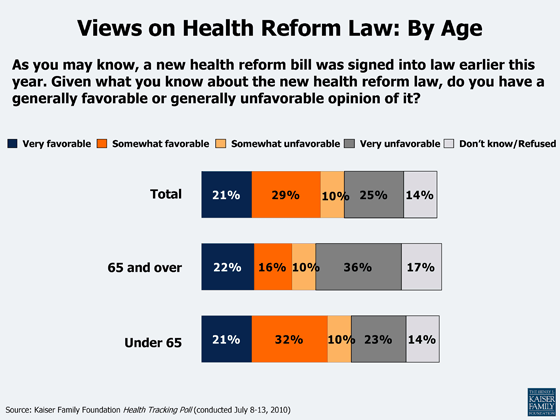
While seniors’ views of the new law are more negative than those of their younger counterparts, they remain roughly split about the law with 46 percent of seniors holding an unfavorable view of the law and 38 percent holding a favorable one. While 35 percent of seniors think they will be worse off under reform, a greater share (57%) say they will be better off (20%) or it will make no difference (37%).
Seniors’ awareness about the specific provisions of the health reform law that affect Medicare is mixed. For example, about half are aware that the new law will result in premium increases for some higher income Medicare beneficiaries (52%) and gradually close Medicare’s “doughnut hole” (50%). However, just a third (33% ) know the law will eliminate Medicare’s co-pays and deductibles for some preventive services.
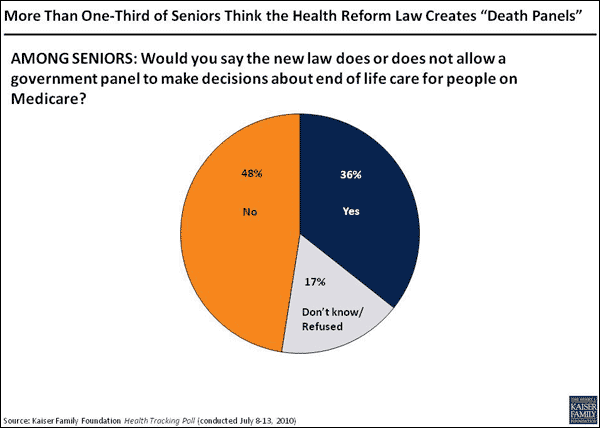
On the other hand, large shares of seniors mistakenly believe the law includes provisions that cut some previously universal Medicare benefits and creates “death panels.” Half of seniors (50%) say the law will cut benefits that were previously provided to all people on Medicare, and more than a third (36%) incorrectly believe the law will “allow a government panel to make decisions about end-of-life care for people on Medicare.”
Despite the fact that Medicare’s actuaries predict the health reform law will extend the life of the Medicare Part A Trust Fund by 12 years (from 2017 to 2029), only 14 percent of seniors know this and nearly half (45%) of seniors think the health reform law will weaken the financial condition of the fund.
In general, seniors with a favorable view of the law are more likely to be aware of some of the law’s benefit improvements for Medicare, while those with an unfavorable view are more likely to be aware of increases in taxes and premiums that occur under the law.
Findings (.pdf)
Chartpack (.pdf)
Toplines (.pdf)
Overall Public Support for the Health Reform Law Is Steady from June
The July Kaiser Health Tracking Poll indicates overall public support for the health reform law is steady from June, while unfavorable views of the law have trended downward somewhat. Half the public (50%) now expresses a favorable view of the law, while 35 percent say they have an unfavorable opinion (down from 41% in June). Seniors’ views of the new law remain more negative than those of their younger counterparts; they tilt towards unfavorable views, 46 percent compared to 38 percent. Meanwhile, Seniors’ awareness of specific reform provisions that affect Medicare is mixed. For example, about half are aware that the new law will result in premium increases for some higher income Medicare beneficiaries (52%) and gradually close Medicare’s “doughnut hole” (50%). However, just a third (33%) know the law will eliminate Medicare’s co-pays and deductibles for some preventive services. And 36 percent believe the law allows a government panel to make descisions about end-of-life care for Medicare recipients.
Pulling it Together: Seniors and Health Reform
It is widely believed that seniors are antsy about the new health reform law. And there is heightened interest in how seniors feel about the law in the political world because they are more likely to vote in midterm elections. About 48% of the electorate said they voted in the 2006 midterms while about 63% of seniors said the same. Our June and July tracking polls shed light on seniors’ views on health reform and their implications.
First, while seniors are in fact more negative towards health reform than the rest of the public, the difference is not huge on key questions. For example, in our July poll 35% of seniors said they or their families would be worse off as a result of the law compared with 27% of people under 65 who said the same thing. Fifty seven percent of seniors either said they would be better off (20%) or that the law would make no difference to them (37%). Seniors split along partisan lines on the health reform law just like the rest of the public.
In our June poll 45% of seniors who said they were most likely to vote in the midterm election said they were either much more likely or somewhat more likely to vote against a candidate who voted for the law. That compared with 28% who said they were more likely to support a candidate who voted for it, a notable 17 percentage point difference. But many other factors come into play in local races other than seniors views on health reform. Seniors said the candidates’ personal qualities (cited by 31%); the direction of the nation as a whole (31%); and the candidates’ stands on the issues (29%) all would influence their votes. That last category includes all issues and significantly, only 13% of seniors said health care would be the most important issue to their vote (11% of people under 65 said the same thing). A district would have to have a very close race, lots of seniors who vote, few other competing issues, and a candidate who succeeds in making his or her opponent’s vote on health reform a hot issue for senior’s votes on health reform to play a significant role in a race.
The emphasis on seniors’ opposition to health reform is at least somewhat over played. Seniors certainly are more negative than the under-65 population, but only a small percentage sees health reform as a voting issue for them. It is more accurate to say that seniors are split on the legislation like the rest of the country but leaning somewhat more negative, and it would take a perfect storm of factors in a local race for seniors’ views of health reform to swing a race.
The second big finding in the tracking poll — the huge misconceptions many seniors have about elements of the legislation, some of them manufactured during the debate. A year after the town meeting wars of last summer, a striking 36% of seniors said that the law “allowed a government panel to make decisions about end of life care for people on Medicare”, and another 17% said they didn’t know.
But the misperceptions were not limited to death panels. Fifty percent said the law cut benefits previously provided to all people on Medicare when it does not, and another 16% didn’t know. Only 33% knew that it eliminated copays and deductibles for many preventive services under Medicare, 26% that it provided bonus payments to doctors who provide primary care services under Medicare and 14% that it would extend the life of the Medicare Trust Fund (by twelve years according to government estimates). Higher percentages, but still not big majorities, knew about some other features of the law. For example, 50% knew that the law would gradually fill the donut hole. The big question: how would seniors’ views about the law change if they did not have these misperceptions and were better informed? We can’t say for sure. What we can say is that as we move from a combative legislative debate to what is likely to be an equally heated election season; seniors’ misperceptions and lack of knowledge about some key elements of the law remain profound. A poll released this week by the National Council on Aging also showed high levels of misperception by seniors.
It is the finding in our July tracking poll that more than one-in-three seniors still believe there are death panels in the health reform law that we should worry about most. It’s not only that it is the most egregious misconception, but it shows how debate about public policy can be manipulated in the echo chamber of the 24-second news cycle with apparent lasting effect. Seniors’ opinions and votes could be targets again as we move beyond the midterms to a potential debate about deficit reduction and changes to Medicare and Social Security. These issues are even more salient and personal to seniors so we could see similar dynamics play out in another policy debate soon.