KFF designs, conducts and analyzes original public opinion and survey research on Americans’ attitudes, knowledge, and experiences with the health care system to help amplify the public’s voice in major national debates.
This issue brief examines the key provisions of the 2010 health reform law that will expand health coverage and are likely to improve access to care for people of color, as well as some of the other provisions that will likely have either a direct or indirect impact on health disparities.
This Part D Data Spotlight documents the wide variations across the private stand-alone drug plans with respect to coverage of drugs, what enrollees pay for those drugs, and restrictions and limitations placed on their use. These variations have potentially significant implications for beneficiaries’ access to medications and out-of-pocket costs.
The spotlight is one in a series analyzing key aspects of the Medicare Part D drug plans that will be available to beneficiaries in 2010. The analysis was conducted jointed by Jack Hoadley and Laura Summer of Georgetown University, Elizabeth Hargrave of NORC at the University of Chicago, and Juliette Cubanski and Tricia Neuman of the Kaiser Family Foundation.
Support for health reform fell over the past month, dipping from a 50 percent favorability rating in July to 43 percent now, while 45 percent of the public reported unfavorable views. The dip in favorability returned public opinion on the new law to the even split last seen in May before a modest uptick in support in June and July. But voters have a lot on their minds besides health reform.
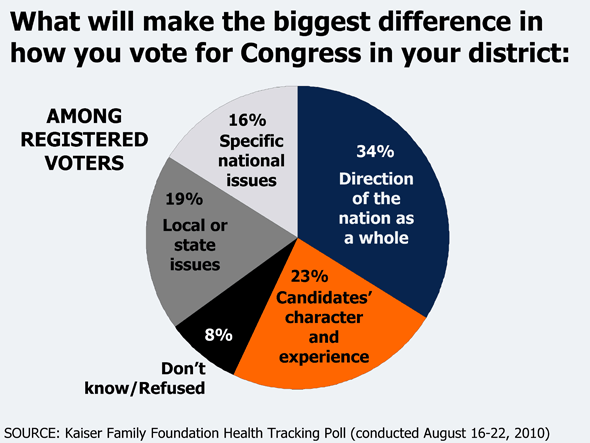
Asked what would make the biggest difference in their vote for Congress, the “direction of the nation as a whole” topped the list, named by 34 percent of voters, twice as many as the proportion who chose “specific national issues”. Roughly a quarter said the “candidate’s character and experience” would be the driving factors, and 19 percent named local or state issues.
This Kaiser Family Foundation issue brief examines the key changes in this year’s health reform law that will reward bonuses to private Medicare Advantage plans based on quality rating. Medicare currently rates plans on a five-star scale, with five stars representing the highest quality. The brief analyzes plans based on their quality rating for the current year and also examines enrollment in each of those plans.
The results indicate that private Medicare Advantage plans with high quality ratings are concentrated in certain states, leaving beneficiaries in some states with few if any options for choosing a highly-rated plan. States with more highly-rated plans, and higher enrollment in those plans, are likely to receive more bonuses and quality-based payments under health reform.
The Foundation previously examined quality ratings in relation to the characteristics of Medicare Advantage plans, including type of plan, length of time serving Medicare beneficiaries, and ownership status. That analysis is available online.
Medicaid and the Children’s Health Insurance Program (CHIP) are serving as an important safety-net for children during the current recession. These programs have contributed to a decrease in the uninsured rate for children, but many eligible children remain uninsured despite the availability of Medicaid and CHIP coverage today. Provisions to strengthen coverage for children are included in both the 2009 Children’s Health Insurance Program Reauthorization Act and the Patient Protection and Affordable Care Act of 2010. The Administration has made covering all eligible children a key priority through its Connecting Kids to Coverage initiative. This renewed effort to reach eligible but uninsured children will help prevent children from needlessly forgoing medical care.
The Kaiser Family Foundation has several resources that explain children’s health care coverage and can serve as helpful reference guides in understanding the crucial role that public coverage plays for this population. These materials include state level data on children’s coverage and background on Medicaid and CHIP, which together provide coverage for almost one-third of all children.
Holding Steady, Looking Ahead: Annual Findings Of A 50-State Survey Of Eligibility Rules, Enrollment and Renewal Procedures, And Cost Sharing Practices in Medicaid and CHIP, 2010-2011 The annual 50-state survey of Medicaid and CHIP eligibility rules, enrollment and renewal procedures and cost sharing practices, conducted by the Kaiser Commission on Medicaid and the Uninsured with the Georgetown University Center for Children and Families, found that, in 2010, coverage in Medicaid and the Children’s Health Insurance Program remained strong with some improvements, particularly for low-income children. However, eligibility for their parents and other low-income adults continued to lag behind. The survey also found that states are adopting technology to modernize their programs, but still have a significant amount of work ahead as they begin to prepare for health reform.
Fact Sheets: Children’s Health Insurance Program Reauthorization Act of 2009This fact sheet provides an overview of provisions of the Children’s Health Insurance Program Reauthorization Act of 2009 (CHIPRA), which was signed into law in February 2009. The Act extends and expands the State Children’s Health Insurance Program that was enacted with bipartisan support as part of the Balanced Budget Act of 1997 (BBA). Another fact sheet provides an overview of new coverage options, enrollment tools and incentives provided by the law and state adoption of those options to date.
Children’s State Fact SheetsThis simple tool allows you to view Children’s Health fact sheets containing the latest data from statehealthfacts.org, comparing your state to the United States or to any other state.
CHIP Tips: Series Focuses On New Opportunities For Covering Children Under Medicaid and CHIPThis series of implementation briefs called “CHIP Tips” examines new opportunities for covering children following the reauthorization and expansion of CHIP in February 2009. Together Medicaid and CHIP provide coverage for more than one in four children in the U.S., yet many others remain eligible but uninsured.
CHIP Enrollment: June 2009 Data Snapshot (updated for 2011)This report provides the latest data on Children’s Health Insurance Program enrollment and policy trends nationally and across the states through June 2009.
This comprehensive survey of the experiences of New Orleans residents is the third in a series conducted by the Kaiser Family Foundation since 2005. Five years after Hurricane Katrina, an increasing majority of the city’s residents says the rebuilding process is going well, but substantial majorities still report that the city has not recovered and feel the nation has forgotten them. The survey also finds the scope and immediacy of the Gulf oil spill weighing heavily on New Orleans residents’ minds. Asked which disaster would cause more damage, more people pointed to the oil spill than picked Katrina and the levee breaks that followed the hurricane. Overall, the survey reveals a markedly changed city, with a population nearly a third smaller than it was at the time of the 2000 Census, still struggling to recover from a storm and levee breaks that killed 1,464 people and displaced more than a million others while flooding entire neighborhoods and swamping local businesses and medical facilities. While residents see significant progress in restoring tourism, many report that New Orleans lags in overcoming an intractable crime problem and that the pace of the recovery has been far slower for the city’s black residents, who are the majority.
The survey was designed and analyzed by a research team from across the Kaiser Family Foundation. Social Science Research Solutions collaborated with Kaiser researchers on sample design and weighting, and conducted the fieldwork. Interviews for the current survey were completed May 26–June 27, 2010, in English and Spanish via landline telephone and cell-phone among 1,528 randomly selected adults ages 18 and older residing in Orleans Parish. Note that the survey included Orleans Parish residents in all their racial and ethnic diversity — including whites, African Americans, Hispanics, Asian Americans and those of other backgrounds — but because groups are represented based on their actual share of the total population, the only two groups large enough to be analyzed separately are African Americans and whites. The margin of sampling error for the total sample is plus or minus 3 percentage points. For results based on other subsets of respondents the margin of sampling error may be higher.
President Obama’s visit to New Orleans on August 29, five years after Hurricane Katrina and the levee failures nearly destroyed the city, presented an opportunity for him to deliver a message on behalf of us all: The country still cares.
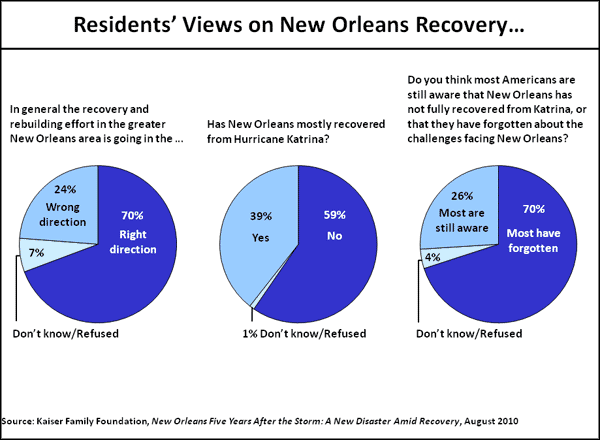
It was a timely message. Seven-in-ten residents of New Orleans told us in our recent survey that they believe the rest of the country has forgotten them and the difficulties the city still faces in its recovery. The survey, the third in a biennial series on the experiences and opinions of New Orleans residents, is part of the Kaiser Family Foundation’s continuing work to get the facts out about the recovery in New Orleans.
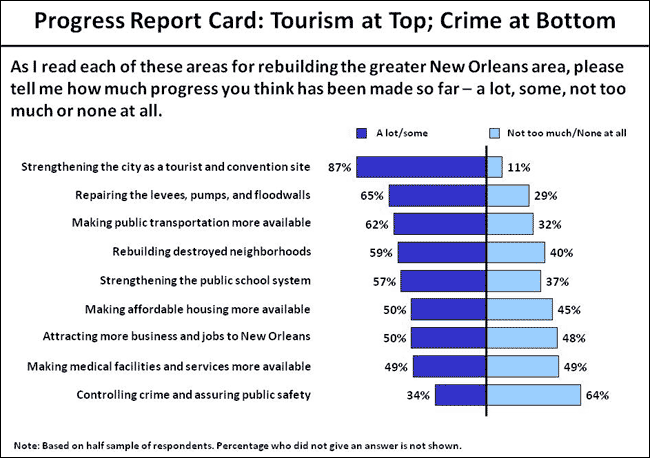
There are signs of remarkable progress in the city. Three-quarters of the people of the city are optimistic about the future. Nearly two-thirds of New Orleans residents say their lives are back to normal and 70% say that the rebuilding effort is going in the right direction, up from 56% in 2008. They applaud the success in bringing back tourism and conventions (87% say they have seen a lot or some progress), repairing the levees (65%), improving transportation (62%), rebuilding some neighborhoods (59%), and making strides in schools (57%), housing (50%) and health care (49%). Over the three surveys we have conducted in New Orleans since Katrina, we have seen steady improvement in most areas, including in race relations. For the first time since 2006, more residents say that race relations are getting better (23%) than say they were getting worse (15%). The proportion of African Americans who see bias in the rebuilding process has fallen from 55% in 2006 to 30% now. Interestingly, more residents see the city as divided by “class” (33%) than by “race” (17%).
But the city that is recovering is a much different New Orleans than before Katrina. The new New Orleans has a population about a quarter smaller than it was before the storm, with whole neighborhoods still just a shadow of what they once were. New Orleans is far from the centers of political and media power in the country and the populations most affected by Katrina were mostly lower income and minority Americans. If a man-made or natural disaster had dislocated a quarter of the population of New York, Boston or San Francisco, and devastated Brooklyn, the Back Bay or the Marina District, it is hard to believe that the rest of America would have resigned itself so quickly to the idea that those residents would never return home and those neighborhoods might not be rebuilt.
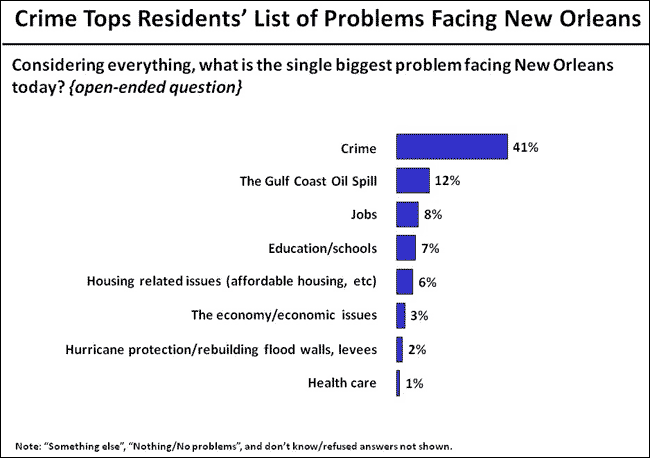
The new New Orleans faces real challenges. Over half (57%) of young professionals, a key to the city’s future, are pessimistic about their career prospects and 37% of those under age 30 are considering leaving. African Americans are much more likely to say they have not recovered from Katrina than whites (42%, compared to 16% of whites). And in a country where every poll finds the economy and jobs as the runaway No. 1 issue, in New Orleans it is crime (cited by 41%) and picked by residents three-to-one over the No. 2 concern, the gulf oil spill (12%).
Concern over the potential economic and environmental effects of the spill was so great in New Orleans when we surveyed in late June that more people picked the oil spill than Katrina (49% vs. 40%) when asked which calamity ultimately will be more damaging to the region.
We asked the people of New Orleans what they liked best about their city. Overwhelmingly they said its culture—nothing else was even close (cited by 35%, compared to 12% for tourism, the second most popular response). We can count progress in jobs and clinics and schools and engineers can test the strength of levees, but the measure that is of greatest importance to the people of the city itself will be the hardest to gauge as the recovery progresses and the makeup of the city changes.
At a time when our nation is struggling with a stubbornly sluggish economy, one war winding down and another intensifying, the challenge of rebuilding New Orleans may appear to some to be little more than a regional concern. But Katrina, more than any other single event in recent memory, was the symbol of failed government. There could be no more tangible demonstration of government’s ability to deliver than a clear success story in New Orleans. Despite real progress in the city five years after the storm, the job of resurrecting New Orleans is far from done.
Drew Altman, PhD, is president and CEO of the Henry J. Kaiser Family Foundation in Menlo Park, California.
[This column expands on an op-ed published in The Washington Post on Sunday, August 29, 2010.]
Crime is By Far The Biggest Concern in New Orleans
Seven in 10 Residents Say Americans Have Forgotten The City’s Plight
African-Americans View Their Recovery Differently; It’s Much Slower
MENLO PARK, Calif. — Five years after Hurricane Katrina, an increasing majority of the city’s residents says the rebuilding process is going well, but substantial majorities still report that the city has not recovered and feel the nation has forgotten them, according to a new comprehensive survey of the lives and attitudes of New Orleans residents by the Kaiser Family Foundation.
New Orleans Five Years After The Storm: A New Disaster Amid Recovery, the third survey in a series that Kaiser has conducted in the aftermath of Katrina, also finds the scope and immediacy of the Gulf oil spill weighing heavily on New Orleans residents’ minds. Asked which disaster would cause more damage, more people pointed to the oil spill than picked Katrina and the levee breaks that followed the hurricane.
Overall, the survey reveals a markedly changed city, with a population nearly a third smaller than it was at the time of the 2000 Census, still struggling to recover from a storm and levee breaks that killed 1,464 people and displaced more than a million others while flooding entire neighborhoods and swamping local businesses and medical facilities. While residents see significant progress in restoring tourism, many report that New Orleans lags in overcoming an intractable crime problem and that the pace of the recovery has been far slower for the city’s black residents, who are the majority.
“Residents report a lot of progress in the recovery effort, but just as the city appeared to be turning a corner it got hit by a different kind of hurricane — the oil spill,” said Kaiser President and CEO Drew Altman. “It is striking that while jobs is the number one issue across America, crime swamps all other issues in New Orleans,” he added.
The survey series gauges people’s experiences, living conditions and attitudes towards the rebuilding effort in New Orleans in the aftermath of Katrina. (Previous surveys were conducted in 2008 and 2006.) It finds that 70 percent of residents say recovery and rebuilding are going in the right direction, up from 56 percent in 2008 and 58 percent in 2006. Yet nearly 6 in 10 believe the city has not “mostly recovered” from Katrina. A third (32%) of residents who lived through the storm report that their lives still are “very” or “somewhat” disrupted, compared to 41 percent two years ago and 46 percent in 2006. Nearly a quarter of residents (24%) are planning or considering a move away from greater New Orleans, up from 12 percent in 2006. And 7 in 10 believe most Americans have “forgotten” the continuing challenges facing the region.
The Gulf Oil Spill: A New Disaster for New Orleans
The Deepwater Horizon oil spill in the Gulf of Mexico, the largest offshore spill in U.S. history, amounts to a new, man-made disaster for greater New Orleans. Nearly half of the city’s residents (49%) believe the fallout from the oil spill represents a more damaging threat to New Orleans than Katrina did, while 40 percent thought Katrina caused more damage. Large majorities say the spill will affect the New Orleans economy (64%) and the local environment (70%) a “great deal.”
BP, the company that operated the doomed oil rig, has come in for scathing public criticism even in a region heavily dependent on the oil and gas industry for jobs, with 84 percent of New Orleans residents reporting a negative view of the company’s response to the crisis.
Residents See Progress In Restoring Tourism, Repairing Damaged Levees And Rebuilding Devastated Areas
Most residents of Orleans Parish see real progress on a majority of recovery issues, the survey finds. Their greatest praise is for strengthening New Orleans as a tourist and convention site, with nearly 9 in 10 residents (87%) saying they see “some” or “a lot” of progress in that area. Two-thirds (65%) see progress in repairing the damaged levees, pumps and floodwalls. And roughly 6 in 10 say they see progress making public transportation more available (62%), rebuilding destroyed neighborhoods (59%) and strengthening the public school system (57%).
In particular, this year marks the first time since Katrina that a majority of residents say they see progress in rebuilding devastated areas, with a solid majority of 59 percent saying so now, compared to 44 percent in 2008 and 33 percent in 2006.”The people of New Orleans believe that the Katrina recovery, while far from complete, is on the right track in a number of areas,” said Mollyann Brodie, Senior Vice President and Director of Public Opinion and Survey Research at the Foundation.
In other areas, residents are more divided. They are split in half on whether the city has shown any improvement in making affordable housing more available, attracting businesses and jobs, and making it easier for people to access medical services.Crime Is By Far The Biggest Concern
By far, residents reserve their lowest ratings for crime, an area in which nearly two in three people (64%) say the city has made little or no progress. Just over half of city residents (54%) are at least somewhat worried about becoming the victim of violent crime. Asked in an open-ended question to name the “single biggest problem facing New Orleans today,” crime rises above all other issues, with more than three times as many residents (41%) putting it at the top of the list as picked the oil spill (12%), the second most-cited problem. Farther down the list were jobs (8%), education/schools (7%), affordable housing (6%), the economy (3%), hurricane protection (2%) and health care (1%).
In contrast, when residents of Detroit, another major city facing tremendous challenges, were asked in a recent Kaiser/Washington Post/Harvard University survey about the single biggest problem in their area, 57 percent named economy-related issues while only 18 percent cited crime and safety. Nationally, the top concern is the economy, cited by 28 percent of people in a June USA Today/Gallup poll, followed by unemployment (21%). Crime was well down the list nationally at 1 percent.Crime was a major problem in New Orleans even before Katrina. The New Orleans Police Department, long viewed as troubled, suffers from a lack of public trust and is currently being assessed by the Justice Department at the request of the city’s new mayor. The survey finds that less than half of Orleans Parish residents say they can trust the police to do what is right for them and their community “almost always” (13%) or “most of the time” (31%). Trust in the police differs starkly by race: a majority of whites (59%) says you can trust the police to do what is right “almost always” (18%) or “most of the time” (41%), while a majority of blacks (64%) says you can trust the police only “only some of the time” (45%) or “almost never” (19%).
African Americans And Whites Continue To Live Differing Realities in NOLA, but More People Cite Income Than Race As The City’s Dividing Line
As was true before Katrina hit, African-American and white residents in New Orleans live substantially different economic realities, an experience not uncommon in America’s large cities. But the storm, and especially the ensuing flooding, disproportionately affected black neighborhoods, translating into a steeper climb to recovery in the very areas of the city that faced higher economic and other challenges even before the hurricane.
The survey finds that African-Americans are more than twice as likely as whites to say that their own lives have not yet recovered from Katrina (42% vs. 16%). And 61 percent of African-American residents report living in low-income households with earnings under 200 percent of the poverty level (roughly $44,000 for a family of four), compared to 24 percent of whites. Similar racial differences exist in the share who say New Orleans has not recovered (66% of blacks vs. 49% of whites); who say it is a bad time to be raising children in the city (51% vs. 35%); who say that NOLA is a worse place to live now than before the storm (42% vs. 28%); and who say they are “very worried” that health care services might not be available if they need them (59% vs. 21%).
Yet the survey also finds signs that race relations in the region may be improving. For the first time since 2006, more parish residents say that race relations are getting better (23%) than say they are getting worse (15%). The share of African-American residents who see racial bias in the rebuilding effort has dropped to 30 percent, down from 55 percent in 2006.
Moreover, while nearly 6 in 10 residents still see New Orleans as divided by race and income, the proportion that see a unified city has risen from 24 percent in 2008 to 37 percent today. Even among those who see divisions, more see the city as divided mainly by income (33%) than see it as divided mainly by race (17%). African-Americans express this view more than whites, with 37 percent of black residents saying New Orleans is mainly divided between rich and poor, while 27 percent of whites say so. (In contrast, 24 percent of whites point to race as the main divide, while 13 percent of African-Americans do.)
A Health System Slowly On The Mend
The picture is mixed on the recovery of the health care system, with 49 percent of residents reporting that they see “a lot” or “some” improvement in the availability of medical services and facilities and an equal share saying there has been little or no progress in this area.
For the first time, a majority (55%) say their health care needs are being met “very well”, up from 42 percent in 2008 and 36 percent in 2006. And an increasing proportion say they have received preventive care in the past six months — 59 percent, up from 47 percent in 2008. Still, one in five adults report being uninsured, and about a quarter of residents say that they have no usual place of care other than the emergency room.
The expansion of health coverage under the new health reform law is expected to shrink those uninsured numbers. The survey finds more support for the law in New Orleans than there is in the nation as a whole. The city’s residents favor the law by a margin of 57 percent to 30 percent, compared to a narrower margin nationally of 50 percent to 35 percent in Kaiser’s July Health Tracking Poll.
Methodology
New Orleans Five Years After the Storm: A New Disaster Amid Recovery is the third in a series of surveys designed and analyzed by a research team from across the Kaiser Family Foundation led by Senior Vice President and Director for Public Opinion and Survey Research Mollyann Brodie and Associate Director for Public Opinion and Survey Research Claudia Deane. Kaiser staff working on the current survey included Drew Altman, Theresa Boston, Sarah Cho, Liz Hamel, Molly McGinn-Shapiro, David Rousseau, and Diane Rowland. SSRS/Social Science Research Solutions collaborated with Kaiser researchers on sample design and weighting, and conducted the fieldwork.
Interviews for the current survey were completed May 26 — June 27, 2010, in English and Spanish via land-line telephone and cell-phone among 1,528 randomly selected adults ages 18 and older residing in Orleans Parish. Note that the survey included Orleans Parish residents in all their racial and ethnic diversity — including whites, African Americans, Hispanics, Asian Americans and those of other backgrounds — but because groups are represented based on their actual share of the total population, the only two groups large enough to be analyzed separately are African Americans and whites. The margin of sampling error for the total sample is plus or minus 3 percentage points. For results based on other subsets of respondents the margin of sampling error may be higher.
Under health reform, Medicaid eligibility will be expanded to reach nearly everyone under age 65 with income below 133 percent of the federal poverty level. As a result, millions of uninsured adults, including many with very low income and significant health needs, will become eligible for the program. This brief provides details of the benefit and cost-sharing rules that will govern the coverage available to these newly eligible adults Medicaid beneficiaries, and it identifies key considerations for state policymakers making Medicaid benefit design choices.