Pulling it Together: The People Behind The Entitlement Debate

Published: Nov 9, 2010

Well before we have any clarity on the impact of the election on health reform, the pundits are handicapping the prospects of efforts to make a serious dent in the national debt and deficit.  Three national commissions are hammering out recommendations for reducing the debt and reining in entitlement spending, putting two giant health programs that serve the elderly, disabled and low-income Americans, Medicaid and Medicare, as well as Social Security, in the crosshairs of a new policy debate.

Just yesterday, the Administration’s National Commission on Fiscal Responsibility and Reform, chaired by Erskine Bowles and Alan Simpson, released draft recommendations, with final recommendations due before the end of the year.  Also yesterday, the Peterson-Pew Commission on Budget Reform issued a report recommending changes in budget process rules to help drive down the national debt.  And next week, the Bipartisan Policy Center’s Debt Reduction Task Force, chaired by Pete Domenici and Alice Rivlin, is expected to issue their recommendations.

All three groups are tackling very real challenges.  The national debt has climbed to $13.7 trillion and the federal deficit has reached nearly $1.4 trillion.  Spending on Social Security and mandatory health programs (Medicare, Medicaid and CHIP) account for about 40 percent of the federal budget, and according to CBO, will grow from roughly 10 percent of GDP today to 16 percent in twenty five years, due to the aging of the population and the rising costs of health care. With projections like these few openly support doing nothing, even though how much can actually get through the legislative process remains unclear.

The discussion of these issues is framed almost always in terms of “hard choices” to reduce spending, increase taxes, or both.  On the spending side of the ledger, many say the hard choices won’t be made because of political realities, including strong resistance from seniors to any changes to Medicare or Social Security.  The mid-term election was just the most recent example illustrating the importance of senior voters. In general, Democrats will resist cuts in these programs and Republicans will resist any new taxes.

But these choices are also hard on legitimate policy grounds, especially when it comes to Medicare.  And the most important reason they are hard is that so many seniors and disabled people on Medicare have low incomes and already pay a significant share of those incomes for their health care today.  It will be difficult if not impossible to ask the majority of beneficiaries to pay more or make do with less.  That has been the missing element in the entitlement/deficit reduction debate: Warren Buffet is not the typical Medicare beneficiary.  Instead the prototype is an older woman with multiple chronic illnesses living on an income of less than $25,000 who spends more than 15 percent of her income on health care.  It is the people on these programs and the realities of their lives that have been left out of the discussion.

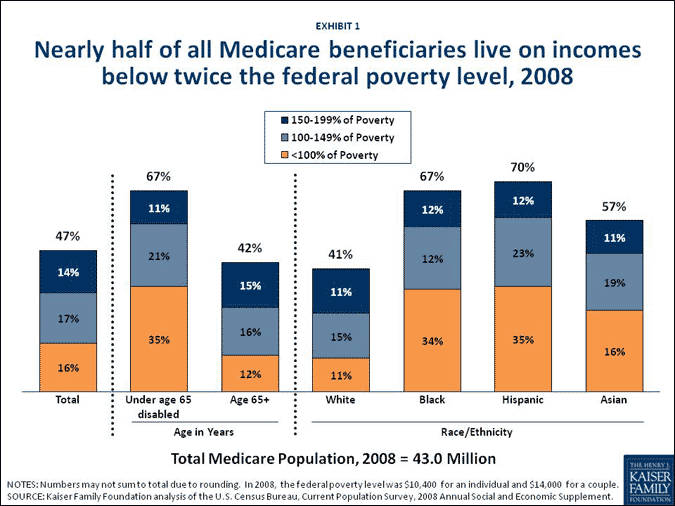
Nearly half (47%) of all elderly and disabled people on Medicare have incomes below twice the federal poverty level (less than $20,800 for an individual and $28,000 for a couple in 2008). Poverty rates are even higher among women, African American and Latino Medicare beneficiaries.  And two-thirds of the 8 million disabled people on Medicare who are under age 65 have incomes below twice the poverty rate; beneficiaries with disabilities face more serious access problems than others on the Medicare program.
PIT-Exhibit1.gif

People on Medicare also already spend a much larger share of their household budgets on health care than the non-elderly do: about 14 percent compared to 4 percent in 2006.  And according to our analysis, median out-of-pocket health spending for the elderly and disabled on Medicare as a share of income has been rising, from about 12 percent in 1997 to more than 16 percent in 2006 — with even higher rates for those living below the poverty level (21%) and among those between 100-200 percent of poverty (23%).
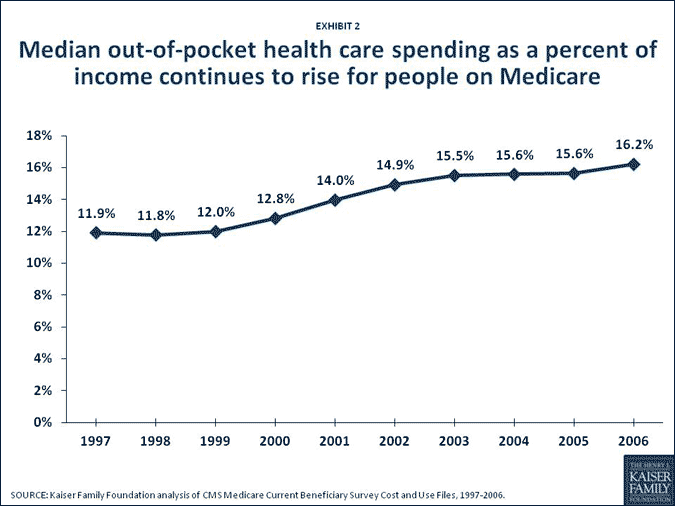
Exhibit2_2.gif

Some “hard choices” to be considered may not affect the most vulnerable elderly and disabled, for example proposals that ask higher-income seniors to pay more. The health reform law has already moved further in this direction by increasing the number of higher-income beneficiaries who will pay higher Medicare premiums.  Additional efforts to raise costs for higher-income beneficiaries could stir up strong political opposition.  Some old ideas may need to be re-evaluated in a post health reform world.  For example, proposals to save money by pushing back the retirement age for Medicare to 67 may save money for Medicare, but may not make as significant a dent in federal spending as once envisioned if the 65 and 66 year olds with incomes below 400 percent of poverty become eligible for government tax credits, or for Medicaid, under health reform.One of the biggest issues likely to emerge is where to draw the line in terms of who should be asked to pay more if policies slow the growth in Medicare by shifting costs to beneficiaries, either directly or indirectly.  Who is wealthy enough to pay more?  Are adequate protections in place to shield seniors with modest incomes from financial hardship and cost-related access problems?  Legislators took one cut at this apple in health reform.  The recently enacted health reform law established premium subsidies to limit the financial burden on families with incomes up to 400 percent of the poverty line.  The leaders participating in the different debt and deficitreduction commissions and the experts assisting them are certainly aware ofthese challenges, although they have not really been part of the public discussionto date.If new policies are proposed to rein in entitlement spending and reduce the deficit, it seems only reasonable to include the following criterion among others for evaluating proposals: do no harm to the financial security or access to care for elderly and disabled beneficiaries living on low and modest incomes.  Indeed, given the high out-of-pocket costs these groups have, and the large share of their incomes they already pay for health care, a comprehensive approach might well seek to improve circumstances for these most vulnerable groups, while also advancing “hard choices” for entitlement programs to reduce the deficit.
Kaiser November Tracking Poll Finds Health Care a Factor in Congressional Election, But Not a Dominant One

Published: Nov 9, 2010

This month’s Kaiser Health Tracking Poll, conducted during the four days following the mid-term election, asked voters in an open-ended question to name in their own words the biggest factors influencing their vote for Congress, and found that health care was a factor, but not a dominant one. Among all voters, the factor mentioned most often was the economy/jobs (29%). The next two most mentioned factors were party preference (25%) and views of the candidates themselves (21%). Health care was the fourth most mentioned factor at 17 percent.

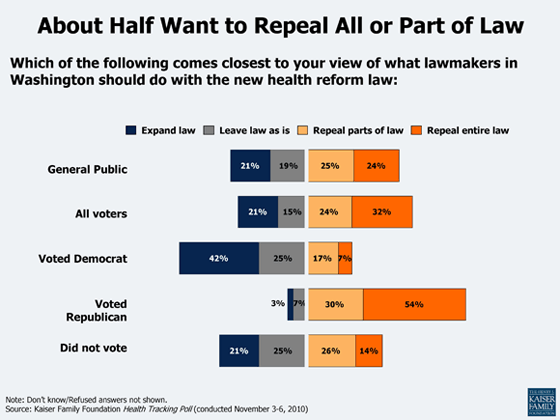
The general public remains split about what lawmakers should do with the health reform law, with 21 percent wanting to see lawmakers expand the law, 19 percent wanting to leave the law as is, a quarter wanting to repeal parts of the law, and nearly a quarter (24%) wanting to see the entire law repealed. However, among those who support repeal of all or parts of the law, a majority want to keep key provisions tested in the poll, except the individual mandate and the Medicare payroll tax increase. Solid majorities of supporters of repeal would like to keep tax credits for small businesses offering coverage (68%), the prohibition on insurance companies from denying coverage based on medical history or health condition (62%), the gradual closing of the Medicare prescription drug “doughnut hole” (60%), and financial subsidies to low and moderate income Americans to help purchase coverage (55%).

Policy-insights-About_Half_Want_to_Repeal_All_or_Part_of_Law
Poll Finding

West vs. South: Regional Differences in Views of the Health Reform Law

Published: Nov 1, 2010

This Data Note examines regional variations in public opinion of the health reform law based on the November 2010 Kaiser Health Tracking Poll. The analysis takes a special look at the Western and Southern regions of the country, where many states are likely to see the biggest increases in coverage under the law, and which stand to be disproportionately eligible for federal Medicaid funds. Despite these similarities in how the two regions might be affected, the Data Note finds broad differences in how residents of these regions are reacting to the law.

Data Note (.pdf)

November 2010 Health Tracking Poll

Poll Finding

Health Reform and the Tea Party Movement

Published: Oct 30, 2010

With much media discussion of the role that the Tea Party will play in the upcoming Congressional midterm elections, this data note takes a closer look at Tea Party supporters using the most recent Health Tracking Poll data from September.

While 57 percent of voters who do not support the Tea Party movement view the health reform law “very” or “somewhat” favorably, 57 percent of Tea Party supporters view the law “very” unfavorably, and another 11 percent “somewhat unfavorably.” At the same time, nearly two-thirds (63 percent) of Tea Party supporters say they feel “angry” about health reform, even though most (82 percent) of these say their anger is more widely targeted at Washington as a whole rather than specific to the reform law.

Data Note (.pdf)

Medicare Chartbook, 2010

Published: Oct 30, 2010

This chartbook provides the most recent and reliable data available about the Medicare program and the 47 million seniors and younger people with disabilities who get health insurance coverage through the program.

Topics covered include: Medicare beneficiaries; the program’s benefits, utilization, and access to care; prescription drugs; the Medicare Advantage program; the role of Medicaid for Medicare beneficiaries; supplemental insurance coverage; out-of-pocket spending; and Medicare spending and financing.

Printable Chartbook (.pdf)

Poll Finding

Kaiser Health Tracking Poll — October 2010

Published: Oct 18, 2010

With the November midterm elections just weeks away, Americans remain chronically divided over the Patient Protection and Affordable Care Act, but most say that their feelings – pro and con – about the health reform law are not a dominant factor in how they will vote for Congress or whether they will go to the polls.

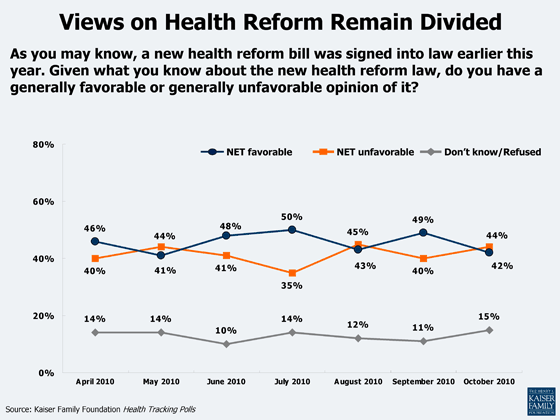
Views on health reform tightened up in October, with 42 percent saying they have favorable views of the new law, 44 percent holding unfavorable views and 15 percent not offering an opinion. This continues a familiar pattern seen over many months in which positive and negative views of the new law move within a relatively narrow band, reflecting a very divided public.

The October poll is the latest in a series designed and analyzed by the Foundation’s public opinion research team.

Findings (.pdf)

Chartpack (.pdf)

Toplines (.pdf)

New Tracking Poll Finds Americans Remain Divided Over Health Law

Published: Oct 18, 2010

With the November midterm elections just weeks away, Americans remain chronically divided over the Patient Protection and Affordable Care Act, but most say that their feelings – pro and con — about the health reform law are not a dominant factor in how they will vote for Congress or whether they will go to the polls, according to the new Kaiser Health Tracking Poll.

Views on health reform tightened up in October, with 42 percent expressing favorable views, 44 percent unfavorable views and 15 percent not offering an opinion. Likely voters are somewhat more negative: 39 percent hold favorable views of the new law, 49 percent hold unfavorable ones. Overall, this continues a now familiar pattern in which positive and negative views of the new law move within a relatively narrow band, reflecting a very divided public. In October, 28 percent said they would support immediate repeal of the law, similar to last month.

No matter what their views on the issue, however, health reform does not appear to be the main issue for most voters as we head into the November elections. Asked to name the most important issue in their vote for Congress, the economy tops voters’ list, named by just over a third (35 percent). Behind that are health reform and dissatisfaction with government, each named by 10 percent. In general, voters are twice as likely to say that the direction of the nation as a whole is more important to their vote than any specific national issue (35 percent vs. 16 percent), with another 21 percent saying their vote will turn on state or local matters and 23 percent saying they will focus more on the specific candidates.

Policy-insights-oct_tracking_poll_560pixels

KFF Explores Health Reform and the Tea Party Movement

Published: Oct 12, 2010

With much media discussion of the role that the Tea Party will play in the upcoming congressional midterm elections, the Kaiser Family Foundation took a closer look at Tea Party supporters using its most recent Health Tracking Poll data from September. While 57 percent of voters who do not support the Tea Party movement view the health reform law favorably, 57 percent of Tea Party supporters view the law “very” unfavorably, and another 11 percent “somewhat unfavorably.” At the same time, nearly two-thirds (63 percent) of Tea Party supporters say they feel “angry” about health reform, even though most (82 percent) of these say their anger is more widely targeted at Washington as a whole rather than specific to the reform law. Republican Tea Party supporters show a more intense opposition to the health reform law than their fellow Republicans who don’t back the Tea Party; in the latter group, 42 percent have intensely negative views of the law, compared to 70 percent of Tea Party Republicans.

News Release

A “Deciding Moment” for AIDS After 30 Years

Published: Oct 5, 2010

New National Media Campaign Inspires Black Americans to Take Action to Stem Spread of HIV

WASHINGTON, Tuesday, 5 October 2010 — Greater Than AIDS, a national movement supported by a broad coalition of public and private sector partners, today unveiled the latest phase of its campaign to mobilize Black Americans in response to the devastating epidemic which will mark its 30th year next June.  Black Americans account for nearly half of new HIV infections occurring annually in the United States, while representing 13 percent of the population.  In addition to being disproportionately affected by HIV/AIDS, Black Americans are also significantly more likely to die as a result as compared to other races and ethnicities in this country.

The cross-platform media campaign focuses on Deciding Moments, everyday opportunities to take a stand against HIV drawn from real-life stories of people from across the country — including those living with HIV.  Be it asking to be tested, buying (and using) condoms, correcting a piece of misinformation, or keeping up with one’s medications, these simple acts serve to challenge the stigma surrounding HIV and stem its spread.  These individuals opened up about their experiences in the hopes of inspiring others to do the same.  An interactive feature on the campaign’s website — www.greaterthan.org — allows visitors to post their own deciding moments.

“As we prepare to close three decades of HIV/AIDS, this is our collective Deciding Moment as a people,” said Phill Wilson, President and CEO of the Black AIDS Institute, a founding partner of Greater Than AIDS.  “Black Americans have borne the brunt of the HIV/AIDS epidemic and now is the time to come together and do our part to change the course of this epidemic.”

The Deciding Moments campaign begins rolling out outdoor, print and online public service advertising this month with television to follow later in the fall and will continue through next year. Leading media companies, including the American Urban Radio Network, CBS Outdoor and Radio, Clear Channel Communications, Ebony, ESSENCE Communications, the National Newspaper Publishers Association, and Radio One, among others, are providing significant donated media space to support the campaign as Greater Than AIDS partners.  A number of state health departments and AIDS offices have also embraced Greater Than AIDS and along with AIDS service organizations and other community groups are leveraging the national campaign to develop expanded targeted efforts in their local areas.

“It’s unprecedented to have such a broad cross-section of media, along with other private and public sector organizations, come together on an issue of such vital importance for Black Americans and the nation,” said Drew Altman, President and CEO of the Kaiser Family Foundation.

The “Deciding Moments” concept grew from research conducted by the Kaiser Family Foundation that reveal the deep-seated stigma that still exists around HIV/AIDS despite strong personal connections to the issue. The overarching message reinforces the core Greater Than AIDS ideals of unity, hope and empowerment by focusing on the power of individuals coming together to achieve a larger goal.  The individuals profiled in the campaign reinforce the range of actions promoted by Greater Than AIDS: knowledge, respect, communication, protection, testing and treatment and involvement.

Among those profiled include a young HIV-positive mother who speaks of her decision to seek treatment when she learned she was pregnant to ensure her baby would be born negative.  A mother who talks about her unconditional love for  her son who on the same day he told her was HIV positive also came out to her as gay.  The son, who has been living with HIV now for more than a decade, shares how his life and well-being has been strengthened by his mother’s support.  An HIV-negative woman discusses her experience living with her husband’s HIV diagnosis more than 20 years ago.  A woman describes going to get tested for herself when her partner would not.  A corresponding profile on the www.greaterthan.org/decidingmoments website provides more detail about each individual’s story and message.  Short video bios have been produced for each individual in the campaign on the website as well as on Facebook.com/greaterthanaids.

“When I was infected by HIV at age 19, I didn’t think I was greater than anything,” said Marvelyn Brown, an HIV activist and author profiled in the Deciding Moments campaign. “I think the Greater Than AIDS message is so important for young people because it’s about empowering us to stand up for ourselves and take control of our bodies and our health.  I hope my decision to be open with my story will help inspire others to take action in response to AIDS, and hopefully, to prevent my peers from becoming infected.”

For radio, Greater Than AIDS joined with up and coming artists to produce original pieces in different musical genres — from rap to hip hop to R&B — to lyrically express the idea behind Deciding Moments.  These works also reflect actual experiences of the participating artists.

The Deciding Moments concept and resulting executions were developed by the Kaiser Family Foundation and Black AIDS Institute working with GTM: Guerilla Tactics Marketing, a grassroots and marketing firm based in Atlanta, which also worked on the campaign’s first year of creative.

The Need

Of the more than 1.2 million people in the United States living with HIV today, half are Black Americans, far surpassing any other racial or ethnic group.  HIV/AIDS is a deeply personal issue with 43 percent of all Americans today — and  nearly 60 percent of Black Americans — now knowing someone who is living with or has died from the disease, for many a family member or close friend, according to a national survey on HIV/AIDS conducted by the Kaiser Family Foundation.

HIV/AIDS is both preventable and treatable — early diagnosis and care helps those with the disease live longer and healthier lives.  Yet, one in five Americans living with HIV today does not know it.   The U.S. Centers for Disease Control & Prevention (CDC) identifies stigma as a major contributor to the spread of HIV, keeping people from seeking information, speaking openly, using protection, getting tested and treated and otherwise acting to protect themselves and those they love.

About Greater Than AIDS

Greater Than AIDS is an unprecedented collaboration among a broad coalition of public and private sector partners united in response to the HIV/AIDS crisis in the United States, in particular among Black Americans and other disproportionately affected groups.  Through a national media campaign and targeted community outreach, Greater Than AIDS aims to increase knowledge and understanding about HIV/AIDS and confront the stigma surrounding the disease. 

The Kaiser Family Foundation – a leader in health policy and communications – provides strategic direction and day-to-day management, as well as oversees the production of the media campaign.  The Black AIDS Institute – a think tank exclusively focused on AIDS in Black America – provides leadership and expert guidance and directs community engagement.  Greater Than AIDS is developed in support of Act Against AIDS, an effort by the U.S. Centers for Disease Control and Prevention (CDC) to refocus attention on the domestic epidemic.  Additional, financial and substantive support is provided by the Elton John AIDS Foundation, Ford Foundation and MAC AIDS Fund, among others.


Coordinating Coverage and Care in Medicaid and Health Insurance Exchanges

Published: Oct 1, 2010

The Kaiser Commission on Medicaid and the Uninsured convened a roundtable discussion on August 31, 2010 with a group of national and state experts to discuss key issues related to coordinating coverage and care in Medicaid and the new Health Insurance Exchanges under health reform. The Patient Protection and Affordable Care Act requires states to create a coordinated, simple and technologically-supported process through which individuals may obtain Medicaid, Children’s Health Insurance Program and subsidized Exchange coverage. Coordinating delivery of care across these coverage types also will be important. A number of challenges must be addressed to achieve these goals, but the requirements also provide an opportunity for states to greatly simplify their Medicaid enrollment process and make large-scale upgrades to their eligibility systems. The discussion emphasized that it will be vital for states to begin taking steps now to have systems in place by 2014, when the reform coverage expansions will be fully implemented. Further, participants stressed the importance of immediate federal guidance and support to advance state efforts.

Issue Brief (.pdf)