KFF designs, conducts and analyzes original public opinion and survey research on Americans’ attitudes, knowledge, and experiences with the health care system to help amplify the public’s voice in major national debates.
Like you, the holidays always make me think about those who are less fortunate. Last year around this time, I wrote a“Holiday Reminder” column about the health reform debate and people’s economic difficulties. The drive to pass the health reform law was struggling, and it would struggle even more in the following weeks after the senatorial special election in Massachusetts. I wondered whether we had lost track of what propelled health care to the top of the domestic agenda in the first place — people’s concerns about paying for health care in the middle of a deep recession.
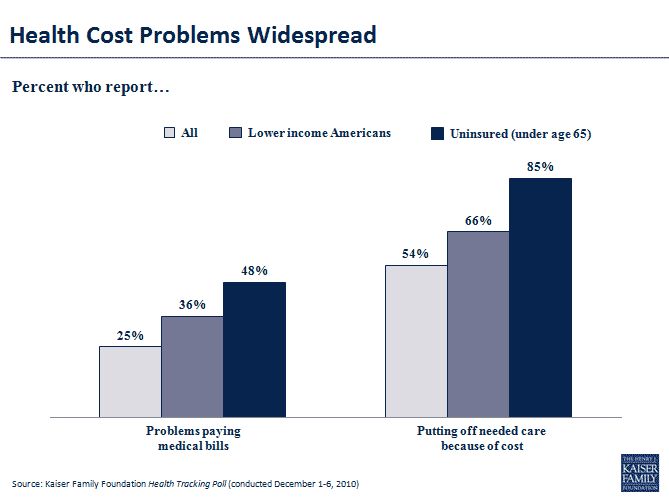
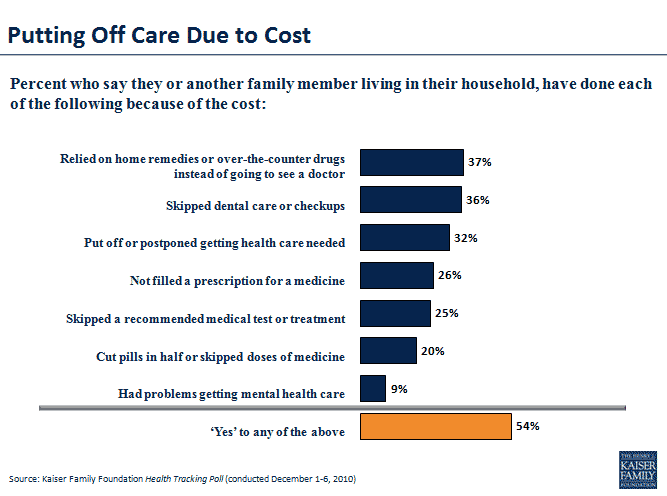
Well, a year later, as we move through another holiday season, much has changed, yet much also remains the same. Congress passed the Patient Protection and Affordable Care Act — spurred in part by reports of big increases in individual health insurance premiums — yet the country continues to debate the merits of the law. We are technically out of the recession, though that means little to the millions of Americans who are out of work or who continue to struggle with their health care bills. Our new tracking poll shows that twenty-five percent of the public, thirty-six percent of low-income people, and forty-eight percent of the uninsured report problems paying their health care bills over the past year. Fifty-four percent of the American people — and a whopping eighty-five percent of the uninsured — report putting off medical care they believe they need because of cost during the same period, including skipping recommended treatments and not filling prescriptions.
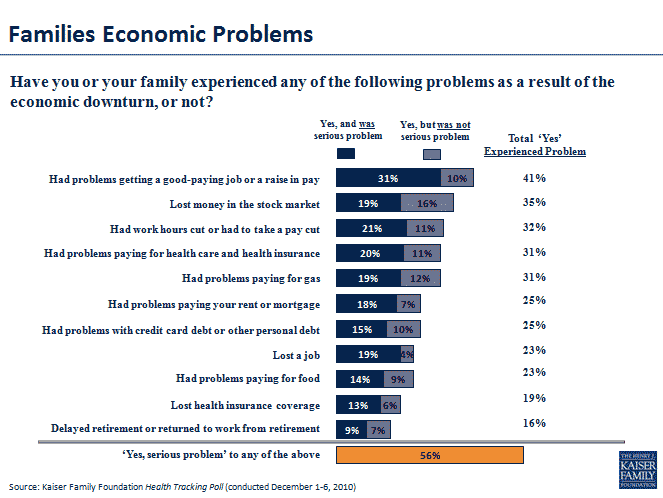
More than half of the American people report a “serious” economic problem, such as difficulty getting a decent job, losing money in the markets, taking a cut in pay, or problems paying for health care, gas, rent or the mortgage. More than half! Difficulty paying for health care ranks fourth on the list of “serious problems experienced as a result of the downturn”, behind job-related issues and losing money in the markets. You can see the data in these three charts:
Click on charts to enlarge.
The public’s concerns about paying their health care bills were the reason we had the health reform debate in the first place. And, as I wrote a year ago, this is also where the health reform message went off track. When average Americans could not easily connect the legislation to their everyday problems of paying bills and making ends meet, they became more susceptible to messages from opponents ready to define the legislation in ways that were scary to the public. However, I am not entirely sure that different messaging would have made a big difference. Views on health reform largely track partisan and ideological differences in the country, and proponents and opponents were always going to play to people’s emotions — whether about the insurance industry (proponents) or about government (opponents). But, helping people understand how the reform law affects their everyday lives might have made a difference at the margin during the debate. And it could continue to, since the law and its implementation obviously remain hotly contested. I’m not sure people understand the degree to which expansions in Medicaid and tax credits will help lower income and working people pay for health insurance. Of course, these changes aren’t scheduled to take effect until 2014.
In the meantime, new rules go into effect next year that require insurers to spend a minimum percentage of their premium revenue on medical care rather than administration and profits, or pay rebates to consumers. And many states are taking more aggressive action to try to hold down premium increases. Their authority and capacity varies from state-to-state, and their efforts are generally limited to the non-group and small employer markets, but several states have had success holding back premium increases (at least temporarily). When states reject proposed rate increases, either insurers or providers have to divide up a smaller pie. The ensuing struggle between the two plays out differently depending upon the relative market power each has in a particular state or region. It would, of course, be better to directly address the fundamental causes of rising health care costs than to limit premium increases, which is the cost control equivalent of plugging a broken steam pipe: the pressure continues to build. But our ability to do that is limited — in some cases by politics and in other cases by how little we as experts know about which delivery and payment reforms will bear fruit — and current efforts will take many years to pay off. In the meantime these efforts by the states err on the side of putting people first, and could meaningfully help some people and small businesses by trying to place reasonable limits on the premium increases they pay.
Whatever your view of the health reform law or of these new state regulatory efforts, our December survey shows that large numbers of people continue to struggle with health care costs and that lower income and uninsured people struggle most of all. In Washington and in health policy circles, debates about how to control health costs are often intensely ideological. The numbers reported in our polls show why people look at health care costs very differently from the combatants in these debates. They are struggling and just want some relief. I doubt they would care much whether the strategy was a liberal, conservative or middle of the road one if they believed it would help them pay their bills.
As 2010 draws to a close, the latest tracking poll from the Kaiser Family Foundation shows the public still divided in their views of the health reform law, a sentiment largely unchanged since the law’s enactment in March. Forty-two percent of Americans say they have a generally favorable view of the law, while 41 percent have a generally unfavorable view of it. As the weak economy continues, the survey finds that a significant number of people are struggling to stay afloat financially. One in four say their household has had trouble paying medical bills over the past year, and 54 percent say they have delayed needed medical care because of cost. Such problems are more prevalent among lower income and uninsured Americans, 36 percent and 48 percent of whom, respectively, report having trouble paying medical bills. Among the uninsured, 85 percent say they have put off needed care because of cost. Beyond health care, many people report having problems getting a good-paying job or a pay raise (41%); losing money in the stock market (35%); suffering cutbacks in pay or work hours (32%); having trouble paying their rent or mortgage (25%); losing a job (23%); and having problems paying for food (23%).
This brief examines efforts by the Chicago Public School system to use multiple strategies including data matching with the school lunch program, marketing and local organizing to target children for outreach and enrollment in public health insurance and other benefits.
It is the third brief in a Spotlight on Technology series profiling several states’ innovative applications of technology to Medicaid enrollment efforts. The series illustrates a range of approaches that states can adopt to improve their systems now and to prepare for the expansion of Medicaid under health reform.
The November 2010 tracking poll was conducted in the days following the mid-term election that resulted in major gains for Republicans, including a shift in control of the House of Representatives. The survey attempts to gauge what role health reform played in voters’ decisions, and to measure the current public mood about the health reform law.
The poll finds that voters say health care reform was a factor that influenced their vote, but not a dominant one. The economy/jobs was the factor mentioned by voters most often (29%), followed by party preference (25%) and views of the candidates themselves (21%). Health care ranked fourth at 17 percent. Those 17 percent of voters who named health care as one of their top voting factors were more likely than non-health care voters to back a Republican candidate for Congress (59% vs. 44%), and to say they have a “very unfavorable” view of the law (56% vs. 33%).
Looking ahead, Americans remain divided about what lawmakers should do, with 21 percent of the public favoring expansion of the health reform law, 19 percent wanting to leave it as is, a quarter wanting to repeal parts of the law, and 24 percent wanting the entire law repealed. Among mid-term voters, a majority (56%) would like to see the law repealed entirely or in part. Voters split sharply along partisan lines. Two-thirds of those who voted for Democratic candidates want the law expanded or left as is, while eight in 10 of those who voted Republican support full or partial repeal.
Several key provisions of health reform remain popular, even among those who support repeal of all or parts of the law. Majorities of supporters of repeal would like to keep tax credits for small businesses offering coverage; the prohibition on insurance companies denying coverage based on medical history or health condition; the gradual closing of the Medicare prescription drug “doughnut hole”; and financial subsidies to help low and moderate income Americans purchase coverage. By contrast, two-thirds of the general public support repealing the individual mandate, another key provision in the law.
The November poll is the latest in a series designed and analyzed by the Foundation’s public opinion research team.
This new analysis from the Kaiser Family Foundation examines the number of Medicare beneficiaries who will pay higher Part B or Part D premiums as a result of newly enacted provisions included the 2010 health reform law.
Part B Premiums. The health reform law modifies a requirement implemented in 2007 that upper-income Part B enrollees pay higher monthly Part B premiums. The change freezes the income thresholds that determine which Medicare Part B enrollees are required to pay the income-related Part B premium, at 2010 levels ($85,000 for individuals and $170,000 for couples). Until now, the income thresholds increased annually so that the higher premiums were paid by about 5 percent of the Medicare population.
Between 2011 and 2019, the share of Part B enrollees subject to the income-related Part B premium will rise from 5 percent to 14 percent (from 2.4 million enrollees in 2011 to 7.8 million enrollees in 2019), according to this analysis. Monthly Part B premiums will range from $161.50 to $369.10 per month in 2011 for those with incomes above the threshold, depending on income, while the standard Part B premium will be $115.40 per month in 2011.
Part D Premiums. The health reform law also imposes a new income-related premium for beneficiaries enrolled in Part D plans, applying the same fixed income thresholds that are applied to Part B premiums. The income-related Part D payments will be calculated based on the national average monthly Part D premium in a given year ($32.34 in 2011). The total amount that higher-income Part D enrollees pay will depend on the premium of the plan they select and their income.
Three percent of all Part D enrollees (1.2 million beneficiaries) will be subject to the new income-related Part D premium in 2011, rising to 9 percent (4.2 million beneficiaries) in 2019.
This analysis was conducted by researchers at the Kaiser Family Foundation and Actuarial Research Corporation.
New Commitments Respond to AIDS in America, Including:
NBA/WNBA Tips Off Campaign to Mobilize Fans & Fight Stigma
Walgreens Recognizes those Making a Difference; HIV/AIDS Informational Resources to be Distributed in More than 700 Health Centers Nationwide
PSAs Featuring those Living with HIV and Loved Ones Debut on Network TV, Join Growing Roster of Media Commitments
New Partnerships Reach Higher-Risk, Men Who Have Sex With Men
State/Local Health Departments, AIDS Organizations Lead Community Responses
On the eve of World AIDS Day (December 1st), Greater Than AIDS, a national movement supported by a broad coalition of public and private sector partners, announced significant new commitments in response to the AIDS crisis in America with a focus on those most affected by the disease. New commitments from the National Basketball Association (NBA) and Walgreens are added to those made by leading media, state and local health departments, community organizations, among others to increase knowledge and understanding about HIV/AIDS and confront the stigma that surrounds the disease.
“From the largest digital billboard in Times Square to the hardwood courts of the NBA and the WNBA, Greater Than AIDS partners are showing new leadership in stemming the spread of HIV,” said Drew Altman, President and CEO of the Kaiser Family Foundation, which provides strategic guidance and day-to-day management for Greater Than AIDS. He added, “This is an unprecedented collaboration of private and public sector partners united in response to a public health challenge.”
Phill Wilson, President and CEO of the Black AIDS Institute, co-founding Greater Than AIDS partner, commented, “Nearly 30 years since the first case of HIV was diagnosed, stigma remains a major barrier to prevention and treatment. Greater Than AIDS is about bringing us together as a community in a unified response.” On December 1st in Los Angeles, the Black AIDS Institute will host its 10th annual Heroes in the Struggle gala themed this year around Greater Than AIDS.
Among the announcements from Greater Than AIDS today:
NBA PARTNERSHIP: The NBA is joining Greater Than AIDS to mobilize NBA fans and local communities in response to AIDS in the United States and reduce the stigma associated with the disease. The campaign builds on the league’s longstanding tradition of supporting social causes, including global HIV/AIDS, as part of NBA Cares.
The campaign includes new television and radio public service ads (PSAs) featuring NBA/WNBA players, including Pau Gasol (Los Angeles Lakers), Al Horford (Atlanta Hawks), Russell Westbrook (Oklahoma City Thunder) and Candice Wiggins (Minnesota Lynx), whose father, former professional baseball player Alan Wiggins, died of AIDS in 1991. The PSAs, which debut across NBA media assets and other Greater Than AIDS media platforms this month, direct to a custom web portal for resources and more information at: http://www.greaterthan.org/nba
In addition, Greater Than AIDS is working with NBA teams across the league to initiate targeted activations, community events, and special “Greater Than AIDS” in-arena nights to bring attention to HIV/AIDS in priority markets, tipping off with a World AIDS Day game in Boston, where the Celtics will host the Portland Trailblazers. Additional team activations are scheduled in December and January.
“Joining with the Greater Than AIDS campaign underscores the NBA family’s longstanding commitment to address important social issues related to health and wellness,” said NBA Community Relations Vice President Todd Jacobson. “The league supports the fight against HIV/AIDS year-round in a variety of ways, including bringing awareness programs to youth from more than 100 countries and territories around the world, and we look forward to continuing these efforts around World AIDS Day.”
WALGREENS PARTNERSHIP: Walgreens, the nation’s largest drugstore chain with more than 7,500 drugstores, is teaming up with Greater Than AIDS to distribute HIV/AIDS informational resources and specialized HIV-related services at select Walgreens pharmacies in heavily affected communities. In partnership with Greater Than AIDS, participating Walgreens pharmacies will distribute jointly-branded informational materials and offer in-store promotions — including HIV screenings — over the next year. In June 2011 Walgreens will team up with Greater Than AIDS to support “HIV Take Action” Month with special promotions.
“We’re excited to partner with Greater Than AIDS to place more attention on the domestic AIDS crisis and slow the spread of this disease,” said Kermit Crawford, Walgreens president of pharmacy services. “At more than 200 locations around the country, our pharmacists are specially trained to care for patients with HIV. These locations also will play a large role in our effort with Greater Than AIDS to promote HIV/AIDS awareness and prevention.”
The Walgreens/Greater Than AIDS partnership kicks off with a World AIDS Day promotion at the Walgreens drugstore at One Times Square in New York City, including HIV messaging on the store’s digital billboard — the nation’s largest — that rises 341 feet above midtown Manhattan. At other times throughout the year, Walgreens’ digital billboards in Times Square and Las Vegas will post photos submitted by every day Americans that celebrate personal “deciding moments” in response to HIV/AIDS. Today, more than 200 Walgreens drugstores across America are debuting new signage and informational materials that carry a Greater Than AIDS message that will run throughout the month. All products encourage customers to learn more about HIV and ways they can be Greater than AIDS at: http://www.greaterthan.org/walgreens
MAJOR MEDIA PARTNERS UNITE IN SUPPORT OF AIDS: Today, Greater Than AIDS adds several major television partners — including FOX, CBS and NBC — to its growing roster of print, radio, outdoor, and online media partners. Since the campaign’s launch in 2009, an unprecedented coalition of media have joined together to support Greater Than AIDS. More than 10,000 outdoor postings have been provided by CBS Outdoor, Clear Channel Outdoor and BlueLine Media in 30 priority markets, and more than 11,000 radio PSAs airings (amounting to approximately 80 hours of airtime) have been placed by American Urban Radio Networks, CBS Radio, Clear Channel Urban and Gospel Radio, and Radio One stations. Leading monthlies, including EBONY, ESSENCE, HIV Plus, Uptown and Vibe, as well as the National Newspaper Publishers Association (NNPA), provide ongoing visibility to the campaign in the form of PSA placements and editorial coverage. To coincide with World AIDS Day, all five magazine partners are running full-page Greater Than AIDS PSAs and NNPA, also known as the Black Press of America, will highlight a Greater Than AIDS message on the mast head and in a letter from the editor in its newspapers throughout the week.
The addition of television partners provides a powerful new platform to reinforce campaign messages and mobilize communities. The campaign’s new TV PSAs complement an extensive outdoor, print and radio campaign that features individuals — including several who are living with the disease — sharing personal “Deciding Moments” that capture everyday opportunities to take a stand against HIV — to be “greater than” the disease. Since the campaign launched in September, thousands of Americans have been inspired to share their own “Deciding Moments” on the campaign’s website: http://www.greaterthan.org/decidingmoments.
MSM-FOCUSED MESSAGING: Greater Than AIDS announced today a targeted initiative to reach men who have sex with men (MSM), who represent more than half of all new HIV infections each year. Here Media — which owns and operates The Advocate, OUT, and HIV Plus magazines, here! TV, the world’s leading premium gay television network, and the popular social networking portal gay.com have joined Greater Than AIDS to help message to MSM about HIV/AIDS. Here Media has announced a major new commitment of contributed advertising and editorial content to reach gay and bisexual men with HIV information and resources. Early next year, the company will launch a new web portal that provides targeted content from Greater Than AIDS and the Here Media brands.
STATE/LOCAL GOVERNMENT AND COMMUNITY PARTNERSHIPS: Greater Than AIDS is working with state and local departments of health and community foundations to expand the reach of the campaign in hard hit areas, including through joint events and special promotions. Health departments in Florida, Georgia, Louisiana, Michigan, New Jersey, and Virginia have integrated Greater Than AIDS into statewide HIV/AIDS outreach efforts. Local health departments and community organizations in Chicago, Dallas, and Detroit — and in other markets across the country — are also working on targeted Greater Than AIDS efforts.
Across the country, dozens of major community organizations are incorporating Greater Than AIDS into their World AIDS Day activities. Some examples include: Howard University, University of Miami and University of Florida are hosting Greater Than AIDS events on campus with speakers from the “Deciding Moments” campaign and outreach materials to promote HIV testing. Houses of worship are also hosting testing events and delivering HIV awareness sermons, including Greater Than AIDS outreach materials in church bulletins and interfaith memorial gatherings in Raleigh, North Carolina and Philadelphia. MetroTeenAIDS, a major provider of HIV services in Washington, D.C., is using Greater Than AIDS materials for giveaways at their “Party for Prevention.” These local outreach efforts — and dozens more across America — reach audiences with face to face interventions, deepening the impact of the media messaging.
The NeedNext year marks 30 years since the first case of HIV was diagnosed. More than 1.1 million people in the United States are living with HIV today, and at least half a million more have died of AIDS. One in two of those infected with HIV today are Black Americans far surpassing any other racial or ethnic group. Men who have sex with men (MSM) of all races represent the most heavily affected group, and the only population for which HIV rates are on the rise again. HIV/AIDS is a deeply personal issue with 43 percent of all Americans today — and nearly 60 percent of Black Americans — now knowing someone who is living with or has died from the disease, for many a family member or close friend, according to a national survey on HIV/AIDS conducted by the Kaiser Family Foundation.HIV/AIDS is both preventable and treatable — early diagnosis and care helps those with the disease live longer and healthier lives. Yet, one in five Americans living with HIV today does not know it. The U.S. Centers for Disease Control & Prevention (CDC) identifies stigma as a major contributor to the spread of HIV, keeping people from seeking information, speaking openly, using protection, getting tested and treated and otherwise acting to protect themselves and those they love.
About Greater Than AIDSGreater Than AIDS is an unprecedented collaboration among a broad coalition of public and private sector partners united in response to the HIV/AIDS crisis in the United States, in particular among Black Americans and other disproportionately affected groups. Through a national media campaign and targeted community outreach, Greater Than AIDS aims to increase knowledge and understanding about HIV/AIDS and confront the stigma surrounding the disease. http://www.greaterthan.org
The Kaiser Family Foundation — a leader in health policy and communications — provides strategic direction and day-to-day management, as well as oversees the production of the media campaign. The Black AIDS Institute — a think tank exclusively focused on AIDS in Black America — provides leadership and expert guidance and directs community engagement. Greater Than AIDS is developed in support of Act Against AIDS, an effort by the U.S. Centers for Disease Control and Prevention (CDC) to refocus attention on the domestic epidemic. Additional, financial and substantive support is provided by the Elton John AIDS Foundation, Ford Foundation and MAC AIDS Fund, among others.
The Patient Protection and Affordable Care Act creates a new federal role to examine “unreasonable increases” in the premiums charged for certain individual and small group health plans. Under the health reform law, the U.S. Department of Health and Human Services (HHS) will work with state insurance departments to conduct an annual review of unreasonable rate increases, and insurers must provide justification for such increases to HHS and to the public via their websites. The new law also allots $250 million for state insurance departments to enhance their process for reviewing proposed rate increases.
This study examines the existing laws and regulations in all 50 states that currently govern the review process for health insurance rates. It finds dramatic variations across states, with some states having with no authority at all and others with robust authority to review and approve or disapprove rates before they are implemented. Researchers also interviewed insurance regulators in 10 states (Alaska, Connecticut, Colorado, Idaho, Louisiana, Maine, Ohio, Pennsylvania, South Carolina, and Wisconsin) to see how different levels of rate regulation work in practice.
The study was conducted by researchers at the Georgetown University Health Policy Institute and the Kaiser Family Foundation.
Based on the November Kaiser Health Tracking Poll, the latest KFF data note examines regional differences in Americans’ views of the new health reform law. Although many states in the American South and West stand to be disproportionately eligible for federal funds under the new law, the analysis finds that opinions of the law play out quite differently in these regions. Those living in the Western and Northeastern United States are more likely to view the law favorably, while those living in the South and Midwest tilt negatively in their views of the law. These regional differences suggest that, despite the fact that their states may stand to benefit from federal spending under the health reform law, recent actions by some Southern lawmakers, such as speaking out about changing or repealing the law, may be consistent with views of the majority of residents in those states.
Employer-provided health insurance is the primary source of insurance coverage in the United States, covering almost 160 million people.1 About 90 percent of the non-elderly privately-insured population is covered by employer-sponsored plans, meaning that employer decisions about whether to offer health benefits will influence overall rates of insurance coverage in the United States. Sixty-nine percent of all firms offered health benefits to their employees in 2010.2
It is well-known that highly-paid workers are more likely to receive employer health insurance offers.3 Many of the studies available on the salaries and fringe benefits of workers do not show how the salaries of a group of co-workers influence an employer’s decision to offer insurance. For example, even if most employees in a firm earn low wages, employers may still decide to offer health benefits if they also employ a few higher-wage workers in the same establishment who value this coverage. This paper addresses this question by showing how the offer of employer health insurance differs depending on the distribution of worker earnings within an establishment.
The analysis is based on data from the National Compensation Survey (NCS), which is a nationwide survey of labor costs in private and public establishments conducted quarterly by the Bureau of Labor Statistics (BLS).4 The figures below show establishment-level offer rates by the number of employees in the establishment and the overall wage level of the jobs that are sampled in the NCS. The figures include all employees in sampled jobs, including those that are seasonal, part-time, or temporary.5 The data are from 2005 through 2010. Employee earnings were adjusted for inflation, and are shown in 2010 dollars.6 Other details about the NCS and our analysis are available below in a methodological appendix.
Offer Rates and Worker Earnings
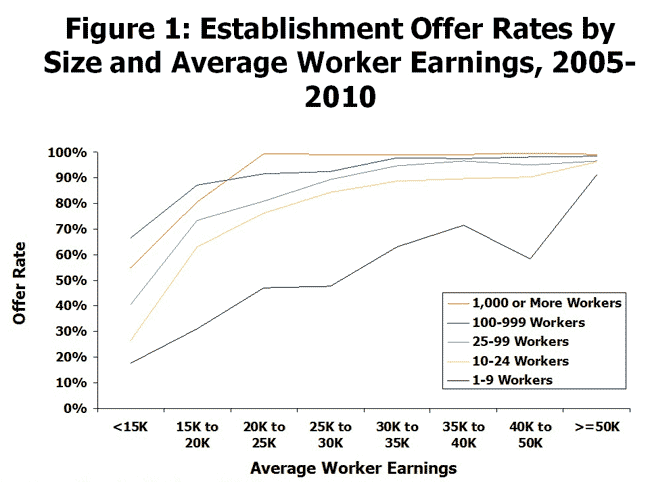
For each firm size category we studied, establishments with higher-wage workers were more likely to offer health benefits than establishments with lower-wage workers (Figure 1). For instance, in establishments with less than 10 employees, only 17 percent offered health insurance when the average employee wage was less than $15,000 per year, whereas 31 percent offered when the average was between $15,000 and $20,000, and 47 percent offered between $20,000 and $25,000. Even at higher average wage levels, establishments with less than 10 employees offered insurance much less often than larger establishments.
Larger establishments with low-wage workers generally offered health benefits more often than smaller establishments with low-wage workers (Figure 1). Fifty-five percent of establishments with 1,000 or more employees offered insurance when the average wage was less than $15,000, whereas 41 percent of establishments with 25 to 99 employees and 26 percent of establishments with 10 to 24 employees offered health benefits in the lowest-wage category.
Notes: Wages cutoffs are adjusted for inflation to 2010 dollars.Source: Kaiser Family Foundation calculations based on data from the National Compensation Survey, 2005-2010, conducted by the Bureau of Labor Statistics.
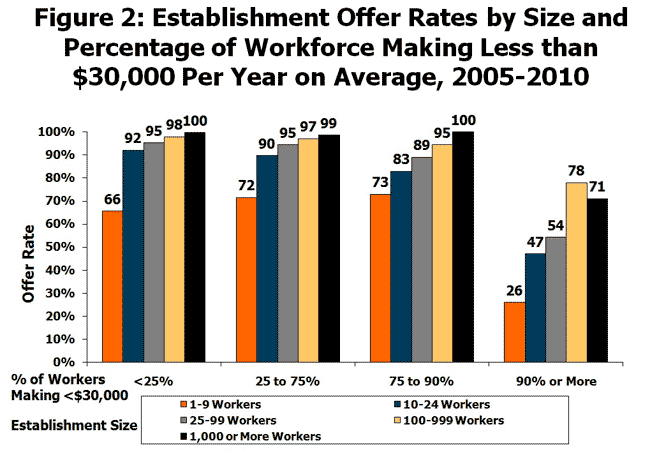
Next, we show establishment offer rates by establishment size and the percentage of workers who are in a job where workers make less than $30,000 on average (Figure 2). Viewing offer rates by an earnings cutoff is useful because it is a more explicit measure of the spread of workers’ salaries within an establishment, and, unlike averages, comparing earnings to wage cutoffs are not sensitive to particular groups of employees with very large or very small salaries.7
Establishments with high percentages of jobs where workers make less than $30,000, on average, were generally less likely to offer than other establishments (Figure 2). Offer rates were much higher for firms where less than 90 percent of employees made less than $30,000. In establishments where 90 percent or more of employees made less than $30,000, the offer rate varied between 26 and 78 percent, depending on establishment size. For most establishment size categories, there was a general progression from lower to higher offer rates, as the percentage making less than $30,000 decreased (moving from right to left in Figure 2).8
Notes: Wages cutoffs are adjusted for inflation to 2010 dollars.Source: Kaiser Family Foundation calculations based on data from the National Compensation Survey, 2005-2010, conducted by the Bureau of Labor Statistics.
Discussion
This paper shows that, on average, establishments with lower-wage employees offer health benefits less frequently. For smaller establishments, offer rates are particularly lower when wages are low.
Of course, other factors that were not considered here might explain the patterns we show for offer rates and worker earnings. For instance, this analysis did not distinguish between full and part-time workers, or between those that are permanent, temporary, or seasonal.
These findings nevertheless suggest that policymakers interested in encouraging employers to offer health benefits may wish to pay particular attention to how the distribution of wages within the establishment are related to whether employees are offered benefits. Smaller, low-wage establishments may require particular focus to encourage offering at a rate comparable to larger, high-wage businesses. Special subsidies or insurance products may be needed in order to encourage more offering among these businesses, or to help their workers seek out other means of insurance coverage.
This paper was prepared by Gary Claxton and Anthony Damico of the Kaiser Family Foundation’s Health Care Marketplace Project, and is an update to an analysis originally published in 2008. Paul Jacobs, who formerly worked in that division, helped to prepare the prior version.
Methodological Appendix
The Employment Cost Index (ECI) is a nationwide survey of labor costs in private and public establishments conducted quarterly by the Bureau of Labor Statistics (BLS). The ECI was developed in the mid-1970s to track changes in the costs of employment. Later modifications added data about health and other fringe benefits. Since about 2003, the ECI sample was merged with a broader group of surveys on employer benefits and payroll costs collectively referred to as the National Compensation Survey (NCS).9
ECI/NCS data are constructed by first choosing establishments in private industry and in state and local governments in the 50 states and the District of Columbia. Federal government, agriculture, and private household establishments are excluded from the sample. Then the survey collects information about the costs of employment for up to eight job classifications in each establishment that is surveyed. The data are aggregated to a job level, rather than collected for individual workers, so that continuity within establishments may be maintained over time as individual workers enter and exit the establishment. Jobs are sampled proportional to their prevalence at the establishment. For instance, in a plant which produces coal, separate wage and benefits costs for miners, engineers, and truck drivers may be obtained by the survey, whereas other jobs with fewer employees, such as for accountants and crane operators, may be excluded. The data we use are nevertheless representative of all workers in the United States as of June of each calendar year. The exhibits and calculations are presented on an establishment level and include all employees in sampled jobs, including those that are seasonal, part-time, or temporary. We use data each year from 2005 to 2010.
Because the data are collected from establishments, not firms, firm-level characteristics, e.g. firm size, are not available. The paper avoids the use of the term firm, although it uses the terms “employer” and “establishment” synonymously although they may not be equal.
The BLS provides survey weights which enable the researcher to calculate statistics which are representative of workers in the United States in a given year. An adjustment to these weights was made to correct for changes in the composition of industries and occupations in the United States over time. This adjustment allows for a more accurate comparison of figures over time, but only very marginally affected the results presented in this paper.
BLS researchers impute missing data for hourly values when respondents do not provide sufficient data to calculate them. 5.9 percent of observations were missing a response to the question of whether health insurance was offered to workers holding that particular job. Rather than impute a value for these observations, for all statistics, these observations were excluded from our sample. For average hours worked within a particular job, we did impute a value whenever a response was missing. The method we used was a regression imputation procedure which very closely approximated the mean and variance of the hours worked variable as originally reported by establishments.
The Kaiser Family Foundation obtained access to the ECI/NCS through an agreement with the BLS. All analyses were performed on site at the BLS headquarters in Washington D.C. from August to October of 2010 by Kaiser Family Foundation staff.
Notes:
1. Kaiser Commission on Medicaid and the Uninsured, “The Uninsured: A Primer,” Kaiser Family Foundation, October 2009. Available online at: http://www.kff.org/uninsured/7451.cfm.
2. Kaiser Family Foundation/Health Research and Educational Trust, “Employer Health Benefits 2010 Annual Survey,” September 2010. Available online at: http://ehbs.kff.org/.
3. This may be because workers with higher wages can more easily afford to pay more for such benefits, because they have higher marginal tax rates so they benefit more from the tax deduction for employer-paid health insurance premiums, or because they may value health coverage more than lower-wage workers for other reasons.
4. As part of the National Compensation Survey, the Bureau of Labor Statistics collects these data quarterly to develop the Employment Cost Index (ECI) which is designed to measure changes in compensation costs for the civilian workforce. Other details on how the statistics were derived from the ECI data are reported in the Methodological Appendix at the back of this report.
5. Excluding part-time workers would most likely increase the average wages within an establishment, and the percentage of workers with earnings in excess of $30,000. Since these establishments are also more likely to be the ones that do not offer benefits, the offer rates for some of the higher wage categories would be more likely to fall. NCS data did not allow us to exclude seasonal or temporary workers as distinct from part-time workers.
6. Because the annualized Consumer Price Index for 2010 was not available at the date of publication, all dollars are inflated to the CPI-U of August 2010.
7. The NCS initially collects wage data from individual workers, and then aggregates that data into average amounts for particular job classifications. (See Methodological Appendix for more details). The numbers shown in Figure 2 are offer rates by the percentage of an establishment’s sampled jobs which have average earnings less than the $30,000 cutoff. Comparing individual workers’ earnings to such a cutoff was not possible given data availability, but may have changed our results. The results also depend, obviously, on the choice of cutoff. The pattern we describe was consistent regardless of whether we used cutoffs of $20,000, $30,000, $40,000, or $50,000.
8. For establishments with less than 10 employees, offer rates were smaller for establishments with less than 75 percent making less than $30,000 (66 and 72 percent) than they were for those where between 75 and less than 90 percent made less than $30,000 (73 percent).
The latest Kaiser Health Tracking Poll assessed the role health reform played in voters’1 decisions in the midterm elections and the public’s overall mood towards the health reform law. This blog post focuses on a different group, people who say they are not registered or did not vote in last week’s election, and examines how their views on the health reform law differ from those that said they did vote.
As is usually the case, particularly in midterm elections, the survey found voters are more likely to be older, Republican, college-educated, and white, all of which we’ve found in past surveys to be associated with negative views on health reform. In contrast, non-voters are more likely to be younger, ‘pure independent’, less educated, and non-white.
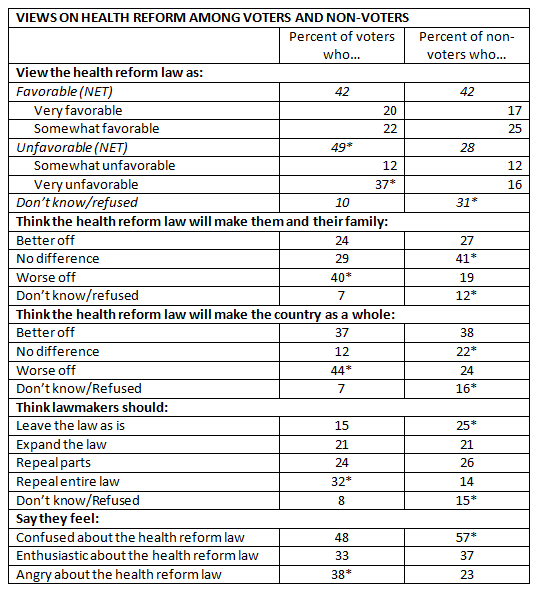
In general, non-voters have less strongly held views, express more confusion about the law, and are more likely to support the status quo than those who say they voted. Almost a third of non-voters declined to offer an opinion of the law (31 percent vs. 10 percent for voters) and a plurality say that it will have no impact on them personally (41 percent), whereas voters tilt more negatively toward the law (42 percent favorable, 49 percent unfavorable), with four in ten saying that they and the country will be worse off under the new law. The differences do not end there – more than half of non-voters feel ‘confused’ about the legislation (57 percent vs. 48 percent for voters) while voters are more likely to feel ‘angry’ (38 percent vs. 23 percent). Non-voters are also more likely to support leaving the law as it is or expanding it (46 percent vs. 36 percent of voters), as opposed to voters who are more likely to favor repealing all or parts of the law (56 percent vs. 40 percent of non-voters).
*indicates statistically significant difference between voters and non-voters
1In this survey, 59 percent of the public overall reported voting in the midterm election, which is much higher than the estimated 41.5 percent of the voting-eligible population that actually turned out to vote. Vote over-reporting is common in public opinion surveys, and is a particular concern for data quality if one party’s supporters over-report at higher rates than the other party’s supporters. The percent who report voting for the Democratic and Republican candidates in this survey (47 percent and 51 percent, respectively) are close to the current estimates of the national vote count of 45 percent Democrat, 52 percent Republican.