Pulling It Together: Predictions

Published: May 20, 2011

I usually don’t make predictions, unless they are backed up by the kind of statistical modeling we often produce.  But here are three predictions I am confident about that form the basis of this latest column.

GROUP HEALTH INSURANCE PREMIUMS WILL CONTINUE TO RISE AT HISTORICALLY MODERATE LEVELS, AT LEAST FOR THE NEXT FEW YEARS.  One reason for this is the lingering effect of the recession.  Employers will have little trouble attracting workers in the current economy without improving health benefits.  The other reason is the continued growth of high deductible health plans, which are holding down premium increases as employers switch to cheaper plans with higher cost-sharing, and also causing consumers to delay and forego care.  The steady growth of high deductible health insurance is changing the face of health coverage in the country and likely impacting utilization.  While attention is focused on Accountable Care Organizations and other small scale experiments and pilots in delivery and payment reform, high deductible health insurance is the default national cost containment strategy for health we don’t seem to know we have.

Last year employer premiums rose a very modest three percent; I expect a similar increase this year, far below the double digit increases in the group market we became accustomed to not so many years ago (the highest recorded increase was 18.9% in 1989).  Our comprehensive employer health benefits survey, which we put out every September, will give us an indication if this prediction is on track.  Keep in mind, even moderate increases in premiums by historical standards can be a serious burden for employers and employees when they are rising faster than inflation and much faster than wages.  For workers the concept of a “moderate increase” has little meaning if their overall out of pocket costs continue to go up and their incomes remain flat.

The smaller non-group market is, of course, an entirely different story.  In the individual market increases of 20% or more are not uncommon.  One claim is that this is largely because the recession drove healthier workers from the market leaving sicker and costlier ones behind and driving up rates.  There are no good independent data to substantiate this assertion.  Whatever the explanation, the practical effect is a market that is out of control and increasingly unaffordable for the roughly 14 million people who need to rely on it at any one time.

THE RETURN OF TIGHTER MANAGED CARE.  Recently in my home state of Massachusetts, reports surfaced about Blue Cross Blue Shield offering a more affordable insurance product by contracting selectively with less expensive community hospitals, requiring patients to pay more if they want to go to the state’s renowned and powerful major academic centers.  Other insurers in the state have also introduced tiered network plans that have higher patient cost-sharing for more expensive hospitals or exclude them altogether.  In the mid and late nineties, in what was called “the managed care backlash,” the American people revolted against tighter forms of managed care with limited provider networks and tough utilization review.  Looser forms of PPOs became the dominant mode for delivering health insurance in the country as a result.  Anecdotal evidence from around the country suggests the Massachusetts plan may be the canary in the coal mine.  What was not palatable in the late nineties may be more palatable today as people and employers accept tighter managed care as a less onerous alternative to ever increasing deductibles and cost-sharing.  Faced with higher and higher out of pocket payments, the public may be willing to accept limitations on what doctors they can see and which hospitals they can go to as well as stricter review of what services they use.  For many, compromising on provider choice and utilization review will be the lesser evil compared with a $5,000 deductible.

MEDICAID BLOCK GRANT: FUNDING CUT TRUMPS FLEXIBILITY.  States are all for greater flexibility when it comes to Medicaid. And they like the idea of block grants when they bring them more federal funding, as happened with the Medicaid block grant secured by the state of Rhode Island through a federal waiver.  But the block grant proposal adopted as part of the House budget framework reduces federal Medicaid matching payments to the states by $1.4 trillion over its first ten years, both by instituting a Medicaid block grant and repealing the Affordable Care Act. The effect of these reductions would vary by state but in every state they are significant, ranging from a 25% reduction in Washington to a 44% reduction in Florida.  A recent analysis by Kaiser and the Urban Institute shows that 31-44 million people could lose Medicaid coverage as a result of these reductions in federal funding, with most becoming uninsured. There could be as much as a one third reduction in Medicaid payments to hospitals over the ten year period. These projections are based on assumptions about likely state responses to reduced federal funding of this magnitude. For sake of argument, assume the study is off by as much as half (there is no reason to believe it is off at all); millions of people would still lose coverage. The study also looks at the impact of the block grant alone, uncoupled from repeal of the Affordable Care Act. This could mean a still sizeable loss in Medicaid coverage of 14-27 million people and $750 billion in federal funding to the states over ten years.

As a former state human services commissioner who oversaw a Medicaid program for a Republican governor, it certainly seems to me that consequences such as these will be too severe even for conservative governors and state legislators to accept. When their voices are heard in Washington the Medicaid discussion will move on to other ways to change Medicaid and reduce spending. Already battle lines have formed around new Medicaid issues, most notably, the proposal to repeal the so-called state “maintenance of effort” requirement, which would give states flexibility to make changes and cuts in Medicaid but potentially undermine the goal of expanding coverage. States will also turn to the federal waiver process to try to gain flexibility to make the changes they want to make in Medicaid without having to absorb big funding cuts from Washington. Several states are gearing up now to submit waiver proposals to HHS.

These three predictions are a comment on the times.  We have seen big health policy debates before but seldom has so much been up for grabs and in flux at the same time: health reform, Medicare, Medicaid, and the insurance and delivery systems themselves.  While the most politically charged issues – health reform and Medicare – get the greatest attention, potential changes to Medicaid and beneath the radar changes in the insurance system could have equal or even greater consequences for people.

News Release

A Medicaid Block Grant Would Reduce Federal Spending But Trigger Substantial Cuts in Medicaid Coverage in the States That Would Increase the Uninsured

Published: May 10, 2011

NEWS RELEASEMay 10, 2011

New State-By-State Analysis Shows House Budget Plan For Medicaid Would Reduce Enrollment By Tens of Millions Of People And Cut Funding For Hospitals And Other Medicaid Services

WASHINGTON, D.C. — Converting Medicaid into a block grant and repealing the health reform law as adopted by the House last month in a party-line vote would trigger major reductions in program spending and enrollment compared to current projections, a shift with big implications for states, hospitals and tens of millions of low-income Americans who likely would become uninsured, according to an analysis released today by the Kaiser Family Foundation’s Commission on Medicaid and the Uninsured.

Under the House Budget Plan, advanced by House Budget Committee Chairman Paul Ryan, projected federal spending on Medicaid for the period 2012 to 2021 would fall by $1.4 trillion, a 34 percent decline. In 2021, the end of the typical 10-year budget window used by Congress, states would receive $243 billion less annually in federal Medicaid funding than they would under current law, a 44 percent reduction, as shown in Figure 1. The plan’s two-pronged approach would curb Medicaid spending and enrollment by eliminating the Patient Protection and Affordable Care Act (ACA) and its major Medicaid expansion scheduled to begin in 2014, and by capping the amount of federal funding for Medicaid through a block grant.

051011_02kcmu

According to the new analysis of the plan conducted by researchers at the Urban Institute working with analysts at the Foundation, total federal Medicaid spending reductions over the next decade relative to current law would range from a 26 percent drop in Washington, Vermont and Minnesota, to 41 percent declines Oregon, Georgia and Colorado and a 44 percent decrease in Florida. The analysis also finds that hospitals could see their Medicaid payments fall by as much as 38 percent, relative to current projections, in 2021.

“Under the House Budget Plan, the Medicaid block grant would reduce and cap federal Medicaid spending, substantially reducing states’ ability to provide coverage to low-income Americans,” said Diane Rowland, Executive Vice President of the Foundation and Executive Director of the Kaiser Commission on Medicaid and the Uninsured. “The repeal of the ACA combined with the adoption of the Medicaid block grant would add millions more to the number of uninsured Americans and compromise Medicaid’s role as the health safety net in the next recession.”

The effect on enrollment in state Medicaid programs could vary widely. Under the House Budget Plan, between 31 million and 44 million fewer people would have Medicaid coverage relative to expected enrollment under current law, the new analysis finds, after examining three possible scenarios using different assumptions about how states might respond to lower federal funding. Most of those people, given their low incomes and few options for other coverage, would end up uninsured.

The House Budget Plan comes at a time of growing concern about the rising federal budget deficit. Under the current system, eligible low-income children and parents, people with disabilities and older Americans living in nursing homes are entitled to Medicaid coverage and states are guaranteed federal matching payments for this coverage with no cap. Under the block grant system in the plan, there would be no individual entitlement and federal funding would not be open-ended. Starting in 2013, states would get a fixed amount of federal money based on a formula rather than actual costs. That amount would increase annually with population growth and inflation and states could have more authority to cut back on eligibility levels or freeze enrollment.

Impact on enrollment

Because Medicaid is financed jointly by the states and the federal government, the impact of the House Budget Plan on program enrollment would depend in part on the spending and policy choices that states make in the face of diminished federal funding. The analysis examines three possible scenarios for state responses to the block grant which would produce decreases in Medicaid enrollment relative to current projections ranging from 31 million people to 44 million people nationally, as shown in Figure 2. Between 14 million and 27 million low income people would lose coverage due to the implementation of the block grant alone, the analysis finds.

051011_01kcmu

In terms of state-level impacts, one scenario, for instance, finds estimated Medicaid enrollment reductions relative to current projections ranging from 32 percent in Vermont to 56 percent in Oregon. To forestall these enrollment cuts, states would need to increase state spending by 45 percent to 71 percent to offset losses in federal spending, the analysis finds.

Impact on hospitals

Across the country, health centers, hospitals and safety-net facilities that serve low-income and uninsured people rely heavily on Medicaid revenues. By 2021, hospitals could see reductions in Medicaid funding of between 31 percent and 38 percent annually, or as much as $84.3 billion, under the House Budget Plan compared with projected funding under current law. The reductions would come at a time when millions more people would lack coverage, increasing the potential demand for uncompensated hospital care.

The full analysis, including an in-depth discussion of methodology and state-by-state data tables, is available online.

The Kaiser Family Foundation is a non-profit private operating foundation, based in Menlo Park, California, dedicated to producing and communicating the best possible information and analysis on health issues.

The Kaiser Commission on Medicaid and the Uninsured provides information and analysis on health care coverage and access for the low-income population, with a special focus on Medicaid’s role and coverage of the uninsured. Begun in 1991 and based in the Kaiser Family Foundation’s Washington, D.C. office, the Commission is the largest operating program of the Foundation. The Commission’s work is conducted by Foundation staff under the guidance of a bipartisan group of national leaders and experts in health care and public policy.

Medicaid Financing Issues: Provider Taxes

Published: May 2, 2011

Current law allows states to use revenue from provider taxes to help fund the state share of spending on Medicaid, a program that is jointly financed by the states and the federal government. Almost all states have at least one provider tax in place. This issue brief reviews the use of provider taxes by states as a mechanism for financing the state share of Medicaid spending. It also explores the implications of recent proposed changes in the federal rules that govern how states may design their provider tax structures.

Issue Brief (.pdf)

Kaiser Media Fellowships 2011 Site Visits

Published: May 2, 2011
clear.gif
clear.gif
clear.gif
clear.gif

Kaiser Media Fellowships 2011 California Site Visits

The first site visit of 2011 focused on the implementation of the Affordable Care Act (ACA) in California. In May 2011, journalists with a strong focus on health policy, state health reform, and/or California-specific policy issues were invited to participate in a week-long program. Based initially in San Francisco and later in Sacramento, the program offered journalists the opportunity to meet with a variety of stakeholders concerned with the implementation of health reform, including officials from the California Health and Human Services Agency, health policy experts, physicians, community clinic staff members and legislative staff. The program focused on a range of issues including the establishment of the California health benefit exchange, the state’s “Bridge to Reform” 1115 Medicaid Demonstration Waiver, Healthy San Francisco, initiatives to improve the delivery of health care and reduce medical costs, and projects addressing physician shortages in the Medicaid program.

Agenda

The Foundation has a fact sheet from the Kaiser Commission on Medicaid and the Uninsured that compares and contrasts key provisions of the California and Texas Section 1115 Medicaid demonstration waivers, while two other fact sheets summarize the health care landscape in Texas and California, including data on demographics, population health, the uninsured and the state Medicaid program. Also available are several existing resources on the two states and Section 1115 Medicaid demonstration waivers, including an issue brief that provides a focused overview of California’s waiver and another paper that examines key questions about Section 1115 Medicaid demonstration waivers more generally.

2011 Kaiser Media Fellowships Site Visit Participants

Sarah Kliff, Politico

“California hits $25B pothole on way to health-care reform.” Politico, May 10, 2011.“California Dispatch: State Reviews Medicaid Cuts with HHS” Politico Pulse, May 5, 2011.“Commissioner Jones: Go Big on Essential Benefits.” Politico Pulse, May 5, 2011.“Healthy San Francisco Enrollment to Drop by Half.” Politico Pulse, May 4, 2011.“ACA will reshape universal coverage.” PoliticoPro, May 4, 2011. (subscription required).“The Firefighter Will See You Now.” Politico Pulse, May 4, 2011.“Belshe: ‘Level 2 or Bust.'” Politico Pulse, May 3, 2011.“Kaiser Permanente Sees Big Under 26 Uptake.” Politico Pulse, May 3, 2011.“Is California still leading health reform?” PoliticoPro, May 9, 2011. (subscription required)“Pulling Back the Curtain.” Politico Pulse, May 6, 2011“Analysts: Insurance biz booms under ACA.” PoliticoPro, May 3, 2011. (subscription required).

Barbara Feder Ostrov, ReportingonHealth.org, USC Annenberg School for Communication & Journalism

“2014 Is Coming Sooner Than You Think: New Ideas for Reporting on Health Reform’s Rollout.” ReportingonHealth.org, May 9, 2011.“Your Safety-Net Hospital and Health Reform: Questions to Ask Now.” Reportingonhealth.org, May 17, 2011.

Kenny Goldberg, KPBS

“Is Affordable Healthcare Within Reach?” KPBS, May 18, 2011.“County Launches New Health Program For Uninsured Adults.” KPBS, May 26, 2011.

Sarah Varney, KQED

“Medi-Cal Moving to Managed Care Model.” The California Report, KQED, May 31, 2011.“Challenging ‘Unreasonable’ Insurance Hikes.” The California Report, KQED May 9, 2011.

Christopher Weaver, Kaiser Health News

“Medicaid Managed Care Expands In California As State Adds 1 Million Seniors And Disabled.” Kaiser Health News, June 2, 2011.

Jonathan Cohn, The New Republic

“California Dreaming.” The New Republic, June 4, 2011.Flu Shots in the Firehouse.The New Republic, January 31, 2013.

Jenny Gold, Kaiser Health News

“Enthusiasm Rises Among Med Students For Primary Care—The KHN Interview.” Kaiser Health News, June 15, 2011.

Amy Lotven, Inside Health Policy

“States Move To Create Health Reform’s Lesser-Known Basic Health Plans.” Inside Health Policy. May 9, 2011. “Sebelius Mum On CA Medicaid Decision, Says Rates And Access Closely Linked.” Inside Health Policy, May 9, 2011.“Lawmakers Revive Call For Federal Rate Review; CA Bill Could Turn Into To Ballot Measure.” Inside Health Policy, May 11, 2011.“California holds 2nd exchange board meeting, eyes level 1 grant.” Inside Health Policy, May 11, 2011.

clear.gif
clear.gif
clear.gif
clear.gif
clear.gif
clear.gif

Uninsured Are Less Satisfied

Published: May 2, 2011

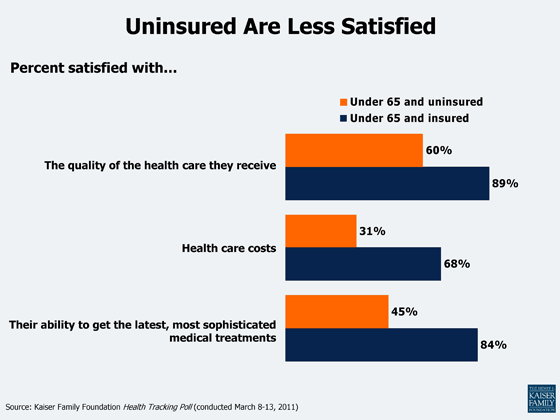
Given that people without health insurance have no protection from health care costs, it is not surprising that they are much less likely to say they are satisfied with costs than those with insurance (31 percent vs. 68 percent Majorities of both the uninsured and insured report being satisfied with the quality of care they receive, but the differences are still striking. Six in ten of the uninsured say they are satisfied with their quality of care, compared to almost nine in ten of those with insurance. For both cost and quality, the uninsured are about half as likely as the insured to report they are “very satisfied.” Additionally, the uninsured are less likely to report they are satisfied in their ability to access the latest, most sophisticated medical treatments than the insured (45 percent vs. 84 percent).

Uninsured Are Less Satisfied
Poll Finding

Kaiser Health Tracking Poll — May 2011

Published: May 1, 2011

Most Americans oppose the idea of converting Medicaid to block grant financing to reduce the federal deficit, and more than half want to see no reductions at all in Medicaid spending. One in five adults has received Medicaid benefits over time, and for most, experiences were positive, although one third of them report having had problems finding a doctor.

The findings come at a time of intense public debate in Washington about the future of entitlement programs such as Medicare and Medicaid as policymakers attempt to address rising public concerns about the federal deficit. While conventional wisdom and recent public opinion polling has suggested that dramatic changes in Medicare would be politically unpopular, the poll findings illustrate that major alterations to Medicaid also could strike a negative chord with many Americans.

Support for maintaining the current program may be due at least in part to the public’s personal connections to Medicaid and a strong sense of the program’s importance. About half of Americans say they or a friend or family member has received Medicaid assistance at some point, and a similar share say the program is important to their family.

The May poll is the latest in a series designed and analyzed by the Foundation’s public opinion research team.

News Release

Findings (.pdf)

Chartpack (.pdf)

Toplines (.pdf)

Medicaid’s Role for Hispanic Americans

Published: May 1, 2011

This fact sheet examines Medicaid’s role for Hispanic Americans. It includes data on Medicaid’s coverage of Hispanic Americans and the program’s impact on their access to care, as well as the impacts of the recent recession and the coming expansion of Medicaid under health reform on enrollment in Medicaid among Hispanic Americans. The fact sheet also has a chart showing state-by-state data on health insurance coverage of Hispanic Americans.

Fact Sheet (.pdf)

Medicaid’s Role for Black Americans

Published: May 1, 2011

This fact sheet examines Medicaid’s role for black Americans. It includes data on Medicaid’s coverage of black Americans and the program’s impact on their access to care, as well as the impacts of the recent recession and the coming expansion of Medicaid under health reform on enrollment in Medicaid among black Americans. The fact sheet also has a chart showing state-by-state data on health insurance coverage of black Americans.

Fact Sheet (.pdf)

Dual Eligibles: Medicaid’s Role for Low-Income Medicare Beneficiaries

Published: May 1, 2011

This updated fact sheet describes the nearly 8.9 million “dual eligibles,” the low-income elderly and persons with disabilities who are enrolled in both Medicare and Medicaid, why this population needs Medicaid, what services they receive from Medicaid, and what the new health reform law may mean for them.

Fact Sheet (.pdf)

Women’s Health Care Chartbook: Key Findings From the Kaiser Women’s Health Survey

Published: May 1, 2011

The Women’s Health Care Chartbook presents findings from a national survey of women ages 18 to 64 and provides a look at the experience of women in the health care system. The chartbook includes data on insurance coverage, affordability of and access to care, use of health care services, prevention, and family health. The survey was conducted in 2008 and builds on data collected during previous women’s health surveys conducted by the Kaiser Family Foundation in 2001 and 2004.

Chartbook (.pdf)