KFF designs, conducts and analyzes original public opinion and survey research on Americans’ attitudes, knowledge, and experiences with the health care system to help amplify the public’s voice in major national debates.
After taking a negative turn in October, the public’s overall views on the Patient Protection and Affordable Care Act (ACA) returned to a more mixed status this month. Still, Americans remain somewhat more likely to have an unfavorable view of the law (44 percent) than a favorable one (37 percent).
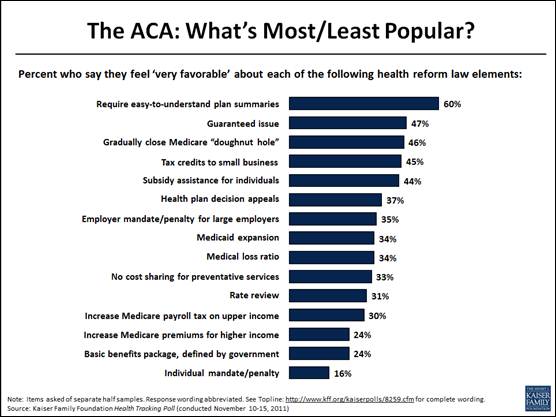
The Kaiser Family Foundation’s November Health Tracking Poll also finds that individual elements of the law are viewed favorably by a majority of the public. The law’s most popular element, viewed favorably by more than eight in ten and “very” favorably by six in ten, is the requirement that health plans provide easy-to-understand benefit summaries. Also extremely popular are provisions that would award tax credits for small businesses and provide subsidies to help some individuals buy coverage, as well as the provision that would gradually close the Medicare doughnut hole and the “guaranteed issue” requirement that prohibits health plans from denying coverage based on pre-existing conditions. Far and away the least popular element of the ACA is the individual mandate, the requirement that individuals obtain health insurance or pay a fine. More than six in ten Americans view this provision unfavorably, including more than four in ten who have a “very” unfavorable view.
The November poll also measured Americans’ familiarity with various elements of the law, which groups they expect to be helped or harmed, and their impressions of news media coverage of the ACA.
This brief examines how Medicare Part B premiums for many beneficiaries are affected by the annual cost-of-living adjustment (COLA) for Social Security benefits. Based on the most recent projections from the Medicare and Social Security Trustees, the brief examines the interactions between the two programs that resulted in some Medicare beneficiaries paying significantly higher Part B premiums in 2010 and 2011 when there was no Social Security COLA, followed by a drop in premiums in 2012.
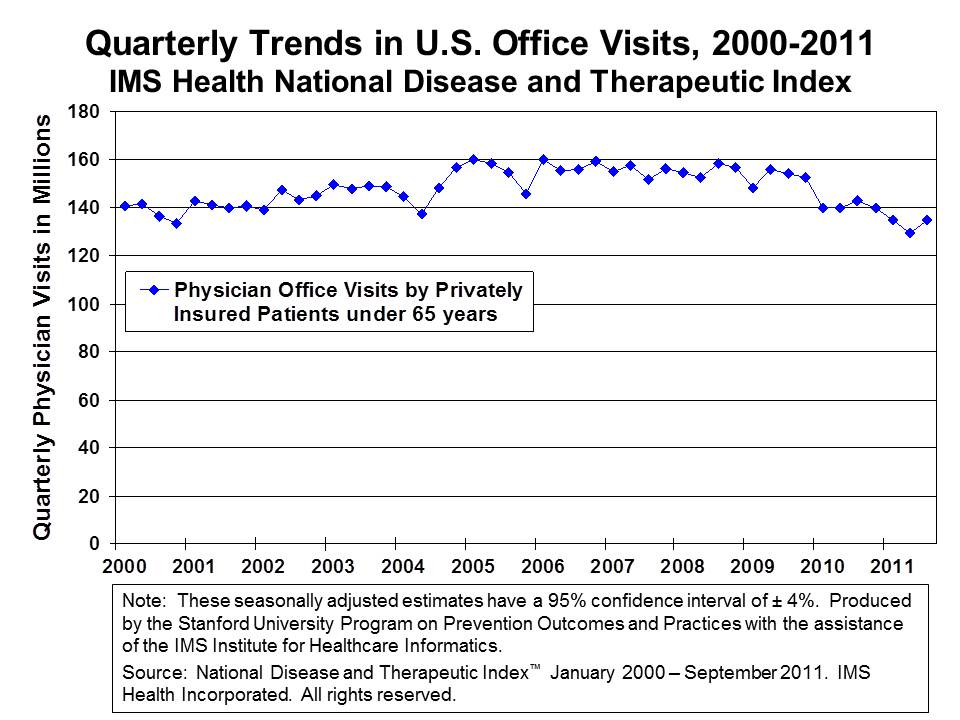
Various market watchers have reported that the use of health care services has not been growing recently as it had in the past, resulting in lower than expected health care claims for people with private insurance and higher than expected earnings for insurers. A look at physician office visits by nonelderly patients with private insurance over the past decade illustrates the change in the use of services (See the chart below). (This analysis was prepared for the Kaiser Family Foundation by researchers at Stanford University using physician utilization data collected by IMS Health.)
Although the total number of visits jumps around somewhat from quarter to quarter, the analysis shows generally that the quarterly number of office visits by privately insured patients increased from about 140 million visits per quarter at the beginning of the decade to 160 million visits early in 2005. The number of non-elderly people with private insurance changed hardly at all over that period, increasing by about 1% according to our analysis of the National Health Interview survey. So, the increase was driven by people with private insurance going to the doctor more often.
From 2005 through 2008, the trend in physician visits was largely flat as the number of people with private insurance dropped slightly (about 1.7%).
Then, as the economic downturn deepened, the number of physician visits among the privately insured started a downward trend, which has continued even as the recession technically ended in June of 2009. The number of visits fell to a low of 129 million in the 2nd quarter of 2011, a decline of 17% from 156 million visits in the 2nd quarter of 2009. The number of people with private insurance declined over this period as well as many people lost their jobs and their insurance along with them. But, the decline in the number of people with private insurance is much smaller than the decline in visits – about 2% between 2009 and 2010. And it looks like private insurance enrollment may be increasing into 2011.
Even people who are insured are going to the doctor less. Likely, consumers are reacting to the severe economic downturn and significant job-loss which has defined the economy over the last several years by cutting back on health spending. Higher deductibles, copays and coinsurance increase the cost of care, and their impact may be magnified in these tough economic times. The Kaiser/HRET Annual Survey of Employer Health Benefits finds that the share of workers covered on the job by plans with a deductible of at least $1,000 grew from 18% in 2008 to 31% this year. In some cases people may be foregoing unnecessary care, meaning that health costs are reduced with little or no effect on health. In other cases people are likely cutting back on necessary care, potentially endangering patients’ longer term health and leading to higher costs over time.
The drop in medical service use poses somewhat of a dilemma for insurers, their customers, and regulators. As the economy recovers, service use will probably begin to increase, but when that will happen and by how much it will increase will be difficult to predict. The data show a slight uptick in physician use by the privately insured in the 3rd quarter of 2011, but the change was not statistically significant and there’s no way of knowing whether it’s the beginning of a trend. It could also simply be that more people are now insured. Insurers will want to protect themselves against an upswing in service use by building higher trends into their rate projections, but purchasers and regulators may push back, claiming that insurer projections are not in sync with recent experience. In fact, reports suggest that insurers have profited this year after raising premiums with the expectation of higher utilization that never materialized.
Two provisions of the Affordable Care Act may come into play here. States and the federal government are now reviewing premium increases of more than 10% to determine if they are justified. This process provides some insights into what insurers are assuming for the future, and an opportunity for regulators to challenge those assumptions. And, insurers are now required to give small businesses and individuals rebates if their medical loss ratios (the share of premium dollars going to medical claims) are below certain thresholds. If insurers project bigger increases in health care use than actually occur, they may find themselves giving money back to consumers.
—Gary Claxton and Larry Levitt. Analysis of the physician utilization data was prepared for Kaiser by Randall Stafford and Laurence Baker of Stanford University.
The Kaiser Media Fellows — journalists with a strong focus on health policy and state health reform — were invited to participate in a week-long program focused on health care and the implementation of the Affordable Care Act in Texas. Based in Austin and Dallas, the site visits offered journalists the opportunity to meet with a variety of experts and stakeholders. Journalists met with state health officials, health policy analysts, academics, community clinic staff members and legislative staff. The program focused on a range of issues including the demographics in Texas and their implication for health care, Medicaid in Texas and the 1115 Waiver, and access to health care and the performance of health care safety net systems in Texas.
The Foundation has a fact sheet from the Kaiser Commission on Medicaid and the Uninsured that compares and contrasts key provisions of the California and Texas Section 1115 Medicaid demonstration waivers, while two other fact sheets summarize the health care landscape in Texas and California, including data on demographics, population health, the uninsured and the state Medicaid program. Also available are several existing resources on the two states and Section 1115 Medicaid demonstration waivers, including an issue brief that provides a focused overview of California’s waiver and another paper that examines key questions about Section 1115 Medicaid demonstration waivers more generally.
2011 Kaiser Media Fellowships Texas Site Visit Participants
The November Health Tracking Poll takes a closer look at public opinion and knowledge about specific provisions of the Patient Protection and Affordable Care Act (ACA). Findings include:
After taking a negative turn in October, the public’s overall views on the ACA returned to a more mixed status this month. Still, Americans remain somewhat more likely to have an unfavorable view of the law (44%) than a favorable one (37%).
The survey also finds that individual elements of the law are viewed favorably by a majority of the public. The law’s most popular element, viewed favorably by more than eight in ten (84%) and “very” favorably by six in ten, is the requirement that health plans provide easy-to-understand benefit summaries. Also extremely popular are provisions that would award tax credits for small businesses (80% favorable, including 45% very favorable) and provide subsidies to help some individuals buy coverage (75% favorable, including 44% very favorable), as well as the provision that would gradually close the Medicare doughnut hole (74% favorable, including 46% very favorable) and the “guaranteed issue” requirement that prohibits health plans from denying coverage based on pre-existing conditions (67% favorable, including 47% “very” favorable).
Despite strongly partisan reaction to the law overall, many of its provisions are popular among Democrats, Republicans, and independents alike. The elements of the law with the highest levels of bipartisan support include requiring plans to publish easy-to-understand summaries (88% of Democrats, 87% of independents, and 76% of Republicans favorable), tax credits to small businesses (88%, 77%, and 73%, respectively), and allowing individuals to appeal their health plans’ decisions to an independent reviewer (82%, 70%, and 70%, respectively).
Far and away the least popular element of the health reform law is the individual mandate, the requirement that individuals obtain health insurance or pay a fine. More than six in ten (63%) Americans view this provision unfavorably, including more than four in ten (43%) who have a “very” unfavorable view.
More than a year and half after health reform was enacted, there is much about the law that the public still does not know, including some of its more popular elements. For example, about four in ten (42%) are unaware of the law’s most popular provision, requiring health plans to produce straightforward benefits summaries. The least well-known provisions — eliminating cost-sharing for preventive services and the medical loss ratio requirement, which fewer than four in ten recognize as being included in the law — are each favored by at least six in ten people, including a third who see each as “very” favorable.
Substantial shares also incorrectly believe the law does two specific things that it does not. For instance, more than half (56%) think the law includes a new government-run insurance plan to be offered along with private plans (while another 13% don’t know if the law does this). And a third (35%) think the law allows a government panel to make decisions about end-of-life care for people on Medicare (with another 12% saying they don’t know). Those numbers have changed little in the past year.
The November poll is the latest in a series designed and analyzed by the Foundation’s public opinion research team.
This brief highlights trends in the Medicare Advantage marketplace, including the choices available to Medicare beneficiaries in 2012, premium levels and other plan characteristics. The brief was authored by researchers at Mathematica Policy Research and the Kaiser Family Foundation.
In June 2011, the Kaiser Family Foundation released its eighth major survey of Americans on HIV/AIDS to examine national public opinion toward HIV/AIDS. This Data Note is a closer examination of the results on HIV‐related attitudes and perceptions among the group of adults living in metropolitan areas hard hit by HIV/AIDS, and how their views compare with those of people living in other areas of the country.
This report looks at the star ratings that have been used for many years to help consumers compare plans, and examines how Medicare Advantage quality scores will interact with plan payments, beginning in 2012.
To encourage Medicare Advantage plans to provide quality care, the 2010 health reform law authorized Medicare to pay plans bonuses beginning in 2012 if they receive four or five stars on the program’s five-star quality rating system, or are unrated. Building on that provision, the Centers for Medicare and Medicaid Services subsequently launched a demonstration that allowed more plans to receive bonuses and increased the size of the bonuses to encourage plans to maintain or improve their rating.
Authored by Foundation researchers, the report is the fourth in a series looking at various aspects of the Medicare Advantage star ratings.
The nearly nine million dual eligibles who receive both Medicare and Medicaid benefits are a high cost, high need population, accounting for a disproportionate share of expenditures relative to their enrollment in both programs. In April 2011, the Centers for Medicare and Medicaid Services (CMS) announced the award of design contracts to 15 states to develop service delivery and payment models to integrate care for dual eligibles. CMS and the participating states have recognized that a key component of better coordinating care for Medicare-Medicaid enrollees will be testing new payment and financing models to align the incentives between Medicare and Medicaid to support care improvements and lower costs. In July 2011, CMS released a State Medicaid Director letter containing preliminary guidance on opportunities to align Medicare and Medicaid financing for dual eligibles. On October 11, 2011, CMS announced that 37 states and the District of Columbia, including the 15 states previously selected for integrated care design contracts, have submitted letters of intent expressing possible interest in pursuing one or both of the new financial alignment models.
This policy brief provides an update on financial alignment models for dual eligibles based on the new information in CMS’s July 2011 State Medicaid Director letter and the responding states’ letters of intent. It describes CMS’s two proposed models and the planning and design process and presents key points from the states’ initial expressions of potential interest in testing these models.
Several deficit-reduction plans have proposed combining Medicare’s separate deductibles for hospital and physician services, standardizing cost sharing across types of benefits, and establishing a new limit on annual out-of-pocket costs for beneficiaries. A new Kaiser Family Foundation study examines the potential implications of proposals to revamp Medicare’s cost-sharing requirements as a way of reducing federal spending.
The analysis projects what would happen if Medicare’s current benefit design were replaced with a unified deductible of $550; 20 percent coinsurance on most Medicare-covered services; and a $5,500 annual limit on out-of-pocket spending. This benefit structure is similar to a recommendation made by the National Commission on Fiscal Responsibility and Reform (Bowles-Simpson).
The Kaiser study shows that restructuring Medicare’s cost sharing is expected to raise costs for most beneficiaries but reduce spending for some of the sickest. The study also illustrates how changes in out-of-pocket spending are greatly influenced by beneficiaries’ medical needs and supplemental coverage.
The study also examines the expected impact of two variations of this proposal. The first looks at a higher or lower out-of-pocket spending limit, and illustrates how raising the limit would increase beneficiary costs while reducing Medicare spending, while a lower limit would do just the opposite. The second variation examines the effect of combining the alternative benefit design with restrictions on Medigap coverage, another frequently mentioned approach to achieving Medicare savings.
The study is authored by researchers from the Kaiser Family Foundation and the Actuarial Research Corporation. It is one in a Kaiser Family Foundation series examining the effects of proposed Medicare changes on the program’s beneficiaries, the federal budget and other stakeholders, as part of the Kaiser Project on Medicare’s Future.