The “Ending the HIV Epidemic Initiative” (EHE), is a federal effort to reduce new HIV infections in the United States, launched by the first Trump administration in 2019, with the goal of a 75% reduction in five years and 90% reduction in ten years. The EHE built on earlier efforts made by the Obama administration and was continued throughout the Biden administration.
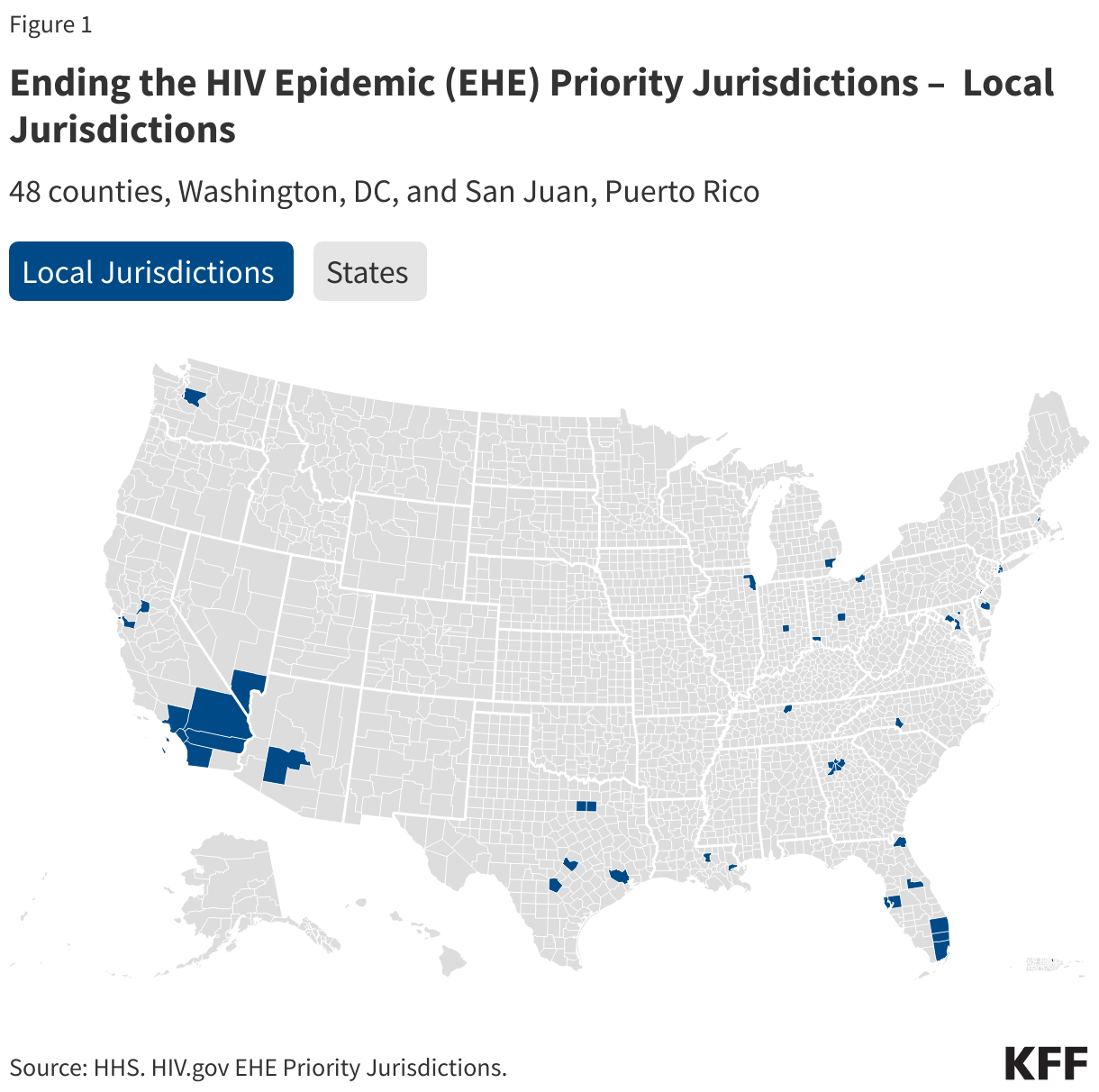
The initiative has focused on a subset of “Priority Jurisdictions”, comprised of the 48 counties in the U.S. that had the largest number of HIV diagnoses (in 2018), as well as San Juan, Puerto Rico, Washington D.C., and 7 states with a substantial share of rural HIV cases (see Figure 1). It also has been accompanied by additional federal funding, including reprogrammed funding in FY 2019 and new Congressional appropriations in FY 2020 through FY 2025. Still, this additional funding accounts for a relatively small share of overall federal HIV funding provided to state and local jurisdictions.
While the second Trump administration has continued the EHE. However, there were some questions as to whether it would when a leaked document suggested the administration may not support EHE early on. The administration has proposed cutting HIV prevention funding at the Centers for Disease Control and Prevention (CDC) and moving that EHE funding to the proposed Adminstration for Healthy America (AHA). More recently, the CDC’s HIV Prevention branch and the Office at Health and Human Services (HHS) tasked with coordinating the EHE were eliminated as were key HIV officials at NIH as was the Office of Infectious Disease Policy at HHS, which coordinated EHE.
This tracker provides up-to-date data on federal EHE funding, including an overview of funding mechanisms by year, agency, grant mechanism, and jurisdiction. It will be updated over time.
Funding by Year, Agency, and Grant Mechanism
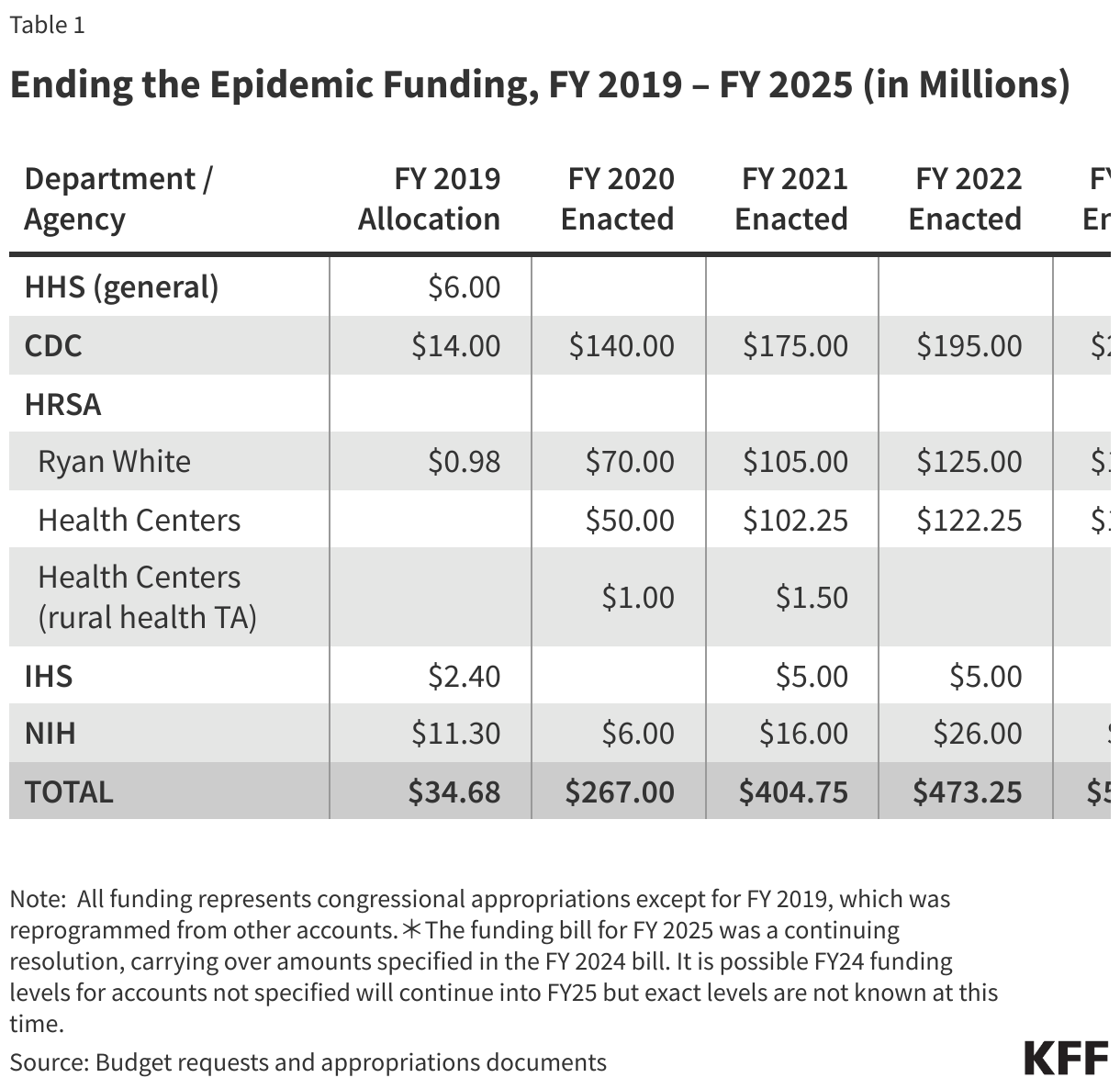
While FY 2020 is considered the first year of EHE funding, in FY 2019, some funds were reprogrammed from existing accounts to help start the initiative. From FY 2019-2024, funding totaled $2.33 billion. Funding for the EHE increased each year from FY 2020-2023 but has since been flat funded. (See Table 1.)
Prior to the Congressional appropriations process, the administration makes a presidential budget request for Congress to consider. A budget request lays out presidential priorities both in terms of the policy issues identified and the level of funding requested. Table 2 provides the history of EHE presidential budget requests showing that EHE funding requests increased each year from FY 2020 to FY 2023. In FY 2024 the request was flat compared to the prior year. The FY 2025 budget request represents a $256.75 million decrease compared to the FY 2024 request. Since then, funding has been similar except for the Indian Health Services (IHS), which has seen declining request levels. (seen in Table 1).
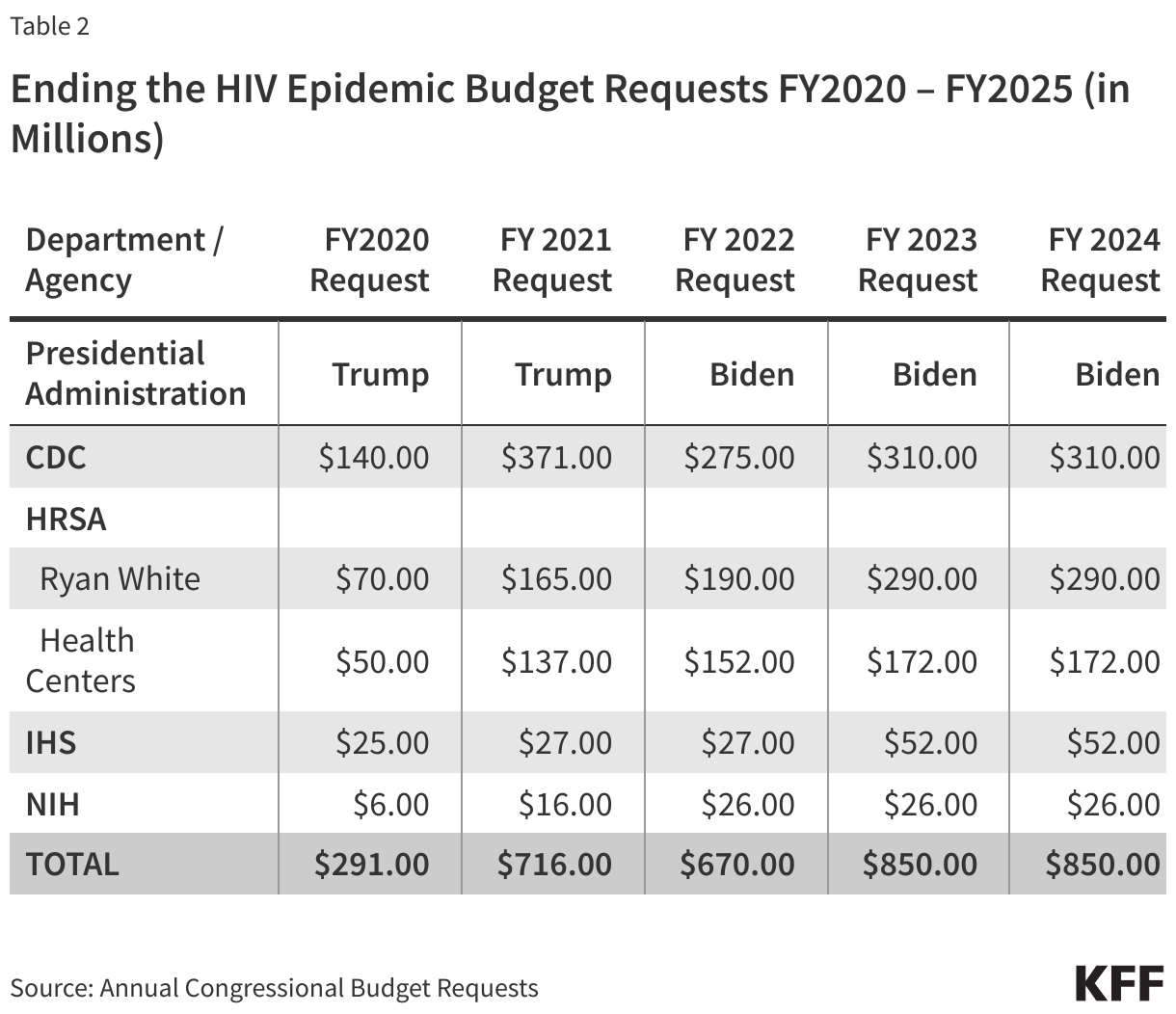
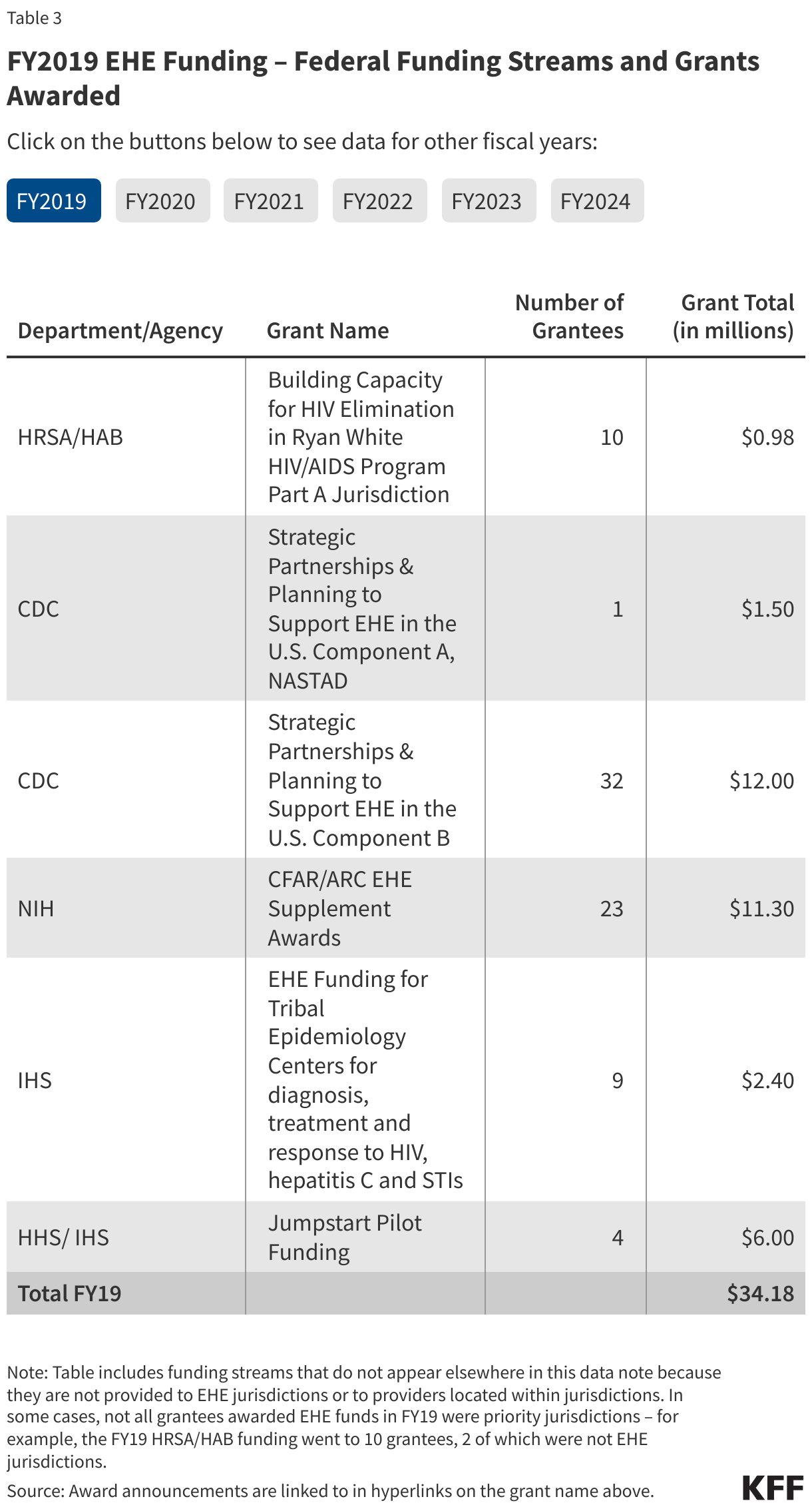
Table 3 provides detail on each federal EHE grant mechanism by agency. Most EHE funding is allocated directly to EHE jurisdictions to assist with local efforts. A subset of EHE funding is provided to other grantees to carry out related efforts, such as to support capacity building and technical assistance and for science implementation hubs through NIH-funded Centers for AIDS Research (CFAR) and the NIMH AIDS Research Centers (ARC) programs.
FY2020 EHE Funding – Jurisdictional Funding Streams and Grants Awarded
Click on the buttons below to see data for other fiscal years:
FY2019
 
FY2020
 
FY2021
 
FY2022
 
FY2023
 
FY2024
 
Table includes funding streams that do not appear elsewhere in this data note because they are not provided to EHE jurisdictions or to providers located within jurisdictions. *Indicates that amounts are approximates, as exact amounts were unavailable.
Award announcements are linked to in hyperlinks on the grant name above.
FY2021 EHE Funding – Jurisdictional Funding Streams and Grants Awarded
Click on the buttons below to see data for other fiscal years:
FY2019
 
FY2020
 
FY2021
 
FY2022
 
FY2023
 
FY2024
 
Table includes funding streams that do not appear elsewhere in this data note because they are not provided to EHE jurisdictions or to providers located within jurisdictions.
Award announcements are linked to in hyperlinks on the grant name above, except in the case of Primary Care HIV Prevention Supplemental Awards which was received in a special data request. PCHP Supplemental Award data available upon request.
FY2022 EHE Funding – Jurisdictional Funding Streams and Grants Awarded
Click on the buttons below to see data for other fiscal years:
FY2019
 
FY2020
 
FY2021
 
FY2022
 
FY2023
 
FY2024
 
Table includes funding streams that do not appear elsewhere in this data note because they are not provided to EHE jurisdictions or to providers located within jurisdictions. *Received by special data request.
Award announcements are linked to in hyperlinks on the grant name above.
FY2023 EHE Funding – Jurisdictional Funding Streams and Grants Awarded
Click on the buttons below to see data for other fiscal years:
FY2019
 
FY2020
 
FY2021
 
FY2022
 
FY2023
 
FY2024
 
Table includes funding streams that do not appear elsewhere in this data note because they are not provided to EHE jurisdictions or to providers located within jurisdictions. *Received via data request.
</span></span>
Award announcements are linked to in hyperlinks on the grant name above, except in the case of Integrated HIV Programs for Health Departments PrEP Supplemental Award. PrEP Supplemental Award data available upon request.
FY2024 EHE Funding – Jurisdictional Funding Streams and Grants Awarded
Click on the buttons below to see data for other fiscal years:
FY2019
 
FY2020
 
FY2021
 
FY2022
 
FY2023
 
FY2024
 
Table may include funding streams that do not appear elsewhere in this data note because they are not provided to EHE jurisdictions or to providers located within jurisdictions. *Indicates that data was provided via special request, amounts represent a 10-month period.
Award announcements are hyperlinked to the grant name, except in the case of CDC EHE Funding which was provided directly to KFF.
Funding by Year and Jurisdictions
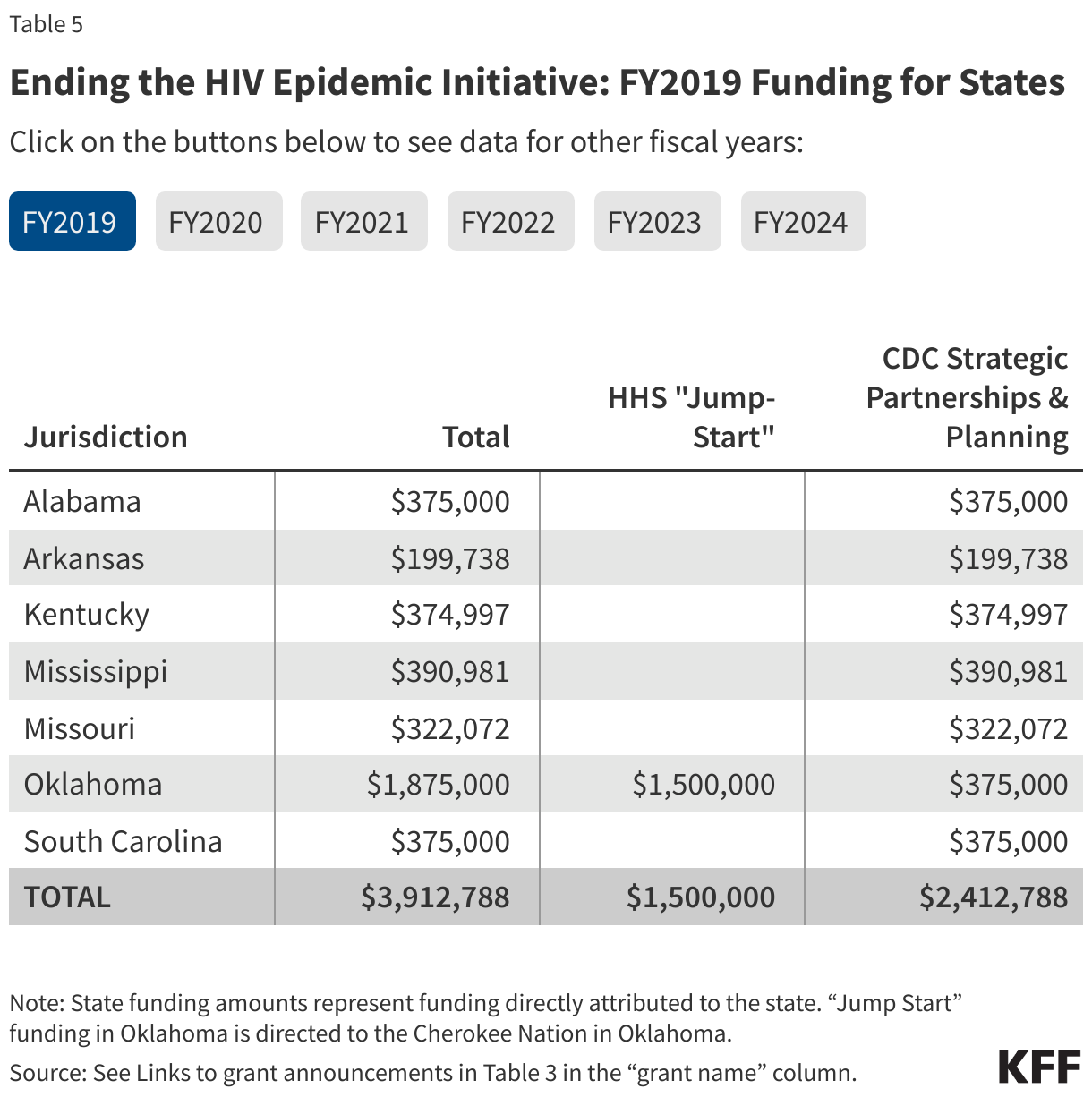
Tables 4 and 5 detail funding from FY 2019 to FY 2024 directed to EHE priority jurisdictions (data for FY 2025 are not yet available). Table 4 includes funding directed to EHE Counties and other local jurisdictions. Table 5 includes funding directed to the seven EHE states. See notes in these tables for details on how funding was allocated in this analysis.

Ending the HIV Epidemic Initiative: FY2020 Funding for Counties, D.C., and San Juan, Puerto Rico
Click on the buttons below to see data for other fiscal years:
FY2019
 
FY2020
 
FY2021
 
FY2022
 
FY2023
 
FY2024
 
CDC EHE funding to EHE counties may be provided directly to those counties, or, when there is no prior grantee relationship with the EHE county, to the state or major approximate city on behalf of an EHE county. In counties that did not have a prior grantee relationship, funding was distributed to the state on behalf of those counties or, in two cases, to the major city within a EHE county (i.e. Philadelphia County’s funding to Philadelphia and Cook County’s funding to Chicago). In all cases but Chicago and Philadelphia, CDC funding in the table depicts its funding pathway. In some cases, a state received a sum to be distributed among multiple EHE counties and county funding levels cannot be disaggregated from the total amount provided to the state. In cases where funding went to a state with a single EHE county, funding was still attributed to the state as states may have withheld a small portion of the award (e.g. for administrative purposes) and it is not possible to know the exact amount the county received. In the case of Ryan White, county funding was distributed to the Eligible Metropolitan Area (EMA) or Transitional Grant Area (TGA) where the relevant EHE county is located due to the prior grantee relationship, except in the case of Hamilton Co., Ohio. Funding for Hamilton Co., Ohio was provided to the state on behalf of the county due to a preexisting funding relationship.. Health center funding is provided to health centers within EHE jurisdictions. In most cases funding was attributed to the EHE county associated with the health center as listed in the “list of eligible health centers” released prior to the awards. This methodology was used in most cases. When the health center award was associated with multiple EHE counties and could not be disaggregated, funding was attributed to the state (the minority of cases).
See Links to grant announcements in Table 3 in the “grant name” column.
Ending the HIV Epidemic Initiative: FY2021 Funding for Counties, D.C., and San Juan, Puerto Rico
Click on the buttons below to see data for other fiscal years:
FY2019
 
FY2020
 
FY2021
 
FY2022
 
FY2023
 
FY2024
 
CDC EHE funding to EHE counties may be provided directly to those counties, or, when there is no prior grantee relationship with the EHE county, to the state or major approximate city on behalf of an EHE county. In counties that did not have a prior grantee relationship, funding was distributed to the state on behalf of those counties or, in two cases, to the major city within a EHE county (i.e. Philadelphia County’s funding to Philadelphia and Cook County’s funding to Chicago). In all cases but Chicago and Philadelphia, CDC funding in the table depicts its funding pathway. In some cases, a state received a sum to be distributed among multiple EHE counties and county funding levels cannot be disaggregated from the total amount provided to the state. In cases where funding went to a state with a single EHE county, funding was still attributed to the state as states may have withheld a small portion of the award (e.g. for administrative purposes) and it is not possible to know the exact amount the county received. In the case of Ryan White, county funding was distributed to the Eligible Metropolitan Area (EMA) or Transitional Grant Area (TGA) where the relevant EHE county is located due to the prior grantee relationship, except in the case of Hamilton Co., Ohio. Funding for Hamilton Co., Ohio was provided to the state on behalf of the county due to a preexisting funding relationship. Health center funding is provided to health centers within EHE jurisdictions. In most cases funding was attributed to the EHE county associated with the health center as listed in the “list of eligible health centers” released prior to the awards. This methodology was used in most cases. When the health center award was associated with multiple EHE counties and could not be disaggregated, funding was attributed to the state (the minority of cases). EHE Supplemental Health Center Award details were provided to KFF via a special data request from HRSA. These awards, while considered an FY21 funding stream, were provided as supplemental funding for FY20 grantees.
See Links to grant announcements in Table 3 in the “grant name” column
Ending the HIV Epidemic Initiative: FY2022 Funding for Counties, D.C., and San Juan, Puerto Rico
Click on the buttons below to see data for other fiscal years:
FY2019
 
FY2020
 
FY2021
 
FY2022
 
FY2023
 
FY2024
 
CDC EHE funding to EHE counties may be provided directly to those counties, or, when there is no prior grantee relationship with the EHE county, to the state or major approximate city on behalf of an EHE county. In counties that did not have a prior grantee relationship, funding was distributed to the state on behalf of those counties or, in two cases, to the major city within a EHE county (i.e. Philadelphia County’s funding to Philadelphia and Cook County’s funding to Chicago). In all cases but Chicago and Philadelphia, CDC funding in the table depicts its funding pathway. In some cases, a state received a sum to be distributed among multiple EHE counties and county funding levels cannot be disaggregated from the total amount provided to the state. In cases where funding went to a state with a single EHE county, funding was still attributed to the state as states may have withheld a small portion of the award (e.g. for administrative purposes) and it is not possible to know the exact amount the county received. In the case of Ryan White, county funding was distributed to the Eligible Metropolitan Area (EMA) or Transitional Grant Area (TGA) where the relevant EHE county is located due to the prior grantee relationship, except in the case of Hamilton Co., Ohio. Funding for Hamilton Co., Ohio was provided to the state on behalf of the county due to a preexisting funding relationship. Health center funding is provided to health centers within EHE jurisdictions. In most cases funding was attributed to the EHE county associated with the health center as listed in the “list of eligible health centers” released prior to the awards. This methodology was used in most cases. When the health center award was associated with multiple EHE counties and could not be disaggregated, funding was attributed to the state (the minority of cases). Funding levels from FY22 — FY24 are lower than prior amounts due to a 10-month funding period rather than a full 12-month period.
See Links to grant announcements in Table 3 in the “grant name” column.
Ending the HIV Epidemic Initiative: FY2023 Funding for Counties, D.C., and San Juan, Puerto Rico
Click on the buttons below to see data for other fiscal years:
FY2019
 
FY2020
 
FY2021
 
FY2022
 
FY2023
 
FY2024
 
CDC EHE funding to EHE counties may be provided directly to those counties, or, when there is no prior grantee relationship with the EHE county, to the state or major approximate city on behalf of an EHE county. In counties that did not have a prior grantee relationship, funding was distributed to the state on behalf of those counties or, in two cases, to the major city within a EHE county (i.e. Philadelphia County’s funding to Philadelphia and Cook County’s funding to Chicago). In all cases but Chicago and Philadelphia, CDC funding in the table depicts its funding pathway. Integrated HIV Programs for Health Departments PrEP Supplemental Award details were provided to KFF via a special data request from CDC. In some cases, a state received a sum to be distributed among multiple EHE counties and county funding levels cannot be disaggregated from the total amount provided to the state. In cases where funding went to a state with a single EHE county, funding was still attributed to the state as states may have withheld a small portion of the award (e.g. for administrative purposes) and it is not possible to know the exact amount the county received. In the case of Ryan White, county funding was distributed to the Eligible Metropolitan Area (EMA) or Transitional Grant Area (TGA) where the relevant EHE county is located due to the prior grantee relationship, except in the case of Hamilton Co., Ohio. Funding for Hamilton Co., Ohio was provided to the state on behalf of the county due to a preexisting funding relationship. Health center funding is provided to health centers within EHE jurisdictions. In most cases funding was attributed to the EHE county associated with the health center as listed in the “list of eligible health centers” released prior to the awards. This methodology was used in most cases. When the health center award was associated with multiple EHE counties and could not be disaggregated, funding was attributed to the state (the minority of cases). Funding levels from FY22 — FY24 are lower than prior amounts due to a 10-month funding period rather than a full 12-month period.
See Links to grant announcements in Table 3 in the “grant name” column.
Ending the HIV Epidemic Initiative: FY2024 Funding for Counties, D.C., and San Juan, Puerto Rico
Click on the buttons below to see data for other fiscal years:
FY2019
 
FY2020
 
FY2021
 
FY2022
 
FY2023
 
FY2024
 
CDC EHE funding to EHE counties may be provided directly to those counties, or, when there is no prior grantee relationship with the EHE county, to the state or major approximate city on behalf of an EHE county. In counties that did not have a prior grantee relationship, funding was distributed to the state on behalf of those counties or, in two cases, to the major city within a EHE county (i.e. Philadelphia County’s funding to Philadelphia and Cook County’s funding to Chicago). In all cases but Chicago and Philadelphia, CDC funding in the table depicts its funding pathway In some cases, a state received a sum to be distributed among multiple EHE counties and county funding levels cannot be disaggregated from the total amount provided to the state. In cases where funding went to a state with a single EHE county, funding was still attributed to the state as states may have withheld a small portion of the award (e.g. for administrative purposes) and it is not possible to know the exact amount the county received. In the case of Ryan White, county funding was distributed to the Eligible Metropolitan Area (EMA) or Transitional Grant Area (TGA) where the relevant EHE county is located due to the prior grantee relationship, except in the case of Hamilton Co., Ohio. Funding for Hamilton Co., Ohio was provided to the state on behalf of the county due to a preexisting funding relationship. Health center funding is provided to health centers within EHE jurisdictions. In most cases funding was attributed to the EHE county associated with the health center as listed in the “list of eligible health centers” released prior to the awards. This methodology was used in most cases. When the health center award was associated with multiple EHE counties and could not be disaggregated, funding was attributed to the state (the minority of cases. Funding levels from FY22 — FY24 are lower than prior amounts due to a 10-month funding period rather than a full 12-month period.
See Links to grant announcements in Table 3 in the “grant name” column.
Ending the HIV Epidemic Initiative: FY2020 Funding for States
Click on the buttons below to see data for other fiscal years:
FY2019
 
FY2020
 
FY2021
 
FY2022
 
FY2023
 
FY2024
 
State funding amounts represent funding directly attributed to the state except in the case of health center funding when awards were provided to health centers within EHE state jurisdictions. Funding was attributed to the EHE state associated with the health center as listed in the “list of eligible health centers” released prior to the awards.
See Links to grant announcements in Table 3 in the “grant name” column.
Ending the HIV Epidemic Initiative: FY2021 Funding for States
Click on the buttons below to see data for other fiscal years:
FY2019
 
FY2020
 
FY2021
 
FY2022
 
FY2023
 
FY2024
 
State funding amounts represent funding directly attributed to the state except in the case of health center funding when awards were provided to health centers within EHE state jurisdictions. Funding was attributed to the EHE state associated with the health center as listed in the “list of eligible health centers” released prior to the awards. Arkansas PCHP funding includes funding for Special Health Resources for Texas, a health center that was designated as eligible based on its Arkansas state location. EHE Supplemental Health Center Award details were provided to KFF via a special data request from HRSA. These awards, while considered an FY21 funding stream, were provided as supplement funding for FY20 grantees. *Indicates amount includes $250,000 in supplemental funding for CDC Component C
See Links to grant announcements in Table 3 in the “grant name” column.
Ending the HIV Epidemic Initiative: FY2022 Funding for States
Click on the buttons below to see data for other fiscal years:
FY2019
 
FY2020
 
FY2021
 
FY2022
 
FY2023
 
FY2024
 
State funding amounts represent funding directly attributed to the state except in the case of health center funding when awards were provided to health centers within EHE state jurisdictions. Funding was attributed to the EHE state associated with the health center as listed in the “list of eligible health centers” released prior to the awards. Funding levels from FY22 — FY24 are lower than prior amounts due to a 10-month funding period rather than a full 12-month period.
See Links to grant announcements in Table 3 in the “grant name” column.
Ending the HIV Epidemic Initiative: FY2023 Funding for States
Click on the buttons below to see data for other fiscal years:
FY2019
 
FY2020
 
FY2021
 
FY2022
 
FY2023
 
FY2024
 
State funding amounts represent funding directly attributed to the state except in the case of health center funding when awards were provided to health centers within EHE state jurisdictions. Integrated HIV Programs for Health Departments PrEP Supplemental Award details were provided to KFF via a special data request from CDC. Funding was attributed to the EHE state associated with the health center as listed in the “list of eligible health centers” released prior to the awards. Funding levels from FY22 — FY24 are lower than prior amounts due to a 10-month funding period rather than a full 12-month period.
See Links to grant announcements in Table 3 in the “grant name” column
Ending the HIV Epidemic Initiative: FY2024 Funding for States
Click on the buttons below to see data for other fiscal years:
FY2019
 
FY2020
 
FY2021
 
FY2022
 
FY2023
 
FY2024
 
State funding amounts represent funding directly attributed to the state except in the case of health center funding when awards were provided to health centers within EHE state jurisdictions. Funding was attributed to the EHE state associated with the health center as listed in the “list of eligible health centers” released prior to the awards. Funding levels from FY22 — FY24 are lower than prior amounts due to a 10-month funding period rather than a full 12-month period.
See Links to grant announcements in Table 3 in the “grant name” column