News Release

Donor Nation Support for HIV Stands Firm but Investments Remain at 2008 Levels

Published: Jul 17, 2012

U.S. continues to account for more than half of all donor government investmentsWashington, D.C. — Donor nation funding in 2011 for HIV in low- and middle-income countries returned to prior levels after a drop in 2010, but has been roughly flat since the recession hit world economies in 2008, according to an annual funding analysis from the Kaiser Family Foundation and the Joint United Nations Programme on HIV/AIDS (UNAIDS).

The study found that donor governments disbursed US$ 7.6 billion in 2011 for the AIDS response in low- and middle-income countries. Overall donor government support for AIDS has been flat since 2008, which marked the end of rapid increases in donor disbursements of more than six-fold over the 2002 to 2008 period.

“International investments still account for two thirds of funding for HIV in Africa, the continent most affected by the epidemic,” said Paul De Lay, Deputy Executive Director, Programme at UNAIDS. “Although more and more countries are increasing domestic investments for HIV, investments from donor governments remain an essential resource.”

“The benefits of early detection and treatment have never been more clear, but countries have never been more challenged to provide needed resources. This is a critical time to keep the focus on the HIV epidemic,” said Drew Altman, Kaiser Family Foundation President and CEO.

The two largest donor governments – the United States and United Kingdom – reported funding increases. The United States, the largest donor nation, reported a US$785 million increase in disbursements over 2010, but only returned to 2009 levels after reporting a delay in disbursements as the reason for last year’s decline. Australia, Canada, Denmark, France, Germany, Norway and Sweden maintained or slightly increased their support, while Ireland, Italy, Japan and the Netherlands decreased funding.

In 2011, the United States accounted for more than half (59.2%) of total donor government disbursements, followed by the United Kingdom (12.8%), France (5.4%), the Netherlands (4.2%), Germany (4.0%) and Denmark (2.5%).

When considering what constitutes a donor’s “fair share” – which this report assesses by looking at donor resources standardized by the size of government economies – Denmark provided the highest amount of resources for AIDS in 2011, followed by the United Kingdom, the Netherlands, Ireland and Sweden. The United States was sixth.

According to the latest estimates from UNAIDS, 34.2 million (31.8 million-35.9 million) people were living with HIV at the end of 2011. Nearly 35 million have died from AIDS-related causes since AIDS was first reported 31 years ago.

The new report provides that latest data available on donor funding based on data provided by governments, and were collected and analyzed by researchers as part of a collaborative effort between the Kaiser Family Foundation and UNAIDS.

The full analysis is available online at http://www.kff.org/hivaids/7347.cfm.

UNAIDSThe Joint United Nations Programme on HIV/AIDS (UNAIDS) leads and inspires the world to achieve its shared vision of zero new HIV infections, zero discrimination and zero AIDS-related deaths. UNAIDS unites the efforts of 11 UN organizations—UNHCR, UNICEF, WFP, UNDP, UNFPA, UNODC, UN Women, ILO, UNESCO, WHO and the World Bank—and works closely with global and national partners to maximize results for the AIDS response. Learn more at unaids.org and connect on Facebook and Twitter.Kaiser Family FoundationThe Kaiser Family Foundation, a leader in health policy analysis, health journalism and communication, is dedicated to filling the need for trusted, independent information on the major health issues of the day. The Foundation is a non-profit private operating foundation, based in Menlo Park, CA with an office and conference center in Washington, D.C.
Financing the Response to AIDS in Low- and MiddleIncome Countries: International Assistance from Donor Governments in 2011

Authors: Jennifer Kates, Adam Wexler, Eric Lief, and Benjamin Gobet
Published: Jul 17, 2012

Introduction

After a decade of significant growth in donor government assistance to address AIDS in low- and middle-income countries, the world entered a financial crisis, raising concerns about the global effort to tackle the epidemic. While resources from all sectors – multilateral institutions, the private sector, low- and middle-income country governments, and households and individuals—are all key to financing the response, donor governments account for most HIV funding in many hard hit countries. Therefore, understanding how donors have responded to this crisis is critical to assessing efforts to address the AIDS epidemic around the world and in meeting the targets set out by United Nations Member States in the 2011 Political Declaration on AIDS.1

UNAIDS and the Kaiser Family Foundation have been tracking donor government assistance for AIDS in low- and middle- income countries since 2002.2 This latest report provides data from governments for 2011, the most recent year with comparable data available across donors. As it shows, international assistance rose sharply from 2002 through 2008, the period just before the onset of the economic crisis. It then began to flatten and, last year, for the first time, disbursements declined. The current report finds that although funding has gone back up, it remains at 2008 levels. If such trends continue, reaching the UN Political Declaration investment target of $22-24 billion needed by 2015 could be at risk.

This report is based on analysis of data provided by the 23 donor government members of the Organisation for Economic Co-operation and Development (OECD)’s Development Assistance Committee (DAC) and the European Union (EU). It includes their combined bilateral assistance and contributions to the Global Fund to Fight AIDS, Tuberculosis and Malaria (the Global Fund) and to UNITAID.

Key Highlights

Funding for international AIDS assistance provided by donor governments increased by more than six-fold between 2002 and 2008 but, other than a decline in 2010, has remained at this level through 2011:

  • Disbursements were US$7.6 billion in 2011, compared to $6.9 billion in 2010. Funding was US$7.7 billion in both 2008 and 2009 (see Chart 5).
  • The decline between 2009 and 2010 was largely attributed to the largest donor, the United States (U.S.) who had reported delays in disbursements during that period.3
  • Commitments (enactments) have also been flat at approximately $8.7-$8.8 billion since 20084 (see Chart 5).

As has been the case over the past decade, a subset of donor governments continues to account for the majority of OECD DAC government international AIDS assistance:

  • In 2011, the United States (U.S.) was the largest donor in the world, accounting for more than half (59.2%) of disbursements by donor governments. The U.K. accounted for the second largest share of disbursements in 2011 (12.8%), followed by France (5.4%), the Netherlands (4.2%), Germany (4.0%), and Denmark (2.5%) (see Chart 6).
  • Together, funding from the member countries of the EU and the European Commission (EC) totalled US$2.6 billion, accounting for 34% of disbursements by governments.

Two governments significantly increased their funding in 2011, compared to 2010, while seven essentially remained level and four decreased.

The U.K. reported significant funding increases following an explicit government policy decision to boost overall development assistance funding by approximately 40% over a three-year period.5

The increase by the U.S. from 2010-2011 brought their funding back up to 2009 levels, after a 16% decrease between 2009-2010.

Australia, Canada, Denmark, France, Germany, Norway and Sweden maintained or slightly increased funding while Ireland, Italy, Japan and the Netherlands decreased. Most donor government assistance for AIDS is provided bilaterally, although funding channels vary by donor.

  • In 2011, bilateral government assistance accounted for US$5.8 billion (see Chart 7).
  • Funding provided to the Global Fund to Fight AIDS, Tuberculosis and Malaria (Global Fund) totalled US$2.9 billion, of which US$1.6 billion (or 56%) represents an adjusted “AIDS share” (see Chart 8).
  • Funding for UNITAID totalled US$263 million, of which US$137 million (52.2%) represents an adjusted “AIDS share”.
  • Overall, 77% of international AIDS assistance in 2011 was provided bilaterally, and 23% multilaterally. While most donor governments provide the bulk of their assistance bilaterally, five (Canada, the EC, France, Germany, and Japan) channel at least half through the Global Fund and UNITAID (see Chart 9).
  • Between 2009 and 2011, the UK significantly increased its contribution to the Global Fund (see Chart 10).
  • Not all donor governments provided contributions to multilateral institutions. In 2011, for example, 6 members of the DAC did not contribute to the Global Fund, including Italy and Spain, several of whom have given in the past. In addition, only 6 contributed to UNITAID.6

One question that often arises is what constitutes a donor’s “fair share” of resources. Yet, assessing “fair share” in the context of international assistance is complex and there is no single, agreed upon methodology for doing so. Two different methodologies were used in this analysis:

  • Share of Resources for AIDS Compared to GDP: In 2011, UNAIDS estimates that US$16.8 billion was made available from all sources (donor governments, multilaterals, the private sector, and domestic sources) for AIDS.7 Of this the U.S. provided 27%, the largest share of any donor and above its share of the world’s economy as measured by gross domestic product or GDP (22% in 2011). Denmark, Ireland, the Netherlands, Sweden, and the U.K. also provided greater shares of total AIDS resources than their shares of GDP (see Chart 11).
  • GDP per US$1 Million: When donor government disbursements are standardized by the size of their economies (GDP per U.S.$1 million), donors rank quite differently than when measured by actual disbursement amounts. Whereas Denmark ranked sixth in actual disbursements provided for AIDS in 2011, it ranked number one when standardized by GDP. The UK ranked second by this measure (the same as for disbursement amounts), followed by the Netherlands, Ireland, and Sweden. The U.S. was sixth when standardized by GDP, compared to first when ranked by disbursement amount (see Chart 12)

  1. UN General Assembly, Political Declaration on HIV/AIDS: Intensifying our Efforts to Eliminate HIV/AIDS, A/RES/65/277, June 2011. ↩︎
  2. See, Kaiser Family Foundation, http://www.kff.org/hivaids/7347.cfm. ↩︎
  3. The U.S. reported that delays in disbursements between 2009 and 2010 were due to new implementation requirements. ↩︎
  4. Enactments are firm budgetary decisions that funding will be provided, regardless of the year in which it is disbursed. While most governments examined disburse enacted amounts significantly within the same year, the U.S. government, the largest donor, does not. Yet, because U.S. enactments are firm budgetary decisions, they provide an important point of comparison to other governments’ disbursement amounts. ↩︎
  5. HM Treasury, Budget 2011, p. 48 and Budget 2012, p. 55. ↩︎
  6. Based on analysis of the Global Fund’s Pledges and Contributions database and UNITAID’s 2011 Annual Report. ↩︎
  7. UNAIDS, Together we will end AIDS, July 2012 ↩︎
Poll Finding

Kaiser Health Tracking Poll: July 2012

Published: Jul 2, 2012

July’s second Health Tracking Poll reports in further depth on public opinion toward the Affordable Care Act (ACA) in the wake of last month’s key Supreme Court decision. When it comes to the individual mandate, the Court’s verdict that the controversial provision is constitutional as a tax appears to have had little impact on opinion, with upwards of six in ten viewing the mandate unfavorably whether it is described as “tax” or as a “fine.” There is confusion over who will be subject to the tax penalty under the mandate: the poll finds that one in five Americans believe they will have to pay a penalty in 2014, even as experts suggest the share will be considerably smaller.

The ACA’s Medicaid expansion is supported by two in three Americans. But the Court’s decision giving states the option to decide whether or not to expand Medicaid has created a new arena for ACA controversy and partisan disagreement. The poll finds that 49 percent of people support expanding Medicaid in their own state while 43 percent say they prefer to keep their state’s status quo. As with most ACA‐related controversies, the public splits sharply along partisan lines on whether their state should undertake the expansion, with 75 percent of Democrats favoring it and 66 percent of Republicans opposed.

Opinion on the ACA remains steady this month, continuing a year of a roughly even divide, even as just over four in ten Americans say they could still change their minds on the law and a slightly larger share than last month say they would back the law’s repeal. The poll also finds evidence of issue fatigue when it comes to health reform. Just over half of Americans are “tired of hearing lawmakers debate the health care law and would like for them to move on to other issues,” while 44 percent say it is important to continue the debate over the law’s future.

The July poll is the latest in a series designed and analyzed by the Foundation’s public opinion research team.

Findings (.pdf)

Chartpack (.pdf)

Toplines (.pdf)

Kaiser Poll: Early Reaction to Supreme Court Decision on ACA

Published: Jul 2, 2012

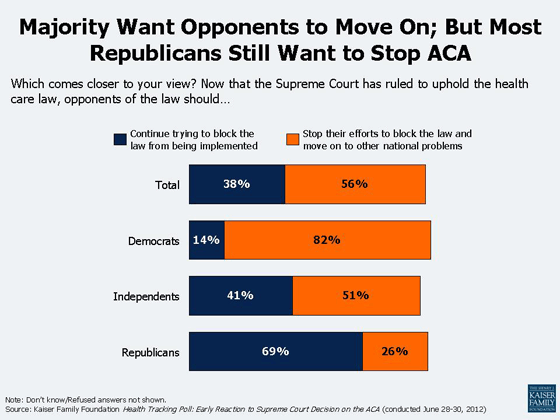
Following last week’s Supreme Court’s decision upholding the heart of the Affordable Care Act (ACA), a majority of Americans (56 percent) now say they would like to see the law’s detractors stop their efforts to block its implementation and move on to other national problems. In the first of two polls to be released this month looking at opinion on the ACA in the wake of the Court’s decision, Democrats overwhelmingly say opponents should move on to other issues (82 percent), as do half (51 percent) of independents. But on the flip side, seven in ten Republicans (69 percent) would like to see efforts to stop the law continue. Solid majorities of voters of every political stripe say the decision won’t impact whether or not they vote this November – though Republicans are more likely than Democrats (31 percent compared to 18 percent) to say the result will motivate them to turn out in November.

The Court did little to change overall views on the ACA, which have been roughly stable since passage. Currently, 41 percent of Americans hold favorable views, 41 percent unfavorable. Still, enthusiasm for the law among Democrats did surge this month: 47 percent are “very favorable” toward the law now compared to 31 percent last month. Even with the jump in enthusiasm, Republicans’ strong opposition to the law continues to outstrip Democratic enthusiasm with 64 percent saying they feel “very unfavorable” about the law.

With policymakers struggling to understand how the Court decision will affect the planned expansion of Medicaid under the ACA, the survey did not attempt to measure the public’s views on this issue.  The poll does find that a large majority see Medicaid as either “very important” (69 percent) or “somewhat important” (23 percent) program, putting it close behind Medicare and Social Security.

Policy-insights-Majority_Wants_Opponents_to_Move_On_But_Most_Republicans_Still_Want_to_Stop_ACA

Program Integrity in Medicaid: A Primer

Published: Jul 1, 2012

Medicaid covers more than 60 million Americans and accounts for about one in six dollars spent on health care in the United States. Multiple agencies at the state and federal levels are involved in efforts to prevent waste, fraud and abuse in the program and ensure appropriate use of taxpayer dollars, and many program integrity initiatives are yielding positive results. The Affordable Care Act (ACA) builds on earlier efforts through the Deficit Reduction Act to promote program integrity. This brief examines program integrity in Medicaid, including a look at the entities involved in such efforts and what key initiatives are underway, as well as the central issues in program integrity as Medicaid expands under health reform.

Report (.pdf)

Responding to AIDS at Home and Abroad: How the U.S. and Other High Income Countries Compare

Published: Jul 1, 2012

This report examines the United States’ response to HIV over the last 30 years compared to that of other high-income countries. The report compares the U.S. to seven other similarly situated nations – Australia, Canada, France, the Netherlands, Sweden, Switzerland and the United Kingdom – noting patterns and themes that have emerged from their experiences. Key areas examined include governance of the national responses, the roles of affected communities and non-governmental actors, policies relating to HIV testing, prevention, care and treatment, and stigma and discrimination.

Executive Summary (.pdf)

Report (.pdf)

Poll Finding

2012 Survey Of Americans On HIV/AIDS

Published: Jul 1, 2012

Leading up to the 2012 International AIDS Conference in Washington, DC, The Washington Post and the Kaiser Family Foundation conducted a joint survey of the American public’s attitudes, awareness, and experiences related to HIV and AIDS. This survey is the 24th in a series of surveys dating back to 1995 that have been conducted as part of The Washington Post/Kaiser Family Foundation Survey Project. It also builds on Kaiser’s extensive survey work on HIV/AIDS, comprised of eight previous surveys between 1995 and 2011, including one in 2002 that was also conducted as part of the partnership series with The Washington Post.

Summary of Findings and Charts (.pdf)

Toplines (.pdf)

Read The Washington Post article on the survey findings

Poll Finding

Kaiser Health Tracking Poll: Early Reaction to Supreme Court Decision on the ACA

Published: Jun 29, 2012

This poll fielded following the Supreme Court’s decision upholding the heart of the Affordable Care Act (ACA) finds a majority of Americans (56 percent) now say they would like to see the law’s detractors stop their efforts to block its implementation and move on to other national problems.

Democrats overwhelmingly say opponents should move on to other issues (82 percent), as do half (51 percent) of independents and a quarter (26 percent) of Republicans. But, seven in ten Republicans (69 percent) say they want to see efforts to stop the law continue, a view shared by 41 percent of independents and 14 percent of Democrats.

The public is also divided in its emotional reaction to the decision, with similar shares reporting being angry (17 percent) and enthusiastic (18 percent). Negative emotions run highest among Republicans who support the Tea Party movement, with 49 percent of this group saying they are angry at the decision.

Solid majorities of voters of every political stripe say the decision won’t impact whether or not they vote this November – though Republicans are more likely than Democrats (31 percent compared to 18 percent) to say the result makes them more likely to turn out.

The poll is the latest in a series designed and analyzed by the Foundation’s public opinion research team.

Findings (.pdf)

Chartpack (.pdf)

Toplines (.pdf)

A Guide to the Supreme Court’s Affordable Care Act Decision

Published: Jun 29, 2012

This policy brief describes the Supreme Court’s decision on the Affordable Care Act and looks ahead to the implementation of health reform now that questions about the constitutionality of the law have been resolved.

Brief (.pdf)