Poll Finding

Dimensions of Partisanship Survey

Published: Aug 1, 2012

With the 2012 presidential elections approaching, The Washington Post and the Kaiser Family Foundation’s latest partnership survey gauged the American public’s attitudes toward the political system and toward major political issues. This survey is the 25th in a series of surveys dating back to 1995 that have been conducted as part of The Washington Post/Kaiser Family Foundation Survey Project.

Toplines (.pdf)

Read The Washington Post articles on the survey findings:Big Gulf Between Political Parties, Divisions WithinIndependents Favor Cooperation, Are Dissatisfied with Political System

Implementing the ACA’s Medicaid-Related Health Reform Provisions After the Supreme Court’s Decision

Published: Aug 1, 2012

On June 28, 2012, the U.S. Supreme Court upheld the constitutionality of the Affordable Care Act (ACA). A majority of the Court also found the ACA’s Medicaid expansion unconstitutionally coercive of states, while a different majority of the Court held that this issue was fully remedied by limiting the Health and Human Services (HHS) Secretary’s enforcement authority. The practical effect of the Court’s decision makes the Medicaid expansion optional for states.

This brief addresses questions that may arise for states in the wake of the Supreme Court decision, including what parts of the ACA are affected by the decision, whether states can opt in and out of the Medicaid expansion over time, whether federal payments to hospitals for uncompensated care will still be reduced if a state does not expand its Medicaid program, and whether the Court decision affects the ACA’s maintenance of effort provisions.

Report (.pdf)

A Guide to the Supreme Court’s Decision on the ACA’s Medicaid Expansion

Published: Aug 1, 2012

On June 28, 2012, the U.S. Supreme Court issued its decision in the case challenging the Affordable Care Act (ACA). The Court upheld the constitutionality of the ACA’s individual mandate, which requires most people to maintain a minimum level of health insurance coverage beginning in 2014. A majority of the Court also found the ACA’s Medicaid expansion unconstitutionally coercive of states, while a different majority of the Court held that this issue was fully remedied by limiting the Health and Human Services (HHS) Secretary’s enforcement authority. The ruling left the ACA’s Medicaid expansion intact in the law, but the practical effect of the Court’s decision makes the Medicaid expansion optional for states.

This policy brief provides background on the Medicaid program and the legal challenge to the Medicaid expansion under health reform, and summarizes the controlling and dissenting opinions of the Court regarding the Medicaid expansion.

Report (.pdf)

See also: Implementing the ACA’s Medicaid-Related Health Reform Provisions After the Supreme Court’s Decision

How Five Leading Safety-Net Hospitals Are Preparing For The Challenges and Opportunities of Health Care Reform

Published: Aug 1, 2012

This study, published in the journal Health Affairs, examines how five leading safety-net hospitals are preparing for major changes expected to result from the Affordable Care Act (ACA), including less government support for uncompensated care and the need to compete for newly insured people. The hospitals studied are Bellevue Hospital Center in New York City; Denver Health Medical Center in Colorado; Parkland Health and Hospital System in Dallas; San Francisco General Hospital in California; and Virginia Commonwealth University Health System in Richmond, Va. Their preparations include improving the efficiency and quality of care delivery, investing in the physical and staffing infrastructure needed to retain patients and attract newly insured ones, and laying the groundwork for accountable care organizations and new payment systems. Authors include Jennifer Tolbert of the Kaiser Family Foundation, Terri Coughlin and Sharon Long of the Urban Institute, and Edward Sheen, a resident physician who was on research fellowship with the Foundation at the time of the study.

Article

July Kaiser Health Tracking Poll: A Focus On The Mandate and the Medicaid Expansion in the Aftermath of the Supreme Court Decision

Published: Jul 31, 2012

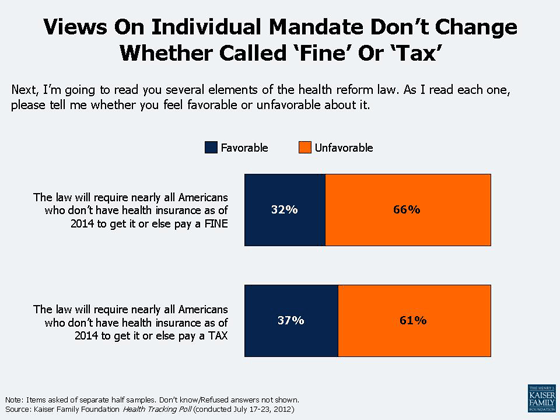
This second July poll reports in further depth on public opinion about the Affordable Care Act (ACA) in the wake of the Supreme Court decision. The Supreme Court’s decision that the individual mandate was constitutional as a tax appears to have had little impact on opinion about the already largely unpopular requirement that most people have health coverage or potentially face a penalty. Sixty-six percent of the public view the mandate negatively when it is described as a “fine” and 61 percent do so when it is labeled a “tax.”

The idea of expanding Medicaid under the ACA to cover more low-income people is popular, with 67 percent of Americans supporting the concept and 30 percent opposing it. But the Court’s decision giving states the option to decide whether or not to expand Medicaid has created a new arena for ACA controversy and partisan disagreement. When people are asked whether their own state should expand its Medicaid program to cover more low-income people, with the federal government eventually paying 90 percent of the cost and the state 10 percent, 49 percent of people support expanding Medicaid in their own state while 43 percent say they prefer to keep their state’s status quo. As with most ACA-related controversies, the public splits sharply along partisan lines on whether their state should undertake the expansion.

Americans remain roughly divided on the ACA, with unfavorable views of the law in July slightly outweighing favorable views, 44 percent to 38 percent this month. When it comes to next steps, the share of Americans who favor repeal of the law (46 percent) matched the share this month who would like to keep the law or expand it (45 percent). Half of those who hope to see the law repealed also favor replacing it with a Republican alternative. With the November election approaching and the law a key point of contention between the president and his challenger, just over half of Americans say their mind is made up on the law, and won’t change. The law’s opponents are much more likely than its proponents to say their minds are firmly made up (69% vs. 47%). For more on the mandate and the Medicaid expansion, including evidence that opinions on these issues may be somewhat malleable, check out the full findings, chartpack, and topline here.

Policy-insights-Views_On_Individual_Mandate_Dont_Change_Whether_Called_Fine_Or_Tax_simple

Comparison of Medicare Premium Support Proposals

Published: Jul 26, 2012

This brief provides a side-by-side comparison of recent proposals to transform Medicare into a premium support program and slow the future growth in Medicare spending.

These proposals each would convert Medicare from a defined benefit program, in which beneficiaries are guaranteed coverage for a fixed set of benefits, to a defined contribution or “premium support” program, in which beneficiaries are provided a fixed federal payment to help cover their health care expenses.

The brief compares the premium support provisions of these proposals, including how the level of premium support for beneficiaries would be determined; whether traditional Medicare would remain an option; what protections would be provided for low-income beneficiaries; and whether and how the proposals would cap federal spending on Medicare. These differences have important implications for Medicare beneficiaries, the federal budget, health care providers, and private health plans.

  • Rep. Paul Ryan in “The Path to Prosperity: A Blueprint for American Renewal,” as released on March 20, 2012;
  • S. 2196, the “Congressional Health Care for Seniors Act of 2012,” as introduced by Sen. Rand Paul, and co-sponsored by Sens. Lindsey Graham, Mike Lee, and Jim DeMint, on March 15, 2012;
  • Sens. Richard Burr and Tom Coburn in “The Seniors’ Choice Act,” released on February 16, 2012;
  • Sen. Ron Wyden and Rep. Ryan, as proposed in “Guaranteed Choices to Strengthen Medicare and Health Security for All: Bipartisan Options for the Future,” released on December 15, 2011; and
  • Former Senator Pete Domenici and Dr. Alice Rivlin, in “The Domenici-Rivlin Protect Medicare Act,” initially released on November 1, 2011 and updated on June 15, 2012.

The descriptions in this side-by-side comparison are based on summaries released by sponsors of each proposal; legislative language is not available at this time. The Foundation has a number of other resources related to deficit-reduction proposals affecting health care, including Medicare and Medicaid.

Brief (.pdf)

Visualizing Health Policy: HIV/AIDS – The State of the Epidemic After 3 Decades

Published: Jul 25, 2012

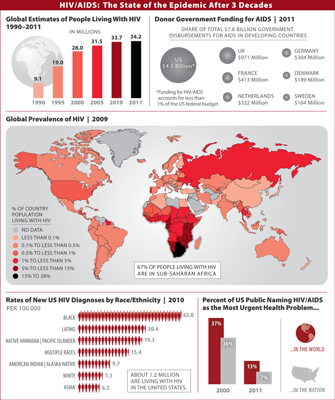
The July 2012 Visualizing Health Policy infographic looks at the state of the HIV/AIDS epidemic after three decades, released during the 19th biannual International AIDS Conference (AIDS 2012) in Washington, D.C.

jama_infographic_hivaids_400px

See the full-size infographic at The Journal of the American Medical Association

View the related Slideshow

Visualizing Health Policy is a monthly infographic series produced in partnership with the Journal of the American Medical Association (JAMA). Each month’s infographic is freely available on JAMA’s website and is published in the print edition of the journal.

The HIV/AIDS Epidemic in Washington, D.C.

Published: Jul 17, 2012

This fact sheet examines the HIV/AIDS epidemic in Washington, D.C., one of the areas hardest hit by HIV in the United States.

Fact Sheet: July 2012 (.pdf)

Summary of Coverage Provisions in the Patient Protection and Affordable Care Act

Published: Jul 17, 2012

On March 23, 2010, President Obama signed comprehensive health reform, the Affordable Care Act (ACA), into law.  The following summary explains key health coverage provisions of the law including:

  • The Medicaid expansion to 138% of the federal poverty level ($15,415 for an individual and $31,809 for a family of four in 2012) for individuals under age 65;
  • The creation of health insurance exchanges through which individuals who do not have access to public coverage or affordable employer coverage will be able to purchase insurance with premium and cost-sharing credits available to some people to make coverage more affordable;
  • New regulations on all health plans that will prevent health insurers from denying coverage to people for any reason,including health status,and from charging higher premiums based on health status and gender;
  • The requirement that most individuals have health insurance beginning in 2014; and
  • The penalties to employers that do not offer affordable coverage to their employees, with exceptions for small employers.

Expansion of Public Programs

The ACA provides for the expansion of Medicaid to individuals with incomes up to 138% of the federal poverty level based on modified adjusted gross income.  This expansion creates a new minimum Medicaid eligibility level for adults and eliminates a limitation of the program that prohibits most adults without dependent children from enrolling in the program (though as under current law, undocumented immigrants are not eligible for Medicaid). Eligibility for Medicaid and the Children’s Health Insurance Program (CHIP) for children with family incomes above 138% of the poverty level will continue at their current eligibility levels until 2019.

  •  The federal government will provide 100% federal funding for the costs of those who become newlyeligible for Medicaid for years 2014 through 2016, 95% federal funding for 2017, 94% federal funding for 2018, 93% federal funding for 2019, and 90% federal funding for 2020 and subsequent years.States that have already expanded adult eligibility to 100% of the federal poverty level will receive a phased-in increase in the FMAP for non-pregnant childless adults.
  • The recent Supreme Court ruling on the ACA limits the ability of the Department of Health and Human Services to enforce the Medicaid expansion.  This change in enforcement authority may affect state decisions to implement the expansion.

American Health Benefit Exchanges

States will create the American Health Benefits Exchanges where individuals can purchase insurance and separate exchanges for small employers to purchase insurance. These new marketplaces will provide consumers within formation to enable them to choose among plans. Premium and cost-sharing subsidies will be available to make coverage more affordable.

  • Access to Exchanges will be limited to U.S. citizens and legal immigrants. Small businesses with up to 100employees can also purchase coverage through the Exchange.
  • Plans in the Exchanges will be required to offer benefits that meet a minimum set of standards.Insurers will offer four levels of coverage that vary based on premiums, out-of-pocket costs, and benefits beyond the minimum required plus a catastrophic coverage plan.
  • Premium subsidies will be provided to families without access to other coverage and with incomes 100-400% of the poverty level ($23,050 to $92,200 for a family of four in 2012) to help them purchase insurance through the Exchanges.These subsidies will be offered on a sliding scale basis and will limit the cost of the premium to between 2% of income for those up to 133% of the poverty level and 9.5 % of income for those between 300-400% of the poverty level.
  • Cost-sharing subsidies will also be available to people with incomes between 100-250% of the poverty level to limit out-of-pocket spending.

Changes to Private Insurance

New insurance market regulations will prevent health insurers from denying coverage to people for any reason, including their health status,and from charging people more based on their health status and gender.These new rules will also require that health plans provide comprehensive coverage that includes at least a minimum set of services and caps annual out-of-pocket spending.

  • Health plan premiums will be allowed to vary only based on age (by a 3 to 1 ratio), geographic area, tobacco use (by a 1.5 to 1 ratio), and the number of family members.
  • Young adults will be allowed to remain on their parent’s health insurance up to age 26.
  • Health insurers will be prohibited from imposing lifetime limits on coverage and will be prohibited from rescinding coverage, except in cases of fraud.
  • New health plans will be required to cover certain preventive services with no cost-sharing.
  • Increases in health plan premiums will be subject to review.
  • Insurers will be required to spend at least 80% of premiums on medical costs or pay rebates back to consumers.

Individual Mandate

All individuals will be required to have health insurance, with some exceptions, beginning in 2014.Those who do not have coverage will be required to pay a yearly financial penalty of the greater of $695 per person (up to a maximum of $2,085 per family), or 2.5% of household income, which will be phased-in from 2014-2016.  Exceptions will be given for financial hardship and religious objections; and to American Indians; people who have been uninsured for less than three months; those for whom the lowest cost health plan exceeds 8% of income; and if the individual has income below the tax filing threshold ($9,500 for an individual in 2011).

Employer Requirements

There is no employer mandate but employers with more than 50 employees will be assessed a fee of $2,000 per full-time employee(in excess of 30 employees) if they do not offer coverage and if they have at least one employee who receives a premium credit through an Exchange.Employers with 50 or more employees that offer coverage but have at least one employee who receives a premium credit through an Exchange are required to pay the lesser of $3,000 for each employee who receives a premium credit or $2,000 for each full-time employee(in excess of 30 employees).

  • Large employers that offer coverage will be required to automatically enroll employees into the employer’s lowest cost premium plan if the employee does not sign up for employer coverage or does not opt out of coverage.