KFF designs, conducts and analyzes original public opinion and survey research on Americans’ attitudes, knowledge, and experiences with the health care system to help amplify the public’s voice in major national debates.
This data spotlight examines the stand-alone Part D drug plan options available to Medicare beneficiaries in 2013 during the open enrollment period, which runs from October 15 to December 7, 2012.
The analysis is the first in a series of planned reports examining the private plan choices available to Medicare beneficiaries for 2013. It is authored by Jack Hoadley and Laura Summer of Georgetown University, Juliette Cubanski and Jennifer Huang of the Kaiser Family Foundation, and Elizabeth Hargrave of NORC at the University of Chicago.
A related fact sheet summarizes the plan options available by state.
NOTE: Originally released in October 2012, this data spotlight was updated in November 2012 to reflect revised data from the Centers for Medicare and Medicaid Services.
This Kaiser Disparities Research Roundup is a regularly updated summary of new research on health care disparities. It includes selected academic research and policy papers that focus on a broad range of disparities in health care, including disparities in health insurance coverage, access to care, utilization of care, quality of care, and health status.
This Kaiser Disparities Research Roundup is a regularly updated summary of new research on health care disparities. It includes selected academic research and policy papers that focus on a broad range of disparities in health care, including disparities in health insurance coverage, access to care, utilization of care, quality of care, and health status.
1. Differences In Patient-Reported Experiences Of Care By Race And Acculturation Status
Using data from the Consumer Assessment of Healthcare Providers and Systems Clinician & Group Survey Adult Primary Care instrument, this study found that race and acculturation status were significantly associated with experiences of care, including patient ratings of their provider and perceptions of shared decision making and helpfulness. Consistent with previous research, unacculturated Hispanics had the poorest self-rated health scores, gave significantly higher provider ratings, and had more interest in shared decision making than other groups. The authors conclude that race and acculturation may play a role in physician-patient relationships and overall health care delivery. (Hasnain M, Schwartz A, Girotti J, et al. Differences in patient-reported experiences of care by race and acculturation status.Journal of Immigrant and Minority Health. 2012 Nov; DOI: 10.1007/s10903-012-9728-x).
2. Racial Disparity In U.S. Diagnoses Of Acquired Immune Deficiency Syndrome, 2000-2009
Using data from the national HIV surveillance records, this study, analyzed trends in racial/ethnic disparities in rates of AIDS diagnoses in all 50 states and the District of Columbia. The analysis found that between 2000 and 2009, disparities in the rate of AIDS diagnoses decreased between all racial/ethnic groups except those between black and white men aged 13-24, for whom disparities increased. The findings indicate progress in reducing overall racial/ethnic disparities in AIDS diagnoses in the last decade but highlight widening black-white disparities among young men nationwide.(An Q, Prejean J, Hall I. Racial disparity in U.S. diagnoses of acquired immune deficiency syndrome, 2000-2009. American Journal of Preventive Medicine. 2012 Oct; 43(5): 461-466).
3. Quality And Equity Of Primary Care With Patient-Centered Medical Homes: Results From A National Survey
This study analyzed the impact of patient-centered medical homes on reducing disparities in the quality of pediatric primary care, using data from the National Survey for Children’s Health. The study found that having a patient-centered medical home (PCMH) was associated with a significant reduction in unmet health needs across racial and ethnic groups. However, it did not alter the disparity between groups for other measures of quality of care. The authors suggest that PCMHs should prioritize obtaining racial and ethnic data on patients and incorporating patient experience data into program evaluations. (Aysola J, Bitton A, Zaslavsky A, et al. Quality and equity of primary care with patient-centered medical homes: results from a national survey. Medical Care. 2012 Oct; DOI: 10.1097/MLR.0b013e318270bb0d).
4. Healthcare Utilization Among Hispanic Immigrants With Diabetes: Investigating The Effect Of U.S. Documentation Status
This study examined differences in the use of health care between documented and undocumented Hispanic immigrants with diabetes using data from the 2007 Hispanic Healthcare Survey. The analysis found that, among Hispanics with diabetes, undocumented immigrants were less likely to have seen a health care provider in the previous six months, report having a usual source of care, and have health insurance compared to documented immigrants. These findings build on existing research by detailing new differences by documentation status. The authors suggest additional research using primary data collection and quantitative analyses be conducted to further understand the causal factors that influence Hispanic immigrants’ decisions to seek medical care.(Do E, Matsuyama RK. Healthcare utilization among Hispanic immigrants with diabetes: investigating the effect of U.S. documentation status. Journal of Immigrant Minority Health. 2012 Oct; DOI: 10.1007/s10903-012-9729-9).
5. Racial/Ethnic Disparities In Health And Health Care Among U.S. Adolescents
This study examined racial and ethnic disparities in health status, access to care, and use of services among U.S. adolescents using data from the 2003 National Survey of Children’s Health. The analysis found lower rates of coverage and care and poorer health status among racial and ethnic minority groups compared to whites and particularly significant disparities for specific groups. For example, American Indians/Alaska Natives had the largest number of disparities at age 18, Latinos had the highest uninsured rate, and African Americans had the largest number of health status disparities. The study found several unique disparities among adolescents that have not previously been identified in children’s health, which may have implications for future research, practice, and policy. (Lau M, Lin H, Flores G. Racial/ethnic disparities in health and health care among U.S. adolescents. Health Services Research. 2012 Oct; 47(5): 2031—2059).
6. Factors That Mediate Racial/Ethnic Disparities In U.S. Fetal Death Rates
This study examined the impact of socioeconomic status, maternal health, complications during pregnancy, and fetal health status on racial disparities in fetal death. Using hospital delivery data from three states between 1993 and 2005, the researchers found that these factors influenced fetal death disparities, but the role of the factors varied across groups. The authors conclude that additional research is needed to understand the role of mediating factors and suggest that those amenable to intervention should be the focus of immediate efforts to reduce fetal death disparities. (Lorch SA, Kroelinger CD, Ahlberg C, Barfield WD. Factors that mediate racial/ethnic disparities in U.S. fetal death rates. American Journal of Public Health. 2012 Oct; 102(10): 1902—1910).
7. Decomposing The Gap In Satisfaction With Provider Communication Between English- And Spanish-Speaking Hispanic Patients
This study quantified and sought to understand disparities in patient satisfaction between English- and Spanish- speaking Hispanic patients using data from the Medical Expenditure Panel Survey. The analysis found that, relative to Spanish-speakers, English-speaking Hispanics were more likely to be satisfied with provider communication and that acculturation, health insurance, and education all contributed to this difference. The findings point to the importance of understanding the heterogeneity of the Hispanic population to create widespread improvements in clinical interactions. (Villani J, Mortensen K. Decomposing the gap in satisfaction with provider communication between English- and Spanish-speaking Hispanic patients. Journal of Immigrant Minority Health. 2012 Oct; DOI: 10.1007/s10903-012-9733-0).
8. Health Care Access And Utilization Among U.S.-Born And Foreign-Born Asian Americans
This study examined disparities in health care access and utilization between U.S.-born and foreign-born Asian Americans using data from the National Health Interview Survey. The study found that, overall, foreign-born Asians had less access to care and lower utilization compared to their U.S.-born peers, with some variation by country of birth. These findings highlight key barriers to care for Asian immigrants, including socioeconomic status, language, and culture. (Ye J, Mack D, Fry-Johnson Y, et al. Health care access and utilization among U.S.-born and foreign-born Asian Americans. Journal of Immigrant Minority Health. 2012 Oct; DOI: 10.1007/s10903-011-9543-9).
9. Racial Disparities In Economic And Clinical Outcomes Of Pregnancy Among Medicaid Recipients
To explore racial and ethnic disparities in pregnancy outcomes among Medicaid enrollees, this study analyzed Medicaid Analytic eXtract data from 2005 to 2007 in 14 southern states. The study found that, among Medicaid enrollees, African-American women were more likely than non-Hispanic white and Hispanic women to have longer hospital stays and pregnancy complications. Hispanic women had the lowest rate of adverse pregnancy outcomes. The study estimated that eliminating disparities in adverse pregnancy events could save between $114 and $214 million annually in Medicaid costs in the 14 states studied. (Zhang S, Cardarelli K, Shim R, et al. Racial disparities in economic and clinical outcomes of pregnancy among Medicaid recipients. Maternal and Child Health Journal. 2012 Oct; DOI: 10.1007/s10995-012-1162-0).
To receive Kaiser’s Monthly Update on Health Disparities, please visit Kaiser’s online subscription site and choose the “Minority Health” topic within the kff.org Kaiser Update section.
You are subscribed to this email alert as %%emailaddr%%.
You may Unsubscribe from all Kaiser emails, or Login to manage all of your subscriptions. If you need help or have questions, please send an email to subscriptions@kff.org.Please do not reply to this email as this address is not monitored.
Henry J. Kaiser Family Foundation 2400 Sand Hill Road, Menlo Park, CA 94025 (650) 854-9400 Washington DC Office 1330 G Street NW, Washington, DC 20005 (202) 347-5270
These Foundation resources shed light on how the ongoing national debate about deficit reduction may affect Medicare, Medicaid and other health-care programs. These resources include analysis of specific savings proposals, polling on the public’s views of deficit-reduction options, summaries and comparisons of relevant elements of major deficit-reduction plans, and explanatory briefs and backgrounders describing key issues related to the debate.
This data note draws primarily on two national surveys, the September Kaiser Health Tracking Poll and the Kaiser 2012 National Survey of Seniors, to examine how health issues are playing as a 2012 election issue for seniors, how this politically important group feels about a variety of policy proposals related to Medicare, including the premium support model, and seniors’ views of the 2010 Affordable Care Act (ACA).
This data note reviews takes a historical look at the public’s views of whom they trust more, Democrats or Republicans, when it comes to health care policy and Medicare policy and analyzes these views in the context of the current presidential election, in which both issues are playing a prominent role.
One health care issue about which the presidential candidates acknowledge they have differences is how the health care system should treat people with pre-existing health conditions.
People who have a health condition (such as an illness or pregnancy) or who are at higher than average risk of needing health care are referred to as having a pre-existing health condition. The insurance reform provisions of the Affordable Care Act (ACA), when they take effect in 2014, will provide for annual and special enrollment periods when health plans must accept all applicants regardless of their health and prohibit health plans from using health when setting premiums for individuals or small employers.1 Governor Romney has said that he would repeal the ACA and replace it with a plan that provides states with flexibility and resources to address affordability and other issues. For people with pre-existing health conditions, Governor Romney proposes requiring insurance companies to accept applicants who have maintained continuous coverage and to provide flexibility to states to help the chronically ill, including high-risk pools, reinsurance, and risk adjustment. 2
Without more details about Governor Romney’s policy proposals, it is difficult to understand the practical differences for people with pre-existing health conditions between his approach and the provisions in the ACA. The issue is further complicated by the fact that the term “pre-existing health condition” is used as shorthand for several different challenges that people with health problems face when they try to get coverage, or when they try to keep or use the health insurance they already have. To provide some context for understanding potential differences between the candidates, we provide a brief description of the key barriers and problems that people with pre-existing health conditions face in the health insurance marketplace now, before the provisions in the ACA take effect.
Current Issues for People with Pre-existing Health Conditions
People who have a health problem or who are at higher than average risk of needing health care are referred to as having a pre-existing health condition. Health plans have an interest in controlling access to coverage for people with pre-existing health conditions because, depending on their condition, they are more likely to use covered services than other enrollees in a health plan. A variety of state and federal rules are already in effect which, to varying degrees, address some of the problems that people with pre-existing health conditions can face when they try to buy, keep, or use coverage under private health plans:
Ability to get health insurance. Nongroup health plans in most states today can deny coverage to applicants because of a pre-existing health condition. In some of these states, a health plan might offer coverage but amend the policy to exclude coverage for services that are related to a specified pre-existing health condition (e.g., a nongroup health plan may exclude treatment for asthma, or even treatment for anything related to a person’s respiratory system, for an applicant with a history of asthma). Many but not all states that permit health plans to deny coverage based on health have some alternative coverage options – such as state high-risk pools – for people with pre-existing health conditions who have been turned down for nongroup coverage. In addition, in 2010 the federal government established the Pre-existing Condition Insurance Program (PCIP) to offer health insurance in all states to people with pre-existing conditions who’ve been uninsured for at least six months. PCIP expires at the end of 2013.In contrast to the nongroup market, coverage denials generally are not an issue in employer-provided coverage, where federal and state laws prohibit health plans from denying coverage to small employers based on the health or claims of enrollees. Federal law also prohibits all employer-provided plans from using an enrollee’s health or medical claims to determine eligibility for coverage in the plan.
Premiums for health insurance. In almost all states, health plans providing nongroup coverage can charge people with pre-existing health conditions higher premiums based on their health. These higher premiums are sometimes called substandard rates.Health plans generally can consider health or claims in setting premiums for an employer group, although many states limit premium variation due to health in the small group market. Within groups, federal law protects individuals with pre-existing conditions by prohibiting group health plans from using health or claims to determine the contributions for individual enrollees under the group plan.
Benefit exclusion periods. Many nongroup and group health plans (both insured and self-funded) exclude coverage for benefits for a defined period for new enrollees if the benefit relates to a pre-existing health condition. These provisions are called pre-existing condition exclusions (PECE). PECEs are different from upfront health screenings, where the health plan looks for pre-existing health conditions during the application process and may deny coverage or amend the policy to exclude specific benefits related to a specified health condition identified during the screening process. PECEs are more general provisions that come into play after a claim has been filed and allow a health plan to investigate whether the claim relates to a health condition the enrollee had prior to enrollment. The result of a PECE is a denial of the claim involved; coverage for other health benefits not related to a pre-existing health condition continues.Federal law sets minimum standards for PECE provisions in group plans while PECE in nongroup plans are primarily regulated under state laws. Standards address how long exclusion periods may be, how far a health plan may look back into an enrollee’s health history, and what may be considered a pre-existing condition. The federal standards for group health plans set fairly tight time periods and use a relatively restrictive definition of a pre-existing health condition: exclusions periods cannot be longer than one year, and can apply only to conditions for which a person actually sought medical advice, treatment, or diagnosis during the six-month period immediately preceding enrollment in the plan. In contrast, standards in some states permit nongroup health plans to impose longer exclusion periods, to look much further back in time for evidence of a pre-existing health condition, and to use a more subjective standard in determining whether a pre-existing health condition exists.
Closed blocks of business. As a general matter, people who have nongroup health insurance and who pay their premiums have the right to keep their policy (or something comparable if the health plan changes the coverage for everyone). This generally means that a health plan cannot drop a person or change their premium just because their health has gotten worse.One issue that still faces people with pre-existing health conditions, however, is that their health plan may stop selling the policy in which they are enrolled.This can lead to spiraling and eventually unaffordable premiums. Premiums for nongroup coverage are usually determined for a policy or group of policies, sometimes called a block of business. When the block is closed the insurer decides to stop actively marketing that policy to new enrollees. With no new and healthy people added to the pool, premiums for that block start to rise. This causes the healthier enrollee who can pass health screening to move to new policies, resulting in even higher premiums for those who remain. People with pre-existing health conditions, who cannot move to a new policy, are essentially trapped. Some states have rules to protect enrollees in closed blocks by limiting how high premiums can go or requiring that closed blocks be pooled with other business.
Switching between health plans. Insured people with pre-existing health conditions face barriers when they want or need to change health plans. This is sometimes referred to as a “portability” issue. Barriers to portability can be related to outright denial of coverage, premium surcharges based on health status, or exclusions related to pre-existing conditions. Federal and state laws address some of these barriers, but in a patchwork way where protections differ based on what type of health plan the person starts in, the type of plan that the person wants to switch to, and what stops the person makes along the way. iiiSwitching into group coverage – People switching from public or private coverage to a group health plan face no barriers as long as they have a history of “continuous” coverage – that is, they do not have a coverage gap between plans of more than 63 days. Federal law effectively prevents the new group health plan from imposing a new PECE for anybody who has at least one year of continuous coverage. And, as discussed above, federal and some state laws prohibit a group health plan from using an enrollee’s health or claims in determining eligibility or contribution amounts under the plan.Switching into nongroup coverage – In contrast, people with pre-existing health conditions trying to switch from public or private health insurance to a nongroup plan can face considerable difficulties, which vary depending on the type of coverage they are leaving. People with nongroup coverage trying to switch to a new nongroup health plan can encounter some or all of the issues discussed above, depending on the state where they live. The new health plan could refuse to cover them at all, may cover them but amend the policy to exclude coverage for benefits that relate to their pre-existing health condition, or may charge them a higher premium because of their health. The person also may be subject to a PECE in the new plan in some states.For people in a group health plan trying to switch to a nongroup plan, federal law (HIPAA) reduces some, but not all, of the access barriers related to pre-existing health conditions. Under HIPAA, people who have at least 18 months of continuous coverage and whose last day of coverage was under a group health plan have the right to enroll in designated nongroup health plans with no PECE despite their pre-existing health condition. States have the option of requiring individual market insurers to guarantee issue coverage, or to designate an alternative plan for HIPAA eligible individuals, and many states have designated their high risk pool. HIPAA, however, does not address the premium that can be charged for the coverage, and because these plans are sold almost exclusively to people with pre-existing health conditions, the premiums tend to be very expensive. Many states, including those that serve HIPAA eligible individuals through high risk pools, limit the premiums that health plans can charge, but even then the cost is generally much higher than typical premiums for other nongroup plans. A HIPAA eligible person who enrolls in a generally available nongroup plan (i.e., not a plan designated for HIPAA eligible individuals) in some states may be subject to a PECE in the new nongroup plan.
What is evident is that people with pre-existing health conditions face potential barriers to coverage at multiple points in the health insurance system. Current (pre-ACA) federal and state laws provide a patchwork of protections, but gaps remain, particularly for people trying to buy or keep nongroup health insurance. This is not surprising because ensuring access to nongroup coverage in a voluntary health insurance market has been the hardest policy nut to crack. These barriers exist to avoid adverse selection. When coverage is voluntary and unsubsidized, the people who need it most are the most likely to enroll at any given price, and without screening, a health plan may end up with a pool of enrollees that is sicker and more costly than the average population. This causes premiums to rise and makes coverage unattractive for the majority of potential applicants. Providing broad access to coverage for people with pre-existing health conditions without charging them very high premiums is not realistic without significantly restructuring the market or creating new and heavily subsidized alternative insurance options for them.
The Candidates
This brings the focus back to the differences in how the candidates would address the issues of people with preexisting health conditions. The ACA, when it takes effect in 2014, restructures the nongroup health insurance marketplace to eliminate the use of health in determining eligibility and premiums for nongroup coverage. The ACA addresses the adverse selection issue by providing significant new tax subsidies to people purchasing nongroup coverage and by imposing tax penalties for people who can afford coverage but do not enroll. These policies together are intended to encourage enough healthy people to enroll to offset any additional costs that might occur from covering people with pre-existing health conditions.
Governor Romney has not provided a detailed proposal on health care. He wants to repeal the ACA. For people with pre-existing health conditions, he has proposed requiring health plans to provide coverage to people who have maintained continuous coverage, although he has not provided specifics about what would constitute continuous coverage or about the premiums that people may have to pay. The Governor also recently suggested that people be provided with a one-time opportunity to enroll in coverage without regard to their health so that they can begin a period of continuous coverage, although he has not said what people would have pay for coverage or offered other details. More generally, Governor Romney has said that he would leave it to states to design programs to help people who cannot afford coverage on their own. He also said he would provide states with the flexibility to help the chronically ill, including high-risk pools, reinsurance and risk adjustment. Information has not been provided on how these programs could be structured or how they would be financed.
Understanding how far Governor Romney’s approach would go in addressing insurance access issues for people with pre-existing conditions would require answers to a number of questions, such as:
Would people with pre-existing health conditions have to pay higher premiums than others for health insurance because on their health? If so, how much more would they pay?
Would people with pre-existing health conditions have access to the same policies as people who could pass health screenings, or would they have to go into a limited set of policies or into special pools? How would the premiums for these policies or pools compare with premiums for other policies sold in the marketplace to people without pre-existing conditions? Would there be additional financing to support the higher costs of covering people with pre-existing conditions? If so, how much support would they receive and where would it come from?
How long must someone be covered to be considered continuously covered? Are there any exceptions or financial assistance for people who lose employment and may not be able to afford to pay for coverage while they are out of work?
How would the one-time opportunity for people with pre-existing health conditions to enroll in coverage work? These people would cost more on average than people who are currently insured. Would they have to pay all of their higher costs through higher premiums? If they do not have to pay for all of the new costs that they bring into the system, who would pay for it? Would the government subsidize some of these costs?
The comprehensive insurance market protections provided by ACA and supported by President Obama are quite popular with the American public. Of course, the ACA’s “individual mandate,” which is used to mitigate against adverse election as a result of these policies, is not.
Governor Romney envisions working to a much greater extent within the current insurance market structure, which may mean less disruption, but also potentially less relief for people with pre-existing health conditions. How far his proposals would go in eliminating existing barriers to insurance for people with pre-existing health conditions, however, depends to a large extent on some unanswered questions.
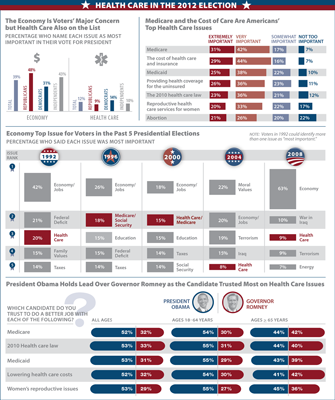
The October 2012 Visualizing Health Policy infographic provides a snapshot of how health care–related issues are shaping the 2012 presidential election, including the percentage of Democrats, Republicans, and independents who named health care or the economy as the issue that is most important in determining their vote for President; which health care issues are considered most important by Americans; how health care has compared with the economy and other issues as the most important issue in the past five elections; and how US adults rank President Obama vs. Governor Romney as the candidate most trusted on various health care–related issues.
Visualizing Health Policy is a monthly infographic series produced in partnership with the Journal of the American Medical Association (JAMA). Each month’s infographic is freely available on JAMA’s website and is published in the print edition of the journal.