KFF designs, conducts and analyzes original public opinion and survey research on Americans’ attitudes, knowledge, and experiences with the health care system to help amplify the public’s voice in major national debates.
To help ensure that access in Medicaid expands to meet anticipated higher demand for care, the health reform law requires states to pay certain physicians Medicaid fees that are at least equal to Medicare’s for a list of 146 primary care services in 2013 and 2014. The idea is to attract new physicians to Medicaid and provide greater support for physicians who already participate. As a result, Medicaid fees paid to certain physicians for primary care services will increase by an unprecedented 73%, on average, in 2013. The cost of fee increase is fully federally funded in 2013 and 2014.
This brief reviews the new provision and explains the Centers for Medicare and Medicaid Services’ November 6, 2012, final rule, which provides the blueprint for implementation of the fee increase. It also discusses implications and policy issues associated with the fee increase.
Rate review is the process by which insurance regulators review health plans’ new or renewed rates for insurance policies in order to ensure that the rates charged are based on accurate, verifiable data and realistic projections of health costs. Historically, state insurance departments have conducted rate review, but under the Affordable Care Act (ACA), federal regulators may review rate increases in some cases.
This fact sheet explains how rate review works and how the ACA has affected it. The document also provides an overview of how states are handling rate review in the individual and small group markets.
This brief provides a summary of the Centers for Medicare and Medicaid Services’ (CMS) March 23, 2012 final rule to implement the ACA provisions relating to Medicaid eligibility, enrollment simplification and coordination. The rule, which is effective Jan. 1, 2014, lays out procedures for states to implement the Medicaid expansion and the streamlined and integrated eligibility and enrollment system created under the ACA. Achieving this goal will require substantial process and system changes among state Medicaid agencies and close coordination between Medicaid, the new health insurance Exchanges and other insurance affordability programs.
We recently wrote about the different ways in which the Affordable Care Act (ACA) changes pathways to health insurance coverage for people with HIV, and chronicled these specifics, as well as several outstanding questions, in a policy brief. As we noted, among the many provisions of the ACA designed to improve care is a new option available to state Medicaid programs to provide “health homes” for Medicaid enrollees with chronic conditions, with a temporary enhanced federal match of 90%. The law specified several chronic conditions that could be targeted by the health home model but did not include HIV. However, the law also authorized the Secretary of Health and Human Services to expand the list, and HHS guidance issued to states in November 2010 signaled that such an addition might be considered. Moreover, HHS has already approved this option for two states that sought permission to include people with HIV in their Medicaid health home models. On November 29, 2012, the Secretary announced that HIV will formally be added to the list of chronic conditions (with a new rule forthcoming), in a move that is seen as signal to states about the importance of considering this population in the health home model in their Medicaid programs.
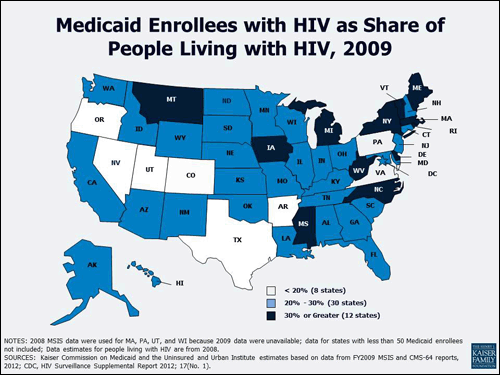
Medicaid, the nation’s principal safety-net health insurance program for low-income Americans, is a critical source of care and coverage for people with HIV, providing them with a range of needed services including antiretrovirals and other prescription drugs. Medicaid is estimated to cover half of people with HIV in regular care and about a quarter of those who have been diagnosed. In 12 states, Medicaid covers 30% or more of the state’s HIV population (see Figure).
Why are health homes important for HIV care and prevention?The idea of a health home is to provide “person-centered”, or “whole-person” care to those with chronic conditions. It has its roots in the longer history of the patient-centered medical home (PCMH) model, and emphasizes the importance of providing medical homes as a way to engage patients and coordinate care to achieve better health outcomes, lower costs, and enhanced quality. The health home has also been an important part of HIV care over the course of the HIV epidemic – and thus far has been a main by-product, and key feature, of the Ryan White HIV/AIDS program, the nation’s federal grant program for uninsured and underinsured people with HIV. What makes the Medicaid health home option significant is it that it provides a platform for adapting successes from Ryan White’s flexible grant funding model to an insurance model, which has historically been much more focused on paying for discrete medical care services.
Today, the HIV “health home” is perhaps even more critical, given that antiretroviral treatment not only provides tremendous health benefits to patients with HIV, but also, recent research has found significantly reduces the risk of transmitting HIV. Yet, data indicate that most people with HIV in the U.S. are falling off the “treatment cascade” – the continuum between HIV diagnosis and viral suppression – with the biggest cliffs occurring between linkage to and retention in care. This demonstrates that people with HIV often need more than primary care and a prescription drug benefit to remain engaged in care. And this is the very type of challenge the health home model is designed to address.
Why a health home in Medicaid? Many individuals served by Medicaid have complex and chronic health care needs. Under the ACA, these beneficiaries are potentially eligible for health home services if they have at least two chronic conditions, have one chronic condition and are at risk for another, or have one serious and persistent mental health condition. The chronic conditions specified in the law were mental health, substance use, asthma, diabetes, heart disease, and being overweight and, as mentioned above, the law authorized the Secretary to expand the list.
While the health home option is important for Medicaid enrollees overall, since many have two or more chronic conditions, it is particularly important for Medicaid enrollees with HIV. Not only are most enrollees with HIV disabled (74%), half are dually or triply diagnosed with mental illness and/or substance use – more than twice the rate among enrollees without the disease (22%) – and Medicaid spending on those who are dually and triply diagnosed is also very high.
States that take up this option for their current enrollees with chronic conditions, as specified in their approved models, will also serve new enrollees in the population they target, including the many low-income, uninsured adults expected to come onto the program in 2014, when the ACA’s new Medicaid eligibility rules take effect (see: http://www.kff.org/healthreform/8348.cfm).
Medicaid health home services and HIV care?Under the ACA, health home services encompass a range of services designed to help manage care for those who are chronically ill:
comprehensive care management;
care coordination and health promotion;
comprehensive transitional care from inpatient to other settings, including appropriate follow-up;
patient and family support;
referral to community and social support services; and
use of health information technology (HIT) to link services.
Of note, these are the very types of services recommended for engaging and retaining people with HIV in care, needed to produce good clinical outcomes and manage costs. To date, however, Medicaid programs have often had limited coverage of these services. This has meant that the Ryan White program, which receives capped funding each year that has never been sufficient to meet all needs, must fill in for these gaps within Medicaid. With the health home option, these services can be paid for by Medicaid – states will receive an enhanced federal match of 90% for these services for two years, and thereafter their regular Medicaid match.
Medicaid health home providers and HIV providers?The ACA specifies the types of providers that can qualify as health homes:
Designated provider: A physician, clinical/group practice, rural health clinic, community health center, community mental health center, home health agency, pediatrician, OB/GYN, or any other provider determined appropriate by the state that meets qualification standards to be set by the Secretary.
Team of health professionals operating with a designated provider: May include physicians and other professionals, such as a nurse care coordinator, nutritionist, social worker, behavioral health professional, or any professionals deemed appropriate by the state.
Health team: The team may include medical specialists, nurses, pharmacists, nutritionists, dieticians, social workers, behavioral and mental health providers, chiropractors, licensed complementary and alternative medicine practitioners, and physicians’ assistants.
These definitions are broad, and could include providers with HIV expertise, including Ryan White providers, if states sought to designate them as part of their health home team model.
What is next?To date, seven states have already received approval to provide Medicaid health homes, another seven have submitted proposals to CMS for health homes, and several others have planning grants to help develop their models. Two states with approval – New York and Oregon – sought and received permission to include people with HIV in their target populations and one with a proposal under review – Alabama – also proposes to include people with HIV. The new rule explicitly including people with HIV is expected to send a signal to states about the importance of considering the health home option for this population.
While stakeholders in the HIV community await the new rule from HHS, there are several issues and questions to consider going forward:
To what extent will the new rule address the need for states to include experienced HIV providers, including Ryan White providers, in their HIV health home teams? Given historic challenges of coordination between state Medicaid and health departments, how will linkages be addressed? This question has bearing on the ACA’s broader Medicaid expansion provisions, where new provider networks will need to be formed and the HIV community has expressed concern about the inclusion of Ryan White providers.
Are there specific lessons to be learned from New York and Oregon about their experiences to date? How have they included HIV providers in their health home teams for people with HIV? What specific efforts were made to engage and retain people with HIV in care?
Ultimately, how will the health home model contribute to both the public health and clinical promise of HIV treatment in those states that adopt it, helping to reduce the size of the “cliffs” along the HIV treatment cascade?
Beginning on January 1, 2014, the Affordable Care Act (ACA) requires that all non-grandfathered individual and small group health insurance plans sold in a state, including those offered through an Exchange, cover certain essential health benefits (EHBs).
As it stands today, many plans offered in the individual and small group markets lack access to key benefits; the Department of Health and Human Services (HHS) estimates that 62% of health plan enrollees in the individual market do not have coverage for maternity services and almost one-fifth of enrollees lack mental health service coverage. Essential health benefits, at a minimum, will have to include ambulatory patient services, emergency services, hospitalization, maternity and newborn care, mental health and substance use disorder services, prescription drugs, rehabilitative and habilitative services, laboratory services, preventive and wellness care, chronic disease management, and pediatric dental and vision care. Approximately 68 million people are anticipated to access care covered by the essential health benefit requirement once the ACA is fully implemented.
In a 2011 bulletin and a proposed rule released in November, HHS explained that each state should choose from a range of existing and popular (as measured by enrollment) health insurance plans to serve as an EHB benchmark plan. States can select from the three largest small group health insurance products, the three largest state employee health plan options, the three largest federal employee health plan options, or the largest commercial HMO plan sold in the state. If the state fails to select a benchmark by December 26, 2012, HHS has proposed that the small group health plan with the largest enrollment will be selected by default. The benchmark plan will define the standard set of benefits that must be covered by plans in that state. Insurers in every state will be required to offer plans with benefits “substantially equal” to those found in a state’s benchmark plan. Importantly, the EHB benchmark defines only what benefits must be covered, not what the cost-sharing levels will be. Carriers will develop the cost-sharing features for the products they offer based on the actuarial values for the different metal level plans (bronze, silver, gold, and platinum) spelled out in the ACA.
The ACA specifies that if states require plans to cover services beyond those defined as EHBs by the law, for example certain state-mandated benefits, states must defray the costs of those benefits. However, the proposed rule issued by HHS indicates that for at least 2014 and 2015, if a benchmark plan that is a small group plan or a state employee plan includes state-mandated benefits, those benefits will be considered essential health benefits and the state will not be required to defray any additional costs.
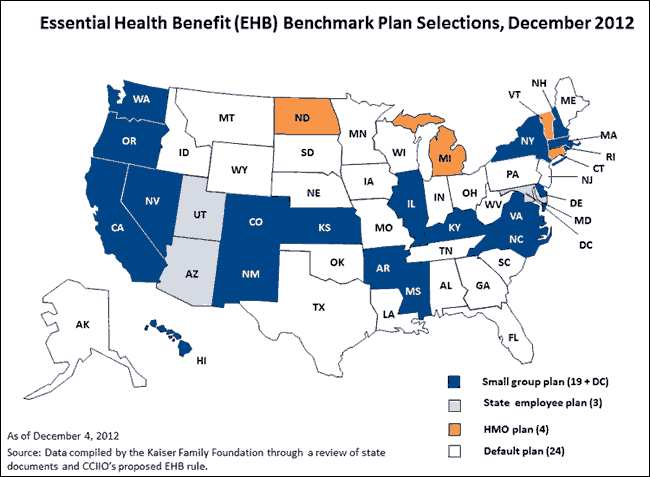
While nearly all states have considered their EHB benchmark options, our review of states’ decisions around EHB shows that only 26 states plus the District of Columbia have already recommended an EHB plan or concluded the default plan is acceptable (see figure above). So far, twenty states and the District of Columbia have selected a small group plan as the state’s EHB benchmark. Three states, Utah, Arizona, and Maryland, chose a state employee health plan as the benchmark. North Dakota, Connecticut, Michigan, and Vermont opted to make their state’s largest commercial HMO plan the EHB benchmark. Nebraska’s Governor submitted an EHB recommendation for a state-defined benefit plan; however, the plan was ultimately not approved by HHS.
Many EHB benchmark plans do not include services in all of the required benefit categories. In those cases, the proposed rule provides that states should identify supplemental coverage to complete their EHB benchmark packages. The proposed rule specifies that, except for habilitative services, the benchmark plan be supplemented by adding benefits for any missing categories from another benchmark plan. For habilitative services, states may define the services to be included in that category or, if they choose not to make that determination, insurers must provide parity with rehabilitative services or define which habilitative services to cover and report to HHS. Almost every state will need to supplement its benchmark plan for pediatric dental and/or pediatric vision services; the proposed rule allows states to select these services from the Federal Employees Dental and Vision Insurance Program (FEDVIP) or the state’s Children’s Health Insurance Program (CHIP). HHS has determined that 20 selected EHB benchmark plans or default plans do not include habilitative services.
Moving forward, HHS will review and approve states’ benchmark recommendations until the December 26, 2012 deadline. With open enrollment in the Exchanges beginning in October 2013, carriers are likely eager for states to finalize their EHB decisions so they can begin analyzing the required benefits and modifying their products to meet the new standards.
Final update made on December 4, 2012 (no further updates will be made)
Establishing the Exchange
Despite previously supporting Alabama’s implementation of a state-based health insurance exchange, Governor Robert Bentley (R) announced on November 13, 2012, the state will default to a federally-facilitated exchange.1
Prior to the decision, Governor Bentley issued Executive Order 17 which created the Alabama Health Insurance Exchange Study Commission to recommend how Alabama should establish a health insurance exchange.2 The Governor appointed an Executive Director of the Alabama Health Insurance Exchange to work with stakeholders and other state agencies on implementing the recommendations of the Commission.3After meeting for three months, the 15-member Health Insurance Exchange Study Commission released final recommendations in late November 2011 to the Governor and Legislature endorsing the establishment of the “Alabama Health Insurance Marketplace.”4 Additional recommendations included, establishing a new quasi-public authority to operate the exchange, following a free market facilitator model, establishing one administrative entity to oversee both the individual and small business exchanges while keeping the risk-pools for both separate, and funding the exchange through fees on all products sold in the individual and small group markets inside and outside the exchange.5
In May 2012, the Governor threatened to veto a bill establishing a state exchange, which passed in the House, if it cleared the Senate before the Supreme Court ruled on the constitutionality of the Affordable Care Act (ACA). The bill failed at the close of the 2012 legislative session, as did a similar bill in 2011.6
Governor Bentley signed into law a measure in May 2012, prohibiting health plans operating within an Alabama exchange from offering abortion services except in cases of life endangerment, rape, or incest.7
Information Technology (IT): In February 2012, the Office of the Alabama Health Insurance Exchange, within the Department of Insurance, released a Request for Information on the IT systems necessary to develop the state’s exchange.8 The state anticipated leveraging existing technology infrastructure to build components of the exchange related to screening, applications, and eligibility determinations. In June 2012, the Department released a Request for Proposals soliciting a subcontractor to build an eligibility and enrollment system capable of making determinations for the state’s Exchange, Medicaid, and the Children’s Health Insurance Program (CHIP); however, the award was put on hold until after the November elections.9 Alabama was also participating in the “Enroll UX 2014” project, which is a public-private partnership creating design standards for exchanges that all states can use.10
Alabama is focusing on a significant Medicaid eligibility system upgrade. The state received CMS approval for an enhanced federal match to assist in financing IT upgrades of the state’s Medicaid eligibility and enrollment system.11 The Alabama Medicaid Agency released a Request for Proposals earlier this year soliciting subcontractors to implement the new system which will meet future exchange interoperability standards.12 Work on the Medicaid eligibility system was anticipated to begin in April 2012.
Essential Health Benefits (EHB): The ACA requires that all non-grandfathered individual and small-group plans sold in a state, including those offered through the Exchange, cover certain defined health benefits. Since Alabama has not put forward a recommendation, the state’s benchmark EHB plan will default to the largest small-group plan in the state, Blue Cross Blue Shield of Alabama 320 Plan PPO.
Exchange Funding
The Alabama Department of Insurance received a federal Exchange Planning grant of approximately $1 million in 2010. In November 2011, the Department was awarded an $8.6 million federal Level One Establishment grant to support contracts and activities around exchange implementation.13
Alabama, along with nine other states, received technical assistance from the Robert Wood Johnson Foundation through the State Health Reform Assistance Network; this assistance included help with setting up health insurance exchanges, expanding Medicaid to newly eligible populations, streamlining eligibility and enrollment systems, instituting insurance market reforms and using data to drive decisions.14
Next Steps
The federal government will assume full responsibility for running a health insurance exchange in Alabama beginning in 2014.
This data spotlight report examines trends in the Medicare Advantage marketplace, including the choices available to Medicare beneficiaries in 2013, premium levels and other plan features. It finds almost all plans offered this year will be available again in 2013, despite concerns that reductions in payments to plans under the Affordable Care Act would result in widespread pullouts from Medicare Advantage plans. If all beneficiaries choose to remain in their current plans, monthly premiums would increase about 10 percent, or $4, on average.
The analysis also examines the types of plans available (HMOs, PPOs, etc.), changes in out-of-pocket limits, and the availability of special needs plans.
The spotlight is authored by researchers at Mathematica Policy Research and the Kaiser Family Foundation.
Washington is the first state to sign a memorandum of understanding (MOU) with the Centers for Medicare and Medicaid Services (CMS) to test a managed fee-for-service (FFS) financial alignment model for beneficiaries who are dually eligible for Medicare and Medicaid, beginning on April 1, 2013. Washington’s managed FFS demonstration uses Medicaid health home services to coordinate care for high risk/high cost dual eligible beneficiaries with chronic conditions. This policy brief summarizes key aspects of the demonstration, including the target population; enrollment; care delivery model; benefits package; continuity of care provisions; financing; grievance and appeals system; disability accommodations; stakeholder engagement; oversight, reporting and quality measures; evaluation; governing authority and waivers; and implementation plans.
This fact sheet examines the similarities and differences between the five-year demonstrations in Massachusetts and Washington state to integrate care and align financing for people dually eligible for Medicare and Medicaid. The states finalized memoranda of understanding (MOUs) with the Centers for Medicare and Medicaid Services in fall 2012, and the demonstrations in each state are set to begin in April 2013.
The Medicaid program provides health and long-term care coverage for low-income families who lack access to other affordable coverage options and for individuals with disabilities for whom private coverage is often not available or inadequate. Medicaid also plays a pivotal role in state budgets, both as an expenditure and a source of federal revenues. This fact sheet provides a brief overview of Medicaid’s role in state budgets, the impact of the recession, current fiscal conditions, as well as results from the most recent annual survey of Medicaid programs conducted by the Kaiser Commission on Medicaid and the Uninsured and Health Management Associates.