Medicaid Balancing Incentive Program: A Survey of Participating States

Authors: Molly O'Malley Watts, Erica L. Reaves, and MaryBeth Musumeci
Published: Jun 5, 2015

Executive Summary

Eighteen states are currently participating in the Medicaid Balancing Incentive Program (BIP) to increase access to home and community-based services (HCBS) as an alternative to institutional care. Established by the Affordable Care Act, BIP authorizes $3 billion in enhanced federal funding from October 2011 through September 2015. As a condition of participation in BIP, states must implement certain structural changes and reach specific financial benchmarks by September 2015, spending at least 25 percent (1 state) or 50 percent (the remainder of states) of their total Medicaid long-term services and supports (LTSS) dollars on HCBS. During the summer of 2014, the Kaiser Family Foundation’s Commission on Medicaid and the Uninsured surveyed BIP states about basic program information, progress with implementing the BIP structural requirements, stakeholder engagement, evaluation activities, and the use of enhanced federal funds in support of other Medicaid LTSS rebalancing efforts.

Key findings from the survey include the following:

  • States report that BIP is helping them achieve their goal of rebalancing LTSS in favor of HCBS. Medicaid LTSS spending on HCBS increased in all 18 BIP states, with 14 states reporting  spending growth of 25 percent or more between 2009 and 2014 (Figure 1).
  • BIP is helping states make further progress in streamlining and standardizing the infrastructure that facilitates beneficiary access to HCBS by establishing a no wrong door/single entry point system, conflict-free case management, and a core standardized assessment.
  • BIP supports LTSS rebalancing efforts by building on existing Medicaid HCBS options available to states. For example, seventeen states used BIP funds to expand Medicaid HCBS waivers by adding slots or services.
  • States report some common challenges encountered to date related to measuring quality, coordinating with capitated managed LTSS delivery systems, and implementing the required structural reforms.
  • While BIP has helped states make progress in LTSS rebalancing, the time-limited nature of the program creates some challenges and leaves open questions about its future.
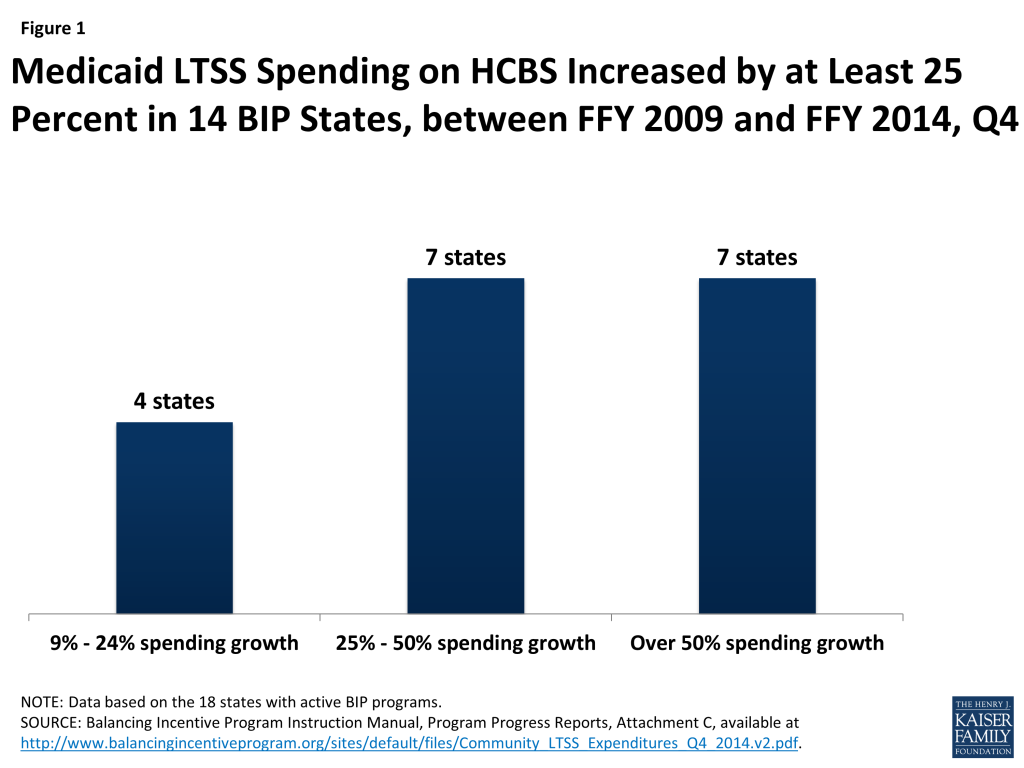
Figure 1: Medicaid LTSS Spending on HCBS Increased by at Least 25 Percent in 14 BIP States, between FFY 2009 and FFY 2014, Q4

States are making progress under BIP towards a more unified person-centered LTSS system. The availability of enhanced funding is increasing access to HCBS, and BIP funds are creating the opportunity to build upon existing Medicaid LTSS rebalancing efforts already underway, including Money Follows the Person.  The structural reform requirements are helping to streamline access to and information about LTSS and reduce administrative inefficiencies that existed in many states’ eligibility determination processes. Collectively, these system reform efforts are helping states reach a desired goal of serving Medicaid beneficiaries with LTSS needs in the most integrated setting. After BIP ends in September 2015, further work will be needed to maintain the costs of the structural changes and to monitor how they are working, particularly within the context of managed care delivery systems.

Report

Introduction

Developing and expanding home and community-based alternatives to institutional care is a priority for many state Medicaid programs, and significant progress has been made over the last twenty years to increase the percentage of long-term services and supports (LTSS) dollars that go toward providing HCBS (Figure 2).  The Affordable Care Act (ACA) established the Medicaid Balancing Incentive Program (BIP) as one option available to states to further support LTSS rebalancing efforts.
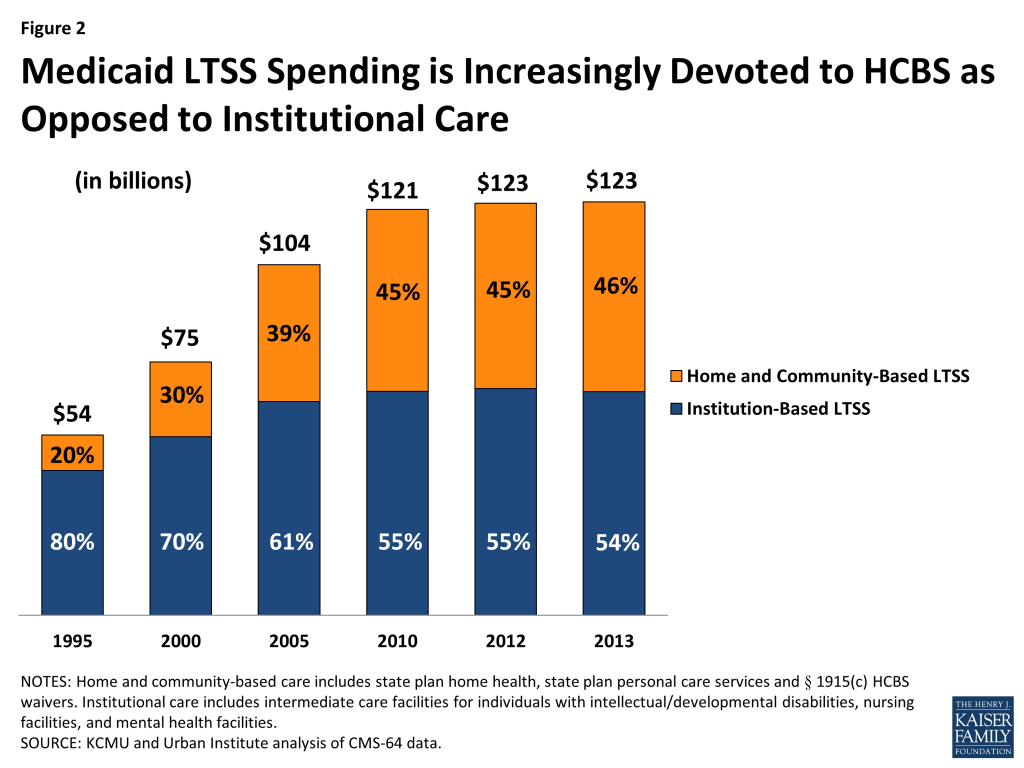
Figure 2: Medicaid LTSS Spending is Increasingly Devoted to HCBS as Opposed to Institutional Care

As of May 2015, eighteen states are participating in BIP (Figure 3).  Twenty-one of 38 eligible states were approved for BIP; however, three states are no longer participating. BIP authorizes $3 billion in enhanced federal funding from October 2011 through September 2015 for the provision of new or expanded home and community-based services (HCBS) as an alternative to institutional care.
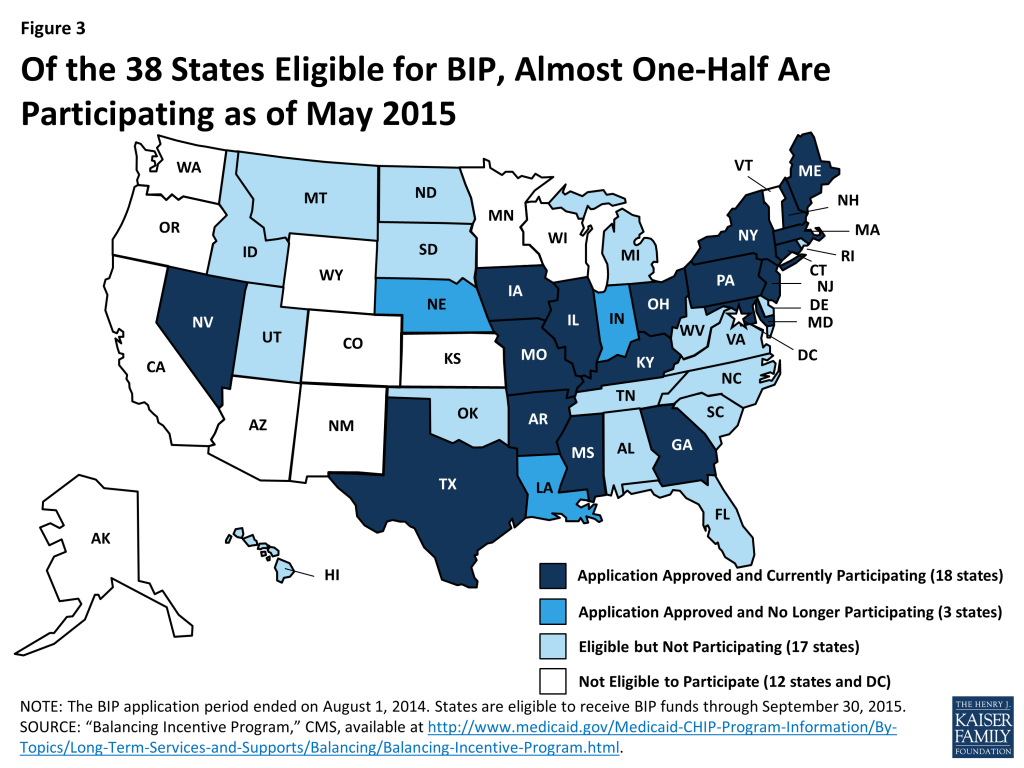
Figure 3: Of the 38 States Eligible for BIP, Almost One-Half Are Participating as of May 2015

Under BIP, states that devoted less than 50 percent of their total Medicaid LTSS spending to HCBS in Fiscal Year (FY) 2009 are eligible for an enhanced Federal Medical Assistance Percentage (FMAP) for all Medicaid HCBS provided from October 2011 through September 2015. States that spent less than 25 percent (1 state) must adopt a target of 25 percent of total LTSS spending on HCBS by September 2015, and can receive a five percent increase in their FMAP. States that spent between 25 to 50 percent of their Medicaid LTSS dollars on HCBS (the remainder of states) must adopt a target of 50 percent of total LTSS spending on HCBS and are eligible to receive a two percent increase (Figure 4). BIP states must use the enhanced federal funds to expand or enhance HCBS and may not adopt more restrictive eligibility standards than were in place on December 31, 2010.1 

In addition to reaching the financial benchmarks, states participating in BIP must make the following three structural changes in their Medicaid LTSS delivery systems:

  • A “no wrong door”/single entry point system (NWD/SEP) for all LTSS;
  • Conflict-free case management (CFCM) services (to avoid conflicts among agencies that provide both individual assessments and service delivery); and
  • A core standardized assessment (CSA) instrument to determine eligibility for HCBS.2 
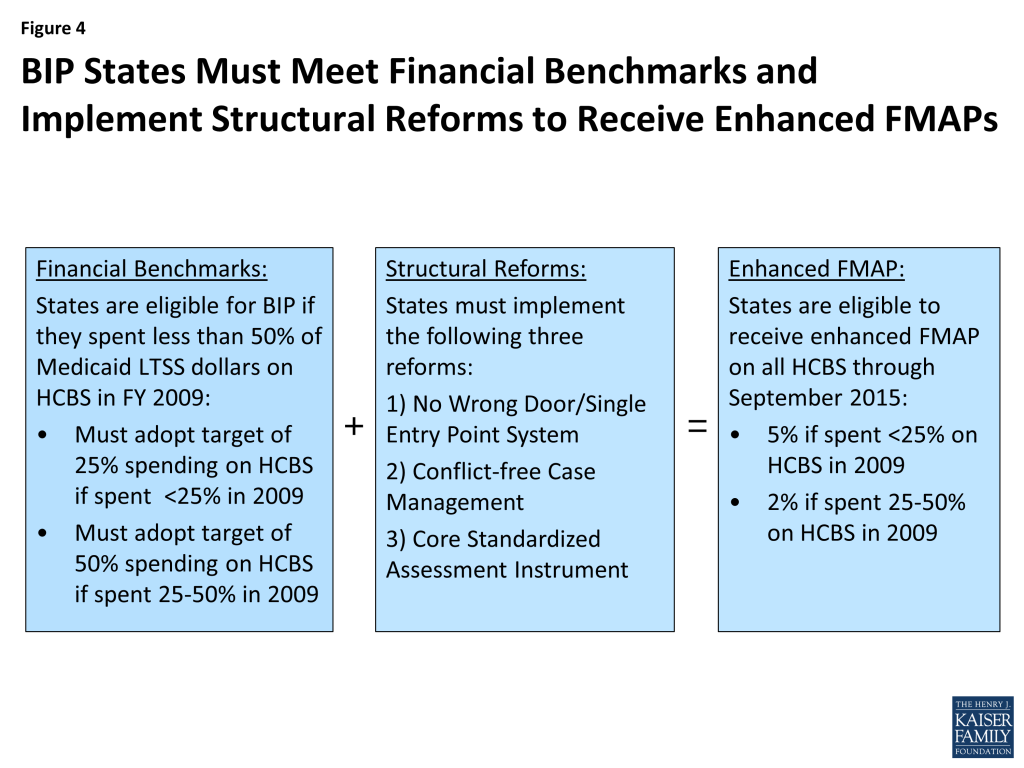
Figure 4: BIP States Must Meet Financial Benchmarks and Implement Structural Reforms to Receive Enhanced FMAPs

Methodology

During the summer of 2014, the Kaiser Family Foundation’s Commission on Medicaid and the Uninsured surveyed BIP states about basic program information, progress with implementing the BIP structural requirements, stakeholder engagement, evaluation activities, and the use of enhanced federal funds in support of other Medicaid LTSS rebalancing efforts. Each state approved to participate in BIP as of September 2014 (21 states) received the written survey instrument, and 17 states (81%) submitted a complete questionnaire. Of the 17 states that responded, 16 states are currently participating in BIP, and one state (LA) is no longer participating. Four states (AR, GA, IN, and NE) opted not to participate in the survey; Indiana indicated its intent to withdraw from BIP, and Nebraska was newly approved in September 2014, but has since withdrawn from BIP. Given that states were at various stages of implementation during the survey period (May through August 2014), not all of the survey questions were applicable to every state’s program. States ineligible to participate in BIP (12 states and DC) as well as states that were eligible but not participating (17 states) were not surveyed. The data summarized here were provided directly from BIP Project Directors and other state staff. The full survey instrument can be found in Appendix A of this report.

Key Findings

1. States report that BIP is helping them achieve their goal of rebalancing LTSS in favor of HCBS.

States’ motivations for pursuing BIP were to gain access to enhanced federal funding to support HCBS, improve their LTSS eligibility determination and service planning infrastructure, and expand access to Medicaid LTSS relative to institutional services.

BIP represents a significant funding opportunity for LTSS delivery reform and rebalancing LTSS expenditures. States cited the ability to access the enhanced federal match as a major motivation for pursuing BIP. States, such as Connecticut and Maryland, that are taking advantage of the Community First Choice (CFC) option, with its own enhanced funding, also have the ability to stack enhanced FMAPs and further LTSS rebalancing efforts.

Project Directors reported that BIP provided an opportunity to fund some needed infrastructure changes and quality improvement efforts, including the CSA and the NWD/SEP system. BIP has enabled states to streamline access to and information about community services and supports through implementation of the required structural changes. For example, states noted that by implementing a standardized assessment tool, individuals would not have to go through multiple assessment processes associated with different waivers to find the one that best meets their needs.

States provided examples of how BIP supported structural reforms in their LTSS systems, such as the following:

Illinois cited the policy expertise and access to technical assistance available through BIP as a major motivation for pursuing BIP and providing critical resources to adopt and implement structural changes in the state’s LTSS system.

Connecticut reported that BIP helped the state focus on building consensus across departments to develop a NWD/SEP system and common assessment tool.

States also reported that BIP helped them expand access to HCBS in lieu of institutional services.  For example, Illinois stated that BIP helped facilitate the implementation of consent decrees resulting from three Olmstead class action lawsuits impacting Medicaid beneficiaries residing in institutional settings. The settlements resulted in additional funds devoted to transition assistance and other HCBS so that individuals can live in the most integrated community-based setting appropriate for their needs.

Medicaid LTSS spending on HCBS increased by more than one quarter in 14 BIP states between 2009 and 2014.

Eighteen states reported positive gains in the amount of Medicaid LTSS spending devoted to HCBS since 2009, with 14 states increasing HCBS spending by at least 25 percentage points between 2009 and the end of 2014 (Figure 5).  Eight states reported already exceeding the target of 50 percent of LTSS spending on HCBS by the fourth quarter of 2014, while the remaining BIP states are making progress toward their spending goal (Table 1). The one state with a 25 percent spending target (MS) reported exceeding its target by the fourth quarter of 2014. Since 2009, the year on which eligibility for BIP was based, Mississippi (111%) and Ohio (86%) havemade the largest gains in the percentage of total LTSS dollars devoted to HCBS.
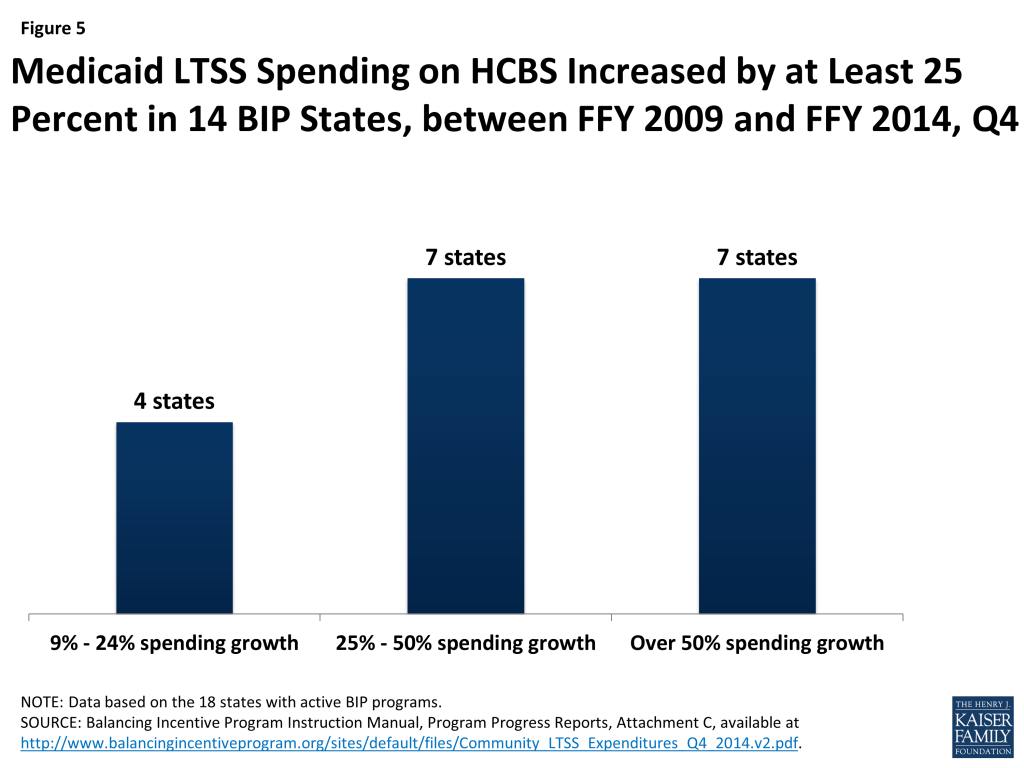
Figure 5: Medicaid LTSS Spending on HCBS Increased by at Least 25 Percent in 14 BIP States, between FFY 2009 and FFY 2014, Q4
Table 1: Share of Total Medicaid LTSS Dollars Devoted to HCBS in BIP States
StateShare of Total Medicaid LTSS Dollars Devoted to HCBSPercentage Change from FFY 2009 to FFY 2014, Q4
FFY 2009FFY 2014, Q4
Arkansas29.8%49.7%66.8%
Connecticut44.1% 48.1%*  9.1%
Georgia37.4%47.5%27.0%
Illinois27.8%44.3%59.4%
Iowa39.8%51.1%28.4%
Kentucky31.1%49.5%59.2%
Louisiana**36.4%44.8%23.1%
Maine49.1%56.8%15.7%
Maryland 36.8%58.9%60.1%
Massachusetts44.8%65.1%45.3%
Mississippi14.4%30.4%111.1%
Missouri40.7%56.6%39.1%
Nevada41.6%48.8%17.3%
New Hampshire41.2% 46.5%*12.9%
New Jersey26.0%46.1%77.3%
New York46.7%58.8%25.9%
Ohio32.5%60.5%86.2%
Pennsylvania33.0%45.1%36.7%
Texas46.9%58.8%25.4%
NOTES: Table omits 2 states (IN and NE) that withdrew from BIP and did not participate in KCMU’s survey. *FFY 2014 Q4 data are not available, so FFY 2014 Q3 data are shown for CT and NH. **As of December 2014, Louisiana is no longer participating in BIP.SOURCE: Balancing Incentive Program Instruction Manual, Program Progress Reports, Attachment C, available at http://www.balancingincentiveprogram.org/sites/default/files/Community_LTSS_Expenditures_Q4_2014.v2.pdf.

BIP Project Directors were asked to report on strategies that are helping states reach their Medicaid HCBS spending goal (of 25% or 50% of total Medicaid LTSS dollars). The most frequently reported strategy was increasing the number of transitions from institutions to HCBS. Several states cited building upon their Money Follows the Person (MFP) demonstration achievements in rebalancing as helping them make progress toward the goal of increasing spending on HCBS. These achievements included improvements to IT systems and streamlining access to services for beneficiaries. States also reported that increasing the number of HCBS waiver slots and increasing outreach and education efforts around HCBS options were effective approaches to increase both total and relative HCBS spending. Other responses included: financial incentives for managed care organizations (MCOs) to provide increased community capacity, implementation of managed long-term services and supports (MLTSS) programs, institutional payment rate reductions, and implementing CFC.

All BIP states anticipate that the program’s required structural reforms will increase beneficiary access to HCBS.

Several states anticipate a significant increase in beneficiary access to HCBS, as a result of BIP’s structural requirements and as barriers to access are removed. Streamlined eligibility processes and access through NWD/SEP entities are expected to increase access to HCBS. Across the states, the development and expansion of the NWD/SEP system seeks to provide unbiased information to individuals seeking LTSS. The initial screening is used to prioritize those who are most at risk for institutionalization, and the CSA ensures that an objective tool is used across multiple programs to assess the functional needs of individuals applying for services.  The CSA helps ensure that beneficiaries do not have to repeat their stories, and increased efficiency in the assessment and service plan development processes may reduce delays in service initiation.State examples in this area included the following:

Iowa designed an integrated database that supports the information and referral functions of its toll-free number and website with a goal of expanding access to information about LTSS regardless of funding source or level of need. Transportation information will also be included in the database and is anticipated to increase beneficiary access to HCBS.

In Texas, individuals will be able to access Texas’ initial screening instrument via the web, telephone, or by visiting an Aging and Disability Resource Center (ADRC). The initial screening will cover all areas of LTSS and will provide individuals with a list of referrals to the agencies that can best meet their needs.  Additionally, the agencies will receive the referral information and will contact the individual, if the person consents. Collectively, these process improvements have the potential to allow quicker, more efficient access to HCBS for individuals and families (including caregivers).

2. BIP is helping states make further progress in streamlining and standardizing the infrastructure that facilitates beneficiary access to HCBS.

Half of BIP states had a NWD/SEP system in place prior to BIP, and states are using BIP to further develop these systems to increase beneficiary access to HCBS.

A NWD/SEP system aims to provide individuals with information about HCBS, determine eligibility, and enroll individuals in services. NWD/SEP systems can take many different forms depending on how they are defined.3  In many states, the ADRC networks serve as the NWD/SEP system, providing outreach, access to information, and referrals for public and non-profit community-based providers. As a result of BIP, Project Directors reported making changes to new or existing NWD/SEP systems including implementing enhanced options counseling, coordinating and integrating data across multiple entry points, expanding local ADRC coverage areas, streamlining access to HCBS across different disability populations and care settings, and collaborating across government agencies and programs to implement a more unified information and referral system for LTSS. Project Directors noted that NWD/SEP system improvements could be achieved through meeting BIP infrastructure requirements that include designation of NWD/SEP systems, a website about HCBS options in the state, and a statewide 1-800 number that connects individuals to the NWD/SEP.

The following are selected state-specific examples of progress toward implementing a NWD/SEP system as a result of BIP:

Prior to BIP, Missouri’s state Medicaid and collaborating agencies interacted at the local level on a daily basis via phone and email. BIP funding has allowed the state to enhance the existing process so that any of the state agencies, HCBS providers, other stakeholders, and the public can utilize the toll-free number and website to access information about HCBS.

Connecticut is integrating its NWD/SEP eligibility system as a result of BIP. The new system will automate and coordinate functional assessments and financial eligibility determinations for LTSS. It will also include a predictive modeling feature that will assist both with pre-screening applications as well as linking the applicant with an appropriate case manager based on service needs. Through the creation of a personal account within the NWD/SEP system, beneficiaries will be able to request non-medical transportation services and view their personal health record, assessments, care plans, and Medicaid benefit statement.

Maine is expanding its NWD/SEP system to include mental health entities, an LTSS website, the state’s financial eligibility determination agency, Center for Independent Living, Medicaid eligibility office, and the 2-1-1 toll-free information line. Maine’s 2-1-1 will be strengthened and enhanced under BIP by becoming Maine’s comprehensive statewide directory for information and referrals regarding Maine’s LTSS. Assistance from Maine’s 2-1-1 could include triage and referral, assistance with pre-screening/application, and transfer to an assisting agency within Maine’s NWD/SEP system. Training for Maine’s 2-1-1 call center operators will be expanded to include information about Medicaid LTSS eligibility, the functional assessment process, and enhancement of the 2-1-1 resource database. State NWD/SEP system entities will also be trained on all available LTSS for adults and children with physical, intellectual, and behavioral health disabilities. Trainings for NWD/SEP entities will include information on the assessment process, eligibility, contracted agencies, and prescreening.

Nearly three-quarters of BIP states (12 of 17) had a CFCM system in place prior to BIP, for at least some of their HCBS programs, and states are using BIP to expand firewalls and CFCM across all medical and LTSS services.

As defined in CMS guidance, conflicts may arise when a social service organization serves as both the agency assessing the individual for services and the agency delivering the services.4  This can result in either over or under utilization of services or development of a care plan that does not promote independence and is not person-centered. While there is no template for CFCM for states to insert into the design of their existing LTSS systems, CMS did provide guidance on some key elements of a CFCM system, including a care plan that is free from bias and influence.5  Key elements in designing a CFCM system include: clinical or non-financial eligibility determination separate from direct service provision, use of case managers and evaluators of beneficiaries’ need for services not related to the consumer, ensuring robust oversight and monitoring, having clear pathways for grievances and appeals, and facilitating meaningful stakeholder engagement.6 

While most states had some elements of CFCM in place prior to BIP, some states noted their behavioral health Medicaid programs were not conflict-free (for example, individual providers could both determine eligibility and offer services) and are working to mitigate this issue for these services. States with existing CFCM systems reported a number of strategies in place to mitigate potential conflicts including administrative firewalls, beneficiary choice, data driven assessments, robust quality management programs, grievance procedures and state oversight.

Some state-specific examples include:

Texas monitors CFCM through state approval of care plans, a beneficiary satisfaction survey, analysis of referrals, a beneficiary complaint system, and data-driven assessments.

Iowa held a series of stakeholder engagement sessions with a representative group of case managers to capture current model practices and garner support for recommended changes to state regulations to formalize CFCM procedures. In addition, the state Medicaid agency’s HCBS Quality Assurance Team and state Division of Mental Health and Disability Services will integrate questions to evaluate CFCM into routine surveys of all providers. The state’s program integrity unit is also conducting quarterly analyses to determine areas of potential concern and monitor potentially problematic utilization patterns, such as service systems that provide both case management as well as home and community-based waiver services.

As a result of BIP, states are working to develop core standardized assessment instruments; prior to BIP, almost all (15 of 17) states were using multiple population-specific functional needs assessment instruments.

The goal of BIP’s CSA requirement is to develop an instrument that determines eligibility for Medicaid HCBS, identifies an individual’s service and support needs, and informs their care plan.7  Per CMS guidance, the CSA instrument and assessment process should be uniform for a given population across the state. The CSA should capture a Core Dataset (CDS) that includes activities of daily living (ADLs), instrumental activities of daily living, medical conditions/diagnoses, cognitive functioning/memory needs, and behavioral needs. Prior to BIP, some states used the same tool to assess seniors and non-elderly adults with physical disabilities; however, most tools were population specific and varied by state. Implementing a standardized automated assessment instrument may help states reduce inefficiencies and administrative burdens associated with having multiple assessments and more equitably allocate services across populations. States can also use the assessment data collected to inform program planning, budgeting, quality monitoring, and reporting.

Some states are further along than others in meeting the CSA requirements. Maine’s existing assessment tools capture all the required CSA domains so the state is now focused on strengthening the coordination of the assessment and referral process. Connecticut developed a single assessment tool for all populations receiving Medicaid services; to start, the state built a cross walk from each of the nine existing tools to the common standard assessment. The state added additional questions specific to each population to the tool. The universal assessment tool will then be automated within the state’s new eligibility management system. In Maryland, BIP provided funding to implement a CSA, including the testing, training, and programming of the tool within a web-based tracking system, and an enhanced web-based eligibility tracking system, including a telephonic time-keeping system for personal assistance providers.

Nevada will be moving to a CSA and converting several manual LTSS processes to more automated IT functions. New York is automating population-specific instruments with the core data set into one system. Texas is adding questions to its assessments related to physical disabilities and mental illness.  These questions allow all LTSS beneficiaries an opportunity to discuss mental health issues and limitations related to ADLs.

3. BIP supports LTSS rebalancing efforts by building on existing Medicaid HCBS options available to states.

BIP funds are creating opportunities for states to build on existing Medicaid LTSS funding streams, including Money Follows the Person, to increase beneficiary access to HCBS.

BIP is helping states address longstanding barriers to rebalancing, such as decentralized information and referral systems and lack of standardization across assessment tools. All states that participate in BIP also participate in the MFP demonstration. States reported building upon infrastructure changes and improvements made with MFP to implement BIP. BIP and MFP share a common goal of rebalancing through the use of enhanced funding, with MFP focused on institutional to community transitions and BIP focused on infrastructure reforms. Both programs are designed to work together and across populations in order to expand HCBS options. Relying on stakeholder input and lessons learned from MFP, states reported building broader infrastructure changes, such as a NWD/SEP system or making further improvements to their IT systems and internal processes for a more unified efficient LTSS system.

Most states are using BIP funding to expand HCBS by increasing the number of waiver slots available and provide more beneficiaries with access to HCBS.

Fifteen (of 17) states reported using BIP funding to expand HCBS waiver programs (Figure 6). Of those states, 14 used BIP funding to increase the number of waiver slots available and three states added services to existing waivers. Examples of new services include care management, health promotion and education programs, individual and family support services, substance abuse treatment services, and support broker services for individuals who self-direct their services. Six states (CT, IA, MD, MS, NY and TX) used BIP funding to implement new or expanded ACA LTSS initiatives including CFC, health homes, and the § 1915(i) HCBS state plan option.
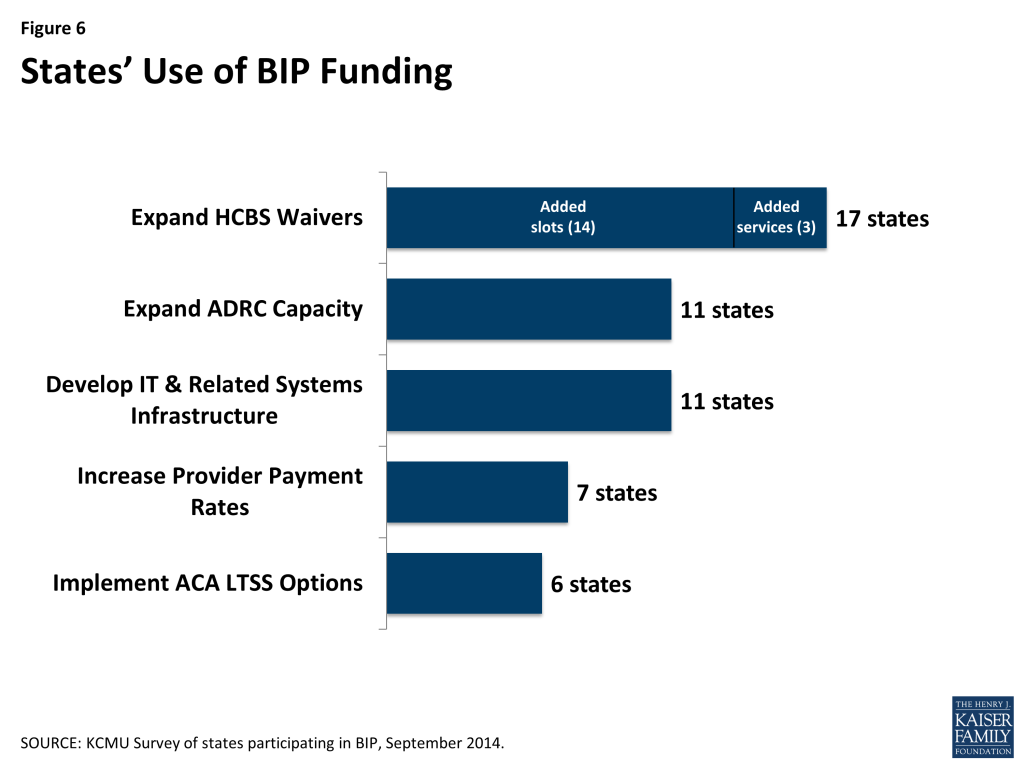
Figure 6: States’ Use of BIP Funding

Iowa participates in MFP and added the health home state plan option and the § 1915(i) HCBS state plan option for adults with serious emotional disturbance. By participating in BIP and expanding these HCBS options, Iowa is moving towards rebalancing LTSS spending.

All 17 BIP states that responded to the survey reported using BIP funds to target specific Medicaid populations including seniors, individuals with physical disabilities and individuals with I/DD. Fifteen states are using BIP funds to target individuals with mental illness, and 12 states are targeting individuals residing in institutions who are transitioning to the community.

States are using BIP funds to support other LTSS initiatives including the ADRC grant programs, training initiatives, and provider payment rate increases.

Most BIP states (13 of 17) reported building on existing ADRC networks to develop the infrastructure needed to develop a NWD/SEP system. Enhancing the state’s ADRC network by increasing their number and coverage areas, requiring all ADRCs to achieve fully functional status, and better integrating Medicaid functional and financial eligibility determination processes will facilitate access to HCBS. BIP Project Directors also reported using the enhanced funds to support the following LTSS initiatives: streamlining or automating beneficiary screenings/assessment (13 states), expanding ADRC capacity (11 states), developing IT and related systems infrastructure (11 states), offering training initiatives for beneficiaries, providers, or health plans (10 states), improving access to substance abuse/rehabilitative services (9 states), and increasing provider payment rates (7 states).

BIP also created opportunities for collaboration across state agencies and with various stakeholder groups. All BIP Project Directors reported partnering with other state agencies, and the majority of states listed partnering with ARDCs (16 states) and Area Agencies on Aging (14 states). Other partnerships included IT and/or technical assistance providers (13), information and referral providers or resource network members (12 states), community behavioral health providers (12 states), and disability service providers (12 states).

States are collecting a variety of quality data through BIP, but there is little overlap in these measures across HCBS programs and states, which can lead to challenges in evaluating HCBS quality.

States’ varied responses to the quality/evaluation survey question illustrate the challenges associated with uniformly assessing HCBS quality. BIP states are required to collect three types of data: service data (claims/encounter data), quality data linked to population-specific outcomes (captures provider quality of care), and outcome measures (assesses beneficiary satisfaction). States must report to CMS the data and measures that will be collected and the methodology for collecting those measures.8  States most frequently cited ongoing review of HCBS waiver programs, NCQA/HEDIS measures, and the Medicaid Adult Health Quality Measures as their mechanisms in place to track quality. CMS has also awarded Testing Experience and Functional Assessment Tools (TEFT) planning grants to states to use health information technology to develop HCBS quality measures.9  Six BIP states (CT, GA, KY, LA10 , MD, NH) have received TEFT funding as of November 2014 (see Text Box 1).Quality initiatives related to outcomes data focused on the development of measures by population to assess beneficiary and family caregiver experience and satisfaction. Examples include the National Core Indicators and the Participant Experience Survey, as well as the MFP Quality of Life survey for those transitioning from institutions to the community. Other selected examples included Consumer Assessment of Healthcare Providers and Systems (CAHPS), critical incident reporting, and the Mental Health Statistics Improvement Programs Survey. Where possible, states reported choosing BIP reporting measures that overlapped with those used for other HCBS initiatives (for example, health homes and the financial alignment demonstrations for dual eligible beneficiaries) to increase overlap and to move toward standardized quality metrics.

Text Box 1: Measuring Quality in HCBS Programs ViaTesting Experience and Functional Tools (TEFT) Grants

The federal Testing Experience and Functional Tools (TEFT) planning and demonstration grants make available up to $45 million ($4 million per awardee) through November 2017 to states to support the collection, testing, and reporting of adult quality measures for use in Medicaid HCBS programs. Any state may apply to participate in one or more of the following TEFT components: (1) test and evaluate a modified set of Continuity Assessment Record and Evaluation (CARE) functional capacity measures; (2) test and evaluate new measures of beneficiary experience in Medicaid HCBS programs; (3) identify and align health information technology practices; and (4) identify and align electronic LTSS standards.Of the nine states with TEFT planning grants, six (CT, GA, KY, LA, MD, and NH) are participating in BIP. All six BIP-TEFT states plan to test the beneficiary experience survey, and four states (CT, GA, KY, LA) plan to test the CARE assessment.  States may use TEFT functional assessment measures to meet the BIP core standardized assessment requirement.For more information, see Amended Announcement Invitation to Apply for FY2013, Patient Protection and Affordable Care Act Section 2701, Planning and Demonstration Grant for Testing Experience and Functional Tools in Community-Based Long Term Services and Supports (TEFT), Funding Opportunity Number: CMS-1H1-13-001, available at http://www.medicaid.gov/AffordableCareAct/Downloads/TEFT-FOA-9-10.pdf.

States that are implementing BIP in a capitated managed LTSS delivery system encounter additional challenges and opportunities in implementing BIP’s structural reforms.

Implementing BIP in a managed care environment requires states to work closely with MCOs to ensure coordinated implementation of the structural requirements. A growing number of states are enrolling seniors and people with disabilities in Medicaid MLTSS programs and implementing initiatives aimed at better coordinating and integrating Medicare and Medicaid services for dual eligible beneficiaries, through capitated or managed fee-for-service arrangements.11  We asked states to describe their MCO coordination efforts to implement the BIP structural requirements. Six BIP states reported operating MLTSS programs, and one state reported interest in moving toward a MLTSS program.

In New Jersey, BIP’s structural requirements were included in the design of its MLTSS program. The state Medicaid agency trained MCOs on these elements before MLTSS was launched. Educational sessions included the elements of CSA, CFCM, and the ADRC as the NWD/SEP. MCOs will be monitored on their use of these requirements.

In Texas, MCOs will be using a common assessment for all LTSS beneficiaries and participating in the initial LTSS screening by receiving referrals electronically. Additionally, MCOs are working with the ADRCs – the basis for the state’s NWD/SEP system – to ensure that the services coordination function fulfills CFCM requirements.

At the same time that states are implementing CFCM systems and policies, several BIP states are also shifting the delivery of LTSS systems to MCOs and acknowledged delineating role separation in a managed care environment as a challenge. The implementation of MLTSS has furthered principles of CFCM through the separation of functional eligibility determination, service planning, and ongoing care coordination functions, but the role of the MCOs in CFCM warrants further monitoring to determine if these processes are conflict-free. In addition, separating functions may result in loss of individual and programmatic expertise, either in an organization or across a population.

Developing a functional assessment instrument for individuals with behavioral health needs that incorporates the BIP core data set requirements can be a challenge for states. Several states reported challenges identifying a suitable tool and developing assessment questions for people with behavioral health conditions. For example, Texas reported a challenge with developing assessment questions related to mental health that would be appropriate for “bachelor level” assessors to ask. This challenge is being addressed through training and supervision. Other challenges reported by states related to the timeline for implementation of the core data set requirements (given the additional training involved with a new assessment tool) and the length of time it takes to administer an initial screening.

Once a state’s functional assessment tools are determined to meet BIP’s CSA requirements, attention turns to the IT infrastructure necessary to implement these tools. We asked states to describe how data is accessed by state and local agencies and providers to get a better understanding of information sharing policies. States reported that protected health information is an inherent component of the HCBS waiver case management system and that appropriate protocols for data security have been and are being developed for online systems. In Maryland, beneficiary assessments are stored in a web-based tracking system where the state Medicaid agency, local health departments (assessors), utilization control agent, and support planners have access to client records and assessment data. Other survey responses about data sharing included negotiating details about provider-specific policies, establishing memoranda of understanding between local agencies specifying information sharing policies, and implementing manual processes where documents are transferred within divisions, using HIPAA officers for oversight. Five states reported they were still in the process of developing the necessary data security requirements that set out the information sharing parameters between the states and other local entities. One state noted that it was still in the process of procuring a uniform assessment tool and therefore, the wrap-around IT system had not yet been determined.

States were asked to report on significant challenges related to compliance with CFCM and responses included: the need for more training and skills building in person-centered planning, standardizing multiple care plan formats across waivers and Medicaid services, eliminating paperwork and process duplications and inefficiencies, navigating staff turnover, and achieving financial sustainability. Additional resources may be needed to either train new staff or sustain expertise in a person-centered planning process. It is important to make sure that in an effort to eliminate conflicts, states do not disrupt care coordination efforts and beneficiary access to services.

Another challenge reported by BIP states was the fact that BIP mitigation strategies alone are not enough to comply with the HCBS rule’s CFCM requirements.12  In addition to BIP’s CFCM requirements, the new federal HCBS regulations include requirements to mitigate conflicts of interest.13  States anticipated challenges with defining an approach to CFCM that addresses the specific requirements in both the BIP guidance and the CMS HCBS regulations, often within the context of a rapidly changing LTSS delivery system.

5. While BIP has helped states make progress in LTSS rebalancing, the time-limited nature of the program creates some challenges and leaves open questions about its future.

Most states (14 of 17) report being on pace to meet the structural requirements by BIP’s end date of September 30, 2015, but states also cite the short timeline remaining for the program as a challenge.

BIP Project Directors cited the short timeline for implementation as the most significant challenge related to BIP’s NWD/SEP system requirements. The seven states that were without a NWD/SEP system at the onset of BIP acknowledged challenging aspects of meeting this objective within a limited period of time, including the following: facilitating the necessary interagency collaborations given the multitude of systematic changes underway; aligning program requirements, processes, and vision across the state’s LTSS system, designing the IT infrastructure to house assessment information and share data across agencies; working in an environment of staff and resource shortages; and developing of a long-range sustainability plan that is mutually agreeable and attainable by all collaborating state agencies. States that were further ahead in meeting the BIP NWD/SEP system requirement also reported challenges related to the timeline for implementation and acknowledged that expanding the expertise necessary to assist certain populations, such as those with developmental disabilities or mental illness, takes time and resources.

Strategies that are helping to keep states on pace with the BIP requirements include working with CMS and other TA consultants and collaborating in work groups across various state program offices. Ohio brought together two stakeholder groups – an implementation group and an advisory group – to ensure all stakeholders as well as sister agencies were working together to implement a NWD/SEP system. Iowa highlighted that its NWD/SEP system improvement efforts include expanding the ADRC network and developing a regional base of mental health and disability services, where beneficiaries can choose services from more than one county. While most states reported being on pace to meet the three structural requirements, some expressed concern that the September 30, 2015 expiration of the program poses a challenge. For example, one state reported challenges related to developing and implementing cross-agency electronic systems within this timeframe.

At the time of the survey, only half the states reported having a sustainability plan in place to maintain the structural changes when BIP expires.

All states reported working on a sustainability plan that includes securing funding to support BIP infrastructure changes going forward, but only half had finalized such a plan at the time of the survey. Some of the funding sources identified were state general funds, federal administrative matching funding, and MFP funding (although the MFP demonstration is set to expire in 2016). Sustainability plans require states to make decisions about which state agency will oversee certain aspects of the BIP structural requirements after the program expires.

Follow-up interviews with BIP states that are no longer participating in the program revealed challenges reaching the spending target of 50 percent of total spending on HCBS by the September 2015 deadline. Project directors also cited the inability to sustain the required infrastructure changes (without the enhanced FMAP) as a major factor in states’ decisions to withdraw from BIP. Still, these states made progress towards rebalancing HCBS during the BIP incentive period, and project directors noted that rebalancing efforts are continuing, using the BIP rebalancing objectives, despite withdrawing from BIP.

Conclusion

States are making progress under BIP towards a more unified person-centered LTSS system. Under BIP, the availability of enhanced federal funding is increasing access to Medicaid HCBS. The structural reform requirements are enabling infrastructure improvements that help streamline information and referral services for people needing LTSS and reducing administrative inefficiencies in many states’ eligibility determination and service planning processes. BIP funds are creating opportunity for states to build upon existing Medicaid LTSS rebalancing efforts already underway, including MFP, and make enhancements to LTSS processes, systems, and infrastructure that may be in place long after BIP expires this fall. Congressional action would be needed to extend these two programs, BIP and MFP, and doing so would bolster state efforts to promote access to HCBS. Collectively, these system reform efforts are helping states reach a desired goal of serving Medicaid beneficiaries with LTSS needs in the most integrated setting. Without BIP funding, states will likely be challenged to continue funding the structural requirement implementation and improvement efforts while also monitoring how such efforts advance longstanding rebalancing initiatives and affect beneficiaries, particularly within the context of managed care delivery systems.

Appendix

Endnotes

  1. ACA § 10202, codified at 42 U.S.C. § 1396d (note). ↩︎
  2. Id. ↩︎
  3. Mission Analytics Group, The Balancing Incentive Program: Implementation Manual (San Francisco, CA: Mission Analytics Group, February 2013), available at www.medicaid.gov/Medicaid-CHIP-Program-Information/By-Topics/Long-Term-Services-and-Supports/Balancing/Downloads/BIP-Manual.pdf. ↩︎
  4. Id. at 29. ↩︎
  5. Id. at 30. ↩︎
  6. Id. ↩︎
  7. Id. at 18. ↩︎
  8.   Balancing Incentive Program, Summary of States’ Tools to Collect Data (San Francisco, CA: Mission Analytics Group, March 2015), available at http://www.balancingincentiveprogram.org/sites/default/files/Data_Collection_State_Summary_2015.v3.pdf. ↩︎
  9. “Testing Experience and Functional Assessment Tools,” CMS, available at http://www.medicaid.gov/medicaid-chip-program-information/by-topics/delivery-systems/grant-programs/teft-program.html. ↩︎
  10. As of December 2014, Louisiana is no longer participating in BIP. ↩︎
  11. MaryBeth Musumeci, Key Themes in Capitated Medicaid Managed Long-Term Services and Supports Waivers (Washington, DC: KCMU, November 2014), available at https://modern.kff.org/medicaid/issue-brief/key-themes-in-capitated-medicaid-managed-long-term-services-and-supports-waivers/. ↩︎
  12. For a list of CFCM guidelines, see Fay Gordon, Conflict Free Case Management: Themes in States Working to Implement New Systems (Washington, DC, Justice in Aging (formerly National Senior Citizens Law Center), October 2014), available at http://justiceinaging.org/wp-content/uploads/2014/10/RE_Conflict-Free-Case-Management-Issue-Brief1.pdf. ↩︎
  13. 42 C.F.R. §§ 441.301(c)(1)(vi), 441.730(b). ↩︎
JAMA Forum: If King v Burwell Ruling Imperils ACA Subsidies for Millions, Is the Fallout Avoidable?

Author: Larry Levitt
Published: Jun 3, 2015

Larry Levitt’s June 2015 post explores what could happen if the U.S. Supreme Court rules for the King v. Burwell challengers and Congress moves forward with a bill that temporarily continues subsidies but repeals the individual mandate and other provisions of the Affordable Care Act. The Court is expected to rule this month in the lawsuit, which challenges the legality of providing subsidies to low and moderate income people in 34 states using the federally-facilitated insurance marketplaces established by the health law. The post is now available at The JAMA Forum.

Other contributions to The JAMA Forum are also available.

News Release

New Analysis Details Impact on Residents in Different States If the U.S. Supreme Court Rules for Challengers in King v. Burwell

Published: Jun 3, 2015

The U.S. Supreme Court is expected to rule this month in the King v. Burwell case that challenges whether low- and moderate-income Americans are eligible for subsidies to help pay for insurance if they live in states where the federal government, rather than the state, established its new insurance marketplace under the Affordable Care Act (ACA).

Using 2015 enrollment data released today, a new Kaiser Family Foundation analysis and interactive map breaks out how residents in each of the 34 states without a state-based exchange would fare if the Court sides with the challengers.

The analysis looks at the total number of residents in each state that would lose premium assistance, and the total dollars in subsidies that would be lost in each state, as well as the size of the lost subsidy for the average resident, and the resulting percentage increase in their premiums.

The analysis finds that Florida would be most affected in terms of the number of people losing subsidies (1.3 million), and the total monthly value of those subsidies ($389 million), with Texas ranked second in both categories (832,000 residents losing a total of $206 million per month).

When looking at the impact per person, subsidized enrollees in Mississippi fare the worst, with the average enrollee facing an average premium increases of 650 percent if the Court rules for the challengers.

Nationally, 6.4 million people would lose subsidies collectively worth $1.7 billion per month if the Court rules for the challengers. Subsidized enrollees would see an average effective premium increase of 287 percent if they had to pay the full cost of coverage.

The analysis and interactive map reflect the latest state-by-state enrollment, subsidy and premium data from the U.S. Department of Health and Human Services. It is available online, along with other resources addressing key aspects of the King v. Burwell case and its potential implications.

News Release

Medicare’s Income-Related Premiums Will Rise for Some Higher-Income Beneficiaries Beginning in 2018 

Published: Jun 3, 2015

Some higher-income Medicare beneficiaries will have to pay more in Part B and Part D premiums starting in 2018, due to a provision in the Medicare Access and CHIP Reauthorization Act of 2015, a recently passed law to change how Medicare pays physicians.

A Kaiser Family Foundation analysis finds that, as a result of the provision, Part B premiums are expected to rise from $238 per month to $310 per month for Medicare beneficiaries with incomes from $133,501 to $160,000 ($267,001-$320,000/couple) in 2018, based on projections of Part B program costs from the Medicare Trustees. This is because the law raises Medicare premiums to cover 65 percent of program costs (from 50 percent) for beneficiaries in this income bracket. Similarly, for beneficiaries with incomes between $160,001 to $214,000 ($320,001 to $428,000/couple), monthly Part B premiums are expected to rise from $310 to $381 per enrollee in 2018, covering 80 percent of program costs (rather than 65 percent).

Relatively few people on Medicare will be affected.  Only 2 percent of beneficiaries would see their premiums rise due to this provision if it were implemented this year, the new analysis finds. Most beneficiaries will pay Medicare premiums that are set to cover 25 percent of program costs. In 2015, that translates into Part B premiums of about $105 a month for individuals with incomes of $85,000 or less in 2015. In 2018, the standard Part B premium is expected to be $119 per month.

Medicare_Alert_6-3-2015

The increase in premiums for some higher-income beneficiaries, designed to help offset the cost of the new law, is expected to increase Medicare’s premium revenues by $34.3 billion between 2018 and 2025, according to the Congressional Budget Office. For the full Kaiser analysis, including a broader examination of current requirements with respected to Medicare’s income-related premiums, visit kff.org.

Medicare’s Income-Related Premiums: A Data Note

Published: Jun 3, 2015

The Medicare Access and CHIP Reauthorization Act of 2015 (MACRA)—a new law to repeal and replace Medicare’s Sustainable Growth Rate (SGR) formula for physician payments—includes a provision to increase Medicare premiums for some higher-income beneficiaries to help offset the cost of the law.  The Congressional Budget Office estimated that this provision would increase Medicare’s premium revenues (and thereby reduce program spending) by $34.3 billion between 2018 and 2025.1   This idea is not a new one, having been raised in the context of earlier proposals to reduce federal spending and also included in the Obama Administration’s proposed budgets in recent years.2 ,3 ,4 

This data note describes current requirements with respect to Medicare’s Part B and Part D income-related premiums, including the number and share of Medicare beneficiaries who are estimated to pay these premiums in 2015, the amount they pay, and the revenues raised from these premiums, based on data from the Centers for Medicare & Medicaid Services (CMS) Office of the Actuary (OACT).  It also explains the recently enacted changes in MACRA that will affect some higher-income people on Medicare who are already paying income-related premiums, beginning in 2018.

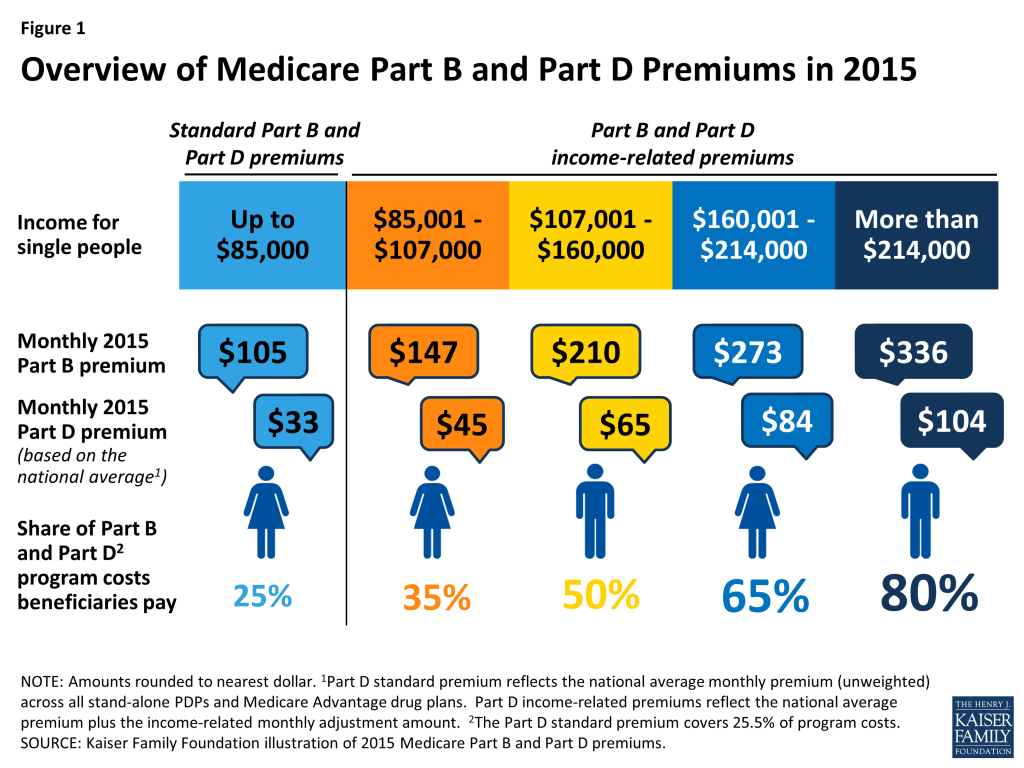
Today, most Medicare beneficiaries pay the standard monthly premium, which is set to cover 25 percent of Part B and Part D program costs, but a relatively small share of beneficiaries (around 6 percent in 2015) with incomes above $85,000 for single people and $170,000 for married couples are required to pay higher premiums for Medicare Part B and Part D—ranging from 35 percent to 80 percent of program costs, depending on their incomes (Figure 1).

Figure 1: Overview of Medicare Part B and Part D Premiums in 2015

Part B and Part D Standard Premiums

Monthly premiums for most people on Medicare equal 25 percent of average per capita Part B expenditures for Part B enrollees and 25.5 percent of average per capita Part D expenditures for drug plan enrollees.  In 2015, the Part B standard monthly premium is $104.90; for Part D, the national average monthly premium, according to CMS, is $33.13.5   Actual monthly premiums for stand-alone prescription drug plans vary across plans and regions from a low of $12.60 to a high of $171.90 in 2015.6 

People on Medicare with incomes above $85,000 for individuals and $170,000 for couples are required to pay higher premiums for Medicare Part B and Part D.  The Part B income-related premium was established by the Medicare Modernization Act of 2003 and took effect in 2007.  The Part D income-related premium was established by the Affordable Care Act of 2010 (ACA) and took effect in 2011.  Under these provisions, beneficiaries with higher incomes pay a larger share of Part B and Part D program costs than 25 percent, ranging from 35 percent to 80 percent of per capita costs, depending on their income.

In 2015, Part B premiums for higher-income beneficiaries range from $147 per month for individuals with annual incomes above $85,000 up to $107,000, to $336 per month for individuals with incomes above $214,000.  For Part D, higher-income beneficiaries pay a monthly premium surcharge in addition to the premium for their specific Part D plan; in 2015, the monthly premium surcharge ranges from around $12 for individuals with annual income above $85,000 up to $107,000, to an additional $71 for individuals with incomes above $214,000.  When combined with the national average premium amount, higher-income Part D enrollees pay between $45 and $104 per month in 2015.

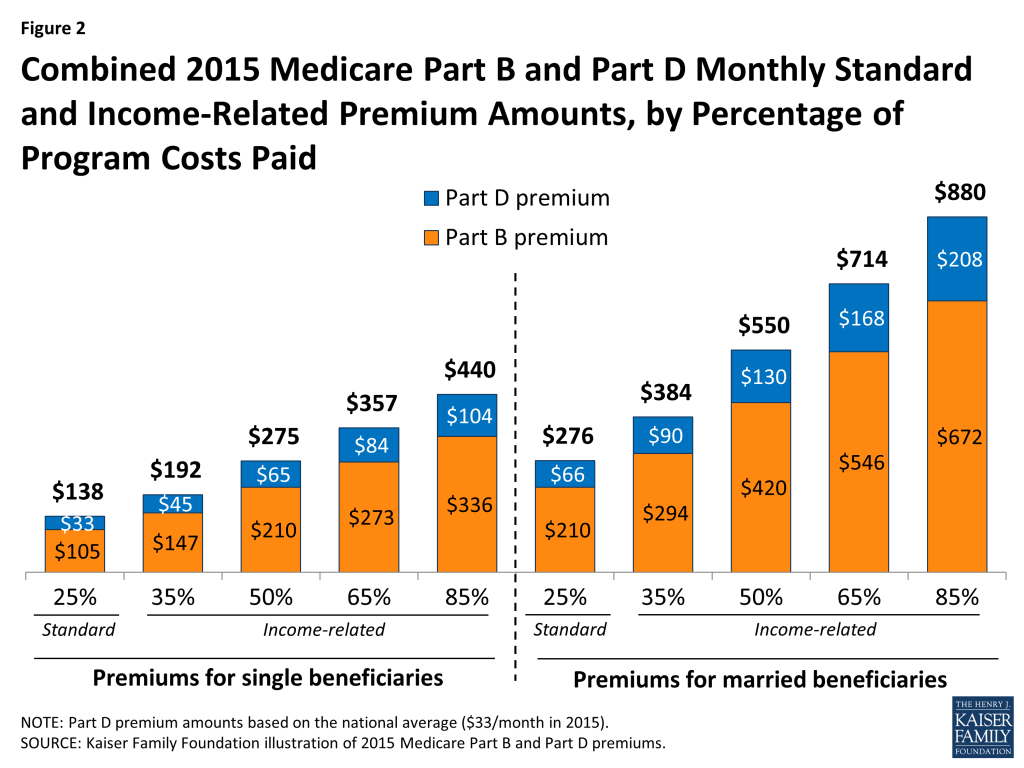
For beneficiaries enrolled in both Part B and Part D, the combined monthly premiums (based on the standard Part D premium) increase with income, ranging from $138 (25 percent of program costs) for single beneficiaries with incomes up to $85,000, to $440 (80 percent of program costs) for beneficiaries with incomes above $214,000 (Figure 2).  Monthly premiums for married couples who are both enrolled in Part B and Part D are twice these amounts, ranging from $276 for those with incomes up to $170,000, to $880 for couples with incomes above $428,000.

Figure 2: Combined 2015 Medicare Part B and Part D Monthly Standard and Income-Related Premium Amounts, by Percentage of Program Costs Paid

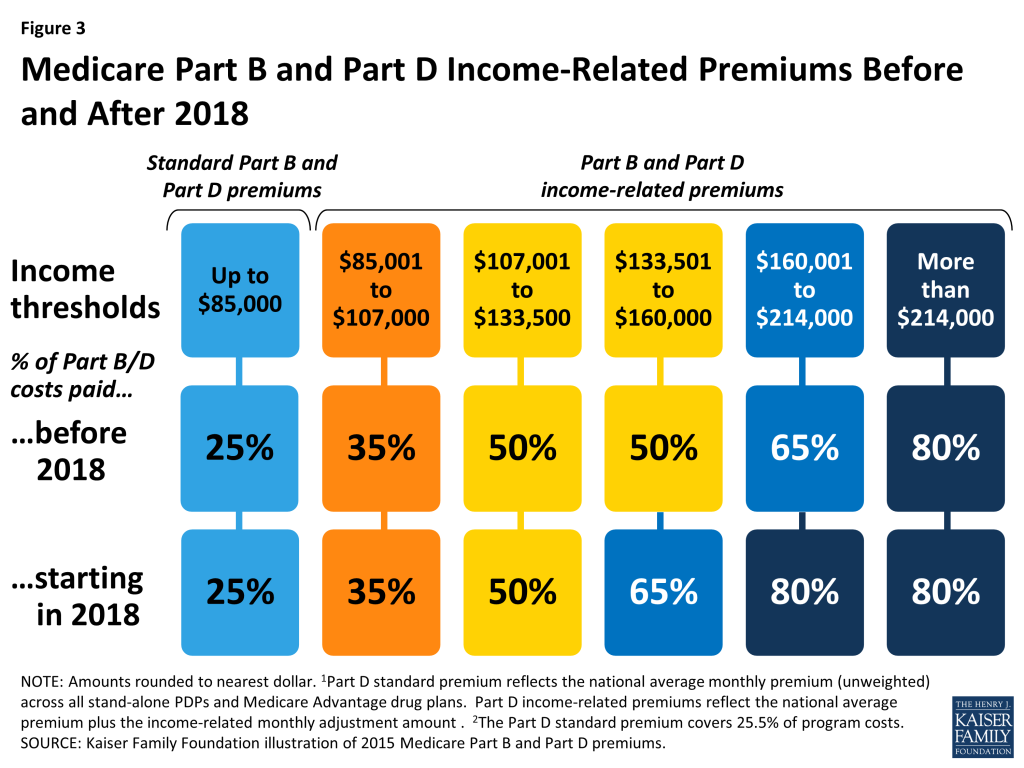
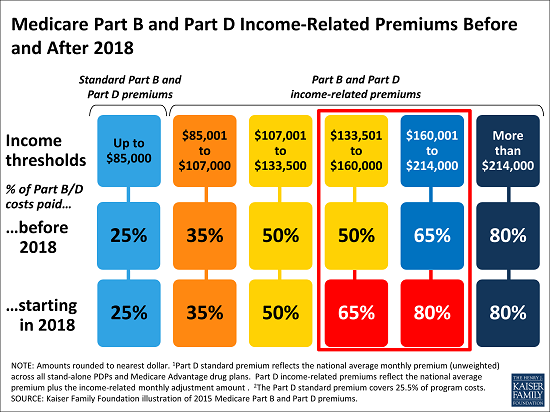
The recent changes to Medicare’s income-related premiums will affect beneficiaries with incomes above $133,500 ($267,000 for married couples) by requiring them to pay a larger percentage of Part B and Part D program costs than they currently pay, beginning in 2018 (Figure 3):

  • Beneficiaries with incomes above $133,500 and up to $160,000 ($267,000-$320,000 for married couples) will pay 65 percent of Part B and Part D program costs starting in 2018, up from 50 percent prior to 2018.  As a result of this change, monthly Part B premiums are expected to be $310 in 2018 for beneficiaries in this income group, rather than $238 that year, based on projections of Part B program costs from the Medicare Trustees.7 
  • Beneficiaries with incomes above $160,000 and up to $214,000 ($320,000-$428,000 for married couples) will be required to pay 80 percent of Part B and Part D program costs, rather than 65 percent.  As a result of this change, monthly Part B premiums in 2018 are expected to be $381 for beneficiaries in this income group, rather than $310 that year, based on projections from the Medicare Trustees.

The law did not change premium payments for beneficiaries with incomes above $214,000, who already are required to pay 80 percent of Part B and Part D program costs.

Figure 3: Medicare Part B and Part D Income-Related Premiums Before and After 2018

Part B

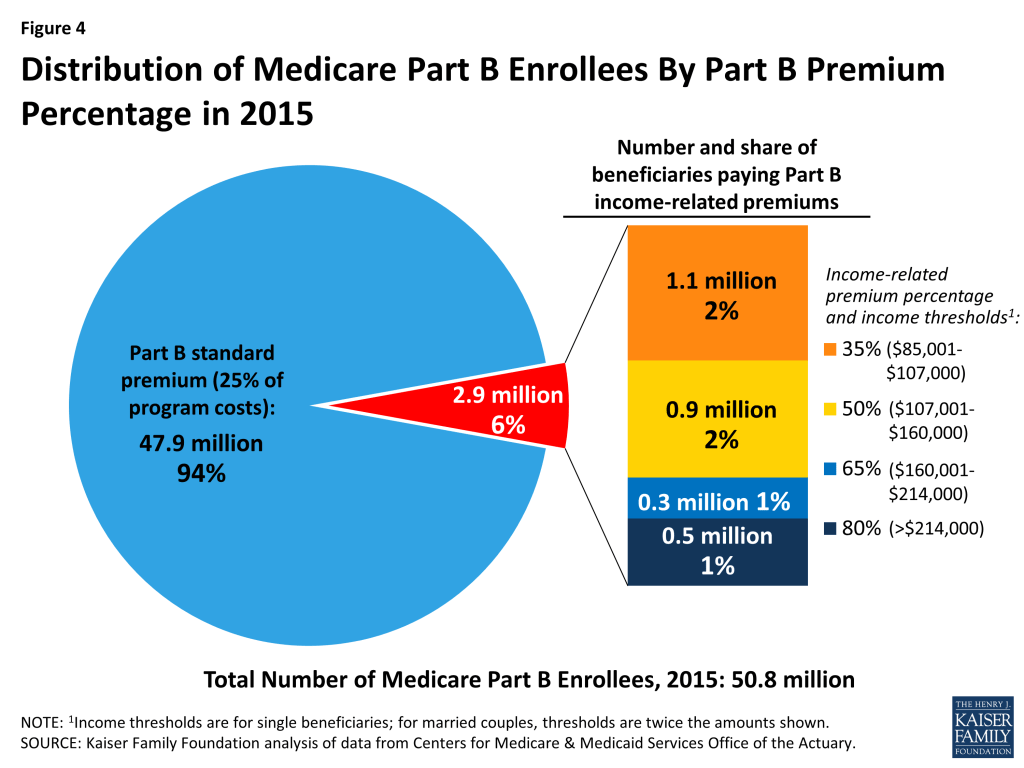
In 2015, an estimated 6 percent (2.9 million) of the 50.8 million Medicare beneficiaries who are enrolled in Part B pay income-related premiums (Figure 4).  Of these 2.9 million Part B enrollees:

  • 1.1 million beneficiaries with incomes above $85,000 up to $107,000 ($170,000 to $214,000 for married couples) pay 35 percent of Part B program costs;
  • 0.9 million beneficiaries with incomes above $107,000 up to $160,000 ($214,000 to $320,000 for married couples) pay 50 percent of Part B program costs;
  • 0.3 million beneficiaries with incomes above $160,000 up to $214,000 ($320,000 to $428,000 for married couples) pay 65 percent of Part B program costs; and
  • 0.5 million beneficiaries with incomes above $214,000 ($428,000 for married couples) pay 80 percent of Part B program costs.
Figure 4: Distribution of Medicare Part B Enrollees By Part B Premium Percentage in 2015

Part D

In 2015, an estimated 5 percent of the 42.2 million Medicare beneficiaries enrolled in Part D plans pay higher income-related amounts in addition to their specific Part D plan monthly premium amounts.  Fewer beneficiaries pay the Part D income-related premium than that for Part B because fewer beneficiaries are enrolled in Part D plans than in Part B.

Of the 2.1 million Part D enrollees who pay the Part D income-related premium:

  • 0.8 million (2 percent of all Part D enrollees) pay 35 percent of Part D program costs;
  • 0.7 million (2 percent of all Part D enrollees) pay 50 percent of Part D program costs;
  • 0.2 million (1 percent of all Part D enrollees) pay 65 percent of Part D program costs; and
  • 0.4 million (1 percent of all Part D enrollees) pay 80 percent of Part D program costs.

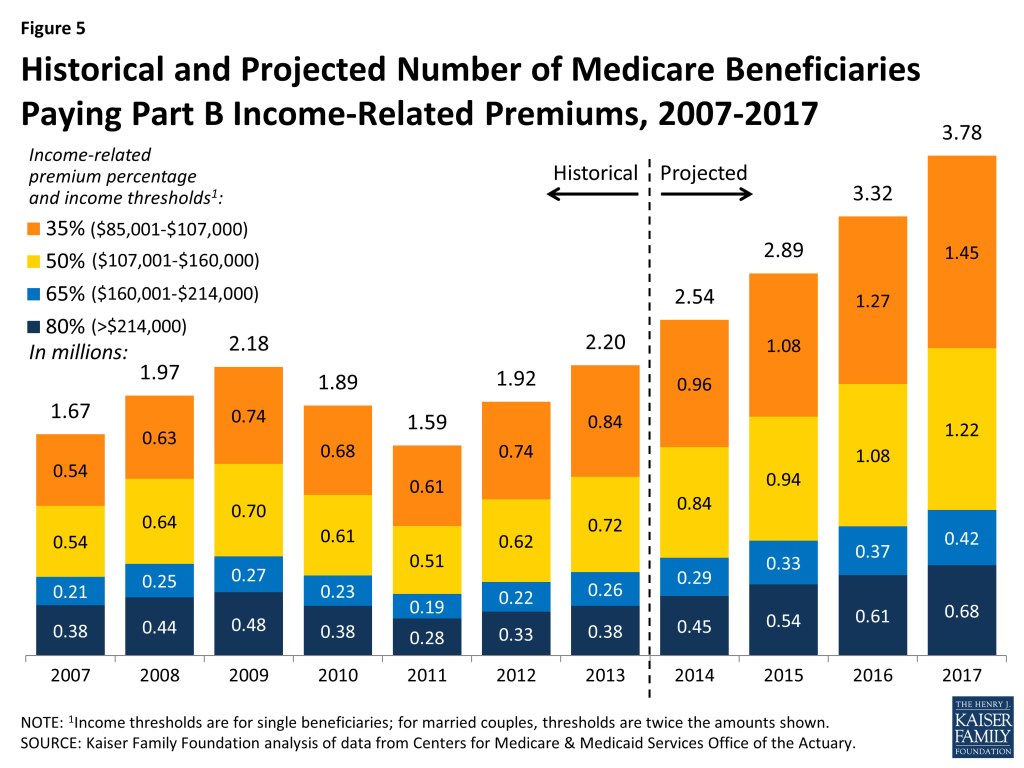
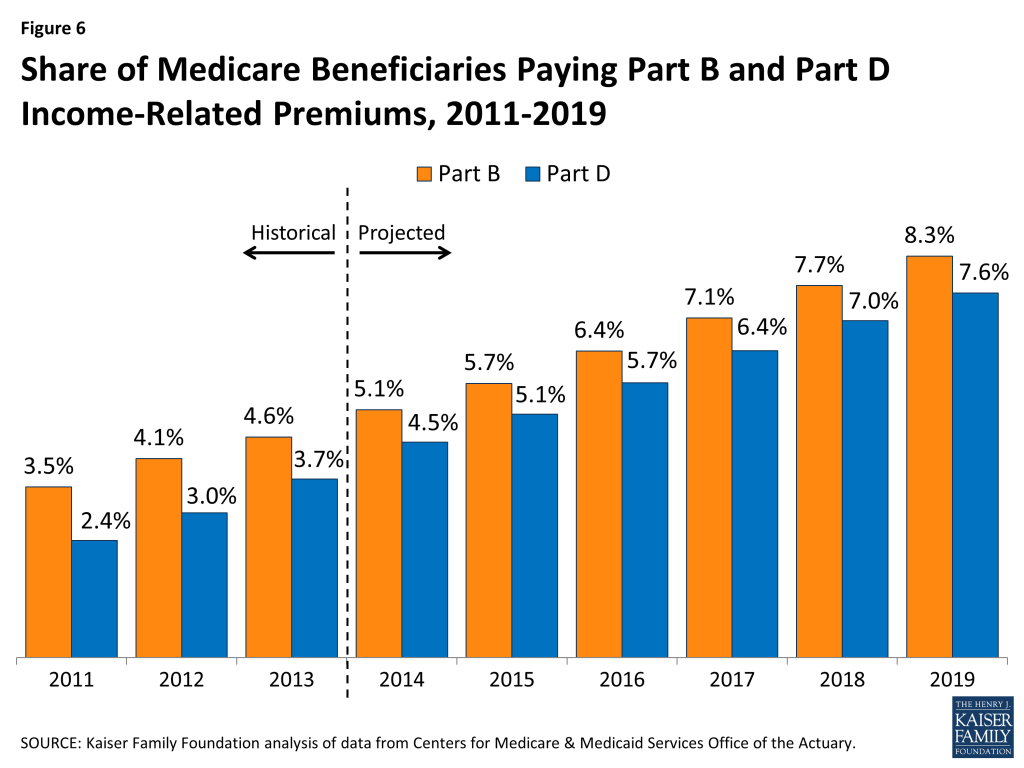
For the first few years that the Medicare Part B income-related premium was in effect (between 2007 and 2010), the income thresholds that determined who paid the higher amounts were set to increase annually with the rate of inflation so that about 5 percent of Part B enrollees would pay the income-related premium.  Since 2011, however, the income thresholds that determine who pays the higher Part B premiums have been fixed at their current levels through 2019 (a provision of the ACA); this provision also applies to Part D.  As a result, the number and share of beneficiaries paying the Part B and Part D income-related premiums has increased since 2011, and is projected to continue to increase through 2019 (Figures 5 and 6).  For example:

  • The share of beneficiaries paying the Part B income-related premium has increased from 3.5 percent in 2011 to 5.7 percent in 2015; the share is projected to rise further to 8.3 percent of enrollees by 2019.
  • Similarly for Part D, the share of beneficiaries paying the income-related premium has increased from 2.4 percent of enrollees in 2011 to 5.1 percent in 2015, and is projected to increase further to 7.6 percent of Part D enrollees in 2019.
  • In 2020 and subsequent years, the income thresholds will once again be indexed to inflation, based on their levels in 2019 (a provision in MACRA). As a result, the number and share of beneficiaries paying income-related premiums will increase as the number of people on Medicare continues to grow in future years and as their incomes rise.
Figure 5: Historical and Projected Number of Medicare Beneficiaries Paying Part B Income-Related Premiums, 2007-2017
Figure 6: Share of Medicare Beneficiaries Paying Part B and Part D Income-Related Premiums, 2011-2019

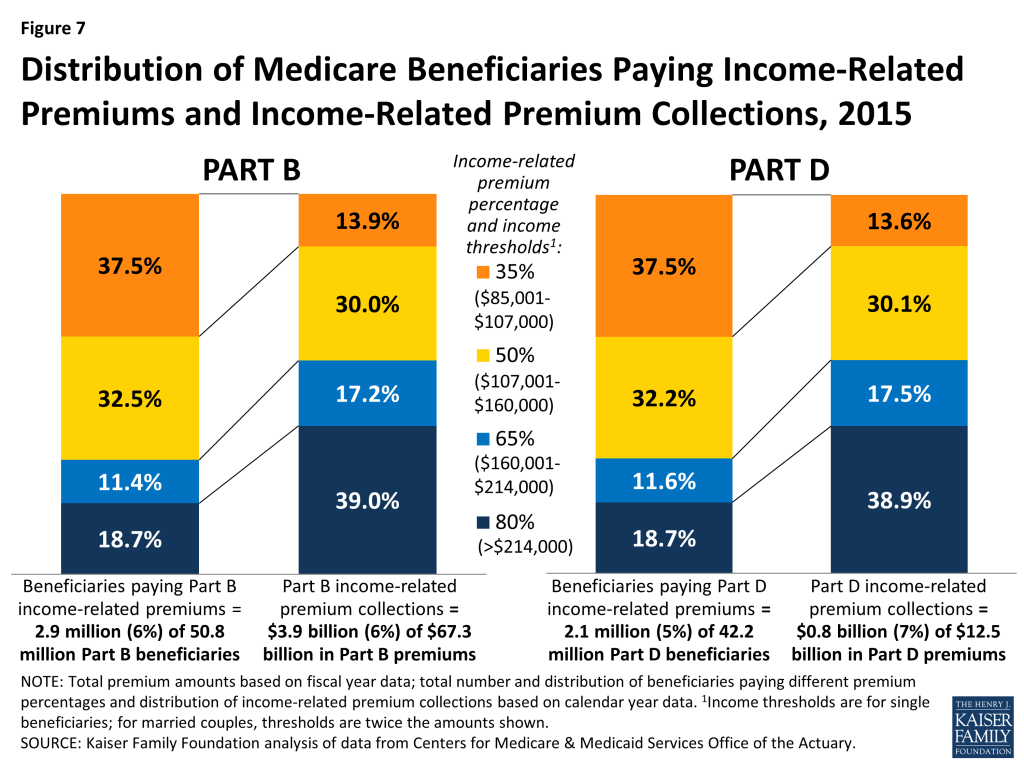
Of the projected $67 billion in total Part B premium collections in 2015, 6 percent, or $4 billion, will be paid by higher-income beneficiaries in the form of Part B income-related premiums, according to OACT.  Income-related premiums paid by Part B enrollees with incomes between $85,000 and $160,000 (70 percent of those paying higher premiums) account for roughly 44 percent of the Part B income-related premium receipts, while premiums paid by Part B enrollees with incomes above $214,000 (19 percent of those paying higher premiums) account for 39 percent of additional premium income (Figure 7).

The picture is similar for Part D.  OACT has estimated that Part D premium collections will total approximately $13 billion in 2015.  Of this total, 7 percent, or $1 billion, will be paid by higher-income beneficiaries in the form of Part D income-related premiums.

Figure 7: Distribution of Medicare Beneficiaries Paying Income-Related Premiums and Income-Related Premium Collections, 2015

Policy Implications

Increasing premiums for some beneficiaries who are already subject to income-related premiums will affect a relatively small but growing share of the Medicare population.  Based on our estimates, the recently enacted provisions that increase Part B and Part D income-related premium percentages for beneficiaries with incomes above $133,500 up to $214,000 ($267,000 to $428,000 for married couples) beginning in 2018, would affect around 2 percent of beneficiaries if it were implemented this year.

Part of the appeal of requiring higher-income beneficiaries to pay a greater share of Medicare costs is that these higher costs are imposed on only a relatively small share of beneficiaries who arguably have greater financial means to bear the additional expenses, thereby protecting the majority of people on Medicare with relatively modest incomes.  At the same time, there is some concern that the income thresholds used to trigger the payment of higher premiums by Medicare beneficiaries ($85,000 for individuals and $170,000 for couples) are lower than the thresholds used to define higher-income people in other policy discussions.  Tracking the effects on beneficiaries of these higher income-related premiums, including whether they affect Part B and Part D participation rates, will be important for understanding the implications of these and similar changes moving forward.

  1. Congressional Budget Office, Cost Estimate and Supplemental Analyses for H.R. 2, the Medicare Access and CHIP Reauthorization Act of 2015, March 25, 2015. ↩︎
  2. J. Cubanski, T. Neuman, G. Jacobson, and K.E. Smith, “Raising Medicare Premiums for Higher-Income Beneficiaries: Assessing the Implications,” Kaiser Family Foundation, January 2014.  Available at https://modern.kff.org/medicare/issue-brief/income-relating-medicare-part-b-and-part/. ↩︎
  3. Office of Management and Budget, The Budget of the United States Government, Fiscal Year 2016, February 2015. ↩︎
  4. G. Jacobson, C. Boccuti, J. Cubanski, C. Swoope, and T. Neuman, “Summary of Medicare Provisions in the President’s Budget for Fiscal Year 2016,” Kaiser Family Foundation, February 2015.  Available at https://modern.kff.org/medicare/issue-brief/summary-of-medicare-provisions-in-the-presidents-budget-for-fiscal-year-2016/. ↩︎
  5. CMS, “Annual Release of Part D National Average Bid Amount and other Part C & D Bid Information,” July 31, 2014. ↩︎
  6. Kaiser Family Foundation, “The Medicare Prescription Drug Benefit Fact Sheet,” September 2014.  Available at https://modern.kff.org/medicare/fact-sheet/the-medicare-prescription-drug-benefit-fact-sheet/. ↩︎
  7. 2014 Annual Report of the Boards of Trustees of the Federal Hospital Insurance and Federal Supplementary Medical Insurance Trust Funds, July 2014. ↩︎
News Release

King v. Burwell and Media Coverage

Published: Jun 2, 2015

In his latest column for The Wall Street Journal’s Think Tank, Drew Altman lays out the news media’s challenge covering the upcoming Supreme Court King v. Burwell decision about the Affordable Care Act.

All previous columns by Drew Altman are available online.

Behavioral Health Parity and Medicaid

Author: MaryBeth Musumeci
Published: Jun 2, 2015

Executive Summary

Behavioral health parity refers to requirements for health insurers to cover mental health and substance use disorder services on terms that are equal to those offered for medical and surgical services.  This issue brief explains how behavioral health parity applies in the Medicaid program, including the major provisions of the Centers for Medicare and Medicaid Services’ (CMS) April 10, 2015 proposed regulations, and identifies key policy issues at the intersection of behavioral health parity and Medicaid.

Key Provisions of Proposed Medicaid Parity Rules

When Parity Applies in Medicaid

Federal law requires Medicaid managed care organizations (MCOs) to provide behavioral health benefits in parity with medical/surgical benefits.  CMS’s proposed rule applies the parity requirement to all Medicaid services provided to MCO enrollees, regardless of whether services are furnished to them through MCOs, prepaid inpatient health plans (PIHPs), prepaid ambulatory health plans (PAHPs), or fee-for-service (FFS).  The rule is designed to ensure parity across all services for MCO enrollees, even if states choose to deliver certain benefits through separate delivery systems, such as managed care behavioral health carve-outs.  The parity rules also apply to Medicaid services contained in Alternative Benefit Plans (ABPs), whether those services are delivered through managed care or FFS.  In addition, states are encouraged, although not required, to apply the parity rules to FFS Medicaid state plan benefits that are provided to beneficiaries who are not MCO enrollees and that are not part of an ABP.

Definition and Classification of Benefits for Parity Analysis

CMS proposes that the state Medicaid agency define medical/surgical and behavioral health benefits for purposes of analyzing parity.  Long-term care benefits are excluded from these definitions for purposes of analyzing parity.  After benefits are defined, all services are assigned to one of four classifications, using the same standards for medical/surgical and behavioral health benefits:  inpatient, outpatient, emergency care, and prescription drugs.  Outpatient services may be sub-classified into office visits and other outpatient services, and prescription drugs may be divided into tiers.  Managed care entities (MCEs, which include MCOs, PIHPs, and PAHPs) providing services to MCO enrollees classify the benefits that each MCE provides, and the state Medicaid agency classifies FFS benefits.

Scope of Benefits Required by Parity

Parity rules require that if behavioral health benefits are provided in any classification, they must be provided in every classification in which medical/surgical benefits are provided.

Financial Requirements and Quantitative Treatment Limits

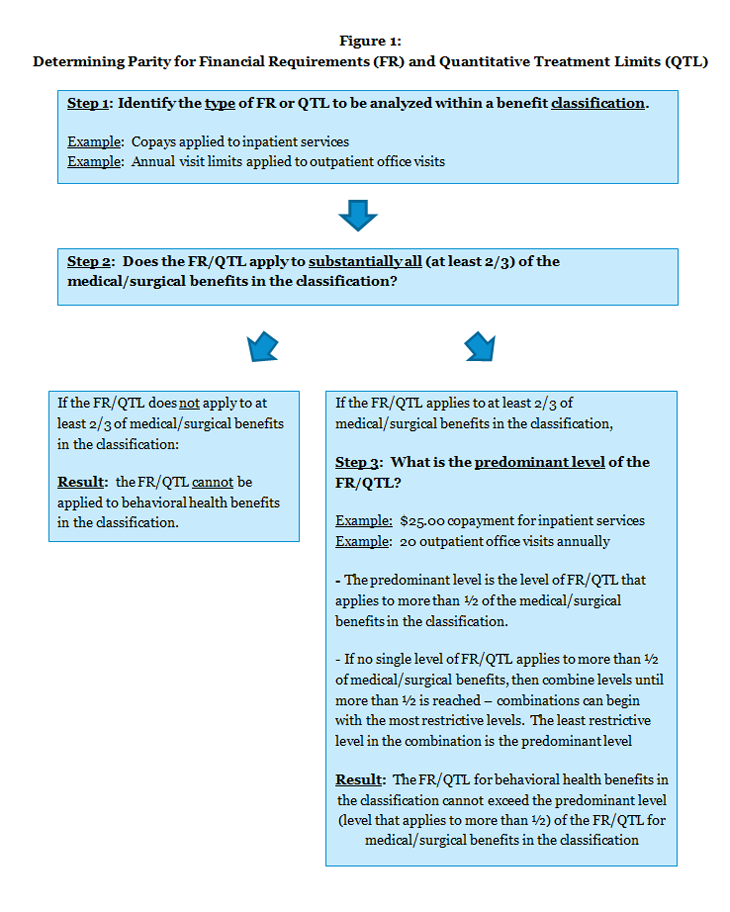
Financial requirements and treatment limits on behavioral health benefits in any classification cannot be more restrictive than the predominant financial requirement or treatment limit of that type that applies to substantially all medical/surgical benefits in the same classification.  The key terms in this rule are further defined in the proposed regulations for purposes of the parity analysis.  Cumulative financial requirements for behavioral health benefits in a classification that accumulate separately from any such requirement for medical/surgical benefits in the same classification are prohibited.

Non-Quantitative Treatment Limits (NQTLs)

A NQTL on behavioral health benefits in any classification may not be imposed unless, under policies and procedures as written and in operation, any processes, strategies, evidentiary standards or other factors used are comparable to and applied no more stringently than those used to apply the NQTL to medical/surgical benefits in that classification.  The proposed rules include a non-exhaustive list of NQTLs.

Aggregate Lifetime and Annual Dollar Limits

Parity rules for aggregate lifetime and annual dollar limits apply only to MCEs that provide services to MCO enrollees; these rules do not apply to ABPs in which all benefits are provided FFS.  The proposed rules set out the analysis for determining parity between behavioral health and medical/surgical services for purposes of these limits.

Information Disclosure Requirements

The criteria for behavioral health medical necessity determinations and the reason for any denial of reimbursement or payment for behavioral health services must be made available to Medicaid beneficiaries, potential MCO enrollees, and providers.

Looking Ahead

Public comments on the proposed regulations are due on June 9, 2015, and CMS proposes that the final regulations take effect 18 months after publication of the final regulations.  The proposed parity rules identify a number of policy issues to be resolved, including:

  • CMS’s proposal that, in the case of split delivery systems, state Medicaid agencies review all services provided to MCO enrollees across all delivery systems to ensure parity;
  • whether states will choose to apply parity rules to Medicaid services that are provided to beneficiaries who are not MCO enrollees and that are not part of an ABP, so that all Medicaid services will be provided in parity to all beneficiaries, regardless of benefit package or delivery system;
  • the specific standards that will be used to classify benefits for purposes of parity determinations and how different MCEs and the state Medicaid agency will coordinate those standards in states with split delivery systems;
  • the extent to which the final parity rules will result in changes in benefits offered and any effects on the determination of managed care payment rates; and
  • the extent to which the final parity rules will result in changes to any financial requirements or treatment limitations applied to behavioral health benefits.

Issue Brief

Introduction

Behavioral health parity refers to requirements for health insurers to cover mental health and substance use disorder services on terms that are equal to those offered for medical and surgical services.1   Historically, insurers could impose more restrictive financial requirements, such as higher co-payments, on behavioral health services than for medical/surgical services, and they could apply more stringent treatment limitations, such as the number of visits covered, for behavioral health services than for medical/surgical services.  The federal behavioral health parity law is intended to achieve equitable coverage when health plans cover both medical/surgical and behavioral health services.  This issue brief explains how the behavioral health parity law applies in the Medicaid program, including the major provisions of the Centers for Medicare and Medicaid Services’ (CMS) April 10, 2015 proposed regulations, and identifies key policy issues at the intersection of behavioral health parity and Medicaid.

Background

Federal Behavioral Health Parity Law for Group Health Plans

The federal behavioral health parity law originally was enacted to apply to group health plans that offer both behavioral health services and medical/surgical services.  The 1996 Mental Health Parity Act requires parity in aggregate lifetime and annual dollar coverage limits between mental health and medical/surgical services for group health plans.  The 2008 Mental Health Parity Addiction Equity Act (MHPAEA) builds on the group health plan parity requirements by mandating parity in financial requirements and quantitative and non-quantitative treatment limitations.  MHPAEA also applies federal parity rules for group health plans to substance use disorder services.2 

Medicaid Coverage of Behavioral Health Services

States have flexibility to determine which services to offer in their Medicaid programs, within the parameters of federal minimum requirements.3   Some behavioral health services may be covered in mandatory state plan categories, such as physician services or outpatient hospital services.  Many behavioral health services are covered under optional state plan categories, such as rehabilitative services, case management, and prescription drugs.  Federal Medicaid law does not require states to cover any particular behavioral health services in their state plan benefit package.

Instead of the traditional state plan benefit package, states may choose to offer an alternative benefit plan (ABP) to most Medicaid beneficiaries, and states must offer an ABP to adults who are newly eligible for Medicaid under the Affordable Care Act’s (ACA) expansion.4   Unlike the Medicaid state plan benefit package, which comprises services in the mandatory and optional categories in federal law, an ABP is based on the contents of a private health insurance plan that is used as a benchmark to define benefits.5   ABPs must cover the ACA’s 10 essential health benefits, including mental health and substance use disorder services.6 

Another provision of federal Medicaid law relevant to parity is the long-standing prohibition against Medicaid payments for services provided in an “institution for mental disease” for beneficiaries between the ages of 21 and 65.7 

Medicaid Behavioral Health Delivery Systems

States have flexibility to design the delivery system through which Medicaid behavioral health services are provided. Delivery systems range from the traditional fee-for-service (FFS) system to capitated managed care models.   In recent years, an increasing number of states are using managed care to deliver Medicaid services.8   Federal law defines the different types of managed care entities (MCEs) that states can use, including managed care organizations (MCOs), prepaid inpatient health plans (PIHPs), and prepaid ambulatory health plans (PAHPs).  All three types of MCEs receive risk-based capitated payments.  MCOs deliver a comprehensive set of services to beneficiaries, while PIHPs and PAHPs are responsible for a more limited set of specific services.9 

Behavioral Health Parity and Medicaid

Medicaid behavioral health parity rules are based on the underlying federal parity law that applies to group health plans, with some changes to account for differences between the different types of coverage.  Federal parity law applies to Medicaid through two statutes:  the 1997 Balanced Budget Act applies federal parity rules to Medicaid MCOs,10  and the ACA applies the financial requirement and treatment limitation provisions of federal parity law to Medicaid ABPs.11 

On April 10, 2015, CMS proposed regulations to further define the rules for behavioral health parity in the Medicaid program.12   Public comments on the proposed regulations are due on June 9, 2015, and CMS proposes that the final regulations take effect 18 months after publication of the final regulations.13   The rest of this brief discusses the major provisions of the proposed Medicaid parity rules.

When Parity Applies in Medicaid

Services Provided to Medicaid MCO Enrollees

CMS proposes that behavioral health parity rules apply to all services provided to Medicaid managed care enrollees, regardless of delivery system carve-outs.14   As described above, states may choose to deliver services through MCOs, PIHPs, or PAHPs, or on a FFS basis.  Many states have a split delivery system in which MCOs are not responsible for the full scope of medical/surgical and behavioral health services available to beneficiaries under the Medicaid state plan; instead, some services are provided by an MCO and other services are provided to MCO enrollees through a PIHP or PAHP or FFS.  Under the proposed rules, parity would apply to all MCOs, PIHPs, and PAHPs that provide benefits to MCO enrollees, without regard to whether all benefits are furnished by the same MCE, so long as both medical/surgical and behavioral health benefits are included in the Medicaid state plan benefit package.15   In split delivery systems, CMS proposes that the state Medicaid agency must review all services provided to MCO enrollees across all delivery systems to ensure parity.16   CMS’s proposal seeks to preserve state flexibility about delivery system choices while avoiding the result of nullifying parity for MCO enrollees if all behavioral health services were carved out from MCO contracts.  CMS considered an alternative solution of requiring all behavioral health services to be included in MCO contracts.17 

Services Provided in Medicaid ABPs

In general, behavioral health parity applies to services contained in Medicaid ABPs, regardless of whether those services are delivered FFS or through managed care.18   The parity rules regarding scope of benefits, financial requirements, treatment limits, and information disclosure apply to all ABPs, including those under which all benefits are delivered on a FFS basis (“all-FFS ABPs”).  For all-FFS ABPs, the state Medicaid agency is responsible for ensuring parity.19   If an ABP contains benefits that are delivered to MCO enrollees, the parity rules for aggregate lifetime and annual dollar limits also apply.20 

States are encouraged, but not required, to apply parity rules to FFS Medicaid state plan benefits that are provided to beneficiaries who are not MCO enrollees and that are not part of an ABP.21   The statutory authority for Medicaid behavioral health parity only reaches MCOs and ABPs; to date, Congress has not required parity for Medicaid FFS benefits outside an ABP.  Parity rules also do not apply to Medicare benefits that are provided by Medicaid MCOs to dual eligible beneficiaries.22   The rules for when parity applies in Medicaid are summarized in Table 1 below.

Table 1:  When Does Behavioral Health Parity Apply in Medicaid?
Delivery System TypeMedicaid State Plan ServicesMedicaid ABP Services
MCOParity applies to all state plan services provided to MCO enrolleesParity applies to all ABP services provided to MCO enrollees; in addition, the scope of benefits, financial requirement, treatment limit, and information disclosure parity rules apply to all ABPs, regardless of delivery system
PIHPParity applies only to state plan services provided by PIHPs to MCO enrollees (carve-outs from MCO contract)Parity applies to ABP services provided by PIHPs to MCO enrollees (carve-outs from MCO contract); in addition, the scope of benefits, financial requirement, treatment limit, and information disclosure parity rules apply to all ABPs, regardless of delivery system
PAHPParity applies only to state plan services provided by PAHPs to MCO enrollees (carve-outs from MCO contract)Parity applies to ABP services provided by PAHPs to MCO enrollees (carve-outs from MCO contract); in addition, the scope of benefits, financial requirement, treatment limit, and information disclosure parity rules apply to all ABPs, regardless of delivery system
FFSParity applies only to state plan services provided on a FFS basis to MCO enrollees (carve-outs from MCO contract)Parity applies to ABP services provided to MCO enrollees on a FFS basis (carve outs from MCO contract); in addition, the scope of benefits, financial requirement, treatment limit, and information disclosure parity rules apply to all ABPs, even those in which all services are provided FFS

Definition and Classification of Benefits for Parity Analysis

The first preliminary step in applying the Medicaid parity rules is for the state to define medical/surgical, mental health, and substance use disorder benefits.23   CMS proposes that these definitions be based on generally recognized independent standards of current medical practice, such as the ICD, DSM or state guidelines.24   CMS also proposes that these definitions should exclude long-term care benefits, because those benefits are not typically provided by private insurers.25 

The second preliminary step in applying the Medicaid parity rules is for all benefits to be assigned to one of four classifications:  inpatient, outpatient, emergency care, and prescription drugs.26   The proposed rules allow for only one benefit sub-classification:  office visits may be sub-classified separately from other outpatient services.27   No other sub-classifications are permitted, such as distinctions between generalists and specialists.28   In addition, prescription drugs may be assigned to different tiers.29   The MCO, PIHP, or PAHP is responsible for classifying the benefits that each provides to MCO enrollees, and the state is responsible for classifying benefits provided to ABP enrollees on a FFS basis.30   In classifying benefits, the same standards must be applied to medical/surgical and behavioral health benefits.31   Prescription drug tiers must be determined based on reasonable factors determined in accordance with the parity rules for non-quantitative treatment limits (described below), including cost, efficacy, generic vs. brand-name, and mail order vs. pharmacy pick-up, and without regard to whether a drug is generally prescribed for behavioral health or medical/surgical purposes.32   The preamble to the proposed rules states that CMS expects MCEs within a state to define benefit classifications similarly and apply terms uniformly.33   The preamble to the proposed rule also indicates that intermediate benefits, such as partial hospitalization or intensive outpatient treatment, may be assigned to any classification so long as the assignment is done consistently for medical/surgical and behavioral health services; however, CMS requests comments on this approach as well as alternatives.34   The benefit definition and classification rules are summarized in Table 2 below.

Table 2:  Benefit Definition and Classification for Purposes of Parity
Step:Who Is Responsible?What Standards Apply?
Step 1:  Benefit Definition         a. Medical/Surgical          b. Behavioral HealthState Medicaid agency is responsible for defining all benefitsGenerally recognized independent standards of current medical practice, such as the ICD, DSM or state guidelines; long-term care benefits are excluded
Step 2:  Benefit Classification         a. Inpatient         b. Outpatient             i.  Office visit*             ii. Other outpatient services         c. Emergency care         d. Prescription drug (tiers allowed)For benefits provided to MCO enrollees, the MCO, PIHP, or PAHP is responsible for classifying medical/surgical and behavioral health benefits as defined by the state.For ABP benefits provided on a FFS basis, the state Medicaid agency is responsible for classifying benefitsThe same standards must be applied when classifying medical/surgical and behavioral health benefits..Prescription drug tiers must be based on reasonable factors** and without regard to whether a drug is generally prescribed for medical/surgical or behavioral health purposes
NOTES:  *Outpatient office visit sub-classification is optional.  **Reasonable factors are determined in accordance with the non-quantitative treatment limit rules and include cost, efficacy, generic vs. brand name, and mail order vs. pharmacy pick-up.

Benefit classifications are important because parity is determined by comparing financial requirements and treatment limitations for medical/surgical and behavioral health benefits within the same classification, as detailed below.  The rest of this brief summarizes the proposed rules for determining parity in various respects after benefits are defined and classified.  The proposed rules cover the scope of benefits, financial requirements and quantitative treatment limits, non-quantitative treatment limits, aggregate lifetime and annual dollar limits, and information disclosure required by parity.  Major provisions of the proposed parity rules are summarized in Text Box 1 below.

Text Box 1:Summary of Proposed Medicaid Behavioral Health Parity Rules

Scope of benefits:  If behavioral health benefits are provided in any classification, they must be provided in every classification in which medical/surgical benefits are provided.

Financial requirements and quantitative treatment limits:

  • Financial requirements and treatment limits on behavioral health benefits in any classification cannot be more restrictive than the predominant level of the financial requirement or treatment limit of that type that applies to substantially all medical/surgical benefits in the same classification (See Figure 1).
  • Cumulative financial requirements for behavioral health benefits in a classification that accumulate separately from any such requirement for medical/surgical benefits in the same classification are prohibited.

Non-quantitative treatment limits (NQTLs):  NQTLs on behavioral health benefits in any classification may not be imposed unless, under the policies and procedures as written and in operation, any processes, strategies, evidentiary standards, or other factors used to apply the NQTL to behavioral health benefits are comparable to and applied no more stringently than those used to apply the NQTL to medical/surgical benefits in that classification.

Aggregate lifetime and annual dollar limits:

  • Aggregate lifetime and annual dollar limits may not be applied to behavioral health benefits if those limits apply to less than 1/3 of medical/surgical benefits.
  • If aggregate lifetime or annual dollar limits apply to more than 1/3 but less than 2/3 of medical/surgical benefits, any such limits for behavioral health benefits must not exceed a weighted average of the limit for medical/surgical benefits.
  • If aggregate lifetime or annual dollar limits apply to at least 2/3 of medical/surgical benefits, then any such limits for behavioral health benefits must be applied in a way that does not distinguish between the two types of benefits.

Information disclosure requirements: The criteria for behavioral health medical necessity determinations and the reason for any denial of reimbursement or payment for behavioral health services must be made available to beneficiaries, potential MCO enrollees, and providers.


Scope of Benefits Required by Parity

If behavioral health benefits are provided in any classification, they must be provided in every classification in which medical/surgical benefits are offered.35   Parity requirements do not affect the amount, duration, and scope of Medicaid behavioral health benefits except as specifically provided in the parity rules.36   The rules specify that MCEs are not required to provide any behavioral health benefits beyond those specified in their contracts with the state Medicaid agency.37   In addition, providing benefits for one or more behavioral health conditions does not require an MCE to provide benefits for any other behavioral health condition.38   MCEs also are not required to provide any additional behavioral health benefits in any classification if the only behavioral health benefit that they cover is tobacco cessation services for pregnant women.39   While the parity rules do not require a state Medicaid agency to provide any specific behavioral health benefits in an all-FFS APB, all ABPs must offer the ACA’s 10 essential health benefits, which include mental health and substance use disorder benefits.40 

Scope of Benefits and Managed Care Payment Rates

CMS proposes that only the cost of Medicaid state plan services plus any additional services provided by MCEs outside the Medicaid state plan benefit package that are necessary to comply with parity may be included when determining actuarially sound payment rates.41   MCEs may cover additional services outside the Medicaid state plan benefit package that are necessary to comply with parity as well as any additional services that the managed care entity voluntarily agrees to provide; however, CMS proposes that only the costs of the former additional services can be used to calculate managed care payment rates. CMS seeks comment on the risk that this rule may be used to include in managed care rate determinations the costs of non-state plan services that are not strictly necessary for compliance with parity and how this risk may be mitigated through more prescriptive language or specific oversight activities.42 

General Parity Rule

The proposed rules provide that financial requirements and treatment limits on behavioral health benefits in any classification cannot be more restrictive than the predominant financial requirement or treatment limit of that type that applies to substantially all medical/surgical benefits in the same classification.43   Each of the italicized terms has a specific meaning in the proposed regulations and is further explained below.  Parity must be analyzed separately for each type of financial requirement or treatment limit.44   If office visits are sub-classified separately from other outpatient services, financial requirements and quantitative treatment limits on behavioral health benefits in one sub-classification may not be more restrictive than the predominant requirement or limit that applies to substantially all medical/surgical benefits in the same sub-classification.45   For prescription drugs, different levels of financial requirements can apply to different drug tiers.46 

Financial Requirements and Quantitative Treatment Limits

The parity analysis for financial requirements and quantitative treatment limitations is described below and summarized in Figure 1.  These rules apply to both MCEs providing services to MCO enrollees and to states for purposes of all-FFS ABPs.  In addition, other Medicaid cost-sharing rules continue to apply.47 

Step 1:  Identify Type of Requirement or Limitation to Be Analyzed within a Benefit Classification

When analyzing parity, a financial requirement or treatment limit must be compared only to a financial requirement or treatment limit of the same type within a benefit classification.  Therefore, the first step in a parity determination is to identify the type of requirement or limitation at issue within a benefit classification.  Types of financial requirements include deductibles, copays, coinsurance, and out-of-pocket maximums.48   Types of quantitative treatment limits include annual, episode, and lifetime day and visit limits.49   A permanent exclusion of all benefits for a particular condition or disorder is not a treatment limit for purposes of the parity rules.50 

Step 2:  Determine Whether the Requirement or Limitation Applies to Substantially All Medical/Surgical Benefits in the Classification

A financial requirement or quantitative treatment limit applies to substantially all medical/surgical benefits in a classification if it applies to at least 2/3 of the medical/surgical benefits in the classification.51   The second step in analyzing parity is to determine whether a particular requirement or limitation applies to substantially all medical/surgical benefits in the classification.  The portion of medical/surgical benefits in a classification subject to a financial requirement or quantitative treatment limit is based on the total dollar amount of all payments for medical/surgical benefits in the classification expected for that year.  For services provided to MCO enrollees, the total dollar amount includes the combined MCO/PIHP/PAHP payments expected for a contract year, determined by any reasonable method.52   (The preamble, but not the proposed rule, provides that this total amount also would include payments for FFS benefits provided to MCO enrollees in states with split delivery systems.53 )  For all-FFS ABPs, the total dollar amount includes all payments expected for the plan year, based on any reasonable method.54  (The preamble, but not the proposed rule, instead refers to the year starting with the effective date of the approved ABP SPA.55 )

Parity Rule if Requirement/Limitation does not apply to at least 2/3 of Medical/Surgical Benefits in the Classification:

If a financial requirement or quantitative treatment limit does not apply to at least 2/3 of all medical/surgical benefits in a classification, then that type of financial requirement or quantitative treatment limit cannot be applied to behavioral health benefits in that classification.56   If the requirement or limitation does apply to at least 2/3 of the medical/surgical benefits in the classification, then the analysis continues to the next step.

Step 3: Determine the Predominant Level of that Type of Requirement or Limitation that Applies to Medical/surgical Benefits in the Classification

The predominant level of that type of financial requirement or quantitative treatment limit is the level that applies to more than ½ of medical/surgical benefits in the classification subject to the financial requirement or quantitative treatment limit.57   If a financial requirement or quantitative treatment limit applies to substantially all (at least 2/3) medical/surgical benefits in a classification, the next step in the parity analysis is to determine the predominant level for the type of requirement or limitation at issue for medical/surgical benefits in the classification.  Examples of levels of financial requirements or quantitative treatment limits include dollar, percentage, day or visit amounts.58   The preamble, but not the proposed rule, provides that, in states with split delivery systems, all payments for services provided to MCO enrollees (MCO, PIHP, PAHP, and FFS) need to be considered when determining if a financial requirement or quantitative treatment limit is the predominant level.59 

If there is no single level that applies to more than ½ of medical/surgical benefits in a classification subject to the financial requirement or quantitative treatment limit, then levels may be combined until the greater than ½ threshold is reached.60   In these cases, the least restrictive level within the combination is the predominant level.  The most restrictive levels can be combined first to reach the more than ½ threshold.

Parity Rule if Requirement/Limitation Applies to at Least 2/3 of Medical/Surgical Benefits in the Classification:

If a type of financial requirement or quantitative treatment limitation applies to at least 2/3 of all medical/surgical benefits in a classification, then that type of financial requirement or quantitative treatment limitation for behavioral health benefits in that classification cannot be more restrictive than the predominant level of the requirement or limitation applied to medical/surgical benefits in the classification.61  

Cumulative requirements

The proposed parity rules prohibit cumulative financial requirements for behavioral health benefits in a classification that accumulate separately from any such requirement for medical/surgical benefits in the same classification.62   Cumulative financial requirements include deductibles and out-of-pocket maximums.63 

The preamble, but not the proposed rule, provides that quantitative treatment limits may accumulate separately for medical/surgical and behavioral health benefits for purposes of determining parity in Medicaid, so long as the general parity rule (described above) is met.  CMS explains that it arrived at this policy due to the difficulties in administering unified treatment limits in split delivery systems.64 

Figure 1: Determining Parity for Financial Requirements (FR) and Quantitative Treatment Limits (QTL)

Non-Quantitative Treatment Limits

Non-quantitative treatment limits (NQTLs) on behavioral health benefits in any classification may not be imposed unless, under policies and procedures as written and in operation, any processes, strategies, evidentiary standards or other factors used to apply the NQTL to behavioral health benefits are comparable to and applied no more stringently than those used to apply the NQTL to medical/surgical benefits in that classification.65   The parity rules for NQTLs apply both to MCEs that provide services to MCO enrollees and to states for purposes of ABPs.  The proposed rule contains a non-exhaustive list of NQTLs, including:66 

  • Medical management standards limiting or excluding benefits based on medical necessity or appropriateness or based on whether the treatment is experimental or investigative;67 
  • Prescription drug formulary design;
  • Provider network admission standards, including reimbursement rates;
  • Methods for determining usual, customary, and reasonable charges;
  • Step therapy/fail first policies;
  • Exclusions based on failure to complete a course of treatment;
  • Restrictions based on geographic location, facility type, provider specialty, and other criteria that limit the scope or duration of benefits;
  • Network tier design, such as preferred or participating providers (not applicable to all-FFS ABPs); and
  • Standards for access to out-of-network providers (not applicable to all-FFS ABPs).68 

Aggregate Lifetime and Annual Dollar Limits

CMS also proposes parity rules for aggregate lifetime and annual dollar limits.  These rules apply only to MCEs that provide services to MCO enrollees; they do not apply to all-FSS ABPs.  The proposed rules about aggregate lifetime and annual dollar limits are as follows:

  • MCEs that have no aggregate lifetime or annual dollar limits, or that apply these limits to less than 1/3 of all medical/surgical benefits, may not impose any such limits on behavioral health benefits.69 
  • MCEs that have aggregate lifetime or annual dollar limits on more than 1/3 but less than 2/3 of all medical/surgical benefits must either:
    • Impose no aggregate lifetime or annual dollar limits on behavioral health benefits; or
    • Impose limits on behavioral health benefits that are no more restrictive than a weighted average of the limits that apply to medical/surgical benefits.70 
  • MCEs that have aggregate lifetime or annual dollar limits on at least 2/3 of all medical/surgical benefits must either:
    • Apply the limit to both medical/surgical and behavioral health benefits in a manner that does not distinguish between the two types of benefits; or
    • Not include a limit on behavioral health benefits that is more restrictive than the limit for medical-surgical benefits.71 

The 1/3 and 2/3 thresholds are based on the total dollar amount of all combinations of managed care payments (MCO, PIHP, PAHP) for medical/surgical services expected to be paid in a contract year, determined by any reasonable method.72 

Availability of Information

The proposed parity rules require certain types of information to be disclosed to beneficiaries, potential MCO enrollees, and providers.  Specifically, the criteria for behavioral health medical necessity determinations73   and the reason for any denial of reimbursement or payment for behavioral health services must be made available.  The information disclosure requirements in the parity rules apply both to MCEs that provide services to MCO enrollees and to states for the purposes of all-FFS ABPs.74 

Looking Ahead

CMS proposes that the parity rules take effect 18 months after publication of the final regulations.  After the final rules are published, states will have 18 months to provide publicly available documentation of their compliance with the parity rules.  States providing services to beneficiaries through MCOs also must provide documentation of how parity is met when they submit their MCO contracts to CMS, and all MCO, PIHP, and PAHP contracts must ensure that behavioral health services are provided to MCO enrollees in parity with medical/surgical services.  These measures can provide important information to stakeholders about how the parity rules are implemented as their impact is assessed going forward.

The proposed parity rules identify a number of policy issues to be resolved, including:

  • CMS’s proposal that, in the case of split delivery systems, state Medicaid agencies review all services provided to MCO enrollees across all delivery systems to ensure parity;
  • whether states will choose to apply parity rules to Medicaid services that are provided to beneficiaries who are not MCO enrollees and that are not part of an ABP so that services will be provided in parity to all beneficiaries, regardless of benefit package or delivery system;
  • the specific standards that will be used to classify benefits for purposes of parity determinations and how different MCEs and the state will coordinate those standards in states with split delivery systems;
  • the extent to which the final parity rules will result in changes in benefits offered and any effects on the determination of managed care payment rates; and
  • the extent to which the final parity rules will result in changes to any financial requirements or treatment limitations applied to behavioral health benefits.

Endnotes

  1. While the term “mental health parity” is used in the law, this brief uses “behavioral health parity” to signify that parity rules apply to both mental health and substance use disorder services. ↩︎
  2. 42 U.S.C. § 300gg-26; 45 C.F.R. § 146.136. ↩︎
  3. See generally Kaiser Commission on Medicaid and the Uninsured, Medicaid Enrollment and Expenditures by Federal Core Requirements and State Options (Jan. 2012), available at https://modern.kff.org/medicaid/issue-brief/medicaid-enrollment-and-expenditures-by-federal-core/. ↩︎
  4. 42 U.S.C. § 1396u-7; 42 U.S.C. § 1396a(k)(1); 42 C.F.R. § § 440.300-440.390.  Beneficiaries who are “medically frail” cannot be required to receive an ABP and instead must have access to the state plan benefit package.  42 U.S.C. § 1396u-7(a)(2)(vi); 42 C.F.R. § 440.315(f). ↩︎
  5. States also may select the “Secretary-approved” option to design an ABP.  42 U.S.C. § 1396u-7(b)(1)(D). ↩︎
  6. 42 U.S.C. § 1396u-7(b)(5). ↩︎
  7. 42 U.S.C. § 1396d(a)(B); cf. 42 U.S.C. § 1396d(r)(5).  However, in a separate rule-making, CMS recently proposed that states may make capitation payments to MCOs and PIHPs for enrollees receiving services of no more than 15 days per month in an IMD that is an inpatient hospital facility or sub-acute facility providing crisis residential services.  Proposed 42 C.F.R. § 438.3(u). CMS proposes this change in the capitated managed care context to address difficulties with beneficiary access to short-term inpatient behavioral health treatment and to recognize managed care plans’ flexibility in providing care in alternate settings in lieu of those covered by statute.  80 Fed. Reg. 31098, 31116-31118 (June 1, 2015), available at https://federalregister.gov/a/2015-12965. ↩︎
  8. Of the 39 states (including DC) with MCOs, 34 indicated that they had expanded managed care in 2014 or planned to do so in 2015.  Kaiser Family Foundation, Medicaid in an Era of Health & Delivery System Reform:  Results from a 50-State Medicaid Budget Survey for State Fiscal Years 2014 and 2015  at 21 (Oct. 2014), available at https://modern.kff.org/medicaid/report/medicaid-in-an-era-of-health-delivery-system-reform-results-from-a-50-state-medicaid-budget-survey-for-state-fiscal-years-2014-and-2015/. ↩︎
  9. MCOs contracts must include at least one of the following services in addition to inpatient hospitalization, or three or more of the following services if inpatient hospitalization is not included:  outpatient hospital, rural health clinic, federally qualified health center, other laboratory and x-ray, nursing facility, Early Periodic Screening Diagnosis and Treatment, family planning, physician, and home health services.  PIHPs include inpatient hospital or institutional services, while PAHPs do not.  42 C.F.R. § 438.2. ↩︎
  10. 42 U.S.C. § 1396u-2(b)(8). ↩︎
  11. 42 U.S.C. § 1396u-7(b)(6). ↩︎
  12. 80 Fed. Reg. 19481-19452 (April 10, 2015), available at http://www.gpo.gov/fdsys/pkg/FR-2015-04-10/pdf/2015-08135.pdf. ↩︎
  13. Proposed 42 C.F.R. § § 438.930, 440.395(d)(4).   For MCEs offering Medicaid state plan services to MCO enrollees, parity rules would take effect in the contract year that begins 18 months after publication of the final rule.  Proposed 42 C.F.R. § 438.930. ↩︎
  14. Proposed 42 C.F.R. § 438.910(b)(1). ↩︎
  15. Proposed 42 C.F.R. § 438.920(a). ↩︎
  16. Proposed 42 C.F.R. § 438.910(b)(1).  In these situations, the state is responsible for ensuring that MCO enrollees receive services in parity.  Proposed 42 C.F.R. § 438.910(b)(2).  The state must provide public documentation of compliance with the parity rules within 18 months of the final rule’s publication and must submit documentation with its MCO contract to CMS to show how parity is met if some services are provided to MCO enrollees through another delivery system.  Proposed 42 C.F.R. § § 438.910(b)(1), 438.6(n)(2); see also proposed 42 C.F.R. § 438.6(n)(1) (all MCO contracts and any PIHP or PAHP contracts that provide services to MCO enrollees must ensure that enrollees receive services in parity). ↩︎
  17. 80 Fed. Reg. 19420. ↩︎
  18. The ABP SPA must contain sufficient information to assure compliance with the parity rules.  Proposed 42 C.F.R. § 440.395(d)(3). ↩︎
  19. Proposed 42 C.F.R. § 440.395(b)(2), (d)(1). ↩︎
  20. Proposed 42 C.F.R. § 440.395(a), (d)(1). ↩︎
  21. 80 Fed. Reg. 19421. ↩︎
  22. 80 Fed. Reg. 19422. ↩︎
  23. Proposed 42 C.F.R. § § 438.900, 440.395(a).  This differs from the parity rules that apply to group health plans in which the insurer defines benefits for purposes of parity. ↩︎
  24. Proposed 42 C.F.R. § § 438.900, 440.395(a). ↩︎
  25. Proposed 42 C.F.R. § 438.900, 440.395(a); see also 80 Fed. Reg. 19424. ↩︎
  26.   Proposed 42 C.F.R. § 438.910(b)(2)(i)-(iv), 440.395(b)(2)(ii)(A)-(D).  This differs from the parity rules for group health plans in that there are no in- or out-of-network distinctions in the benefit classifications. ↩︎
  27. Proposed 42 C.F.R. § § 438.910(c)(2)(ii), 440.395(b)(3)(ii)(B). ↩︎
  28. Id.  ↩︎
  29. Proposed 42 C.F.R. § § 438.910(c)(2)(i), 440.395(b)(3)(ii)(A). ↩︎
  30. Proposed 42 C.F.R. § § 438.910(b)(2), 440.395(b)(2)(ii). ↩︎
  31. Id.  ↩︎
  32. Proposed 42 C.F.R. § § 438.910)(c)(2)(i), (d)(1);  440.395(b)(3)(ii)(A), 440395(b)(4)(i). ↩︎
  33. 80 Fed. Reg. 19425. ↩︎
  34. Id.  ↩︎
  35. Proposed 42 C.F.R. § § 438.910(b)(2), 440.395(b)(2)(ii). ↩︎
  36. Proposed 42 C.F.R. § § 438.920(c)(3); 440.395(d)(2)(ii). ↩︎
  37. Proposed 42 C.F.R. § 438.920(c)(1). ↩︎
  38. Id.  ↩︎
  39. Proposed 42 C.F.R. § 438.920(c)(2). ↩︎
  40. Proposed 42 C.F.R. § 440.395(d)(2)(i). ↩︎
  41. Proposed 42 C.F.R. § 438(e). ↩︎
  42. 80 Fed. Reg. 19421. ↩︎
  43. Proposed 42 C.F.R. § § 438.910(b)(1), 440.395(b)(2)(i). ↩︎
  44. Id.  ↩︎
  45. Proposed 42 C.F.R. § § 438.910(c)(2)(ii), 440.395(b)(3)(ii)(B). ↩︎
  46. Proposed 42 C.F.R. § § 438.910(c)(2)(i), 440.395(b)(3)(ii)(A). ↩︎
  47. Proposed 42 C.F.R. § §438.910(c)(4), 440.395(b)(3)(iv). ↩︎
  48. Proposed 42 C.F.R. § § 438.900, 438.910(a)(2), 440.395(a), (b)(1)(ii). ↩︎
  49. Proposed 42 C.F.R. § § 438.910(a)(2), 440.395(b)(1)(ii). ↩︎
  50. Proposed 42 C.F.R. § § 438.900, 440.395(a). ↩︎
  51. Proposed 42 C.F.R. § § 438.910(c)(1)(i), 440.395(b)(3)(i)(A). ↩︎
  52. Proposed 42 C.F.R. § 438.910(c)(1)(ii), (v). ↩︎
  53. 80 Fed. Reg. 19425. ↩︎
  54. Proposed 42 C.F.R. § 440.395(b)(3)(i)(C), (E). ↩︎
  55. 80 Fed. Reg. 19425. ↩︎
  56. Proposed 42 C.F.R. § 438.910(c)(1)(i), 440.395(b)(3)(i)(A). ↩︎
  57. Proposed 42 C.F.R. § § 438.910(c)(1)(ii)(A), 440.395(b)(3)(i)(B)(1). ↩︎
  58. Proposed 42 C.F.R. § § 438.910(a)(3), 440.395(b)(1)(iii). ↩︎
  59. 80 Fed. Reg. 19425. ↩︎
  60. Proposed 42 C.F.R. § §438.910(c)(1)(ii)(B), 440.395(b)(3)(i)(B)(2). ↩︎
  61. Proposed 42 C.F.R. § § 438.910(b)(1), 440.395(b)(2)(i). ↩︎
  62. Proposed 42 C.F.R. § § 438.910(c)(3), 440.395(b)(3)(iii). ↩︎
  63. Proposed 42 C.F.R. § 438.900. ↩︎
  64. 80 Fed. Reg. 19427. ↩︎
  65. Proposed 42 C.F.R. § § 438.910(d)(1), 440.395(b)(4)(i). ↩︎
  66. Id.  ↩︎
  67. CMS also proposes removing an existing rule, 42 C.F.R. § 456.171, that requires state Medicaid agency medical professionals to evaluate each beneficiary’s need for inpatient mental hospital admissions, as there is no similar requirement for medical/surgical hospital admissions.  States could continue to evaluate the need for inpatient admissions as a utilization management technique but would have to ensure that any processes and standards comply with the NQTL parity rules.  80 Fed. Reg. 19433. ↩︎
  68. Specifically, any MCE that provides access to out-of-network providers for medical/surgical benefits within a classification must use the same processes, strategies, evidentiary standards or other factors when determining out-of-network access for behavioral health benefits.  MCEs are deemed compliant with this rule if they comply with § 42 C.F.R. § 438.206(b)(4).  Proposed 42 C.F.R. § 438.910(d)(3). ↩︎
  69. Proposed 42 C.F.R. § 438.905(b). ↩︎
  70. Proposed 42 C.F.R. § 438.905(e)(1). ↩︎
  71. Proposed 42 C.F.R. § 438.905(c). ↩︎
  72. Proposed 42 C.F.R. § 438.905(e)(2). ↩︎
  73. Proposed 42 C.F.R. § § 438.915(a), 440.395(c)(1).  MCEs are deemed compliant with the medical necessity criteria disclosure rule if they comply with 42 C.F.R. § 438.236(c).  Proposed 42 C.F.R. § 438.915(a). ↩︎
  74. Proposed 42 C.F.R. § § 438.915(b), 440.395(c)(2).  The proposed rules provide that compliance with the parity information disclosure requirements is not determinative of compliance with any other federal or state law, such as Medicaid notice requirements.  Proposed 42 C.F.R. § § 438.915(c), 440.395(c)(3). ↩︎

Early Insights from Commonwealth Coordinated Care: Virginia’s Demonstration to Integrate Care and Align Financing for Dual Eligible Beneficiaries

Authors: Laura Summer and Jack Hoadley
Published: Jun 1, 2015

Executive Summary

Virginia is among the early states to launch a 3-year capitated financial alignment demonstration to integrate Medicare and Medicaid payments and care for beneficiaries who are dually eligible for Medicare and Medicaid. This report describes the early implementation of Virginia’s capitated demonstration, Commonwealth Coordinated Care (CCC). Findings are based on interviews conducted with a diverse group of state leaders, including representatives from state agencies; medical, behavioral health, and social services providers; consumer advocates; and health plans, involved in the design and early implementation of the CCC program. The report also includes data on enrollment in CCC to provide context for the qualitative findings.

CCC launched in April 2014, and as of January 10, 2015, had enrolled 27,333 beneficiaries, about 42 percent of the population estimated to be eligible for the program, most of whom (84 percent) were automatically assigned to a health plan and enrolled in the program, and the remainder (16 percent) voluntarily enrolled on their own. About 40 percent of all eligible beneficiaries across the state have opted out of the program, with the remaining 18 percent not yet enrolled.

The Virginia demonstration includes the following features:

  • focuses on a comprehensive population of adult dually eligible beneficiaries, including seniors, people with physical disabilities, and people with behavioral health needs;
  • includes beneficiaries residing within five regions of the state;
  • allows beneficiaries to opt out of the demonstration for both their Medicare and Medicaid benefits;
  • covers both community-based and institutional long-term services and supports (LTSS), including Medicaid home and community-based waiver services for seniors and people with physical disabilities;
  • requires a minimum medical loss ratio for health plans and offers financial incentives for health plans to provide home and community-based services; and
  • sets aside funds for an early state-specific evaluation.

Beneficiaries, the state, plans, and providers faced several challenges during the early implementation stage of the demonstration, such as:

  • with an ambitious timeline for implementation, particularly because Virginia did not receive an earlier design contract and was among the first states to implement its demonstration, program development was occurring even as enrollment started: provider contracts were still being negotiated, systems for data exchange were being refined, and features such as integrated care teams or behavioral health homes were under development;
  • confusion among beneficiaries and providers about the program and its benefits and policies;
  • limited capacity to match beneficiaries to their Medicare providers during initial health plan auto-assignment, which has the potential to result in disrupted care arrangements;
  • lack of extensive experience in working with LTSS managed care plans prior to program implementation, relative to other states;
  • unanticipated difficulties with maintaining continuity of care for enrollees who switched plans or left the program; and
  • lower initial enrollment than anticipated due to beneficiaries opting out of CCC.

Strengths of the implementation process included:

  • frequent communication and promotion of “a culture of cooperation” between the state and other stakeholders;
  • limits on the number of health plans, which helped to simplify plan choice for consumers and plan and provider contract negotiations, administration, and monitoring;
  • contract requirements for provider inclusion and prompt payment, which helped encourage provider participation; and
  • early collection, analysis, and public reporting of data, including data on the reasons that beneficiaries did not enroll or disenrolled from the CCC program, kept stakeholder informed and helped identify problems and improve program operations quickly.

As one of the first capitated dual eligible financial alignment demonstrations to be implemented in the country, Virginia’s early experience may help other states prepare and implement their programs. Stakeholders noted that the longer-term viability of the CCC program will depend on attracting and keeping beneficiaries enrolled; some stakeholders recommended restricting beneficiaries from opting-out or switching plans, while others expressed concern about limited choices for beneficiaries. They noted that plans’ decisions about the breadth of their networks as well as providers’ decisions about whether to join networks and beneficiaries’ desires to continue using their current providers will all play a role in ensuring program viability. Additionally, stakeholders noted that examinations of the frequency with which the appeals process is used and the outcomes of appeals will be instructive. Stakeholders generally were eager to move beyond CCC program start-up issues. As many noted, the post-transition period will be an important time to understand how the new program is affecting beneficiaries and what the longer-term impacts might be.

It is important to note that this case study provides a very early look at the program. More data collection and analysis will help answer questions about the long-term financial viability of the demonstration, whether and how savings are achieved, the extent to which service coordination, health outcomes, and quality improve, and the program’s impact on beneficiaries’ health and wellbeing. Consequently, it will be important to assess Virginia’s and other states’ demonstrations over time as more information becomes available.

Issue Brief

Introduction

Commonwealth Coordinated Care (CCC) is a new program designed to coordinate the delivery of primary, preventive, acute, behavioral, and long-term services and supports for Virginians who are dually eligible for Medicaid and Medicare. Virginia is one of 12 states that have agreements with the Centers for Medicare and Medicaid Services (CMS) to sponsor a Financial and Administrative Alignment Demonstration for Dual Eligible Beneficiaries (see Box 1). The CCC program is one of the first to be implemented. It was introduced in March 2014 and beneficiaries first enrolled in plans effective in April. The program will continue through December 31, 2017.

Box 1: The Duals Demos: Financial and Administrative Alignment Demonstrations

Based on authority in the Affordable Care Act, CMS is testing capitated and managed fee-for-service financial alignment models and seeking to improve care and control costs for beneficiaries dually eligible for Medicare and Medicaid. The demonstrations seek to maintain or decrease health care costs while maintaining or improving health outcomes for this vulnerable population of seniors and non-elderly people with significant disabilities. The three-year demonstrations, implemented beginning in July 2013, are introducing changes in the care delivery systems through which beneficiaries receive medical and long-term care services. The demonstrations also are changing the financing arrangements among CMS, the states, and providers. As of February 2015, CMS had finalized memoranda of understanding (MOUs) with 11 states to implement demonstrations. California, Illinois, Massachusetts, Michigan, New York, Ohio, South Carolina, Texas, and Virginia are testing a capitated financial alignment model. Colorado and Washington are testing a managed fee-for-service (FFS) financial alignment model. Minnesota is testing the integration of administrative functions without financial alignment. As of February 2015, nine states had begun enrolling beneficiaries in their programs.See Kaiser Commission on Medicaid and the Uninsured, State Demonstration Proposals to Integrate Care and Align Financing and/or Administration for Dual Eligible Beneficiaries (February 2015), available at: https://www.kff.org/medicaid/fact-sheet/state-demonstration-proposals-to-integrate-care-and-align-financing-for-dual-eligible-beneficiaries/

Initially, an estimated 78,600 beneficiaries were eligible for the CCC program, which operates in five regions of the state.1  The program was implemented in phases with opportunities for beneficiaries to opt in or out. Enrollees choose or are assigned to one of three managed care plans, referred to as Medicaid-Medicare Plans (MMPs), which are charged with overseeing the delivery and coordination of an enhanced set of services. Prior to the CCC program, few dually eligible Medicare beneficiaries in Virginia were enrolled in Medicare Advantage plans. The state did have experience with the delivery of Medicaid services through managed care plans, but dually eligible beneficiaries were excluded from these plans. Thus, many providers serving the dually eligible population had little experience with managed care. The demonstration also represents a significant change for the state in terms of how long-term services and supports (LTSS) are provided. Prior to the demonstration, there was no broadly-available option for managed LTSS in Virginia.2 

This case study provides an early look at the experiences of dually eligible beneficiaries and other stakeholders in Virginia’s CCC program. It describes key program features, highlights early successes, and discusses efforts to overcome initial difficulties. The case study is based on interviews with state officials, service providers, plan staff, advocates, and other stakeholders. Interviews were conducted during a site visit to Richmond, Virginia, in late October 2014 and were supplemented by telephone interviews between July and November. The findings reported here reflect the observations of almost 50 people (including state officials, representatives of provider organization, participating health plans, and consumer organizations) who agreed to discuss the program. A review of materials published on the program website as well as data provided by program officials provided additional information.

As an early snapshot of activities in Virginia, the information in this case study about start-up problems and solutions should be valuable for other states as they implement new programs. It is important to note, however, that the emphasis on early problems should not eclipse consideration of other program design and policy issues that may affect the program’s longer-term prospects. These were also discussed and the results are reported here.

Program Features

Program Administration

The Department of Medical Assistance Services (DMAS), the state Medicaid agency, administers the Commonwealth Coordinated Care program in Virginia. Staff associated with the Department of Aging and Rehabilitative Services (DARS) also play important roles. The program staff has a reputation among stakeholders for being hard working and highly invested in the new program. Many have been involved for years in efforts to promote service delivery improvement for Medicaid medical and long-term services and supports. Still, one official characterized the rollout of the CCC program as “harder than anything DMAS has ever done” and noted that having broad political support was a positive factor as the program was developed and launched. Significantly, the demonstration proposal was developed during the administration of Republican Governor Bob McDonnell and was implemented during the administration of Democratic Governor Terry McAuliffe.

Virginia did not receive an early federal design contract for program development as some other demonstration states did, but the state has devoted significant resources to create new positions, hire staff, apply for related federal grants, make major data system changes, educate and communicate with stakeholders, and fund an early state-specific evaluation. CMS is an important partner in the demonstration.

Outreach and Enrollment

At the start of the program, approximately 78,600 dually eligible beneficiaries in five regions of Virginia were estimated eligible to participate in the CCC program.3  Almost one-third of them were receiving long-term services and supports – 17 percent in nursing facilities and 13 percent through the Elderly or Disabled with Consumer Direction (EDCD) waiver program.4  The remaining 70 percent live in the community and do not participate in a waiver program.5 

Enrollment information and assistance: The state pays an enrollment broker a flat fee to assist beneficiaries with enrollment or with questions about MMP characteristics such as provider networks, drug formularies, or enhanced benefits. The CCC program also relies on the Virginia Insurance Counseling and Assistance Program (VICAP) to play an important role in counseling beneficiaries who request assistance. VICAP is a well-established federally funded state health insurance assistance program that offers one-on-one counseling and assistance primarily from volunteers in person or by telephone to people with Medicare and their families.6  At the start of the CCC program, the state VICAP office received a federal grant to hire an Options Counseling Coordinator who handles inquiries from beneficiaries about the program and conducts outreach events across the state for beneficiaries and providers, including sessions at nursing facilities and senior housing units. The new position also increased the state office’s capacity to handle inquiries about the CCC program from beneficiaries and from local VICAP counselors who were generally aware of the new program, but not overly familiar with program details. Although DMAS expected that VICAP counselors would play an important role in explaining the CCC program, some counselors felt that they did not have enough information about Commonwealth Coordinated Care program details. Consequently they often referred clients to the enrollment broker for assistance. Also, VICAP agencies have limited capacity to provide counseling in languages other than English.

DMAS also hired a dedicated outreach specialist for the program and sponsors regular calls for beneficiaries and their advocates. Despite Virginia’s education and outreach efforts, respondents raised questions about how thoroughly beneficiaries understand the new program. One counselor was impressed by informed questions from beneficiaries who called about the program. Another thought that beneficiaries had a “broad awareness of change, but not so much on the specifics.” Another saw a “tremendous amount of confusion from beneficiaries.” Still another pointed out that obtaining information is not always a “one-stop” experience. For example, beneficiaries who consult VICAP counselors may also have to call plans directly to get the latest information about provider networks.

Some of the challenges that respondents said contributed to lack of awareness on the part of beneficiaries include:

  • Program and plan staff report difficulties reaching eligible beneficiaries, especially when current contact information is missing. Thus it is not possible to know if beneficiaries who do not respond to letters about the program ever received them.
  • Several respondents noted that some beneficiaries have low levels of health insurance literacy. They do not necessarily understand, for example, that the network of providers associated with a managed care plan may offer many fewer choices of providers than they are accustomed to having in a fee-for-service arrangement. They may not realize that their current providers are not necessarily participating in the new program.
  • Respondents raised a particular concern about certain beneficiaries’ ability to make choices about their coverage, particularly beneficiaries with cognitive impairments who do not have a designated legal representative empowered to make decisions for them.
  • Respondents generally did not see a substantial focus on “hard to reach” populations. Resources, counseling, and awareness of needs appeared to be scarce for populations whose first language is not English or whose culture differs from the mainstream. Introductory letters are available in languages other than English and the enrollment broker has translation services, but little targeted outreach has occurred to date.

The enrollment process: The process provides several opportunities for beneficiaries to opt in or out of the CCC program and to choose among the three plans: Anthem HealthKeepers, Humana Gold Plus Integrated, and Virginia Premier Complete Care. All eligible individuals received a maximum of four letters. The first introduced the program and offered them the opportunity to select an MMP. Eligible beneficiaries were also advised in that letter of their right to opt out of the program. About three months after the introductory letter, beneficiaries who neither selected a plan nor opted out of the program received a letter advising them that they would be automatically enrolled in an MMP in 60 days if they did not select one on their own or opt out of the program. A letter sent 30 days later repeated the same information.7  The health plans then sent a welcome package to all enrolled beneficiaries, whether they signed up voluntarily or were automatically enrolled. Beneficiaries were also advised that they may opt in or out of the program or may switch plans at any time.

The enrollment process occurred in phases in 2014 in the five regions. The phase-in approach was helpful in that program administrators could improve operations in the later regions based on early lessons. Coverage for the first set of voluntary enrollees was effective April 1, 2014 in the Tidewater and Central Virginia regions; the first round of automatic enrollment in these regions was effective July 1, 2014 and September 1, respectively.8   A short time after the start of the outreach and enrollment process in the first two regions, the same process was repeated for the other three regions (see Table 1).

Table 1: 2014 Enrollment Schedule for Virginia’s CCC Program
RegionVoluntary enrollmentfirst effective dateAutomatic enrollmentfirst notification dateAutomatic enrollmentfirst effective date
TidewaterApril 1May 1July 1
Central VirginiaApril 1July 1September 1
CharlottesvilleJune 1August 1October 1
RoanokeJune 1August 1October 1
Northern VirginiaJune 1September 1November 1
SOURCE: Commonwealth Coordinated Care Enrollment Timeline and Update, July 2014. Available at: http://www.dmas.virginia.gov/content_pgs/altc-stkhld.aspx.

Plan assignment: Notably, the CCC program was designed to use an “intelligent assignment” process for automatic enrollment that takes each beneficiary’s prior health service providers into account.9  The goal of intelligent assignment is to promote continuity of care by assigning beneficiaries to MMPs with networks that include their current providers if possible. Ideally, plan assignments can be based on Medicare and Medicaid claims data that indicate which primary care providers, specialists, and hospitals beneficiaries have used. As one of the earliest demonstrations, Virginia was at somewhat of a disadvantage in that expected data from Medicare were not available at the start of the program. Thus, assignments were based on other available data: previous health plan enrollment for the small number of enrollees who had been in Medicare Advantage plans and plan network participation by the beneficiary’s nursing facility or adult day health provider.10 

Respondents reported that the intelligent assignment process, as implemented, assigned some beneficiaries to plans with networks that do not include their providers. Even when beneficiaries were matched based on residence in a nursing facility, sometimes the physicians who care for patients in the facilities were not in MMP networks. The state expects to have Medicare data from CMS for use in future automatic enrollments. In discussing the efficacy of the intelligent assignment process, stakeholders noted that even when data are available to identify beneficiaries’ primary care providers, those might not be the most appropriate matches because beneficiaries may have closer relationships with specialists such as cardiologists, endocrinologists, or with their personal care providers. Respondents recommended consideration of those relationships as well.

Program enrollment: As of January 10, 2015, 27,333 beneficiaries were enrolled in the CCC program across the five regions, representing about 42 percent of the eligible population. Another 40 percent of eligible beneficiaries opted out of the program. The remaining 18 percent were not enrolled, but had not yet opted out nor been subject to passive enrollment.11  Overall enrollment rose in increments as each round of passive enrollment occurred during 2014. Since the last round of passive enrollment effective in November 2014, enrollment has declined modestly as new opt-outs have outnumbered new opt-ins (Figures 1, 2, and 3).

Figure 1: CCC Enrollment Status of Eligible Beneficiaries January 10, 2015 (all regions)
Figure 2: CCC Enrollment Status of Eligible BeneficiariesJanuary 10, 2015 (by region)
Figure 3: Total Enrollment in CCC Plans, 2014-2015

Automatic enrollment and therefore program enrollment has lagged, particularly in some parts of the state, due to several unanticipated complications:

  • Program rules specify that automatic enrollment cannot occur unless beneficiaries have a choice of plans, but early in the program, there were several locations with only one MMP available – particularly in some of the larger cities and counties in Northern Virginia.12  Therefore, beneficiaries in those locations could opt into the CCC program, but were not automatically enrolled. In the two regions where automatic enrollment has occurred in all localities, all eligible enrollees have either enrolled or opted out.
  • In an effort to avoid confusion for beneficiaries, CMS directed the state to delay automatic enrollment until January 2015 for approximately 7,500 beneficiaries who had been randomly assigned or reassigned to a Medicare Part D plan effective for calendar year 2014.13 

Program opt-out: The opt-out rate in Virginia is also a factor in low program enrollment. As of January 10, 2015, about 40 percent of all eligible beneficiaries have opted out across the state (Figure 4). In developing budget savings estimates, Virginia officials assumed that 80 percent of eligible beneficiaries would enroll in CCC plans.14  Opt-out rates to date leave enrollment considerably short of that level.

Figure 4: Share of Eligible CCC Enrollees Opting OutJanuary 10, 2015 (by region)

The share is modestly higher in the regions where early implementation of automatic enrollments occurred (50 percent in Tidewater and 48 percent in Central Virginia) and much lower (14 percent) in Northern Virginia, where automatic enrollments have not been possible in all localities.15  The higher rates for more established regions likely reflect the program design feature that allows beneficiaries to opt in or out of the program at any time. In the Tidewater region, for example, between the first letter that beneficiaries received and the scheduled enrollment date, about one-fourth of the 11,900 beneficiaries who received the letter opted out. A similar number opted out during their first three months as plan enrollees. Thus only 50 percent of the beneficiaries notified about automatic enrollment were actually enrolled three months after the scheduled enrollment date. The pattern appears similar for cohorts with later enrollment dates, although available data were incomplete at the time of this study. The overall opt-out rate could rise as those who were enrolled automatically have longer to consider their options.

The opt-out rates are considerably higher for those participating in the EDCD waiver (receiving LTSS at home), compared to the other two groups. Nearly two-thirds of EDCD beneficiaries have opted out. By contrast, opt-out rates for nursing facility residents and those living in the community and not receiving LTSS are similar to the program-wide opt-out rate.

Data collected by the enrollment broker indicate that the vast majority of beneficiaries who opted out of the CCC program said they are happy with their current Medicaid and Medicare coverage. A smaller but still significant group opted out because their current provider was not participating in the program.16   Given that the provider recruitment process was slower than anticipated and the implementation timeline was so short, beneficiaries had to consider whether their current providers participated in the CCC program even as plans were continuing to contract with providers. This caused confusion or worries for beneficiaries and posed an enrollment challenge.

Respondents reported that providers who were wary of the new program influenced beneficiaries’ enrollment choices and that initially some nursing facilities attempted to opt out all of their eligible residents. State officials responded with a Medicaid memo that explained the role of beneficiary choice in the CCC program and with a variety of activities to educate and engage providers.

Program opt-in: The share of beneficiaries who actively chose a CCC plan, as of January 10, 2015 – only 16 percent of CCC enrollees – is similar in all regions across the state (Figure 5). The remaining enrollees were automatically enrolled into their plans.

Figure 5: Share of CCC Enrollees Enrolling ActivelyJanuary 10, 2015 (by region)

Although the demonstration does not require that plans offer extra benefits beyond those required under Medicaid and Medicare, stakeholders report that some beneficiaries who opt into the program and select their own plans are attracted by plan benefits such as additional dental and vision services, podiatry, gym memberships, hearing exams and hearing aids. Others value the promise of additional care coordination.

Enrollment volatility: All beneficiaries retain the right to exit or join the program in any month and the right to switch among the three plans. Data supplied to DMAS by the enrollment broker indicate that approximately two-thirds of the beneficiaries who disenroll say it is because they want to go back to their original coverage or because their current provider does not participate in the program. Most of the others who disenroll say they are not satisfied with the program or the MMP or that they do not like the change in their coverage.17  Notably, understanding the reasons that beneficiaries disenroll has been a priority for CCC program staff as they think about how to engage beneficiaries who disenroll. The state is collecting information about reasons for disenrollment from plans and the enrollment broker and from focus groups and surveys that are part of the state-sponsored evaluation.

Stakeholders said that confusion is a primary reason for changes in program or plan enrollment, noting that many beneficiaries were not aware initially of a change in their coverage. Beneficiaries and providers who were aware of the new program struggled early on to understand more about how they would be affected.

Data obtained from DMAS provide some indication of how commonly beneficiaries move in and out of the program or switch among plans. As of January 2015 (about nine months after the first enrollments), about 2.6 percent of enrollees had switched from one plan to another. In addition, about 1.5 percent of enrollees have opted back into the program after opting out. Most of the latter group rejoined the program after they were auto-assigned to a plan by the state.

Stakeholders spoke about enrollment volatility and identified problems that arose early on related to enrollment changes:

  • The state was not able to fully test systems for information exchange with Medicare before the start of the program. As a result of delays in information exchanges among various systems (Medicare, Medicaid, MMPs and the enrollment broker), providers lacked real-time information on beneficiaries’ enrollment status and therefore were not certain if or how they would be paid for services. For example, nursing facilities had difficulty determining which plans their residents were enrolled in. An eligibility system enhancement that became available in September 2014 allows providers to learn whether beneficiaries are in the CCC program and which plan they are enrolled in.
  • Initially, some of the beneficiaries who left the CCC program were not aware that they had to re-enroll in a Medicare Part D plan in order to restore the prescription drug coverage they had before being enrolled in the CCC program. Medicare provided interim safety net coverage, but beneficiaries still had to re-enroll.
  • Switches from plan to plan hampered the ability to conduct meaningful health assessments, develop care plans and coordinate services.

Stakeholders raised concerns about the longer-term stability and viability of the CCC program if too many beneficiaries opt out or if too much plan switching occurs. Some suggested that there be a “lock-in period,” even as short as several months, or a limit on the number of enrollment changes or plan switches in a given year. But they also recognized the need to balance those types of policies with the protection for beneficiaries provided by the ability to make changes.

Respondents noted that problems related to coverage instability could also occur if beneficiaries who do not complete the periodic Medicaid eligibility redetermination process become ineligible for Medicaid coverage and therefore for the CCC program, even for a short time. They suggested that efforts to ensure continuous coverage could be important in furthering program goals.

Health Plans

Plan participation: In April 2013, Virginia solicited applications from health plans with the goal of selecting at least two plans in each of the five regions. Ultimately, state officials selected three plans that proposed to serve beneficiaries in all five regions of the state, pending plan readiness.

Program administrators intentionally chose a relatively small number of plans to make program contract negotiations and monitoring manageable, to limit the number of plans providers would have to work with and to foster collaboration and cooperation among the plans. Stakeholders said that the decision to have no more than three plans was also helpful in that beneficiaries had meaningful choices, but the process of sorting through their options for enrolling in plans was easier than it would have been had they had a large number of plans to consider.

As Table 2 indicates, only one of the plans previously had both Medicare and Medicaid managed care experience in Virginia. But for the most part, the Virginia managed-care experience for these plans did not involve dually eligible beneficiaries.18  Anthem HealthKeepers and Humana are drawing upon experience of their parent organizations in other states, including their Medicare Advantage Special Needs Plans for dually eligible beneficiaries (dual SNPs). Both operated dual SNPs in Virginia, but Humana’s plans had only about 1,000 enrollees statewide, and Anthem’s plan had minimal enrollment.

Table 2: Characteristics of the Three MMPs Participating in Virginia’s CCC Program
PlanType of OrganizationOrganization Also Sponsors Medicare Advantage (MA) Plan in VirginiaOrganization Also Sponsors Medicaid Plan in VirginiaCCC Enrollment Share, January 2015
Anthem HealthKeepersNational for-profit company5th largest MA planLargest Medicaid managed care plan40%
Humana Gold Plus IntegratedNational for-profit companyLargest MA planNo Medicaid managed care plan contract37%
Virginia Premier Complete CareNon-profit, affiliated with local providerNo MA contractSecond largest Medicaid managed care plan23%
SOURCES: Medicare Advantage and CCC enrollment from CMS administrative files. Medicaid enrollment from http://www.dmas.virginia.gov/Content_atchs/mc/mc-mcc2.pdf.

In practice, the three plans are participating in all five regions, though not in all cities or counties. Significant gaps in networks have been a particular problem in certain locations, where prominent providers have been reluctant to affiliate with plans. In some of the larger cities and counties in Northern Virginia, for example, only one of three plans has been approved with an adequate provider network. Negotiations with health systems have been an issue for the other two plans in that region. With only one plan approved, beneficiaries can opt into the CCC program, but auto-enrollment cannot occur.19 

Provider networks in plans: All plans faced a significant challenge in developing provider networks for the CCC program. Networks for CCC plans require a broader scope of service providers than most Medicare, Medicaid, or private health insurance plans. The range of services includes traditional medical services, behavioral health services, and LTSS. State requirements for network adequacy are based on existing Medicaid and Medicare rules, generally following the more stringent of the two sets of rules.

Respondents indicated various issues with recruiting provider networks. Anthem HealthKeepers and Humana could build on existing networks for services covered by Medicare under Medicare Advantage. Similarly, Anthem already had contracts with some Medicaid service providers. Virginia Premier had a relationship with providers because of its affiliation with the VCU Medical Center, but that health system does not operate in all regions. It also had provider networks for its Medicaid managed care plan.

Developing LTSS provider networks posed a particular challenge early in the program. Medicaid has always paid LTSS providers on a FFS basis in Virginia so experience with managed LTSS was very limited. LTSS providers were encountering new policies and procedures. The learning curve was also steep for MMPs as they negotiated with new entities, including small business owners, and developed an understanding of the roles that community-based providers, such as Area Agencies on Aging or Centers for Independent Living, have played traditionally. Some stakeholders suggested that plans may have had little incentive to negotiate with a large number of small providers.

Certain program features helped in the development of provider networks. All plan contracts include an “any willing provider” policy for nursing facilities, whereby nursing facilities are included in plan networks as long as they accept standard contract terms. In addition, plans must pay nursing facilities at the same Medicaid rates used by the state. Plans are also required to contract with Community Service Boards, the public entities that provide behavioral health services. Also, the three plans must use the same fiscal agent for consumer-directed services. The state specified time frames for provider payments, and plans must report regularly to the state on their claims turnaround times.20   Several stakeholders mentioned that generally, providers have been paid on time.

Cooperation: Respondents spoke of frequent communication and a “culture of cooperation” both between CCC staff and MMPs and among the three plans; most stakeholders interviewed, including those who raised specific concerns about program requirements, complimented state officials on their openness and outreach efforts. Plans have sponsored joint training meetings with providers and provider organizations and have developed some common forms and procedures, such as for prior authorization. The state sponsors quarterly stakeholder meetings. Stakeholders said that state staff have been available to troubleshoot when individual problems arise. One challenge that a few respondents mentioned is turnover in leadership at MMPs during the CCC program’s short history.

Providers

All types of providers expressed support for the CCC program goals, particularly the emphasis on enhanced services and better service coordination, but some continue to have concerns about program details. Providers, particularly those who had not worked with managed care plans before, were somewhat wary of the CCC program and the “extra layer” of administration that they thought the MMPs represented so the tasks of recruiting providers for the plans and helping them understand new policies and procedures posed early challenges. Providers were particularly concerned about how they would get paid, whether payment would be prompt, and how to get service authorizations. Traditional Medicaid medical service providers, such as physicians and hospitals, tend to be more familiar with managed care. Behavioral health and LTSS providers had less experience at the start of the program. A few providers were very positive about the new arrangement noting that the close alignment of financial and clinical incentives in the CCC program allows them to provide the type of enhanced services that they believe are beneficial for their patients.

Early impact on providers: Larger provider organizations tend to have more capacity to respond to new requirements, though some report that their administrative offices have had to expand to accommodate new program procedures. For others, new administrative requirements related to credentialing, service authorization, and claims submission posed bigger challenges. Because some of their clients are in the demonstration and some are not, smaller “mom and pop” providers, especially LTSS providers that previously had dealt only with Medicaid and sometimes with Medicare, now must work with up to five entities – Medicaid, Medicare, and three plans – all with different requirements and procedures.

Some are not equipped for electronic billing and payment and have not yet developed the capacity to bill plans. Providers report that they are encountering differences in billing and authorization procedures for FFS Medicaid and Medicare and plans. For example, they may have to use both electronic portals and paper forms. Authorizations may be done online or by telephone. These differences can be confusing, especially when patients make transitions in or out of the CCC program. One goal of the demonstration is to streamline and align administrative processes for beneficiaries, but processes have become more complicated for some providers as they attempt to work with each of the three plans.

Stakeholders spoke about the need for clarification about Medicaid, Medicare, and CCC policies that do not always align, particularly when beneficiaries opt in or out of the CCC program. For example, Medicare has a 100-day limit on skilled nursing facility benefits, but CCC plans have the option of setting different limits. There is uncertainty about which rules apply if a patient receiving skilled care opts in or out of the CCC program but continues to be treated at the same nursing facility. Similarly, providers are confused about the Medicare three-day qualifying hospital stay requirement for skilled care, which was waived for the CCC program, but applies again if the beneficiary opts out. Also, rules related to hospital readmissions apply differently in the two settings. Nursing facilities are concerned about the implications of new approaches to service delivery employed by CCC plans for Medicaid and Medicare survey and certification reviews.

When unanticipated questions arose early in the program regarding the intersection of Medicaid, Medicare, and CCC policies, respondents said the clarification process was sometimes lengthy. One stakeholder noted that Medicaid and Medicare operations are not always in sync and observed, “In reality, they are still two separate programs.” Respondents spoke about the steep learning curve for state officials and stakeholders not accustomed to dealing with Medicare and mentioned that often program staff cannot resolve policy questions without input from CMS. Noting that resolving policy questions that require communication within the various CMS offices can take time, one respondent suggested that having a direct contact at the CMS Medicare office could be helpful.

Several providers recognized that many of the glitches they experienced are related to program start-up and expect that the program will work well once outstanding questions are resolved and stakeholders become more familiar with new program operations. Even at this early stage, one provider noted that the plans are “good to work with” and have resolved issues quickly. Another reported that the “we-they” attitude between providers and insurers is changing and that in the new program, “things (such as obtaining equipment) happen quicker for patients.”

Provider engagement: The number and variety of education and training efforts conducted for providers initially and on an ongoing basis is noteworthy. Early in the program, private foundations supported provider training for nursing facilities, personal care providers, and service facilitators. As the program roll-out continued, program and plan staff recognized the need for more “hand-holding” regarding the new way of doing business, particularly for smaller providers. The CCC program sponsors ongoing outreach and training for providers including regional town halls and on-site training by request. They also hold separate calls each week for five types of providers: adult day service providers, personal care and home health service facilitators, nursing facilities, hospitals and medical practices, and behavioral health providers. Six months after the first effective enrollment date, program staff noted that providers are at different stages of learning about the CCC program and that the program still had a strong focus on provider education.

Service Delivery

Initial assessments: MMPs must provide Health Risk Assessments (HRAs) for all members within 90 days of enrollment. If an enrollee is considered to be part of a “vulnerable subpopulation,” the assessment must occur within 60 days.21 

Assessments are used as the basis for developing individual care plans, which specify the types and amounts of services beneficiaries receive. Plans are required to provide face-to-face assessments for nursing facility residents and EDCD waiver enrollees. Assessments for other categories of enrollees may be conducted by telephone. Providers emphasized the importance of conducting assessments for patients with complicated conditions and high needs in the home rather than from a cubicle or over the phone. The problem of assessment backlogs appears to be related to the program’s ambitious start-up schedule. A phased-in enrollment schedule was helpful in limiting the number of HRAs that had to be completed at any one time. Still, with automatic enrollment, large numbers of beneficiaries in any one region were assigned to plans effective on the same date.

Another factor that affected plans’ ability to conduct HRAs in a timely manner was that current contact information was missing for some of the beneficiaries who were automatically enrolled. This not only caused difficulties related to conducting HRAs, but also indicated that some of the auto-enrolled beneficiaries might not have received the information about the CCC program and would need explanations about the program as well as assessments. A promising practice is plans’ use of pharmacy records, when available, to help locate beneficiaries. Because prescriptions are often filled on a monthly basis, these events may be the first encounters between enrollees and their new plans.

At this point in the program’s history, it is difficult to know the extent to which assessments have led to changes in care plans or whether the HRAs are considered helpful by plan enrollees or their providers. Plan staff noted that the assessments provide the opportunity to identify under-reported behavioral health needs, to make disease management referrals, and to plan care for their high-cost, high-touch members. Observers were not aware of service reductions related to the first round of assessments and subsequent care plans. Each MMP has documented success stories about the role of assessments in improving care for enrollees. It is not possible to generalize from these anecdotes, however.

The assessment and care planning processes also provide an opportunity to discuss whether beneficiaries want to direct certain services, such as personal care attendant services, on their own. Stakeholders report that the plans are just in the early stages of working with beneficiaries on self-direction.

Continuity of services and providers: Continuity for beneficiaries during their transition period from traditional Medicaid and Medicare into an MMP is a fundamental priority for the CCC program. The transition period is also seen as a time for providers and MMPs to work through the credentialing and contracting processes for providers not initially included in plan networks. Plans must allow new CCC enrollees to maintain their current providers (including out-of-network providers) and preauthorized services for 180 days from the date of initial enrollment. Enrollees who transfer from another MMP may maintain current providers and preauthorized services for 30 days. Current residents of a nursing facility are permitted to stay in the facility for the duration of the demonstration as long as they continue to meet the criteria for nursing facility care, even if the facility is not part of their plan’s network.22   These policies are intended to promote continuity of care for beneficiaries.23 

Few problems related to continuity of care were apparent early in the program, though respondents noted that the transition period was still in effect. They raised certain implementation issues:

  • The transition protections may mask provider network inadequacies that could become apparent later.
  • Beneficiaries who are not aware that their coverage has changed may be surprised at the end of the transition period by the need to find a new provider.
  • Lack of familiarity with transition policies was cited as a reason that some providers discouraged the beneficiaries they serve from participating in the CCC program. Providers were not aware that they would continue to be paid for services they provided during the transition period, were not certain about how and when they would be paid, or did not know that the program includes an option for plans and providers to enter into “single case agreements,” which allow enrollees to continue to receive services from current providers who may not be part of plan networks.

Service access: Given that the transition period is still in effect for most enrollees, it is too early to understand the extent to which service access issues will arise. The new extra services and benefits that plans can offer through the CCC program are a particularly attractive feature. Stakeholders reported that early in the program some beneficiaries reported access problems related to these services. The potential for enrollees to receive enhanced behavioral health services is another popular program feature. For example, nursing facilities are looking forward to the availability of more behavioral health options and services for their residents. Health plans are working in partnership with Virginia’s Community Services Boards in the development of behavioral health homes to better coordinate care for CCC enrollees with serious mental illness. Plans to provide these types of services are progressing, but early reports indicate that for the most part the innovations have not been implemented yet.

The promise of improved access to community-based LTSS is another program feature of great interest. Plans have more flexibility in the types of services they provide. There is an expectation that program costs can be reduced as quality is improved if a larger share of beneficiaries who use LTSS want the opportunity to live independently and receive services in the community rather than in institutions. Respondents questioned whether the utilization of community-based services will be as great in Virginia given that the criteria to qualify for Medicaid LTSS are stricter than in other states. Other important issues flagged were whether communities have sufficient housing stock and adequate workforces to support community-based LTSS and whether MMPs can help build that capacity.

Program policies require that providers accommodate enrollees with disabilities by ensuring that facilities are physically accessible and scheduling for appointments is flexible. In addition, plans and providers must be able to communicate effectively with those who are deaf or hard of hearing, have limited English proficiency, or have cognitive impairments. At the time of the study it was too early to determine how effective those policies are in practice.

Service coordination and care management: A particularly desirable feature of the CCC program, according to many stakeholders, is the emphasis on service coordination. One provider said that the new program will give his organization the ability to place more emphasis on providing comprehensive health care. Notable improvements that respondents mentioned include the availability of more convenient round-trip transportation services from one plan and the development of a system that provides electronic record access to enhance care coordination for patients with behavioral health and medical conditions. Other potential coordination activities involve facilitating transitions from hospitals to the most appropriate setting or helping manage medications.  Anecdotal reports from the MMPs refer to efforts on the part of care managers to recognize signs of severe depression and arrange for appropriate care, to help an enrollee and family members made decisions about end of life care, and to arrange for a personal emergency response system and home renovations so that an enrollee could live independently at home.

Care or service coordination generally refers to non-clinical functions such as providing information and logistical help to referred individuals, assuring timely and effective transfer of patient information, and tracking referrals and transitions to identify and remedy glitches. Case management often involves more intensive services provided by nurses or other health workers to high-risk patients.24   Stakeholders are confused about how different types of care coordinators and managers will communicate and work together and about how beneficiaries and providers will be affected. Prior to their enrollment in the CCC program beneficiaries may have been working with social workers at primary care practices or in institutions; they may have been receiving targeted case management services through Medicaid. After enrollment, care coordinators or managers from plans are also involved.

There are notable early instances of collaboration among organizations. Community-based Area Agency on Aging staff, which provides care management services under the FFS system, are now providing those services for at least one plan. And at least one large group primary care practice has made space at their facility so that MMP case managers can work on-site to facilitate better communication with provider care teams.

MMPs are required to have Interdisciplinary Care Teams (ICTs) and the program is designed to promote the creation of behavioral health homes in partnership with Community Services Boards for enrollees with serious mental illness. Respondents reported that plan staff are beginning to play a role, but noted that it is too early to assess the impact of their activities on providers or enrollees. The perception of one provider was that “at this point, ICTs really only exist in theory.”

Performance Assessment

All respondents agreed that it is too early to determine whether the program will meet its ambitious goals. When asked at the program’s six-month point, they suggested that at least a full year or two from the start of the program would be a reasonable timeframe to get past start-up issues and then begin to answer questions related to program success. Currently, however, DMAS is engaged in a number of efforts to monitor program operations, respond to problems as they are identified, and make adjustments to help ensure that the program functions well.

Demonstration oversight: Strong oversight is a notable feature of the CCC program. Each week, plans must complete and submit “dashboards” – operational data reports –  to DMAS and CMS. Required data include: the number of opt-in enrollments and disenrollments, outreach calls and home visits to new members, completed HRAs and care plans, and new, open, and closed appeals. Plans also report on the most frequent call topics from enrollees and provider complaint topics as well as provider training activities, provider networks, and claims processing times. Program staff hold weekly contract monitoring team meetings with each plan.

CCC staff made program changes early on in response to the feedback they received. For example, in response to reports from providers about the confusion that occurs when beneficiaries disenroll from CCC and return to traditional Medicaid or Medicare, DMAS implemented a longer timeframe for continuity of care authorizations upon return to FFS. They also made enhancements to the system used to inquire about the eligibility status of Medicaid beneficiaries so that information about who is enrolled in the CCC program and the name of enrollees’ MMP is more readily available.

Quality measures: Virginia has developed a list of 113 core quality measures for the demonstration. They include 71 measures specified by CMS, another 32 measures related mostly to LTSS that the state already had developed for the EDCD waiver, and 10 measures developed specifically for the CCC program. The new measures pertain, for example, to tracking demographic data, documenting care goals, tracking increases in decreases in the authorization of certain LTSS services, and transitions of enrollees receiving LTSS between community-based and institutional settings. Subsets of the core quality measures are designated as “quality withhold measures.” In each year of the demonstration, the state and CMS with withhold a percentage of the capitation rate to be paid based on plan performance. Respondents, particularly in the plan and provider communities, indicated that while they appreciate the need for quality measurement, it is difficult to be responsive to and particularly to report on so many measures.

Stakeholder involvement: DMAS is making an effort to analyze and present program data publicly in a timely manner at quarterly meetings of a stakeholder advisory committee, other meetings, and on the program website. Plans must establish an independent beneficiary advisory committee that provides input to the governing board and includes beneficiaries with disabilities in the plan governance structure. Each of the plans held an advisory committee kick-off meeting in June 2014. Stakeholders think it is too early to know what impact these meetings will have.

Ombudsman office: The state received a federal grant at the start of the CCC program to help cover expenses for a new full-time staff member to expand the capacity of the state long-term care ombudsman to respond to issues related to community-based LTSS. A notable feature of the ombudsman office is that its operations are separate from the CCC program, though as a state government entity it is not entirely independent.25   This arrangement also requires extra effort, particularly to publicize the availability of assistance from the ombudsman. Early in the program, neither the role nor the existence of the new office was well known in the stakeholder community. Most of the 46 cases with which the CCC ombudsman was involved from June through late October 2014 concerned assistance with plan authorizations for enrollees or their providers; enrollment or disenrollment problems; Part D prescription drug coverage; or service access.26 

Evaluation: In addition to participating in the national evaluation of the demonstration sponsored by CMS, DMAS and researchers at George Mason University are conducting a state-specific evaluation, comprising site visits and focus groups, to learn about beneficiaries’ early program experiences. A telephone survey of enrollees who are receiving personal care services is also planned. The evaluators are working with community-based groups such as Centers for Independent Living, Area Agencies on Aging, and Community Services Boards to recruit focus group participants. Preliminary focus group findings indicate that beneficiaries think enhanced benefits, care coordination, and customer service are positive features of the CCC program. Concerns identified by the beneficiaries include enrollment system errors, authorizations and payments for personal care attendants, narrow provider networks, and prescriptions that are not covered.27 

Financing

State officials have projected that efficiencies gained through the CCC program should yield financial savings to Virginia. The agency’s budget forecast for state fiscal year 2014 included total savings of $44 million for 2014 through 2016 (half general funds and half federal matching funds) attributable to the demonstration.28   This projected savings amount assumes that 80 percent of eligible beneficiaries enroll in the CCC; the state projects $28 million in savings if enrollment reaches only 50 percent. The primary mechanism for savings is a series of reductions built into the capitation rates paid to the health plans. In January 2015, state officials reported a revised savings projection for fiscal years 2015 and 2016, reducing its savings estimate by $10 million in general funds ($20 million total), presumably to account for lower-than-expected enrollment.

Many stakeholders saw the potential for reducing costs through the CCC program, pointing to the potential for reducing unnecessary hospitalizations or emergency department visits and improving care coordination. Stakeholders also cautioned, however, that it will be important to understand the extent to which savings are associated with better service delivery or simply reductions in the types or amounts of services provided. Respondents said that it will likely take at least a year before savings can be achieved. Furthermore, some noted that upfront investments by plans and providers may be needed to develop better approaches to care delivery before those improvements yield savings.

CCC health plans receive capitation payments for each enrolled plan member to cover the cost of all services provided to CCC beneficiaries. Capitation payments include three separate payments: one from Virginia based on historical fee-for-service payments, one from CMS for all Medicare Parts A and B services, and another from CMS for Medicare Part D prescription drug services.29   Medicare payments are based on the standard methodologies for paying Medicare Advantage plans and Part D plans and are adjusted for a plan member’s health status using Medicare’s usual risk adjustment methodologies.

Virginia’s Medicaid payments are based on historical fee-for-service Medicaid payments. The state used payment claims for 2011 and 2012 to measure costs for the eligible population had the CCC program not existed. It adjusted those costs to include any changes in the state’s Medicaid benefits after those dates and to account for spending trends between the 2011-2012 period and the time of the demonstration.  The base Medicaid rates are set separately for each of the five geographic regions used in the CCC program and then are risk-adjusted based on the appropriate rate cell for each plan member. The program uses four rate cells based on two factors: age (enrollees age 21 to 64 and age 65 and over) and whether or not enrollees meet nursing facility level of care criteria and are either enrolled in the EDCD waiver or residing in a nursing facility for 20 or more consecutive days; LTSS enrollees receive a “nursing home eligible” or “community well” designation.30   The rate cells do not take health conditions or service needs into account. The decision to construct rate cells in this manner means that plans receive the same payment, for example, for a “community well” enrollee who is in relatively good health and one with multiple chronic conditions, despite the likely differences in the cost of providing care to these different enrollees. It will be important to monitor the impact of these payment policies on whether all enrollees receive care appropriate to their needs.

Given that plans receive the same Medicaid payment for all enrollees who receive LTSS services, whether in the community or in a nursing facility, they have an incentive to provide community-based care, which generally is less costly on a per person basis.31   Plans receive a temporary enhanced rate for two months after an enrollee transitions from nursing home eligible to community well status. It will be important to understand how this policy plays out in terms of changes to level of care designations when redeterminations for nursing facility eligibility occur.

As established in the Memorandum of Understanding between Virginia and the federal government, both Medicaid payments and Medicare Parts A/B capitation payments (but not the Part D payment) build in a savings percentage by reducing the capitation payments otherwise calculated by 1 percent in year one, 2 percent in year two, and 4 percent in year three. The reductions are designed to capture the savings that should be achieved by the program’s promised coordination of services across Medicare and Medicaid. One additional provision builds in a limited form of risk sharing to protect the plans. In year three, the savings percentage will be lowered from 4 percent to 3 percent if any one of the three participating plans experience losses exceeding 3 percent of revenue in all regions in year one (based on 20 months of data from February 2014 to December 2015).

In addition to the savings reductions, the program will make quality withholds of 1 percent in year one, 2 percent in year one, and 3 percent in year three; these apply to state Medicaid payments and to the Medicare payment for Parts A and B, but not to Part D payments. Both federal and state agencies will evaluate plan performance according to a set of measures to determine if the plans earn back the quality withhold for a given year. Eight measures are specified for year 1 and a total of 12 measures for the next two years. For example, plans are evaluated on the share of enrollees with documented plans of care developed within specified time frames, the share of plans of care that include documented discussions of care goals, and whether plans have established a means to ensure smooth transitions to and from hospitals, nursing facilities, and the community.

The participating CCC plans are also subject to a minimum medical loss ratio requirement – the share of total payments that cover expenses directly related to medical claims or to the care and quality of plan enrollees. A plan that does not achieve a 90 percent loss ratio is subject to a corrective action plan or a fine if it falls between 85 and 90 percent. If a plan’s loss ratio is below 85 percent, the plan must return a portion of its payments. These provisions are designed to limit plan administrative costs and profits and ensure that most of the payments are spent on activities directly helping plan enrollees.

Looking Ahead

Respondents noted that the longer-term viability of the CCC program will depend on attracting and keeping beneficiaries enrolled. Some recommended restrictions regarding the timeframe or number for program opt-outs or plan switches. Others expressed concerns about limited beneficiary choice, however, and suggested that before policy changes are proposed, it will be important to determine the extent to which beneficiaries opt in or out of the program or switch plans after the transition. Unlike demonstrations in other states, beneficiaries are allowed to opt out of the CCC program and remain in fee-for-service Medicaid. If, as state officials have suggested, that option is not available in the future, it will be important to understand the impact on beneficiaries and the program.

Respondents also discussed the relationship between developing and maintaining robust provider networks and ensuring program viability. The decisions plans make about the breadth of their networks as well as providers’ decisions about whether to join networks and beneficiaries’ desires to continue using their current providers will all play a role. Stakeholders observed that beneficiaries are more likely to enroll or stay in the program if their providers support it and if they can continue with the same provider even after the transition period. They suggested that a continued commitment to providing information, education, and training as well as timely policy clarifications from CMS could increase providers’ confidence in the program.

As more information becomes available, understanding the extent to which health risk assessments lead to changes in care plans and whether the changes are for service enhancements or reductions will be important. Assessments of service accessibility will also be helpful. Examinations of the frequency with which the appeals process is used and the outcomes of appeals will be instructive.

It is too early to determine whether the program goal of improving care will be realized. Anecdotal reports from the plans highlight improvements in service delivery for individual beneficiaries, but the extent to which improvements are occurring is not yet clear. Respondents said that it will be important to understand how well coordinated services are on an ongoing basis and to review the results of health risk assessments and care plans as they are developed. Enrollment stability as well as stability of the plans’ care coordinator and case manager workforce are two factors that stakeholders say can affect service delivery over the longer term.

Stakeholders also want to understand the impact of the demonstration on the cost of providing services to dually eligible beneficiaries, but warn that it is too early to know whether savings will be achieved. They note that it will be important to understand the reasons for any savings that occur, for example the relative roles of better service coordination and service reductions. They suggest that the cost of investments to achieve better service delivery be taken into account as well.

Stakeholders generally were eager to move beyond CCC program start-up issues. As many noted, the post-transition period will be an important time to understand how the new program is affecting beneficiaries and what the longer-term impacts might be.

This issue brief was prepared by Laura Summer and Jack Hoadley of the Georgetown University Health Policy Institute.

Endnotes

  1. The five regions where the CCC program is operating are Central Virginia (including Richmond), Tidewater, Northern Virginia, Western/Charlottesville, and the area near Roanoke. Some counties and cities in southwestern and south central parts of the state are excluded from CCC. ↩︎
  2. Virginia does offer the PACE program (Program of All-inclusive Care for the Elderly) option for a limited number of beneficiaries. PACE is a Medicare and Medicaid program that helps people meet their health care needs in the community instead of going to a nursing home or other care facility. ↩︎
  3. Virginia Department of Medical Assistance Services, presentation by Karen E. Kimsey to the National Health Policy Forum, Improving Care for Medicare-Medicaid Enrollees, Virginia’s Financial Alignment Demonstration, December 6, 2013. Available at: http://www.nhpf.org/uploads/Handouts/Kimsey-slides_12-06-13.pdf. In its October 2014 enrollment report, DMAS reports a modestly lower count (75,300) of eligible beneficiaries. ↩︎
  4. The Medicaid EDCD Waiver program provides services that help individuals live in their own home or community instead of a nursing home. It is available to individuals 65 years of age and older, and to individuals of any age who have a disability. Individuals who depend on another person for their supports and have medical or nursing needs may be eligible for the EDCD Waiver. The EDCD Waiver offers services such as: adult day health care, agency and consumer-directed personal care, personal emergency response system, agency and consumer-directed respite care, and medication monitoring. ↩︎
  5. Excluded from the CCC program include those receiving hospice care, individuals with end-stage renal disease, those in home and community-based waiver programs other than EDCD, those in other programs (PACE, Money Follows the Person, Independence at Home), those in state mental hospitals or ICF/DDs, those under age 21, and those eligible for Medicaid for less than three months or based only on spend-down. ↩︎
  6. The Virginia Department of Aging and Rehabilitative Services (DARS) administers VICAP. ↩︎
  7. Letters are on the CCC website. The initial welcome and opt-in notice can be found at http://www.dmas.virginia.gov/Content_atchs/altc/mmfa-imme5.pdf.  The 60-day passive enrollment notice  is at http://www.dmas.virginia.gov/Content_atchs/altc/60DayLetterBeneficiaries.pdf. ↩︎
  8. Automatic enrollment was delayed one month in Central and Northern Virginia to give plans more time to get established and expand and diversify provider networks. ↩︎
  9. Automatic enrollment was delayed one month in Central and Northern Virginia to give plans more time to get established and expand and diversify provider networks. ↩︎
  10. An initial programming glitch caused confusion because the system matched first based on nursing facility residence rather than on current enrollment in a Medicare Advantage plan. ↩︎
  11. According to DMAS, about 12 percent of those originally estimated to be eligible had lost CCC eligibility because they lost Medicaid eligibility, moved out of the demonstration area, participate in some other exempt program, or are in an exempt facility. These beneficiaries are excluded from the numbers presented in this report. ↩︎
  12. By late October 2014, two localities in the Western/Charlottesville region and seven in the Northern Virginia region had only one approved MMP. Three localities in Northern Virginia had two plans available and started automatic enrollment in November 2014. ↩︎
  13. This group is known as “PDP Exclusion Members.” They are Medicare beneficiaries eligible for Part D’s Low-Income Subsidy (LIS) who are assigned to a plan by CMS if they do not select one on their own.  In subsequent years, some LIS beneficiaries are reassigned by CMS to a new plan to ensure that they are in a premium-free plan.  These reassignments are normally effective in January, so CMS opted to defer assignments to a CCC plan until January 2015 in order to avoid two changes in beneficiaries’ drug coverage within a single year. ↩︎
  14. Cindi B. Jones, “Estimates of Medicaid Reform Costs and Savings,” presentation to the Medicaid Innovation and Reform Commission, October 21, 2013. http://mirc.virginia.gov/documents/10-21-13/102113_No5_Jones_MIRC.pdf. ↩︎
  15. These rates are similar to those in Massachusetts, as of November 1, 2014 (27 percent overall and 37 percent in counties with automatic enrollment). Calculated from http://www.mass.gov/eohhs/docs/masshealth/onecare/enrollment-reports/enrollment-report-november2014.pdf. ↩︎
  16. Data for the period from June 14, 2014 to September 20, 2014 from: Virginia Department of Medical Assistance Services, presentation by Fuwei Guo to the Commonwealth Coordinated Care Advisory Committee, Examples of CCC Data Analytics, October 22, 2014. Available at: http://www.dmas.virginia.gov/Content_atchs/altc/October%2022%202014%20Duals%20Meeting%20Materials.pdf. ↩︎
  17. Data for the period from June 14, 2014 to September 20, 2014 from: Virginia Department of Medical Assistance Services, presentation by Fuwei Guo to the Commonwealth Coordinated Care Advisory Committee, Examples of CCC Data Analytics, October 22, 2014. Available at: http://www.dmas.virginia.gov/Content_atchs/altc/October%2022%202014%20Duals%20Meeting%20Materials.pdf. ↩︎
  18. According to 2010 data, 0.7 percent of Virginia duals were in Medicare Advantage Special Needs Plans for dually eligible beneficiaries (dual SNPs), and 0.3 percent were in PACE plans.  No duals were in comprehensive Medicaid managed care plans.  Marsha R. Gold, Gretchen A. Jacobson, and Rachel L. Garfield, “There is Little Experience and Limited Data to Support Policy Making on Integrated Care for Dual Eligibles,” Health Affairs 31(6):1176-1185, June 2012. ↩︎
  19. Networks were approved for a second plan in six additional cities and counties in early 2015. Beneficiaries not yet enrolled or opted out in those localities received their passive enrollment letters by May 1, 2015, with their coverage effective on July 1, 2015. As of April 2015, there were still nine cities or counties without two approved plans where passive enrollment is not authorized. ↩︎
  20. See Contract Between United States Department of Health and Human Services Centers for Medicare & Medicaid Services In Partnership with The Commonwealth of Virginia Department of Medical Assistance Services and (Health Plans) Issued: December 4, 2013. Section 2.7.5. Available at: http://www.cms.gov/Medicare-Medicaid-Coordination/Medicare-and-Medicaid-Coordination/Medicare-Medicaid-Coordination-Office/FinancialAlignmentInitiative/Downloads/VirginiaContract.pdf. ↩︎
  21. Vulnerable subpopulations include: Individuals enrolled in the EDCD Waiver; Individuals with intellectual/developmental disabilities; Individuals with cognitive or memory problems (e.g., dementia or traumatic brain injury); Individuals with physical or sensory disabilities; Individuals residing in nursing facilities; Individuals with serious and persistent mental illnesses; Individuals with end stage renal disease; and, Individuals with complex or multiple chronic conditions. See Contract Between United States Department of Health and Human Services Centers for Medicare & Medicaid Services In Partnership with The Commonwealth of Virginia Department of Medical Assistance Services and (Health Plans) Issued: December 4, 2013. Section 2.7.2.3. Available at: http://www.cms.gov/Medicare-Medicaid-Coordination/Medicare-and-Medicaid-Coordination/Medicare-Medicaid-Coordination-Office/FinancialAlignmentInitiative/Downloads/VirginiaContract.pdf. ↩︎
  22. See Contract Between United States Department of Health and Human Services Centers for Medicare & Medicaid Services In Partnership with The Commonwealth of Virginia Department of Medical Assistance Services and (Health Plans) Issued: December 4, 2013. Section 2.7.5. Available at: http://www.cms.gov/Medicare-Medicaid-Coordination/Medicare-and-Medicaid-Coordination/Medicare-Medicaid-Coordination-Office/FinancialAlignmentInitiative/Downloads/VirginiaContract.pdf. ↩︎
  23. These policies are similar to those in other states, though more comprehensive than some in terms of making provisions for enrollees if they change plans, and for allowing enrollees to remain in any nursing facility. The period for maintaining current providers generally ranges from 90 to 180 days in other demonstrations, though some allow certain groups of enrollees – such as those receiving home and community-based LTSS – to maintain current providers for up to one year. ↩︎
  24. Virginia Department of Medical Assistance Services, presentation by Tammy Whitlock to the Commonwealth Coordinated Care Advisory Committee, Virginia Update, July 17, 2012. Available at: http://www.dmas.virginia.gov/Content_atchs/altc/October%2022%202014%20Duals%20Meeting%20Materials.pdf. ↩︎
  25. The Ombudsman Office is located in the Department of Aging and Rehabilitative Services. ↩︎
  26. Virginia Department for Aging and Rehabilitative Services, presentation by Susan Johnson to the Commonwealth Coordinated Care Advisory Committee, Ombudsman Program Update, October 22, 2014. Available at: http://www.dmas.virginia.gov/Content_atchs/altc/October%2022%202014%20Duals%20Meeting%20Materials.pdf. ↩︎
  27. Virginia Department of Medical Assistance Services, presentation by Gerald A. Craver to the Commonwealth Coordinated Care Advisory Committee, Program Evaluation Update, October 22, 2014. Available at: http://www.dmas.virginia.gov/Content_atchs/altc/October%2022%202014%20Duals%20Meeting%20Materials.pdf. ↩︎
  28. Cindi B. Jones, “Estimates of Medicaid Reform Costs and Savings,” presentation to the Medicaid Innovation and Reform Commission, October 21, 2013.  http://mirc.virginia.gov/documents/10-21-13/102113_No5_Jones_MIRC.pdf. Reductions in federal funds are based on Virginia’s 50 percent Federal Medical Assistance Percentage (FMAP). ↩︎
  29. “Commonwealth Coordinated Care CY 2014 Rate Report,” November 25, 2013.  http://www.dmas.virginia.gov/Content_atchs/altc/cntct-mmfa_cr1.pdf. ↩︎
  30. A further adjustment is made to reflect the split of “nursing home eligible” beneficiaries between those in nursing facilities and those in the community at the time of enrollment into each plan. Because care in a facility is more costly, this adjustment ensures that a plan is not penalized if more of its passive enrollees or fewer of those opting out are in facilities at the time of enrollment. ↩︎
  31. There is a lagged adjustment in payment rate amounts reflecting each plan’s mix of nursing home eligible enrollees in nursing facilities versus the community. The intent is to maintain an incentive to keep nursing eligible enrollees in the community while capturing some savings for the state. ↩︎

How Have Insurers Fared Under the Affordable Care Act?

Published: Jun 1, 2015

The first full year of implementation of the Affordable Care Act (ACA) brought substantial changes to the individual insurance market. Beginning in 2014, insurers could no longer turn down applicants with pre-existing health conditions or charge them higher premiums. The so-called “individual mandate” required people to obtain coverage or pay a penalty, and federal subsidies available in the new health insurance Marketplaces made coverage more affordable for low and middle income enrollees. Overall, enrollment in the individual market grew by 46% in 2014.

Along with these changes came increased uncertainty for insurers. Carriers did not know how many new people would enroll, how many would be sick versus healthy, and how much pent up demand for health care there would be among those who were previously uninsured.

To mitigate this uncertainty, the ACA included three mechanisms (known as the “3Rs”) to stabilize the individual market: reinsurance, which reimburses insurers for some of the cost of high-cost patients; risk adjustment, which transfers money from insurers that attracted a healthier than average pool of enrollees to those with a sicker than average pool; and risk corridors, where insurers that overestimated expenses pay into a fund to cover a portion of the losses for those that underestimated their costs. The reinsurance and risk corridor programs last for three years, while the risk adjustment program is permanent.

How insurers performed financially with their individual market business as the ACA was implemented has important implications for the future. In particular, insurance regulators are currently reviewing proposed premiums for 2016, and this is the first time that insurers have access to a full year of claims under the ACA in order to project premiums.

Based on recently-filed data submitted to state insurance commissioners, we analyzed 2014 financial performance for insurers in the individual market (using data compiled by Mark Farrah Associates). We examined the trend in the medical loss ratio (MLR), which is calculated as claims divided by premiums adjusted for taxes and fees, and is a widely-accepted measure of financial performance.

As shown in the chart below, the overall MLR in the individual market began climbing following passage of the ACA, increasing from 80% in 2010 to 85% in 2013, the year before the new insurance market rules and subsidies took effect. This increase is likely due in large part to a requirement in the ACA that insurers achieve an MLR of at least 80% beginning in 2011 or pay rebates to consumers. (Note that the MLR calculation we use here is somewhat different from that used to calculate rebates, which includes adjustments for spending on quality improvement and other factors.)

For 2014, financial results depend heavily on how much insurers will receive in reinsurance payments under the ACA, which will not be known until June 30, 2015. Insurers submit requests for reinsurance payments to the federal government based on expenses for high-cost patients. If total requested payments are less than the funding available, payments to insurers will be increased. Total reinsurance funding for 2014 was set at $10 billion for 2014 in the ACA statute, though the total amount available from reinsurance fees is now projected to be $9.7 billion. Insurers have reported $5.5 billion in expected reinsurance payments in filings to state insurance commissioners, though that figure does not include any adjustments upward the federal government may make or data from insurers in California, which file separate reports.

We estimate that the MLR in 2014 for the individual market – including coverage purchased since January 1, 2014 under new ACA rules as well as plans bought prior to then under pre-ACA insurance rules – will range from 81% to 87%. The high end of the range assumes that reinsurance payments to insurers will total (as a share of claims) what carriers with available data reported to state insurance departments. The low end of the range assumes that the full estimated amount of $9.7 billion will be paid out.

This would suggest insurers overall had roughly comparable financial performance as in recent years, and that performance likely ranged from somewhat better to somewhat worse than in in 2013. Even in the worst case, financial results were not substantially different from the years prior to when the ACA’s major changes in insurance market rules took place in 2014. (Financial performance, of course, varied substantially across insurers.)

Medical Loss Ratio for the Individual Health Insurance Market

These results suggest that actual experience in the first year of changes to the individual insurance market under the ACA may validate the need for somewhat higher premiums, but the effect is not likely to be dramatic across the market overall. While some insurers saw unexpectedly high health expenses relative to the premiums they set, others largely balanced that out with better experience than expected. In addition, some of the claims experience in 2014 likely included pent up demand among the newly insured that will not necessarily persist.

There are factors pushing premiums higher in 2016, including expectations for an upward trend in health care costs generally – particularly for prescription drugs — as well as the phasing out of the transitional reinsurance program (from $10 billion in 2014 to $4 billion in 2016). Other factors may push premiums down in the coming years, such as competitive forces in marketplaces in much of the country, as well as a possible influx of healthier enrollees as penalties under the individual mandate ramp up and so-called “grandmothered” insurance plans operating under transitional rules phase out. Insurers will continue to assess and balance these factors, as will the state insurance regulators who have the responsibility of judging whether premiums are justified and appropriate.

News Release

Updated for 2015: Tool Displays By Locality the Share of Potential ACA Federal Marketplace Enrollees That Signed Up

Published: Jun 1, 2015

An interactive tool from the Kaiser Family Foundation is now updated with 2015 data, allowing users to view on a local level the share of potential enrollees who signed up for a health plan in a federally-based marketplace under the Affordable Care Act.

With Mapping Marketplace Enrollment, users can also compare the number of potential and actual enrollees – and the percentage that signed up for a plan — in 2014 and 2015 within 100,000-resident statistical geographical areas associated with a zip code.

A Foundation analysis of the data shows areas with very high or very low enrollment as a share of the potential market in 2014 tended to display similar patterns in 2015. Some of the most significant growth in the percentage signing up took place in parts of Florda, Indiana, and Pennsylvania. Among areas with available data, Detroit, Mich., was the only one to see a decrease in the share of potential enrollees selecting a plan.

The tool uses data from the U.S. Department of Health and Human Services and the U.S. Census Bureau’s American Community Survey. Potential enrollees for the marketplaces are people who were uninsured or buying their own insurance before the ACA went into effect, who are not eligible for Medicaid or employer coverage, who are not in the coverage gap and who are citizens or authorized immigrants.

For more Health Reform resources, please visit kff.org.