An analysis of out-of-network claims in large employer health plans

Published: Aug 13, 2018

A new Kaiser Family Foundation brief examines out-of-network claims in large employer plans, and finds that a significant share of inpatient hospital admissions includes bills from out-of-network providers, often leaving patients exposed to “surprise medical bills” and high out-of-pocket costs.

The analysis of part of the Peterson-Kaiser Health System Tracker, an online information hub dedicated to monitoring and assessing the performance of the U.S. health system.

News Release

Analysis: For Patients with Large Employer Coverage, About 1 in 6 Hospital Stays Includes an Out-of-Network Bill

Emergency Room, Mental Health and Substance Abuse Admissions Most Likely to Generate Out of-Network Claims

Published: Aug 13, 2018

A new Kaiser Family Foundation analysis of medical bills from large employer plans finds that a significant share of inpatient hospital admissions includes bills from providers not in the health plan’s networks, generally leaving patients subject to higher cost-sharing and potential additional bills from providers.

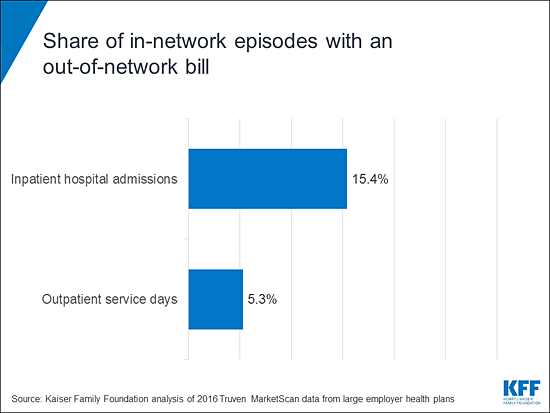
Almost 18 percent of inpatient admissions result in non-network claims for patients with large employer coverage. Even when enrollees choose in-network facilities, 15 percent of admissions include a bill from an out-of-network provider, such as from a surgeon or an anesthesiologist.  These bills potentially expose enrollees to high out-of-pocket costs if these providers charge enrollees more than their plans pay for services.  This is typically referred to as “balance billing,” and can result in a “surprise” medical bill if a patient did not anticipate receiving care from an out-of-network provider. Health insurance plans also typically require higher patient cost-sharing for out-of-network claims.

The analysis looks at inpatient admissions and outpatient services to examine how often they result in claims from providers that are not participating in an enrollee’s provider network.

For both inpatient admissions and outpatient services, use of an emergency room is associated with higher rates of out-of-network bills. Treatments for mental health and substance abuse also have a much higher chance of including a claim from an out-of-network provider, potentially reflecting difficulty in finding a participating provider.  

The issue brief is available on the Peterson-Kaiser Health System Tracker, a partnership between the Peterson Center on Healthcare and the Kaiser Family Foundation that monitors the U.S. health system’s performance on key quality and cost measures.

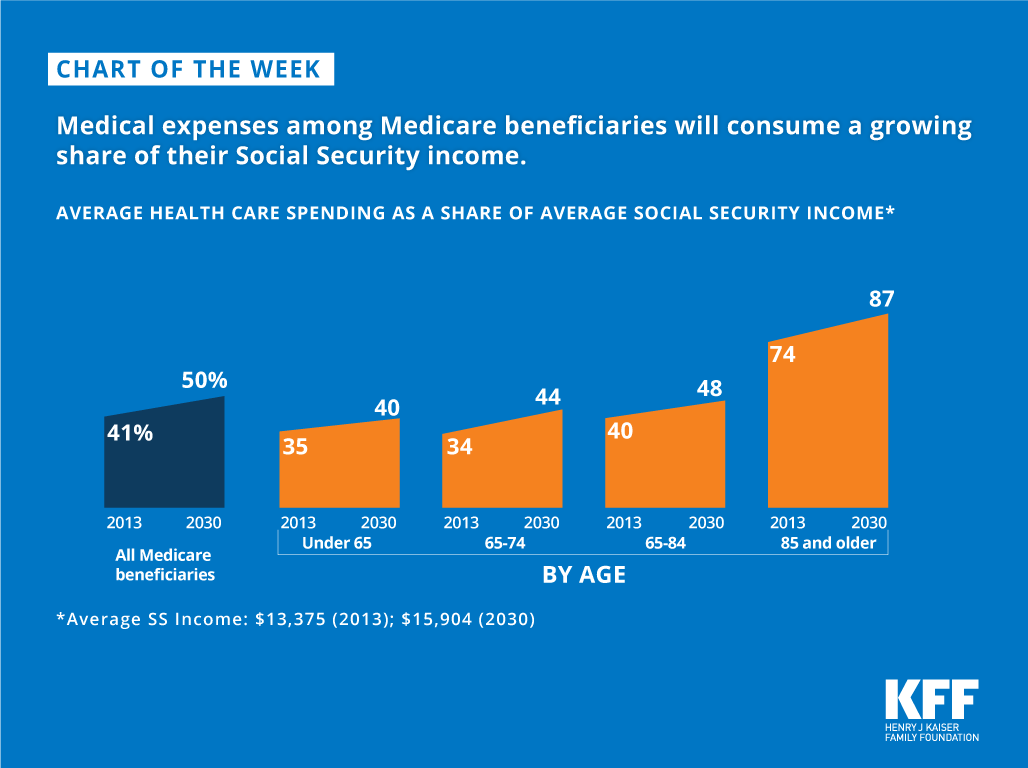
Medical expenses among Medicare beneficiaries will consume a growing share of their Social Security income

Published: Aug 9, 2018

Source

KFF analysis based on CMS Medicare Current Beneficiary Survey 2013 Cost and Use file and The Urban Institute’s DYNASIM3

News Release

Does Employment Lead to Improved Health? New Research Review Finds Mixed Evidence with Caveats that Could Impact Applicability to Medicaid Work Requirements

Published: Aug 7, 2018

With nearly a dozen states seeking or implementing waivers to add work requirements for some Medicaid beneficiaries, a central question is whether such policies promote health and therefore promote the goals of the Medicaid program.

A new Kaiser Family Foundation report reviews research about the relationship between work and health and finds only limited evidence that employment improves health, with some studies showing a positive impact and others showing no relationship at all or only limited effects. The review does find strong evidence of an association between unemployment and poorer health outcomes.

While unemployment is almost universally a negative experience and linked to poor outcomes, especially for mental health, employment can be positive or negative depending on the nature and quality of work, including its stability, hours, pay and stress levels. Low-quality, unstable and poorly paid jobs lead to or are associated with adverse health effects, suggesting that all jobs should not be expected to have similar effects on workers’ health.

The report also discusses other limitations and conclusions to consider in applying research findings to Medicaid work requirements, such as the “healthy worker” effect of healthier people being more likely to work, limits on applying population-wide studies to the low-income Medicaid population, and the potential health effects of losing health coverage as a result of work requirements.

The new report examines past research on the relationship between work and health and its implications for Medicaid work requirements. It focuses primarily on findings from other literature or systematic reviews rather than individual studies and includes studies cited in the federal government’s policy documents on work requirements in the Medicaid program as well as other research.

The Relationship Between Work and Health: Findings from a Literature Review

Authors: Larisa Antonisse and Rachel Garfield
Published: Aug 7, 2018

Issue Brief

Summary

A central question in the current debate over work requirements in Medicaid is whether such policies promote health and are therefore within the goals of the Medicaid program. Work requirements in welfare programs in the past have had different goals of strengthening self-esteem and providing a ladder to economic progress, versus improving health. This brief examines literature on the relationship between work and health and analyzes the implications of this research in the context of Medicaid work requirements. We review literature cited in policy documents, as well as additional studies identified through a search of academic papers and policy evaluation reports, focusing primarily on systematic reviews and meta-analyses. Key findings include the following:

  • Being in poor health is associated with increased risk of job loss, while access to affordable health insurance has a positive effect on people’s ability to obtain and maintain employment.

    KFF review: Research about the relationship between work and health finds only limited evidence that employment improves health, with some studies showing a positive impact and others showing no relationship or only limited effects.

  • There is limited evidence on the effect of employment on health, with some studies showing a positive effect of work on health yet others showing no relationship or isolated effects. There is strong evidence of an association between unemployment and poorer health outcomes, but authors caution against using these findings to infer that the opposite relationship (work causing improved health) exists. While unemployment is almost universally a negative experience and thus linked to poor outcomes, especially poor mental health outcomes, employment may be positive or negative, depending on the nature of the job (e.g., stability, stress, hours, pay, etc.). Further, most studies note major limitations in our ability to draw broad conclusions on health and work, including:
    • Job availability and quality are important modifiers in how work affects health; transition from unemployment to poor quality or unstable employment options can be detrimental to health.
    • Selection bias in the research (e.g., healthy people being more likely to work) and other methodological limitations restrict the ability to determine a causal work-health relationship.
  • Studies note several caveats to and implications of the research on work and health that are particularly relevant to work requirements in Medicaid. For example:
    • The work-health relationship may differ for the Medicaid population compared to the broader populations studied in the literature, as Medicaid enrollees report worse health than the general population and face significant challenges related to social determinants of health.
    • Limited job availability or poor job quality may moderate or reverse any positive effects of work.
    • Work or volunteering to fulfill a requirement may produce different health effects than work or volunteer activities studied in existing literature.
    • Loss of Medicaid coverage under work requirements could negatively impact health care access and outcomes, as well as exacerbate health disparities.

Introduction

On January 11, 2018, CMS issued a State Medicaid Director Letter providing new guidance for Section 1115 waiver proposals that would impose work requirements (referred to as community engagement) in Medicaid as a condition of eligibility. On January 12, 2018, CMS approved the first work requirement waiver in Kentucky, and three additional work requirement waiver approvals followed in Indiana (February 1, 2018), Arkansas (March 5, 2018), and New Hampshire (May 7, 2018). The new guidance and work requirement approvals reverse previous positions of both Democratic and Republican Administrations, which had not approved work requirement waiver requests on the basis that such provisions would not further the Medicaid program’s purposes of promoting health coverage and access. However, in both the new guidance and work requirement waiver approvals, CMS explains its policy reversal by maintaining that employment leads to improved health outcomes, and policies that condition Medicaid eligibility on meeting a work requirement will further this objective. Though the structure of work requirements is similar to those used in other programs, the administration’s stated goal of  improving health through Medicaid work requirements is different from the goals of welfare reform work requirements in the past, which were to strengthen self-esteem and provide a ladder to economic progress.

On June 29, 2018, the DC federal district court vacated HHS’s approval of the Kentucky Section 1115 waiver program. The court held that consideration of whether the waiver would promote beneficiary health in general is not a substitute for considering whether the waiver promotes Medicaid’s primary purpose of providing affordable health coverage and remanded to HHS to consider how the waiver would help furnish medical assistance consistent with Medicaid program objectives. However, the court also noted that plaintiffs and their amici assert that proclaimed health benefits of employment are unsupported by substantial evidence. Thus, there is likely to be ongoing debate and policy discussion over whether work requirements will further the aims of Medicaid.

To address whether work will further the aims of Medicaid, we examine the literature on the relationship between work and health and analyze the implications of this research in the context of Medicaid work requirements. Due to the large number of studies in this field spanning decades, this literature review focuses primarily (although not exclusively) on findings from other literature or systematic reviews rather than individual studies on these topics. We drew on studies cited in policy documents on work requirements in Medicaid, results of keyword searches of PubMed and other academic health/social policy search engines, and snowballing through searches of reference lists in previously pulled papers. In total, we reviewed more than 50 sources, the vast majority of which were published academic studies or program evaluations and most of which are reviews of multiple studies themselves. A more detailed description of the methods underlying this analysis is provided in the Methods box at the end of this brief.

What effect do health and health coverage have on work?

Not surprisingly, research has demonstrated that being in poor health is associated with an increased risk of job loss or unemployment.1 ,2 ,3 ,4 ,5  A meta-analysis of longitudinal studies on the relationship between health measures and exit from paid employment found that poor health, particularly self-perceived health, is associated with increased risk of exit from paid employment.6  Another study that simultaneously examined and contrasted the relative effects of unemployment on mental health and mental health on employment status in a single general population sample found mental health to be both a consequence of and a risk factor for unemployment. However, the evidence for men in particular suggested that mental health was a stronger predictor of subsequent unemployment than unemployment was a predictor of subsequent mental health.7  Additional research suggests that, in some cases, individual characteristics such as income, race, sex, or education level may mediate the relationship between poor health and unemployment.8 ,9 10  Research also demonstrates that an unmet need for mental health or substance use disorder treatment results in greater difficulty with obtaining and maintaining employment.11 ,12 ,13 ,14 ,15 

Additional research suggests that, in addition, access to affordable health insurance and care, which may help people maintain or manage their health, promotes individuals’ ability to obtain and maintain employment. For example, in an analysis of Medicaid expansion in Ohio, most expansion enrollees who were unemployed but looking for work reported that Medicaid enrollment made it easier to seek employment, and over half of employed expansion enrollees reported that Medicaid enrollment made it easier to continue working.16  Similarly, a study on Medicaid expansion in Michigan found that 69% of enrollees who were working said they performed better at work once they got coverage, and 55% of enrollees who were out of work said the coverage made them better able to look for a job.17  A study on Montana’s Medicaid expansion found a substantial increase of 6 percentage points in labor force participation among low-income, non-disabled Montanans ages 18-64 following expansion, compared to a decline in labor force participation among higher-income Montanans.18  National research found increases in the share of individuals with disabilities reporting employment and decreases in the share reporting not working due to a disability in Medicaid expansion states following expansion implementation, with no corresponding trends observed in non-expansion states.19  Additional literature suggests that access to health insurance and care promotes volunteerism, finding that the expansion of Medicaid under the ACA was significantly associated with increased volunteerism among low-income adults.20 ,21 

What effect does work have on health and health coverage?

Overall, the body of literature examining whether work affects health shows mixed results, with some studies showing a positive effect of work on health yet others showing no relationship or isolated effects. A 2006 literature review found that, while “there is limited amount of high quality scientific evidence that directly addresses the question [of whether work is good for your health]… there is a strong body of indirect evidence that work is generally good for health and well-being.”22  That assessment was based on comprehensive review of the literature, including other systematic reviews as well as narrative and opinion pieces. A more focused 2014 systematic review about the health effects of employment, which included 33 longitudinal studies,23  found strong evidence that employment reduces the risk of depression and improves general mental health, yet it found insufficient evidence for an effect on other health outcomes due to a lack of studies or inconsistent findings of the studies.24  A 2015 review of 22 longitudinal studies found an association between employment and re-employment with better physical health.25 

In contrast, research shows a strong association between unemployment and poor health outcomes, though researchers caution that these findings do not necessarily mean the reverse is true (e.g. employment causes improved health). The effect of unemployment on health has long been an area of research focus, and a substantial body of research from the U.S. and abroad consistently demonstrates a strong association between unemployment and poorer health outcomes,26 ,27 ,28 ,29  30 ,31 ,32   with some evidence suggesting a causal relationship in which unemployment leads to poor health.33 ,34 ,35  The bulk of the research in the unemployment and health field focuses on mental health outcomes.36   Examples of negative health outcomes associated with unemployment include increases in depression, anxiety, mixed symptoms of distress, and low self-esteem.37 ,38  A more limited body of research suggests an association of unemployment with poorer physical health (including increases in cardiovascular risk factors such as hypertension and serum cholesterol as well as increased susceptibility to respiratory infections), and mortality.39 ,40  A 2006 literature review noted that there is continuing debate about the relative importance of possible mechanisms involved in this relationship, and adverse effects of unemployment may vary in nature and degree for different individuals in different social contexts.41  Some evidence also indicates that cumulative length of unemployment is correlated with deteriorated health and health behavior.42  However, despite the evidence of a relationship between unemployment and health, researchers caution against using findings to infer that an opposite relationship (employment causing improved health) exists.43 ,44   In addition, researchers note that the literature on unemployment tends to study more negative than positive health outcome variables,45  which may skew our understanding of the health effects of unemployment.46 

Another related area of research is studies examining the relationship between re-employment (i.e., returning to work) and health, which find some association between re-employment and mental health. A 2012 systematic review on this topic found support for a beneficial health effect of returning to work, with most of the 18 studies included in this review focusing on mental health-related outcomes.47  The review also tried to assess to what extent the relationship was causal (i.e., reemployment caused health improvements) versus due to selection (e.g., people with poor health were more likely to remain unemployed) and concluded that both were at play. The review did not reach a definitive conclusion about mechanisms linking re-employment to improved health (due to lack of evidence), and it noted that it is still unclear whether health effects of reemployment are moderated by factors such as socioeconomic status, reason for unemployment, and the nature of employment.48  The 2006 literature review described above also analyzed research findings on re-employment and found strong evidence that re-employment leads to improved psychological health and measures of general well-being, with a dearth of information on physical health and some but not all studies showing that re-employment/health relationship is at least partly due to health selection. However, these authors also cite evidence from numerous studies suggesting that “the beneficial effects of re-employment depend mainly on the security of the new job, and also on the individual’s motivation, desires, and satisfaction”49 

Research review: Low-quality, unstable and poorly paid jobs lead to or are associated with adverse health effects, suggesting that all jobs should not be expected to have similar effects on workers’ health.

Studies on work and health have found that the quality and stability of work is a key factor in the work-health relationship: research finds that low-quality, unstable, or poorly-paid jobs lead to or are associated with adverse effects on health.50 ,51 ,52 ,53 ,54 ,55 ,56   For example, a 2014 meta-analysis of studies published after 2004 found that job insecurity can pose a comparable (and even modestly increased) risk of subsequent depressive symptoms compared to unemployment.57  A 2011 longitudinal analysis found that while unemployed respondents had poorer mental health than those who were employed, the mental health of those who were unemployed was comparable or more often superior to those in jobs of poor psychosocial quality (based on measures of job control, perceived job security, and job demands and complexity) and the mental health of those in poor quality jobs declined more over time than the mental health of those who were unemployed. Moreover, while moving from unemployment into a high quality job led to improvement in mental health, the transitioning from unemployment to a poor quality job was more detrimental to mental health than remaining unemployed.58  Additionally, a 2003 study that examined the association of different employment categories with physical health and depression found a consistent association between less than optimal jobs (based on economic, non-income, and psychological aspects of the jobs) and poorer physical and mental health among adults.59 

It is possible that the work-health association reflects people in good health being more likely to work, versus work causing good health. Some researchers caution against the possibility that selection bias has occurred in many of the studies on work and health. The existence of a “healthy worker effect”—in which relatively healthy individuals are more likely to enter the workforce whereas those with health problems are at increased risk to withdraw from and remain outside of the workforce—has been documented in multiple studies.60 ,61 ,62 ,63  64  ,65   Authors of both individual studies and literature reviews on this topic explain that the healthy worker effect is difficult to control for even in studies that attempt to do so, and thus this effect may cause an overestimation of the findings in the literature on health effects of work.66 ,67  As authors of a 2014 systematic review of studies on health effects of employment point out, there are no randomized controlled trials on this topic available in the literature because performing such trials would be unethical,68  yet randomized controlled trials are the gold standard for determining a causal relationship.

Most study authors specifically note additional caveats to drawing broad conclusions about work and health. The 2006 review concluding a general positive effect of work on health emphasized three major provisos to this conclusion: (1) findings are about average or group affects, and a minority of people may experience contrary health effects from work, (2) the beneficial health effects of work depend on the nature and quality of work (described above), and (3) the social context must be taken into account, particularly social gradients in health (i.e. inequalities in population health status related to inequalities in social status) and regional deprivation.69  These caveats could explain the seemingly contradictory findings about employment and unemployment: While unemployment is almost universally a negative experience and thus linked to poor outcomes, especially poor mental health outcomes, employment may be positive or negative, depending on the nature of the job (e.g., stability, stress, hours, pay, etc.). As discussed below, these provisos have implications for the applicability of research to Medicaid work requirements.

While work can help people access employer-sponsored health coverage, many jobs—especially low-wage jobs—do not come with an affordable offer of employer coverage. In 2017, just over half (53%) of firms offered health coverage to their employees,70  and workers in low-wage firms are less likely than those in higher wage firms to be eligible for coverage through their employer.71  In 2017, less than a third of workers who worked at or below their state’s minimum wage had an offer of health coverage through their employer.72  Though most employees take up employer-sponsored coverage when offered, workers in low-wage firms are less likely to be covered by their employer even if coverage is offered, likely reflecting the fact that workers in such firms pay a larger share of the premium than workers in higher-wage firms.73  The fact that work does not always lead to health coverage is further demonstrated by the large majority of uninsured people who are in a family with either a full-time (74%) or part-time (11%) worker.74 

What is the effect of volunteerism on health?

In the January 2018 guidance, CMS includes volunteering as a “community engagement” activity that may improve health outcomes,75  and the Medicaid work requirement waivers approved to date all permit volunteer activities to count towards the required weekly/monthly hours of work activity.

However, there is limited existing evidence that volunteer activities benefit health outcomes. One literature review on the health effects of volunteering “did not find any consistent, significant health benefits arising through volunteering” based on experimental studies available at the time of the literature review.76  The authors’ analysis of cohort studies revealed limited benefits of volunteering on depression, life satisfaction, and well-being (with no significant benefits on physical health). In addition, the cohort studies focused primarily on volunteers ages 50 and over, with some of the studies suggesting that the association between volunteerism and improved health outcomes may be limited to older volunteers and that that the health benefits of volunteering may diminish as hours of volunteering increase.77  Another study (published in 2018) examined the health benefits of “other-oriented volunteering” (other-regarding, altruistic, and humanitarian-concerned volunteering) compared to “self-oriented volunteering” (volunteering focused on seeking benefits and enhancing the volunteers themselves in return). While the authors found beneficial effects of both forms of volunteer activity on health and well-being, other-oriented volunteering had significantly stronger effects on the health outcomes of mental and physical health, life satisfaction, and social well-being than did self-oriented volunteering.78  As discussed below, this finding may indicate that health benefits of volunteering are likely to be weaker when individuals are compelled to engage in volunteering.

What does this research mean for Medicaid work requirements?

The body of literature summarized above includes several notable caveats and conclusions to consider in applying findings to a work requirement in Medicaid. Limitations and implications that are particularly relevant include:

Effects found for the general population may not apply to Medicaid, as the link between work and health is not universal across populations or social contexts. In general, the studies examined above analyze the relationship between work and health among broad populations of all income levels. However, several authors suggest that population differences may modify the relationship between work and health.  A 2003 study found that nationally, older adults, women, blacks, and individuals with low education levels were more likely to be employed in jobs viewed as “barely adequate” or “inadequate” (the types of jobs that the study found to be independently associated with poorer physical health and higher rates of depression) compared to other populations.79  Authors of a 2006 literature review qualify their broad findings on the work/health relationship with the proviso that the social context must be taken into account (particularly social inequities in health and regional deprivation), and also cite evidence that the strong association between socioeconomic status and physical and mental health and mortality likely outweighs (and is confounded with) all other work characteristics that influence health.80  Authors of a 2005 review on unemployment and health found a strong association between deprived areas, poor health, poverty and unemployment (although the exact relationship is not clear), and highlight the need for more research on the geographical dimension on unemployment and health.81  These findings imply that the work/health relationship may differ significantly for the low-income Medicaid population, who report worse health status compared to the total US population and often face more significant challenges related to housing, food security, and other social determinants of health.82 ,83 ,84  In addition, some volunteerism research suggests that the association between volunteerism and improved health outcomes may be limited to older volunteers, yet approved and pending Section 1115 Medicaid work requirement waiver requests all include exemptions for individuals above a certain age (which varies by state but ranges from 50 to 65 years).85 

Work or volunteering undertaken to fulfill a requirement may produce different health effects than work and volunteer activities studied in existing literature. For example, research on health effects of work requirements in Temporary Assistance for Needy Families (TANF) suggests that they did not benefit and sometimes negatively affected health among enrollees and their dependents.86  Another study found that welfare reform was associated with increases in self-reported poor health and self-reported disability among white single mothers without a high school diploma or GED.87  These adverse effects could reflect different relationships between work and health for low-income populations, as described above, or different effects of work undertaken voluntarily versus as a requirement. Authors of a 2006 literature review on work and health found that forcing claimants off benefits and into work without adequate supports would more likely harm than improve their health and well-being.88  Similarly, most studies on volunteerism and health define volunteerism as an act of free-will (essentially, a voluntary act), a definition that may not be applicable to volunteer activity undertaken for the purpose of meeting work/community engagement requirements in order to maintain eligibility for Medicaid. Volunteer activities undertaken to retain Medicaid appear more closely aligned with the self-oriented form of volunteerism (volunteering focused on seeking benefits and enhancing the volunteers themselves in return), which research shows has weaker health effects than the other-oriented form (other-regarding, altruistic, and humanitarian-concerned volunteering).

Limited job availability, low demand for labor, or poor job quality may moderate any positive health effects of employment. Authors of a 2014 systematic review of prospective studies on health effects of employment commented that most studies in this field do not adjust for quality of employment and include all kinds of jobs in their analysis (e.g. part- and full-time employment, self-employment, and both blue- and white-collared jobs) despite the possibility that different forms of employment have different health effects.89  Under Medicaid work requirement programs, the population subject to Medicaid work requirements may have access to only low-wage, unstable, or low-quality jobs to meet the weekly/monthly hours requirement, as these are the types of positions adults with Medicaid who currently work hold.90  In discussing the policy implications of their findings, multiple researchers have concluded that such policies could be detrimental to health, with authors of one study asserting that, “Policies that promote job growth without giving attention to the overall adequacy of the jobs may undermine health and well-being.”91 

Long-term effects of work on health are unclear. Much of the evidence on the work/health relationship is about short-term effects after about one year, which, as authors of one literature review point out, is a short period when assessing health impacts.92  There is less evidence on longer-term effects over a lifetime perspective.93  In addition, research on work requirements in other public programs shows little evidence of long-term impacts on employment or income. Studies on welfare recipients subject to work requirements generally have found that any initial increase in employment after an imposition of a work requirement faded over time.94 ,95 ,96  After five years, one study showed those who were not required to work were just as likely or more likely to be working compared to those who were subject to a work requirement, suggesting that these work requirements had little impact on increasing employment over the long-term.97  Other research has found that employment among people who left welfare was unsteady and did not lift them out of poverty.98  Thus, even short-term effects are likely to disappear as short-term boosts in employment fade over time.

Loss of health insurance coverage due to not meeting reporting or work requirements under waivers could affect access to health care and health. Low-wage workers typically work in small firms and industries that often have limited employer-based coverage options, and very few have an offer of coverage through their employer. Work requirements in Medicaid could lead to large Medicaid coverage losses, especially among people who would remain eligible for the program but lose coverage due to new administrative burdens or red tape versus those who would lose eligibility due to not working.99  Several studies on individuals leaving TANF following welfare reform show reductions in insurance coverage across this “welfare leaver” population, with significant decreases in Medicaid coverage that were not fully offset by the smaller increases in private coverage.100 ,101 ,102 ,103 ,104  A study evaluating welfare-to-work interventions found that some programs led to a reduction in health insurance coverage for both children and parents.105   Given the evidence of Medicaid’s positive impact on access to care and health outcomes,106  as well as data demonstrating that uninsured individuals go without needed care due to cost at much higher rates than those with Medicaid coverage,107  widespread coverage losses as a result of Medicaid work requirements are likely to result in adverse effects on health outcomes. In TANF evaluations, for example, studies found that children of TANF enrollees who lose benefits for failure to comply with a work requirement experience adverse health effects such as behavioral health problems108  or hospitalization.109 

Policies that have disproportionate effects on certain Medicaid enrollees could widen health disparities. Data demonstrate the persistence of clear disparities in health insurance coverage, access to care, and health outcomes for certain vulnerable populations in the US, including people with disabilities (compared to their non-disabled counterparts)110  and people of color (compared to whites).111  Research shows that people with disabilities and people of color are face disproportionate challenges in meeting and are disproportionately sanctioned under existing work requirement programs.112 ,113  If racial minority groups, people with disabilities, or other vulnerable populations face similarly disproportionate challenges in meeting work requirements when they are attached to the Medicaid program, these policies could result in wider disparities in health insurance coverage and health outcomes.

Looking Ahead

Taken as a whole, the large body of research on the link between work and health indicates that proposed policies requiring work as a condition of Medicaid eligibility may not necessarily benefit health among Medicaid enrollees and their dependents, and some literature also suggests that such policies could negatively affect health. While it is difficult to determine a causal relationship between employment and health status (largely due to challenges controlling for health selection bias and the inability to conduct randomized controlled trials on this topic), there is strong evidence of an association between employment and good health. However, research suggests that factors like job availability and quality, as well as the social context of workers, mediate the effect of work or work requirements on health. Given the characteristics of the Medicaid population, research indicates that policies could lead to emotional strain, loss of health coverage, or widening of health disparities for vulnerable populations. As debate considers the question of whether policies to promote health—versus health coverage—are the aim of the Medicaid program, the question of whether work requirements will promote health also will remain key to the ongoing debate over the legality of work requirements in Medicaid.

Methods

This brief is based on a review of existing research on the relationship between work and health. To collect relevant studies, we began by drawing on studies cited in policy documents on work requirements in Medicaid, including the January 2018 guidance from CMS, comments and reactions to the guidance, and documents related to the Stewart v. Azar litigation and decision. We then conducted keyword searches of PubMed and other academic health/social policy search engines to compile relevant studies and program evaluations.  Due to the large number of studies in this field spanning decades, we focused primarily (although not exclusively) on findings from other literature or systematic reviews rather than individual studies on these topics. We then used a snowballing technique of pulling additional studies from reference lists in previously pulled papers. In areas with limited evidence or in which reviews indicated conflicting or unclear results, we looked at original source studies to understand findings and assess the strength of the evidence.

In total, we reviewed more than 50 sources, the vast majority of which were published academic studies or program evaluations and most of which are reviews of multiple studies themselves. In weighing evidence, we prioritized recent research and research based in the United States over older research and research based on experiences in other countries, though we did include older and international studies if they were highly cited, directly relevant, or included in systematic reviews that also included US-based studies. We excluded commentaries (as compared to original work or comprehensive literature reviews) and studies that were not directly focused on the link between health and work (e.g., we excluded studies of workplace wellness programs).


Endnotes

  1. Sarah Olesen, Peter Butterworth, Liana Leach, Margaret Kelaher, and Jane Pirkis, “Mental Health Affects Future Employment as Job Loss Affects Mental Health: Findings from a Longitudinal Population Study,” BMC Psychiatry 13 (2013), https://bmcpsychiatry.biomedcentral.com/articles/10.1186/1471-244X-13-144 ↩︎
  2. Peter Butterworth, Liana Leach, Jane Pirkis, and Margaret Kelaher, ”Poor Mental Health Influences Risk and Duration of Unemployment: A Prospective Study,” Social Psychiatry and Psychiatric Epidemiology 47 no. 6 (June 2012): 1013-1021, https://link.springer.com/article/10.1007/s00127-011-0409-1 ↩︎
  3. Rogier van Rijn, Suzan Robroek, Sandra Brouwer, and Alex Burdorf, “Influence of Poor Health on Exit from Paid Employment: A Systematic Review,” Occupational & Environmental Medicine 71 no. 4, (2014): pp. 295-301, https://oem.bmj.com/content/71/4/295 ↩︎
  4. Merel Schuring et al., “The Effect of Ill Health and Socioeconomic Status on Labor Force Exist and Re-Employment: A Prospective Study with Ten Years Follow-Up in the Netherlands,” Scandinavian Journal of Work, Environment, and Health 39 no. 2 (March 2013): pp. 134. ↩︎
  5. Merel Schuring et al., “The Effects of Ill Health on Entering and Maintaining Paid Employment: Evidence in European Countries,” Journal of Epidemiology & Community Health 61 (2007): pp. 597-604,  https://jech.bmj.com/content/61/7/597.full ↩︎
  6. Rogier van Rijn, Suzan Robroek, Sandra Brouwer, and Alex Burdorf, “Influence of Poor Health on Exit from Paid Employment: A Systematic Review,” Occupational & Environmental Medicine 71 no. 4, (2014): pp. 295-301, https://oem.bmj.com/content/71/4/295 ↩︎
  7. Sarah Olesen, Peter Butterworth, Liana Leach, Margaret Kelaher, and Jane Pirkis, “Mental Health Affects Future Employment as Job Loss Affects Mental Health: Findings from a Longitudinal Population Study,” BMC Psychiatry 13 (2013), https://bmcpsychiatry.biomedcentral.com/articles/10.1186/1471-244X-13-144 ↩︎
  8. Victoria Blinder et al., “Women with Breast Cancer Who Work For Accommodating Employers More Likely To Retain Jobs After Treatment,” Health Affairs 36 no. 2 (February 2017), https://www.healthaffairs.org/doi/10.1377/hlthaff.2016.1196 ↩︎
  9. Merel Schuring et al., “The Effects of Ill Health on Entering and Maintaining Paid Employment: Evidence in European Countries,” Journal of Epidemiology & Community Health 61 (2007): pp. 597-604,  https://jech.bmj.com/content/61/7/597.full ↩︎
  10. Victoria Blinder et al., “Women with Breast Cancer Who Work For Accommodating Employers More Likely To Retain Jobs After Treatment,” Health Affairs 36 no. 2 (February 2017), https://www.healthaffairs.org/doi/10.1377/hlthaff.2016.1196 ↩︎
  11. National Institute on Drug Abuse, Consequences of Drug Misuse (Bethesda, MD: National Institute on Drug Abuse, March 2017), https://www.drugabuse.gov/related-topics/health-consequences-drug-misuse ↩︎
  12. Neil Jordan et al., “Economic Benefit of Chemical Dependency Treatment to Employers,” Journal of Substance Abuse Treatment 34, 3(2008):311-319 ↩︎
  13. Ronald C. Kessler et al., “Depression in the Workplace: Effects on Short-term Disability,” Health Affairs (Millwood) 18, 5(1999):163-71 ↩︎
  14. Cheryl J. Cherpitel and Yu Ye, “Drug Use and Problem Drinking Associated with Primary Care and Emergency Room Utilization in the US General Population: Data from the 2005 National Alcohol Survey,” Drug and Alcohol Dependence 97 3(2008):226-30 ↩︎
  15. Doris J. James and Lauren E. Glaze, Mental Health Problems of Prison and Jail Inmates (Washington, DC: US Department of Justice, December 2006), https://www.bjs.gov/content/pub/pdf/mhppji.pdf ↩︎
  16. The Ohio Department of Medicaid, Ohio Medicaid Group VIII Assessment: A Report to the Ohio General Assembly (The Ohio Department of Medicaid, January 2017). ↩︎
  17. University of Michigan Institute for Healthcare Policy & Innovation, Medicaid Expansion Helped Enrollees Do Better at Work or in Job Searches (June 2017), http://ihpi.umich.edu/news/medicaid-expansion-helped-enrollees-do-better-work-or-job-searches ↩︎
  18. Bureau of Business and Economic Research, The Economic Impact of Medicaid Expansion in Montana (University of Montana Bureau of Business and Economic Research, Prepared for the Montana Healthcare Foundation and Headwaters Foundation, April 2018), https://mthcf.org/wp-content/uploads/2018/04/BBER-MT-Medicaid-Expansion-Report_4.11.18.pdf ↩︎
  19. Jean Hall, Adele Shartzer, Noelle Kurth, and Kathleen Thomas, “Medicaid Expansion as an Employment Incentive Program for People With Disabilities,” American Journal of Public Health epub ahead of print (July 2018), https://ajph.aphapublications.org/doi/pdf/10.2105/AJPH.2018.304536 ↩︎
  20. Heeju Sohn and Stefan Timmermans, “Social Effects of Health Care Reform: Medicaid Expansion under the Affordable Care Act and Changes in Volunteering,” Socius: Socialogical Research for a Dynamic World 3 (March 2017): 1-12, http://journals.sagepub.com/doi/full/10.1177/2378023117700903 ↩︎
  21. Sohn and Timmermans used the volunteering supplement to the Current Population Survey (CPS) to measure volunteerism. Analyzed changes in formal volunteering based on two CPS questions: “Since September 1st of last year, have you done any volunteering activities through or for an organization?” and, “Sometimes people don’t think of activities they do infrequently or activities they do for children’s schools or youth organizations as volunteer activities. Since September 1st of last year, have you done any of these types of volunteer activities?”  Also separately analyzed changes in informal helping based on one CPS question: “Since September 1st of last year, have you worked with people in your neighborhood to fix or improve something?” ↩︎
  22. Gordon Waddell and A. Kim Burton, Is Work Good for your Health and Well-Being?, (2006), https://www.gov.uk/government/publications/is-work-good-for-your-health-and-well-being ↩︎
  23. The authors judged 23 of these studies to be “high quality” studied from a methodological perspective, and they classified the remaining 10 as “low quality” studies from a methodological perspective. ↩︎
  24. Maaike van der Noordt, Helma IJzelenberg, Mariel Droomers, and Karin Proper, “Health Effects of Employment: A systematic Review of Prospective Studies,” Occupational and Environmental Medicine, 71 (October 2014): 730-736, https://www.ncbi.nlm.nih.gov/pubmed/24556535 ↩︎
  25. K. Hergenrather, et al., Employment as a Social Determinant of Health: A Systematic Review of Longitudinal Studies Exploring the Relationship Between Employment Status and Physical Health, Rehabilitation Research, Policy, and Education (2015), https://www.researchgate.net/publication/273333771_Employment_as_a_Social_Determinant_of_Health_A_Systematic_Review_ of_Longitudinal_Studies_Exploring_the_Relationship_Between_Employment_Status_and_Physical_Health ↩︎
  26. Gordon Waddell and A. Kim Burton, Is Work Good for your Health and Well-Being?, (2006), https://www.gov.uk/government/publications/is-work-good-for-your-health-and-well-being ↩︎
  27. Robert Jin, Chandrakant Shah, and Tomislav Svoboda, “The Impact of Unemployment on Health: A Review of the Evidence,” Canadian Medical Association Journal 153, no. 5 (September 1995), https://www.ncbi.nlm.nih.gov/pmc/articles/PMC1487417/ ↩︎
  28. K. Hergenrather, et al., Employment as a Social Determinant of Health: A Systematic Review of Longitudinal Studies Exploring the Relationship Between Employment Status and Physical Health, Rehabilitation Research, Policy, and Education (2015), https://www.researchgate.net/publication/273333771_Employment_as_a_Social_Determinant_of_Health_A_Systematic_Review_of_ Longitudinal_Studies_Exploring_the_Relationship_Between_Employment_Status_and_Physical_Health ↩︎
  29. Jennifer Pharr, Sheniz Moonie, and Timothy Bungum, “The Impact of Unemployment on Mental and Physical Health, Access to Health Care and Health Risk Behaviors,” International Scholarly Research Network Public Health (2012), https://www.hindawi.com/journals/isrn/2012/483432/   ↩︎
  30. Carl McClean et al., Worklessness and Health—What do we Know about the Causal Relationship? (London: Health Development Agency, 2005), http://www.employabilityinscotland.com/media/83147/worklessness-and-health-what-do-we-know-about-the-relationship.pdf ↩︎
  31. Gregory Murphy and James Athanasou, “The Effect of Unemployment on Mental Health,” Journal of Occupational and Organizational Psychology 72 (March 1999): 83-99, https://onlinelibrary.wiley.com/doi/pdf/10.1348/096317999166518 ↩︎
  32. Sarah Olesen, Peter Butterworth, Liana Leach, Margaret Kelaher, and Jane Pirkis, “Mental Health Affects Future Employment as Job Loss Affects Mental Health: Findings from a Longitudinal Population Study,” BMC Psychiatry 13 (2013), https://bmcpsychiatry.biomedcentral.com/articles/10.1186/1471-244X-13-144 ↩︎
  33. Gordon Waddell and A. Kim Burton, Is Work Good for your Health and Well-Being?, (2006), https://www.gov.uk/government/publications/is-work-good-for-your-health-and-well-being ↩︎
  34. Karsten Paul and Klaus Moser, “Unemployment Impairs Mental Health: Meta Analyses,” Journal of Vocational Behavior 74, no.3 (June 2009): 264-282, https://www.sciencedirect.com/science/article/abs/pii/S0001879109000037 ↩︎
  35. Frances McKee-Ryan, Zhaoli Song, Connie Wanberg, and Angelo Kinicki, “Psychological and Physical Well-Being During Unemployment: A Meta-Analytic Study,” Journal of Applied Psychology 90 no. 1 (January 2005): 53-76, http://psycnet.apa.org/doiLanding?doi=10.1037%2F0021-9010.90.1.53 ↩︎
  36. Frances McKee-Ryan, Zhaoli Song, Connie Wanberg, and Angelo Kinicki, “Psychological and Physical Well-Being During Unemployment: A Meta-Analytic Study,” Journal of Applied Psychology 90 no. 1 (January 2005): 53-76, http://psycnet.apa.org/doiLanding?doi=10.1037%2F0021-9010.90.1.53 ↩︎
  37. Gordon Waddell and A. Kim Burton, Is Work Good for your Health and Well-Being?, (2006), https://www.gov.uk/government/publications/is-work-good-for-your-health-and-well-being ↩︎
  38. Karsten Paul and Klaus Moser, “Unemployment Impairs Mental Health: Meta Analyses,” Journal of Vocational Behavior 74, no.3 (June 2009): 264-282, https://www.sciencedirect.com/science/article/abs/pii/S0001879109000037 ↩︎
  39. Gordon Waddell and A. Kim Burton, Is Work Good for your Health and Well-Being?, (2006), https://www.gov.uk/government/publications/is-work-good-for-your-health-and-well-being ↩︎
  40. Karsten Paul and Klaus Moser, “Unemployment Impairs Mental Health: Meta Analyses,” Journal of Vocational Behavior 74, no.3 (June 2009): 264-282, https://www.sciencedirect.com/science/article/abs/pii/S0001879109000037 ↩︎
  41. Gordon Waddell and A. Kim Burton, Is Work Good for your Health and Well-Being?, (2006), https://www.gov.uk/government/publications/is-work-good-for-your-health-and-well-being ↩︎
  42. Urban Janlert, Anthony Winefield, and Anne Hammarstrom, “Length of Unemployment and Health-Related Outcomes: A Life-Course Analysis,” European Journal of Public Health 25 no. 4 (August 2015), https://academic.oup.com/eurpub/article/25/4/662/2398865 ↩︎
  43. Steve Crabtree, “In U.S., Depression Rates Higher for Long-Term Unemployed,” Gallup (June 2014), http://news.gallup.com/poll/171044/depression-rates-higher-among-long-term-unemployed.aspx ↩︎
  44. Gordon Waddell and A. Kim Burton, Is Work Good for your Health and Well-Being?, (2006), https://www.gov.uk/government/publications/is-work-good-for-your-health-and-well-being ↩︎
  45. Frances McKee-Ryan, Zhaoli Song, Connie Wanberg, and Angelo Kinicki, “Psychological and Physical Well-Being During Unemployment: A Meta-Analytic Study,” Journal of Applied Psychology 90 no. 1 (January 2005): 53-76, http://psycnet.apa.org/doiLanding?doi=10.1037%2F0021-9010.90.1.53 ↩︎
  46. Existing research does suggest that for a minority of people, unemployment can lead to improved health and well-being. See Waddell and Burton, Is Work Good for your Health and Well-Being?, (2006), https://www.gov.uk/government/publications/is-work-good-for-your-health-and-well-being ↩︎
  47. Sergio Rueda et al., “Association of Returning to Work with Better Health in Working-Aged Adults: A Systematic Review,” American Journal of Public Health 102 no. 3 (March 2012): 541-556, https://www.ncbi.nlm.nih.gov/pmc/articles/PMC3487667/ ↩︎
  48. Sergio Rueda et al., “Association of Returning to Work with Better Health in Working-Aged Adults: A Systematic Review,” American Journal of Public Health 102 no. 3 (March 2012): 541-556, https://www.ncbi.nlm.nih.gov/pmc/articles/PMC3487667/ ↩︎
  49. Gordon Waddell and A. Kim Burton, Is Work Good for your Health and Well-Being?, (2006), https://www.gov.uk/government/publications/is-work-good-for-your-health-and-well-being ↩︎
  50. Peter Butterworth et al., “The Psychosocial Quality of Work Determines Whether Employment Has Benefits for Mental Health: Results From a Longitudinal National Household Panel Survey,” Occupational and Environmental Medicine 68 no. 11 (2011): pp. 806-812, https://oem.bmj.com/content/68/11/806.long ↩︎
  51. Marianna Virtanen et al., “Temporary Employment and Health: A Review,” International Journal of Epidemiology 34 (2005): 610-622, https://www.ncbi.nlm.nih.gov/pubmed/15737968 ↩︎
  52. Pekka Virtanen, Urban Janlert, and Anne Hammarstrom, “Exposure to temporary employment and job insecurity: A Longitudinal Study of the Health Effects,” Occupational and Environmental Medicine, 68, no. 8 (August 2011): 570-574, https://www.ncbi.nlm.nih.gov/pubmed/21081513 ↩︎
  53. Joseph Grzywacz and David Dooley, “’Good jobs’ to ‘bad jobs’: replicated evidence of an employment continuum from two large surveys,” Social Science and Medicine 56 no. 8 (April 2003): 1749-1760, https://www.ncbi.nlm.nih.gov/pubmed/12639591 ↩︎
  54. Gordon Waddell and A. Kim Burton, Is Work Good for your Health and Well-Being?, (2006), https://www.gov.uk/government/publications/is-work-good-for-your-health-and-well-being ↩︎
  55. David Dooley and JoAnn Prause, “Underemployment and Alcohol Misuse in the National Longitudinal Survey of Youth,” Journal of Studies on Alcohol and Drugs, 50 no. 6 (1998): 669-680, https://www.jsad.com/doi/pdf/10.15288/jsa.1998.59.669 ↩︎
  56. JoAnn Prause and David Dooley, “Effect of Underemployment on School-Leavers’ Self-Esteem,” Journal of Adolescence, 20 no. 3 (1997): 243-260, http://psycnet.apa.org/record/1997-04916-002 ↩︎
  57. Tae Jun Kim and O von dem Knesebeck, “Perceived job insecurity, unemployment and depressive symptoms: a systematic review and meta‑analysis of prospective observational studies,” International Archives of Occupational and Environmental Health 89 no. 4 (May 2016): 561-573, https://www.ncbi.nlm.nih.gov/pubmed/26715495 ↩︎
  58. Peter Butterworth et al., “The Psychosocial Quality of Work Determines Whether Employment Has Benefits for Mental Health: Results From a Longitudinal National Household Panel Survey,” Occupational and Environmental Medicine 68 no. 11 (2011): pp. 806-812, https://oem.bmj.com/content/68/11/806.long ↩︎
  59. Joseph Grzywacz and David Dooley, “’Good jobs’ to ‘bad jobs’: replicated evidence of an employment continuum from two large surveys,” Social Science and Medicine 56 no. 8 (April 2003): 1749-1760, https://www.ncbi.nlm.nih.gov/pubmed/12639591 ↩︎
  60. Sergio Rueda et al., “Association of Returning to Work with Better Health in Working-Aged Adults: A Systematic Review,” American Journal of Public Health 102 no. 3 (March 2012): 541-556, https://www.ncbi.nlm.nih.gov/pmc/articles/PMC3487667/ ↩︎
  61. Ritam Chowdhury, Divyang Shah, and Abhishek Payal, “Healthy Worker Effect Phenomenon: Revisited with Emphasis on Statistical Methods – A review,” Indian Journal of Occupational and Environmental Medicine 21, no. 1 (2017): 2-8, http://www.ijoem.com/article.asp?issn=0973-2284;year=2017;volume=21;issue=1;spage=2;epage=8;aulast=Chowdhury ↩︎
  62. Pekka Virtanen, Urban Janlert, and Anne Hammarstrom, “Health status and health behaviour as predictors of the occurrence of unemployment and prolonged unemployment,” Public Health 127 no. 1 (January 2013): 46-52, https://www.publichealthjrnl.com/article/S0033-3506(12)00370-8/fulltext ↩︎
  63. Silje Kaspersen et al., “Health and Unemployment: 14 Years of Follow-Up on Job Loss in the Norwegian HUNT Study,” European Journal of Public Health, 26 no. 2 (April 2016): 312-317, https://academic.oup.com/eurpub/article/26/2/312/2570411 ↩︎
  64. Catherine Ross and John Mirowsky, “Does Employment Affect Health?,” Journal of Health and Social Behavior, 36 (September 1995): 230-243, https://www.researchgate.net/publication/15605496_Does_Employment_Affect_Health ↩︎
  65. Maaike van der Noordt, Helma IJzelenberg, Mariel Droomers, and Karin Proper, “Health Effects of Employment: A systematic Review of Prospective Studies,” Occupational and Environmental Medicine, 71 (October 2014): 730-736, https://www.ncbi.nlm.nih.gov/pubmed/24556535 ↩︎
  66. Maaike van der Noordt, Helma IJzelenberg, Mariel Droomers, and Karin Proper, “Health Effects of Employment: A systematic Review of Prospective Studies,” Occupational and Environmental Medicine, 71 (October 2014): 730-736, https://www.ncbi.nlm.nih.gov/pubmed/24556535 ↩︎
  67. Pekka Virtanen, Urban Janlert, and Anne Hammarstrom, “Exposure to temporary employment and job insecurity: A Longitudinal Study of the Health Effects,” Occupational and Environmental Medicine, 68, no. 8 (August 2011): 570-574, https://www.ncbi.nlm.nih.gov/pubmed/21081513 ↩︎
  68. Maaike van der Noordt, Helma IJzelenberg, Mariel Droomers, and Karin Proper, “Health Effects of Employment: A Systematic Review of Prospective Studies,” Occupational and Environmental Medicine, 71 (October 2014): 730-736, https://www.ncbi.nlm.nih.gov/pubmed/24556535 ↩︎
  69. Gordon Waddell and A. Kim Burton, Is Work Good for your Health and Well-Being?, (2006), https://www.gov.uk/government/publications/is-work-good-for-your-health-and-well-being ↩︎
  70. Kaiser Family Foundation, 2017 Employer Health Benefits Survey (Washington, DC: Kaiser Family Foundation, September 2017), https://modern.kff.org/report-section/ehbs-2017-section-2-health-benefits-offer-rates/ ↩︎
  71. Kaiser Family Foundation, 2017 Employer Health Benefits Survey (Washington, DC: Kaiser Family Foundation, September 2017), https://modern.kff.org/report-section/ehbs-2017-section-3-employee-coverage-eligibility-and-participation/ ↩︎
  72. Kaiser Family Foundation analysis of 2017 Current Population Survey. ↩︎
  73. Kaiser Family Foundation, 2017 Employer Health Benefits Survey (Washington, DC: Kaiser Family Foundation, September 2017), https://modern.kff.org/report-section/ehbs-2017-section-6-worker-and-employer-contributions-for-premiums/ ↩︎
  74. Julia Foutz, Anthony Damico, Ellen Squires, and Rachel Garfield, The Uninsured: A Primer – Key Facts about Health Insurance and the Uninsured Under the Affordable Care Act (Washington, DC: Kaiser Family Foundation, December 2017), https://modern.kff.org/uninsured/report/the-uninsured-a-primer-key-facts-about-health-insurance-and-the-uninsured-under-the-affordable-care-act/ ↩︎
  75. Centers for Medicare and Medicaid Services, “Opportunities to Promote Work and Community Engagement Among Medicaid Beneficiaries,” (Letter to State Medicaid Directors, CMS, January 2018), https://www.medicaid.gov/federal-policy-guidance/downloads/smd18002.pdf ↩︎
  76. Caroline Jenkinson et al., “Is Volunteering a Public Health Intervention? A Systematic Review and Meta-Analysis of the Health and Survival of Volunteers,” BMC Public Health 13 (2013), https://bmcpublichealth.biomedcentral.com/articles/10.1186/1471-2458-13-773 ↩︎
  77. Caroline Jenkinson et al., “Is Volunteering a Public Health Intervention? A Systematic Review and Meta-Analysis of the Health and Survival of Volunteers,” BMC Public Health 13 (2013), https://bmcpublichealth.biomedcentral.com/articles/10.1186/1471-2458-13-773 ↩︎
  78. Jerf Yeung, Zhuoni Zhang, and Tae Yeun Kim, “Volunteering and Health Benefits in General Adults: Cumulative Effects and Forms,” BMC Public Health 18 no. 8 (2018), https://www.ncbi.nlm.nih.gov/pmc/articles/PMC5504679/ ↩︎
  79. Joseph Grzywacz and David Dooley, “’Good jobs’ to ‘bad jobs’: replicated evidence of an employment continuum from two large surveys,” Social Science and Medicine 56 no. 8 (April 2003): 1749-1760, https://www.ncbi.nlm.nih.gov/pubmed/12639591 ↩︎
  80. Gordon Waddell and A. Kim Burton, Is Work Good for your Health and Well-Being?, (2006), https://www.gov.uk/government/publications/is-work-good-for-your-health-and-well-being ↩︎
  81. Carl Mclean et al., Worklessness and Health—What do we Know about the Causal Relationship? (London: Health Development Agency, 2005), http://www.employabilityinscotland.com/media/83147/worklessness-and-health-what-do-we-know-about-the-relationship.pdf ↩︎
  82. In 2016, 7% of nonelderly adults in Medicaid reported being in “poor” health compared to 2% of the US total nonelderly adult population, and 17% of nonelderly adults in Medicaid reported being in “fair” health compared to 9% of the US total nonelderly adult population (both differences between the two populations were statistically significant). A significantly greater percentage of Medicaid nonelderly adults compared to US total nonelderly adults also reported: that they often or sometimes cannot afford to eat balanced meals (26% vs. 11%), that they often or sometimes worry food will run out before they have money to buy more (34% vs. 15%), and that they are very or moderately worried about rent, mortgage, or other housing costs (42% vs. 24%). (Kaiser Family Foundation analysis of 2016 National Health Interview Survey data). ↩︎
  83. Julia Paradise and Rachel Garfield, What is Medicaid’s Impact on Access to Care, Health Outcomes, and Quality of Care? Setting the Record Straight on the Evidence (Washington, DC: Kaiser Family Foundation, https://modern.kff.org/medicaid/issue-brief/what-is-medicaids-impact-on-access-to-care-health-outcomes-and-quality-of-care-setting-the-record-straight-on-the-evidence/ ↩︎
  84. Julia Paradise, Barbara Lyons, and Diane Rowland, Medicaid at 50 (Washington, DC: Kaiser Family Foundation, May 2015), https://modern.kff.org/medicaid/report/medicaid-at-50/ ↩︎
  85. For more detailed information on work requirement age exemptions by state, see the detailed work requirement waiver table that is downloadable through the KFF Medicaid Waiver Tracker: https://modern.kff.org/medicaid/issue-brief/which-states-have-approved-and-pending-section-1115-medicaid-waivers/ ↩︎
  86. Marcia Gibson et al., “Welfare-To-Work Interventions and their Effects on the Mental and Physical Health of Lone Parents and their Children,” The Cochrane Database of Systematic Reviews (February 2018), https://www.ncbi.nlm.nih.gov/pmc/articles/PMC5846185/ ↩︎
  87. Kimberly Narain et al. “The Impact of Welfare Reform on the Health Insurance Coverage, Utilization, and Health of Low Education Single Mothers,” Social Science and Medicine 180 (March 2017): pp. 28-35, https://www.ncbi.nlm.nih.gov/pubmed/28319907 ↩︎
  88. Gordon Waddell and A. Kim Burton, Is Work Good for your Health and Well-Being?, (2006), https://www.gov.uk/government/publications/is-work-good-for-your-health-and-well-being ↩︎
  89. Maaike van der Noordt, Helma IJzelenberg, Mariel Droomers, and Karin Proper, “Health Effects of Employment: A systematic Review of Prospective Studies,” Occupational and Environmental Medicine, 71 (October 2014): 730-736, https://www.ncbi.nlm.nih.gov/pubmed/24556535 ↩︎
  90. Rachel Garfield, Robin Rudowitz, MaryBeth Musumeci, and Anthony Damico, Implications of Work Requirements in Medicaid: What Does the Data Say? (Washington, DC: Kaiser Family Foundation, June 2018), https://modern.kff.org/medicaid/issue-brief/implications-of-work-requirements-in-medicaid-what-does-the-data-say/ ↩︎
  91. Joseph Grzywacz and David Dooley, “’Good jobs’ to ‘bad jobs’: replicated evidence of an employment continuum from two large surveys,” Social Science and Medicine 56 no. 8 (April 2003): 1749-1760, https://www.ncbi.nlm.nih.gov/pubmed/12639591 ↩︎
  92. Gordon Waddell and A. Kim Burton, Is Work Good for your Health and Well-Being?, (2006), https://www.gov.uk/government/publications/is-work-good-for-your-health-and-well-being ↩︎
  93. Ibid. ↩︎
  94. MaryBeth Musumeci and Julia Zur, Medicaid Enrollees and Work Requirements: Lessons from the TANF Experience (Washington, DC: Kaiser Family Foundation, August 2017), https://modern.kff.org/report-section/medicaid-enrollees-and-work-requirements-issue-brief/#endnote_link_232243-20 ↩︎
  95. LaDonna Pavetti, Work Requirements Don’t Cut Poverty, Evidence Shows (Center on Budget and Policy Priorities, June 2016), https://www.cbpp.org/research/poverty-and-inequality/work-requirements-dont-cut-poverty-evidence-shows ↩︎
  96. Marcia Gibson et al., “Welfare-To-Work Interventions and their Effects on the Mental and Physical Health of Lone Parents and their Children,” The Cochrane Database of Systematic Reviews (February 2018), https://www.ncbi.nlm.nih.gov/pmc/articles/PMC5846185/ ↩︎
  97. Gayle Hamilton et al., National Evaluation of Welfare-to-Work Strategies: How Effective are Difference Welfare-to-Work Approaches? Five-Year Adult and Child Impacts for Eleven Programs, (Washington, DC: Manpower Demonstration Research Corporation, December 2001), http://www.mdrc.org/sites/default/files/full_391.pdf ↩︎
  98. Tazra Mitchell, LaDonna Pavetti, and Yixuan Huang, Life After TANF in Kansas: For Most, Unsteady Work and Earnings Below Half the Poverty Line (Washington, DC: Center on Budget and Policy Priorities, February 2018), https://www.cbpp.org/sites/default/files/atoms/files/1-23-18kstanf.pdf ↩︎
  99. Rachel Garfield, Robin Rudowitz, and MaryBeth Musumeci, Implications of a Medicaid Work Requirement: National Estimates of Potential Coverage Losses (Washington, DC: Kaiser Family Foundation, June 2018), https://modern.kff.org/medicaid/issue-brief/implications-of-a-medicaid-work-requirement-national-estimates-of-potential-coverage-losses/ ↩︎
  100. John Cawley, Mathis Schroeder, and Kosali Simon, “How Did Welfare Reform Affect the Health Insurance Coverage of Women and Children?,” Health Services Research 41 no. 2 (April 2006), 486-506, https://www.ncbi.nlm.nih.gov/pmc/articles/PMC1702522/ ↩︎
  101. Marianne Bitler, Jonah Gelbaxch, and Hilary Hoynes, “Welfare Reform and Health,” The Journal of Human Resources 40 no. 2 (2005): pp. 309-334, https://www.jstor.org/stable/4129526?seq=1#page_scan_tab_contents ↩︎
  102. Robert Kaestner and Neeraj Kaushal, “Welfare Reform and Health Insurance Coverage of Low-Income Families,” Journal of Health Economics 22 (2003): 959-981, https://www.ncbi.nlm.nih.gov/pubmed/14604555 ↩︎
  103. Kaiser Family Foundation, Participation in Welfare and Medicaid Enrollment (Washington, DC: Kaiser Family Foundation, August 1998), https://modern.kff.org/medicaid/participation-in-welfare-and-medicaid-enrollment/ ↩︎
  104. John Cawley, Mathis Schroeder, and Kosali Simon, “How Did Welfare Reform Affect the Health Insurance Coverage of Women and Children?,” Health Services Research 41 no. 2 (April 2006), 486-506, https://www.ncbi.nlm.nih.gov/pmc/articles/PMC1702522/ ↩︎
  105. Gayle Hamilton, Stephen Freedman, and Sharon McGroder, National Evaluation of Welfare to Work Strategies, (US Department of Health and Human Services, June 200), https://www.mdrc.org/sites/default/files/do_mandatory_welfare-to-work_programs_affect_fr.pdf ↩︎
  106. Robin Rudowitz and Rachel Garfield, 10 Things to Know About Medicaid: Setting the Facts Straight (Washington, DC: Kaiser Family Foundation, April 2018), https://modern.kff.org/medicaid/issue-brief/10-things-to-know-about-medicaid-setting-the-facts-straight/ ↩︎
  107. Kaiser Family Foundation, Key Facts about the Uninsured Population (Washington, DC: Kaiser Family Foundation, November 2017), https://modern.kff.org/uninsured/fact-sheet/key-facts-about-the-uninsured-population/ ↩︎
  108. Brenda J. Lohman et al., “Welfare Reform: What About the Children,” Welfare, Children & Families 02-1(2002): 1-8, https://works.bepress.com/brenda_lohman/3/ ↩︎
  109. John Cook et al., “Welfare Reform and the Health of Young Children: A Sentinel Survey in 6 US Cities,” Archives of Pediatrics and Adolescent Medicine 156 no. 7, (2002): 678-684, https://jamanetwork.com/journals/jamapediatrics/fullarticle/203607 ↩︎
  110. Gloria Krahn, Deborah Walker, and Rosaly Correa-De-Araujo, “Persons with Disabilities as an Unrecognized Health Disparity Population,” American Journal of Public Health 105 (April 2015), https://www.ncbi.nlm.nih.gov/pmc/articles/PMC4355692/ ↩︎
  111. Samantha Artiga, Julia Foutz, Elizabeth Cornachione, and Rachel Garfield, Key Facts on Health and Health Care by Race and Ethnicity (Washington, DC: Kaiser Family Foundation, June 2016), https://modern.kff.org/disparities-policy/report/key-facts-on-health-and-health-care-by-race-and-ethnicity/ ↩︎
  112. Mathematica Policy Research, Assisting TANF Recipients Living with Disabilities to Obtain and Maintain Employment:  Conducting In-Depth Assessments (Feb. 2008), https://www.acf.hhs.gov/sites/default/files/opre/conducting_in_depth.pdf ↩︎
  113. Heather Hahn et al., Work Requirements in Social Safety Net Programs, (Washington, DC: The Urban Institute, December 2017), https://www.urban.org/sites/default/files/publication/95566/work-requirements-in-social-safety-net-programs.pdf ↩︎
News Release

Enrollment in the Individual Insurance Market Continued to Fall in the First Quarter of 2018, With the 12 Percent Overall Decline Concentrated in Off-Exchange Plans

Published: Jul 31, 2018

Enrollment in the individual insurance market continued to shrink in the first quarter of 2018, declining by 12 percent compared to the first quarter of 2017, according to a new analysis from the Kaiser Family Foundation. The decline was concentrated in off-exchange plans where enrollees are not eligible for Affordable Care Act subsidies and have had to pay the full cost of recent premium increases.

At the same time, enrollment in plans sold through the ACA exchanges (also known as Marketplaces) has largely remained stable, increasing by 3 percent in 2018 after declining somewhat from a peak of 11.1 million people in 2016, the analysis finds.  In the first quarter of 2018, 10.6 million people had coverage through the ACA exchanges, including 9.2 million receiving federal premium subsidies. (A modest gain in enrollment among subsidized exchange enrollees was partially offset by a decline among those not eligible for federal help with their premiums.)

The departure of about two million people from the individual market overall in Q1 2018 follows a decrease in total enrollment in 2017. In both years, the steepest declines have been in off-exchange enrollment, which tumbled 38 percent in the first quarter of 2018 relative to the same period in 2017, the analysis finds.

As unsubsidized consumers drop plans or seek coverage elsewhere, people with low incomes who are eligible for ACA premium subsidies and those with pre-existing conditions make up an increasingly larger share of the individual market. Nearly two-thirds of enrollees in the total individual market were subsidized in the first quarter of 2018, the analysis shows. The trend is likely to continue in 2019 with the repeal of the individual mandate penalty and the expected expansion of short-term health plans, both of which would likely siphon away healthy people and push up premiums further.

The individual market comprises coverage purchased by individuals and families. As measured by insurance regulators, the market is in many ways a mixture of very different types of coverage: subsidized policies purchased through the ACA exchanges, ACA-compliant policies purchased on and off the exchanges and non-compliant short-term insurance plans and grandfathered non-compliant policies that were purchased before the ACA went into effect.

Despite the recent decline in overall individual market enrollment, there are still 14.4 million people enrolled as of the first quarter of 2018, compared to 10.6 million people in 2013, the year before the ACA subsidies and market rules protecting people with pre-existing conditions took effect. The biggest decline in individual market enrollment from 2015 to 2017 has been in non-ACA-compliant coverage.

The Role of Community Health Centers in Addressing the Opioid Epidemic

Authors: Julia Zur, Jennifer Tolbert, Jessica Sharac, and Anne Markus
Published: Jul 30, 2018

Issue Brief

Executive Summary

Community health centers play an important role in efforts to address the opioid epidemic. In many communities, they are on the front lines of the epidemic and have become an important source of treatment for those with opioid use disorder (OUD). This issue brief presents findings from a 2018 survey of community health centers on health center activities related to the prevention and treatment of OUD. Survey responses indicated that health centers have expanded treatment services in response to the escalating crisis, yet treatment capacity challenges remain. Additionally, health centers in Medicaid expansion states seem to be more equipped to respond to the epidemic in their states than are those in non-expansion states. Key findings include:

  • Most health centers reported an increase in the number of patients with OUD in the past three years. Nearly seven in ten said they saw more patients with prescriptiion OUD while 63 percent said the number of patients with nonprescription OUD had increased.
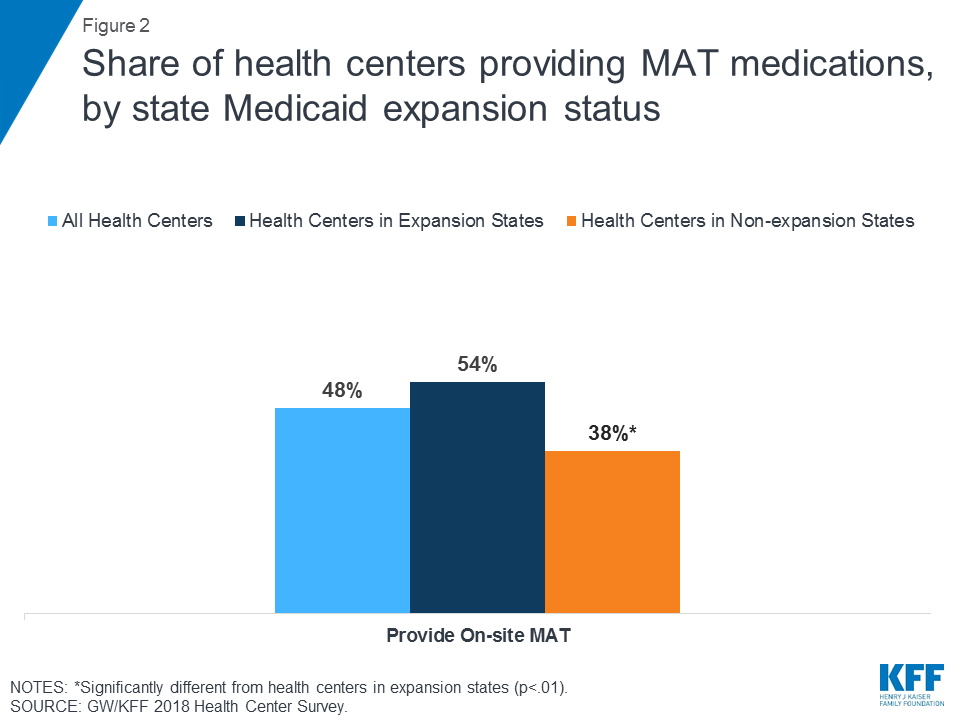
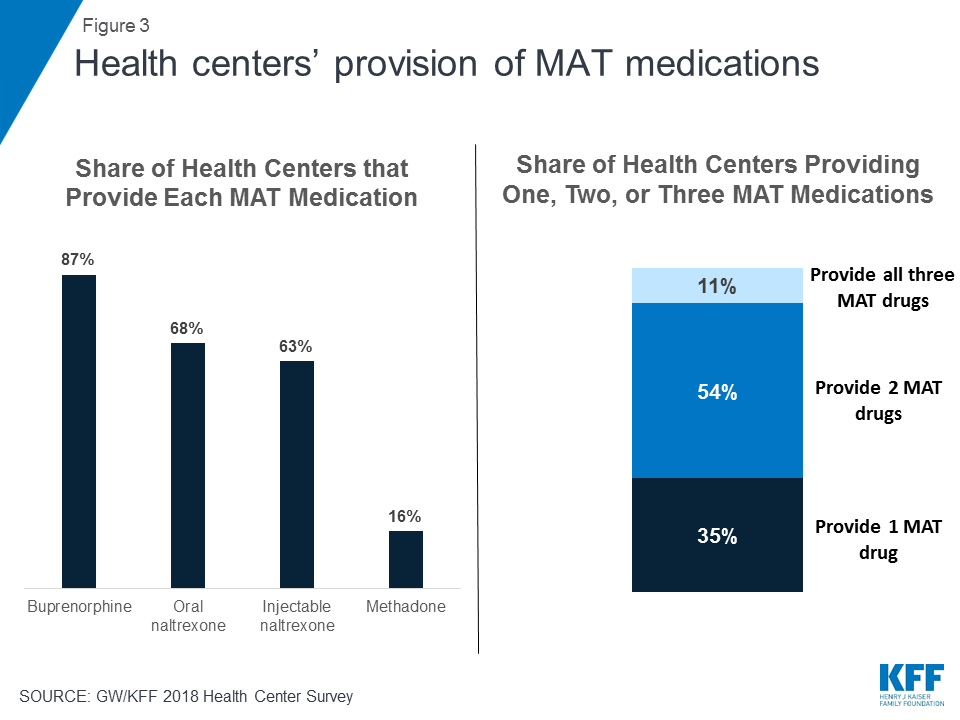
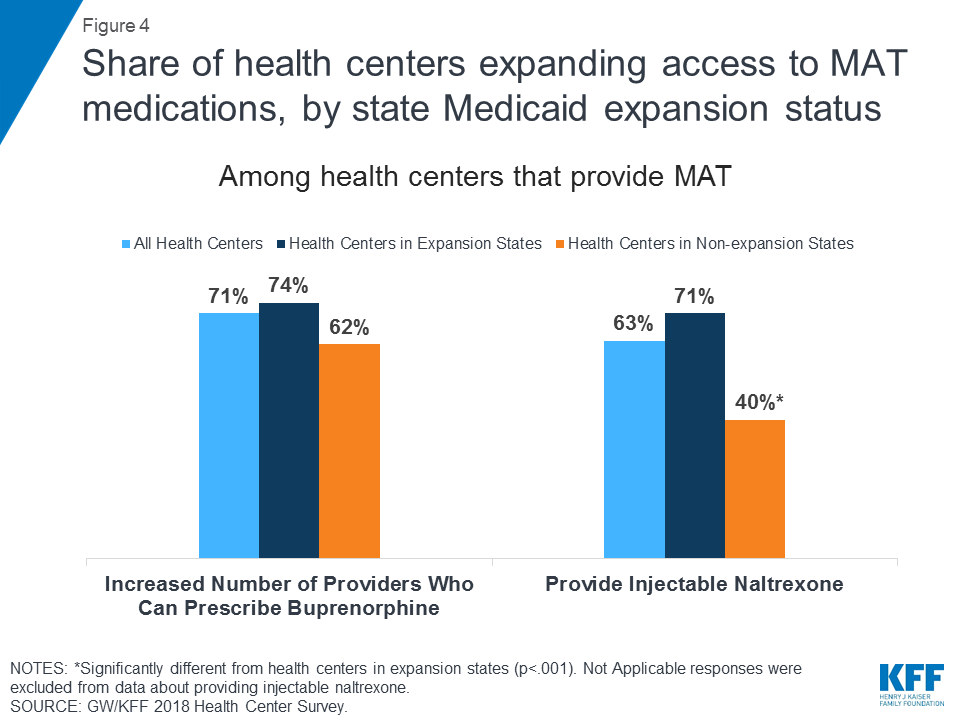
  • Nearly half (48%) of health centers provide medications as part of medication-assisted treatment (MAT), considered to be the most effective OUD treatment. Among health centers that provide MAT, nearly two-thirds (65%) offer at least two of the three MAT medications. Buprenorphine is the most commonly prescribed MAT medication, available at 87 percent of health centers that provide MAT, and 71 percent of health centers have increased the number of providers who have waivers to prescribe it.
  • Health centers in Medicaid expansion states are more likely to provide MAT than those in non-expansion states (54% vs. 38%).They are also more likely to provide injectable naltrexone, a longer-acting MAT medication.
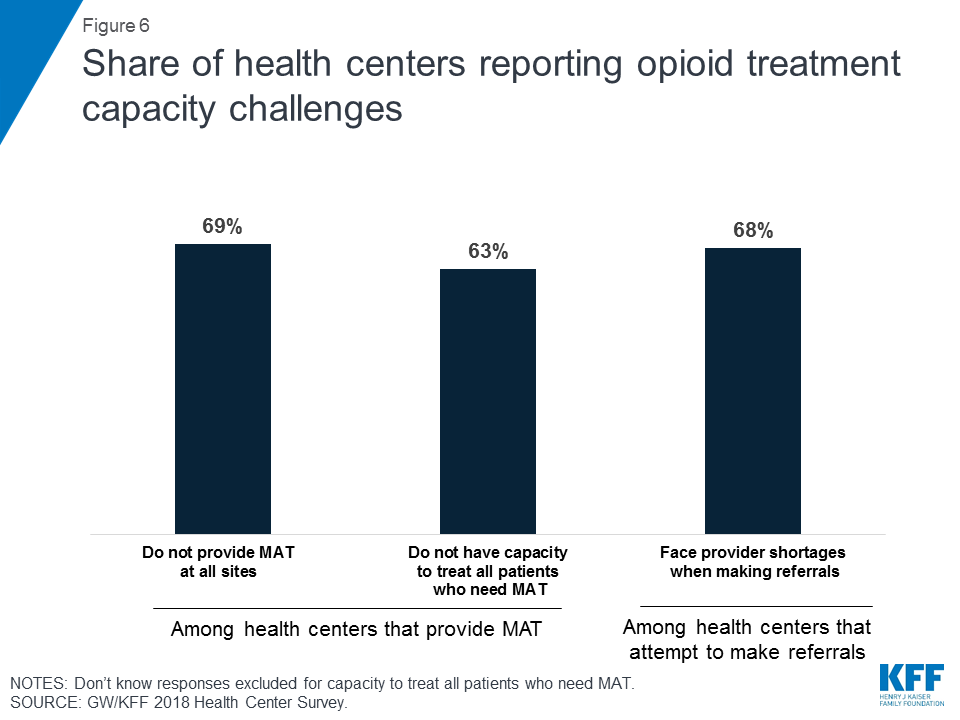
  • Health centers face many treatment capacity challenges in responding to the opioid epidemic. Among those that provide MAT, 69 percent do not provide MAT services at all of their sites, and 63 percent report not having the capacity to treat all patients with OUD. Among health centers that attempt to refer patients for MAT services, 68 percent said they face provider shortages when doing so.
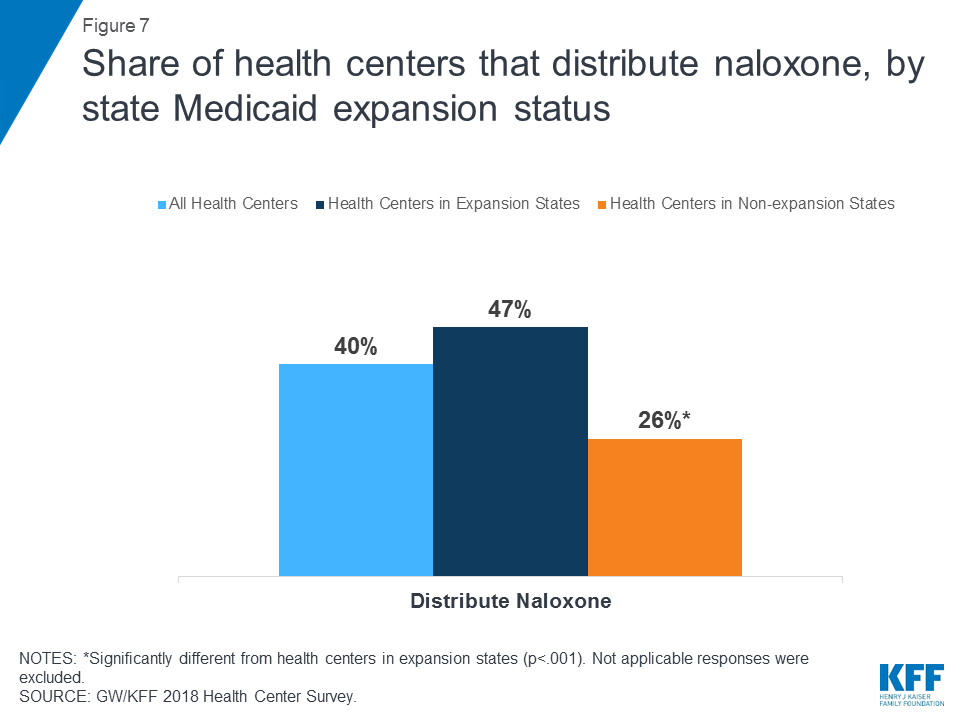
  • Many health centers (40%) distribute naloxone, an opioid overdose reversal drug. Those in expansion states are nearly twice as likely as those in non-expansion states to provide the drug (47% vs. 26%).

Health centers play a critical role in addressing the opioid epidemic and many rely on Medicaid, especially in expansion states, to increase their ability to respond to the crisis.

Introduction

Community health centers are on the front lines of addressing the opioid epidemic, which affected two million Americans and resulted in 42,249 opioid overdose deaths in 2016.1  Health centers are located in medically underserved rural and urban areas, where the impact of the opioid epidemic has been especially devastating. As providers of comprehensive primary care services, they are increasingly meeting the treatment needs of their patients with substance use disorders (SUD), including those with OUD. The share of health centers providing SUD services has risen. In 2016, 388 (28%) health centers provided these services, which was a substantial increase from 20 percent in 2010.2  Health centers also remove affordability barriers to accessing needed treatment services, particularly for people with OUD who are more likely to have low incomes compared to the general population and are disproportionately covered by Medicaid or are uninsured.3 

Based on a survey of health centers conducted in early 2018, this brief presents findings on health center activities related to the prevention and treatment of OUD as well as health centers’ provision of medication for opioid overdose reversal. This brief includes data from these survey questions and discusses the differences between opioid-related activities at health centers in Medicaid expansion states and in non-expansion states.

Opioid Use Disorder among Health Center Patients

Many health centers reported increases in the number of patients with OUD in the previous three years. Over seven in 10 (73%) health centers reported an increase in any opioid use disorder (Figure 1). Health centers were more likely to report an increase in the number of patients with an addiction to prescription opioids (69%) than they were to report an increase in the number of patients with an addiction to nonprescription opioids, such as heroin or fentanyl (63%) (Figure 1). These findings are consistent with national trends, which show substantial increases in the prevalence of OUD in recent years.4 

Figure 1: Share of health centers reporting an increase in the number of patients with opioid use disorder in the past three years, by type of opioid

Health centers in Medicaid expansion states were more likely to report an increase in the number of patients with OUD than those in non-expansion states; however, this difference disappears when limiting the comparison to health centers in states hard hit by the epidemic. Over three-quarters (76%) of health centers in expansion states reported an increase in the number of patients with an addiction to opioids, compared to two-thirds (67%) of health centers in non-expansion states. When limiting this analysis to states that were hit especially hard by the opioid epidemic, defined as those with above-average opioid overdose rates, the difference in the share of health centers reporting increases in opioid use disorder between those in expansion and non-expansion states was not statistically significant. These findings suggest that the observed differences between health centers in expansion and non-expansion states likely reflect geographic trends in the prevalence of OUD, which has hit Appalachia and parts of New England particularly hard. Many states in these regions have expanded Medicaid.5  Additionally, health centers in expansion states may be seeing an increasing number of patients with OUD as more people seek treatment, in part due to broad Medicaid coverage of treatment services and efforts by these health centers to expand access to these services.

Opioid Use Disorder Treatment at Health Centers

Staffing and Service Patterns

Provision of on-site SUD services at health centers has increased considerably in recent years. As the opioid epidemic has intensified, health centers have responded by adding or expanding SUD services. SUD services are defined in the Uniform Data System (UDS) as those that are provided by SUD workers, including “psychiatric nurses, psychiatric social workers, mental health nurses, clinical psychologists, clinical social workers, family therapists and other individuals providing alcohol or drug use disorder counseling and/or treatment services.”6  From 2010 to 2016, the number of full-time equivalent (FTE) health center staff providing SUD services increased 36 percent from 854 to 1,163, and the number of patients receiving these services increased 43 percent from 98,760 to 141,569.7 

It should be noted, however, that these numbers likely underestimate the true magnitude of on-site SUD service provision at health centers. The UDS does not include SUD services provided by physicians and advanced practice clinicians in these totals, and instead codes them as medical visits.8  Additionally, some health centers may also classify visits for both mental health and SUD services as “mental health visits” for purposes of UDS reporting.

Provision of Medication-Assisted Treatment

Health centers are addressing the opioid epidemic by providing on-site MAT services, particularly in Medicaid expansion states. MAT, which includes counseling along with one of three medications (methadone, buprenorphine, and naltrexone), is the standard of care for the treatment of OUD.9  Nearly half (48%) of health centers provide MAT medications and the large majority of these health centers provide counseling as well (Figure 2). Health centers in Medicaid expansion states are significantly more likely than those in non-expansion states to provide on-site MAT services (54% vs. 38%). This finding holds even among health centers in states hit especially hard by the opioid epidemic (63% vs. 40%) (Appendix Table 1). These differences are likely related to more sustainable Medicaid reimbursement for services in expansion states enabling health centers to provide a broader array of services,10  including MAT. Workforce shortages and regulatory barriers in some states may also be factors.

Figure 2: Share of health centers providing MAT medications, by state Medicaid expansion status

Most health centers that provide MAT services provide more than one medication. Among health centers that provide MAT services, roughly one in 10 (11%) offer all three MAT medications–methadone, buprenorphine, and naltrexone (oral and/or injectable). Over half (54%) offer two MAT drugs, while roughly a third (35%) offer only one drug (Figure 3).  Buprenorphine is the most widely available MAT drug, with 87 percent of health centers that provide MAT medications reporting they provide it. Slightly smaller shares report providing oral naltrexone (68%) or injectable naltrexone (63%), while fewer than one in five (16%) provide methadone (Figure 3). Facilities must be certified as opioid treatment programs in order to dispense methadone, while buprenorphine and naltrexone can be prescribed in any setting.11  Additionally, all state Medicaid programs cover buprenorphine12  and almost all (49) cover naltrexone,13  while only 36 state programs cover methadone.14  As part of a broader initiative to combat the opioid epidemic, the Trump administration included a proposal to require states to cover all three MAT drugs, although it has not yet been implemented.15 

Figure 3: Health centers’ provision of MAT medications

As the opioid epidemic has worsened, health centers have increased access to buprenorphine to treat OUD. Over seven in ten health centers that provide MAT have increased the number of providers who are able to prescribe buprenorphine in the past year (Figure 4). Because buprenorphine is a partial opioid agonist, providers must obtain a Drug Abuse Treatment Act of 2000 (DATA) waiver from the federal government and complete additional training requirements in order to prescribe it.16  In 2016, health centers reported 1,700 on-site or contracted physicians with a data waiver and 39,075 patients who received MAT from a physician with a DATA waiver.17  Previously, only physicians could obtain a DATA waiver, but the Comprehensive Addiction and Recovery Act (CARA), enacted in 2016, enables physician assistants and nurse practitioners to obtain waivers as well.18 

Figure 4: Share of health centers expanding access to MAT medications, by state Medicaid expansion status

Compared to health centers in non-expansion states, those in expansion states are significantly more likely to provide injectable naltrexone. In 2018, among health centers that provide MAT, 40 percent of health centers in non-expansion states provided injectable naltrexone compared to 71 percent of health centers in expansion states (Figure 4). Similar trends were observed when examining only health centers in hard-hit states (45% vs. 78%) (Appendix Table 1). Providing naltrexone is more expensive than providing other MAT drugs,19  and that may be a factor limiting its availability at health centers in non-expansion states. While Medicaid covers naltrexone in nearly all states, fewer patients receiving MAT services at health centers in non-expansion states are likely to be covered by Medicaid.20  Naltrexone is advantageous in that it does not have to be prescribed in a certified opioid treatment program and providers do not have to obtain waivers to prescribe it, though patients have to detox fully from opioids before they can be given naltrexone. Furthermore, injectable naltrexone only has to be administered once per month, which has been shown to increase patients’ treatment adherence.21  Therefore, health centers, particularly those in expansion states, play an important role in facilitating access to injectable naltrexone and ultimately helping to curb the opioid epidemic.

Provider Training

Health centers that provide MAT in expansion states and non-expansion states are equally likely to provide training to providers, but those in non-expansion states may be more dependent on federal funds to finance these trainings. Provider training is an integral part of effective MAT, and just over six in ten (62%) health centers provide on-site training to providers on prescribing medications as part of MAT (Figure 5). However, financing the on-site training can be challenging, particularly for smaller health centers that have more limited capacity. Of the health centers that provide on-site training, six in ten reported funding the training with a Health Resources and Services Administration (HRSA) grant. Health centers in non-expansion states were significantly more likely than those in expansion states to report funding their provider MAT training with a HRSA grant (76% vs. 54%) (Figure 5). This finding was particularly pronounced among health centers in hard-hit states (86% vs. 51%) (Appendix Table 1).

Figure 5: Share of health centers that provide MAT training and that fund training through HRSA grants, by state Medicaid expansion status

Treatment Capacity Challenges

Health centers face challenges in meeting the high demand for treatment among their patients with OUD. Due to staffing and other resource constraints, nearly seven in ten (69%) health centers that provide MAT services do not provide them at all sites (Figure 6). Overall, over six in ten (63%) health centers that provide MAT report not having the capacity to treat all patients who seek these services. Among health centers that attempt to refer patients to other MAT providers (including both those that provide MAT services and those that do not), 68% face provider shortages that limit access to treatment for their patients. These challenges are likely the result of system-wide treatment shortages22  and the surging prevalence of OUD.23  In 2016, fewer than three in ten (29%) adults with OUD received any treatment, and this percentage was even lower (23%) for patients who were uninsured.24 

Figure 6: Share of health centers reporting opioid treatment capacity challenges

To support the expansion of SUD treatment services, including services to treat OUD, the Health Resources and Services Administration (HRSA) has provided additional funding to health centers. HRSA awarded $94 million to 271 health centers in 45 states and DC in March 2016 and an additional $200 million to 1,178 health centers in all 50 states and DC in September 2017.25 ,26  These grants funded additional staff, services, and provider training. More recently, in June 2018, HRSA announced the availability of $350 million in supplemental grant funding (including $200 million in one-time grants) to enable health centers to continue to strengthen their services, using a comprehensive, team-centered approach to care.27 

Opioid Overdose Reversal

Many health centers distribute naloxone, a drug that reverses the effects of an overdose, and benefit from pharmacy benefit management (PBM) strategies to increase access to naloxone. Overall, four in 10 health centers reported distributing naloxone and health centers in expansion states were almost twice as likely as those in non-expansion states to do so (47% vs. 26%) (Figure 7). Among health centers in states that were hit hard by the opioid epidemic, those in expansion states were also significantly more likely to distribute naloxone (51% vs. 32%) (Appendix Table 1). With dramatic increases in opioid overdose deaths in recent years, naloxone has become a critical tool in minimizing fatalities due to the opioid epidemic.28  Most state Medicaid programs have PBM strategies in place to increase access to naloxone for enrollees, such as making some formulations of naloxone available without prior authorization or allowing family or friends to obtain naloxone prescriptions on a Medicaid enrollee’s behalf. Medicaid programs in expansion states are more likely than those in non-expansion states to cover the atomizer for the nasal spray (53% vs. 16%) and the auto-injector (28% vs. 5%) without prior authorization (Table 1).29  They are also more than twice as likely (25% vs. 11%) to cover naloxone for family or friends of an enrollee.30 

Figure 7: Share of health centers that distribute naloxone, by state Medicaid expansion status
Table 1: Medicaid Coverage of Naloxone, by Medicaid Expansion Status
 OverallExpansion StateNon-expansion State
State Medicaid program covers atomizer without prior authorization38%53%16%*
State Medicaid program covers auto-injector without prior authorization19%28%5%*
State Medicaid program covers naloxone for friends/family of enrollee21%25%11%
*Significantly different from expansion states at p<.05. Source: 2017 Kaiser Family Foundation 50-State Medicaid Budget Survey.

Safer Prescribing Practices

Most health centers have made efforts to make prescribing practices safer. Nearly nine in ten (87%) health centers reported having written policies and procedures regarding the use of prescription drug monitoring programs (PDMP) before writing prescriptions for opioids. PDMPs are electronic databases that enable providers to track controlled substance prescriptions for patients in their state in order to prevent overprescribing to an individual patient.31  Because of their complex health needs, many Medicaid enrollees and other health center patients may be more likely than the general population to need prescription opioids to treat pain. The large share of health centers with policies and procedures regarding the use of PDMPs helps to maximize the likelihood that patients are receiving prescription opioids only when medically necessarily.

Looking Ahead

As the primary source of health care for many low-income Americans, health centers play a critical role in addressing the opioid epidemic, through prevention, treatment, overdose reversal, and safe prescribing practices. The majority of health centers reported an increase in the share of patients with an OUD, and nearly half provide on-site MAT. Many health centers also distribute naloxone for opioid overdose reversal and prioritize the use of PDMPs. Because of enhanced federal funding from Medicaid expansion, as well as the broad coverage of treatment services through Medicaid, health centers in expansion states appear to be better equipped to address the opioid epidemic. Compared to health centers in non-expansion states, those in expansion states are more likely to provide on-site MAT, and to distribute naloxone.

As the opioid epidemic continues to escalate, health centers will face ongoing challenges in meeting the demand for OUD treatment. Grant funding plays an important but somewhat limited role in this regard. One-time grants can bolster existing services and support service expansions, but the funding per health center grantee is often modest. Health centers rely heavily on Medicaid as an ongoing revenue source in order to continue to meet patients’ needs. Given Medicaid’s role in supporting efforts to expand access to treatment and overdose prevention, decisions by more states to expand Medicaid coverage could increase health centers’ capacity to address the epidemic and to provide long-term recovery support to patients.

Because Medicaid is so important to health centers’ ability to build sustainable treatment and recovery programs, states’ efforts to use Section 1115 waivers to impose work or community engagement, premium, and drug testing requirements for Medicaid enrollees bear close watching. Such demonstrations could create barriers to Medicaid coverage for health center patients with OUD. Even in the case of demonstrations that exempt people receiving SUD treatment, states have not yet defined the concept of active treatment, which could exclude important long-term recovery care. Health centers rely heavily on Medicaid revenue and if patients lose their Medicaid coverage, health centers could be limited in their ability to respond to the epidemic. Additionally, work, premium, and drug testing requirements would create administrative burdens for health centers as they help their patients navigate these requirements, which could interfere with their capacity to provide comprehensive care.

Methods

The 2018 Survey of Community Health Centers’ Experiences and Activities under the Affordable Care Act was conducted by researchers at the Geiger Gibson Program in Community Health Policy at the George Washington University (GW) and the Kaiser Family Foundation Program on Medicaid and the Uninsured, with support and input from the National Association of Community Health Centers (NACHC) and the RCHN Community Health Foundation. This brief used data from the questions about how health centers are approaching the opioid crisis and the treatment options that are available.

The online survey was emailed to all CEOs of federally funded community health centers in the 50 states and the District of Columbia (DC) identified in the 2016 Uniform Data System (UDS) (n=1,337), to which all health centers must report annually. The survey was fielded from early January to late February 2018. There were a total of 489 survey responses from 49 states and DC, resulting in a response rate of 37%.

Bivariate analyses (chi-squared tests) were conducted to test for significant differences by health centers’ location in Medicaid expansion or non-expansion states. Findings are presented for all respondents and by location in states that expanded Medicaid and non-expansion states. For findings with statistically significant differences between expansion and non-expansion states, additional analyses were conducted for a smaller subset of health centers located in states with above-average opioid overdose death rates. Again, chi-squared tests were conducted to test for significant differences by health centers’ location in Medicaid expansion or non-expansion states.


Appendix

Appendix Table 1: Differences between Health Centers in Medicaid Expansion and Non-expansion States in States With Above-Average Opioid Overdose Death Rates
 Health Centers in Hard-hit StatesHealth Centers in Hard-hit Expansion StatesHealth Centers in Hard-hit Non-expansion States
Increase in opioid use disorder in past three years81%83%75%
Provide on-site medication-assisted treatment56%63%40%*
Provide injectable naltrexone71%78%45%*
Distribute naloxone45%51%32%*
Fund MAT training with HRSA grant60%51%86%*
*Significantly different from health centers in hard-hit expansion states at p<.05. Source: GW/KFF 2018 Health Center Survey

Endnotes

  1. Seth, P., Scholl, L., Rudd, R. A., & Bacon, S. (2018). Overdose Deaths Involving Opioids, Cocaine, and Psychostimulants-United States, 2015-2016. MMWR. Morbidity and Mortality Weekly Report, 67(12), 349-358. https://www.cdc.gov/mmwr/volumes/67/wr/mm6712a1.htm?s_cid=mm6712a1_w#T1_down ↩︎
  2. Rosenbaum, S., Tolbert, J., Sharac, J., Shin, P., Gunsalus, R. & Zur, J. (2018). Community Health Centers: Growing Importance in a Changing Health Care System. Kaiser Family Foundation. https://modern.kff.org/medicaid/issue-brief/community-health-centers-growing-importance-in-a-changing-health-care-system/ ↩︎
  3. Julia Zur and Jennifer Tolbert, “The Opioid Epidemic and Medicaid’s Role in Facilitating Access to Treatment,” Kaiser Family Foundation, accessed June 2018, https:/”modern.kff.org/medicaid/issue-bief/the-opioid-epidemic-and-medicaids-role-in-facilitating-access-to-treatment/. ↩︎
  4. “The Opioid Epidemic and Medicaid’s Role in Treatment: A Look at Changes Over Time,” Kaiser Family Foundation,” accessed June 2018, https://modern.kff.org/slideshow/the-opioid-epidemic-and-medicaids-role-in-treatment-a-look-at-changes-over-time/ ↩︎
  5. “Status of State Action on the Medicaid Expansion Decision,” accessed June 2018, https://modern.kff.org/health-reform/state-indicator/state-activity-around-expanding-medicaid-under-the-affordable-care-act. ↩︎
  6. Health Resources and Services Administration, “Uniform Data System: Reporting Instructions for 2016 Health Center Data,” (p. 54), accessed June 2018, https://www.bphc.hrsa.gov/datareporting/reporting/2016udsreportingmanual.pdf. ↩︎
  7. Health Resources and Services Administration, “2010 Health center data: National data,” accessed June 2018, https://bphc.hrsa.gov/uds/view.aspx?q=tall&year=2010&state; Health Resources and Services Administration, “2016 health center data: National data,” accessed June 2018, https://bphc.hrsa.gov/uds/view.aspx?q=tall&year=2016&state=. ↩︎
  8. “Medical providers treating patients with substance use diagnoses remain reported on Lines 1 through 10 (p. 54).” “Because substance abuse is also seen as a mental health diagnosis, it is permissible to count the visit under mental health (p. 63).” Health Resources and Services Administration, “Uniform Data System: Reporting Instructions for 2016 Health Center Data,” accessed June 2018, https://www.bphc.hrsa.gov/datareporting/reporting/2016udsreportingmanual.pdf. ↩︎
  9. Substance Abuse and Mental Health Services Administration, “Medication-Assisted Treatment (MAT)” https://www.samhsa.gov/medication-assisted-treatment (accessed June 4, 2018). ↩︎
  10. Rosenbaum, S., Tolbert, J., Sharac, J., Shin, P., Gunsalus, R. & Zur, J. (2018). Community Health Centers: Growing Importance in a Changing Health Care System. Kaiser Family Foundation. https://modern.kff.org/medicaid/issue-brief/community-health-centers-growing-importance-in-a-changing-health-care-system/ ↩︎
  11. Substance Abuse and Mental Health Services Administration, “Medication-Assisted Treatment (MAT)” https://www.samhsa.gov/medication-assisted-treatment (accessed June 4, 2018). ↩︎
  12. Colleen M. Grogan, et al., “Survey Highlights Differences in Medicaid Coverage for Substance Use Treatment and Opioid Use Disorder Medications,” Health Affairs 35, no. 12 (Dec. 2016):2289-2296, http://content.healthaffairs.org/content/35/12/2289.full ↩︎
  13. Kathleen Gifford et al., Medicaid Moving Ahead in Uncertain Times: Results from a 50-State Medicaid Budget Survey for State Fiscal Years 2017 and 2018,” Kaiser Family Foundation, accessed June 2018, https://modern.kff.org/medicaid/report/medicaid-moving-ahead-in-uncertain-times-results-from-a-50-state-medicaid-budget-survey-for-state-fiscal-years-2017-and-2018/. ↩︎
  14. Ibid ↩︎
  15. Office of Management and Budget, “Efficient, Effective, Accountable: An American Budget,” accessed June 2018, https://www.whitehouse.gov/wp-content/uploads/2018/02/budget-fy2019.pdf. ↩︎
  16. Substance Abuse and Mental Health Services Administration, “Buprenorphine Waiver Management,” https://www.samhsa.gov/programs-campaigns/medication-assisted-treatment/training-materials-resources/buprenorphine-waiver (accessed June 4, 2018). ↩︎
  17. Health Resources and Services Administration, “Electronic Health Record Capabilities and Quality Recognition: National data,” accessed June 2018, https://bphc.hrsa.gov/uds/datacenter.aspx?q=tehr&year=2016&state=&fd=. ↩︎
  18. U.S. Congress, Senate, Comprehensive Addiction and Recovery Act of 2016, S.524, 114th Congress, https://www.congress.gov/114/plaws/publ198/PLAW-114publ198.pdf. ↩︎
  19. Heide Jackson et al., “Cost Effectiveness of Injectable Extended Release Naltrexone Compared to Methadone Maintenance and Buprenorphine Maintenance Treatment for Opioid Dependence,” Substance Abuse 36, no. 2 (2015):226-231, https://www.ncbi.nlm.nih.gov/pmc/articles/PMC4470733/ ↩︎
  20. Rosenbaum, S., Tolbert, J., Sharac, J., Shin, P., Gunsalus, R. & Zur, J. (2018). Community Health Centers: Growing Importance in a Changing Health Care System. Kaiser Family Foundation. https://modern.kff.org/medicaid/issue-brief/community-health-centers-growing-importance-in-a-changing-health-care-system/ ↩︎
  21. Substance Abuse and Mental Health Services Administration, An Introduction to Extended-Release Injectable Naltrexone for the Treatment of People with Opioid Dependence (Rockville, MD: US Department of Health and Human Services, 2012), https://www.integration.samhsa.gov/Intro_To_Injectable_Naltrexone.pdf ↩︎
  22. Substance Abuse and Mental Health Services Administration, Report to Congress on the Nation’s Substance Abuse and Mental Health Workforce Issues (Rockville, MD: US Department of Health and Human Services, January 2013), https://store.samhsa.gov/shin/content/PEP13-RTC-BHWORK/PEP13-RTC-BHWORK.pdf. ↩︎
  23. “The Opioid Epidemic and Medicaid’s Role in Treatment: A Look at Changes Over Time,” Kaiser Family Foundation,” accessed June 2018, https://modern.kff.org/slideshow/the-opioid-epidemic-and-medicaids-role-in-treatment-a-look-at-changes-over-time/ ↩︎
  24. Julia Zur and Jennifer Tolbert, “The Opioid Epidemic and Medicaid’s Role in Facilitating Access to Treatment,” Kaiser Family Foundation, accessed June 2018, https://modern.kff.org/medicaid/issue-bief/the-opioid-epidemic-and-medicaids-role-in-facilitating-access-to-treatment/. ↩︎
  25. U.S. Department of Health and Human Services. “HHS awards $94 million to health centers to help treat the prescription opioid abuse and heroin epidemic in America,” accessed June 5, 2018, https://www.hhs.gov/hepatitis/blog/2016/03/17/hhs-awards-94-million-to-health-centers-to-help-treat-the-prescription-opioid-abuse-and-heroin-epidemic-in-america.html ↩︎
  26. U.S. Department of Health and Human Services. “HRSA awards $200 million to health centers nationwide to tackle mental health and fight the opioid overdose crisis,” accessed June 5, 2018, https://www.hhs.gov/about/news/2017/09/14/hrsa-awards-200-million-to-health-centers-nationwide.html ↩︎
  27. U.S. Department of Health and Human Services. “FY 2018 expanding access to quality substance use disorder and mental health services (SUD-MH) supplemental funding technical assistance (HRSA-18-118),” accessed July 10, 2018, https://bphc.hrsa.gov/programopportunities/fundingopportunities/sud-mh/index.html ↩︎
  28. Substance Abuse and Mental Health Services Administration, “Naloxone” https://www.samhsa.gov/medication-assisted-treatment/treatment/naloxone (accessed June 4, 2018). ↩︎
  29. “States Reporting Medicaid FFS Pharmacy Benefit Management Strategies for Naloxone in Place,” Kaiser Family Foundation, accessed June 2018, https://modern.kff.org/medicaid/state-indicator/states-reporting-medicaid-ffs-pharmacy-benefit-management-strategies-for-naloxone-in-place ↩︎
  30. Ibid ↩︎
  31. Centers for Disease Control and Prevention, “What States Need to Know about PDMPs,” https://www.cdc.gov/drugoverdose/pdmp/states.html (accessed June 4, 2018).   ↩︎
News Release

Four in 10 Women Voters Age 18-44 Are “More Enthusiastic” to Vote in Mid-Terms This Year, Almost Three Times Higher than the Last Mid-Term

Six in Ten of Younger Women Voters Say They Are More Likely to Vote for a Candidate Supportive of #MeToo Movement

Published: Jul 30, 2018

With the 2018 primary election season concluding in August and the general congressional mid-term election season ramping up, Kaiser Family Foundation polling finds younger women (ages 18-44) voters are more enthusiastic about voting this year than in previous mid-term elections.

In a new data note about KFF’s June Health Tracking Poll that is focused on women voters’ influence in this year’s elections and beyond, the 39 percent of younger women voters expressing “more enthusiasm” is almost three times higher than the 14 percent expressing the same sentiment in the 2014 mid-term election.

With young women’s voting sentiment higher this year, their ideological makeup will be of interest. The poll finds that twice as many young women voters identify as Democrats (43%) than as Republicans (21%).

The 2018 mid-term election will be the first since the #MeToo movement (campaign to raise awareness about sexual harassment and assault) went viral last year. About half of all women voters (54%) and six in ten (62%) of younger women voters say that they are more likely to vote for a candidate who is an outspoken supporter of the international #MeToo movement. About one-third (35%) of women voters say a candidate’s stance on #MeToo does not matter to their vote and few women voters (7%) say they are more likely to vote for a candidate who does not address these issues.

More findings focused on women voters’ opinions about their priorities for campaign issues and on policy issues of special interest to women can be found in the Data Note: How Women Voters Could Influence the 2018 Elections and Beyond.

Designed and analyzed by researchers at the Kaiser Family Foundation, the poll was conducted from June 11-20, 2018 among a nationally representative random digit dial telephone sample of 1,492 adults. The poll includes an oversample of young women under the age of 45 (n=402) for an analysis. Interviews were conducted in English and Spanish by landline (319) and cell phone (1,173). The margin of sampling error is plus or minus 3 percentage points for the full sample and plus or minus 6 percentage points for women under age 45. For results based on subgroups, the margin of sampling error may be higher.

Poll Finding

Data Note: How Women Voters Could Influence the 2018 Elections and Beyond

Published: Jul 30, 2018

While the 2018 midterm elections are still nearly four months away, this election cycle has already been deemed by many as the “year of the woman” with recent attention to the #MeToo Movement and primary wins by female candidates. This, coupled with speculation about what Justice Kennedy’s retirement might mean for the future of abortion access, has placed increased attention on the views of younger women (ages 18-44) and how this unique group of voters could influence the upcoming elections.

Key Findings:

  • Expected to be a key voting group in the upcoming 2018 midterms, the poll finds twice as many women voters ages 18-44 saying they are Democrats as saying they are Republicans (43 percent compared to 21 percent). In addition, younger women voters (18-44 years old) are more likely to say they are “more enthusiastic” about voting this year than in previous midterm elections. Four in ten (39 percent) women voters, ages 18-44, say they are “more enthusiastic” about voting in this Congressional Election compared to previous years. In 2014, the last midterm election cycle, 14 percent of women voters ages 18-44 said they were “more enthusiastic” about voting.1 
  • The poll also examines how 2018 candidates’ positions on key issues such as the international #MeToo movement, access to abortion services, and other reproductive health issues may influence women voters. A larger share of women voters, regardless of party identification or age, say they are more likely to vote for a candidate who supports work-related issues like paid parental leave and enacting harsher penalties for sexual harassment and assault in the workplace or is a proud supporter of the #MeToo movement, than vote for a candidate who does not support these issues or movements. However, considerable shares of Republican women voters say a candidate’s stance on these issues will not play a role in their vote choice.
  • When it comes to the role that abortion may play in the 2018 election, there are sharp partisan divides. Most Democratic women (73 percent) say they are more likely to vote for a candidate who supports access to abortion services while nearly six in ten Republican and Republican-leaning women voters say they are more likely to vote for a candidate who wants to restrict access to abortion services. Yet, younger Republican and Republican-leaning women are split on whether they think Roe v. Wade should be overturned.

Health Care Is Among Top Issues in 2018 for Women

Health care is the top issue that women voters overall, and women voters between the ages of 18 and 44 want to hear candidates talk about during their 2018 congressional campaigns. Three in ten women voters (29 percent) say health care is the “most important issue” for 2018 candidates to discuss during their campaigns, which is slightly larger than the share who say the same about gun policy (24 percent), the economy and jobs (22 percent), and immigration (20 percent).2  Fewer say the same about foreign policy (12 percent) and issues that mainly affect women (10 percent). This is similar to the ranking of issues among women voters 18-44 years old, with one-fourth (27 percent) saying health care is the “most important issue” for candidates to be discussing during their campaigns. Fewer, about one-fifth (21 percent) of men voters say health care is the “most important issue.”

Figure 1: Health Care Is Top Campaign Issue for Women Voters

Partisanship, 2018 Election, and Women Voters

A slight majority (53 percent) of women voters overall, and two-thirds (65 percent) women voters ages 18-44, say they are either Democrats or lean Democratic in their views. Among younger women (ages 18-44), four in ten say they are Democrats (43 percent) and an additional fifth say they are Democratic-leaning independents (21 percent), compared to three in ten who say they are either Republicans (21 percent) or Republican-leaning independents (8 percent).

Figure 2: Larger Shares of Women, Ages 18-44, Say They Are Democrats or Democratic-Leaning Independents

Two-thirds (68 percent) of women voters, ages 18-44, disapprove (either “strongly” or “somewhat”) of the job President Trump is doing, as do 58 percent of women voters, overall.

Four in ten (39 percent) younger women voters (ages 18-44) say they are more enthusiastic about voting in this Congressional Election compared to previous ones. In fact, enthusiasm about voting in this year’s midterm election is much higher, across genders, than when compared to 2014 (the last midterm election cycle). Yet, more than twice as many of the younger group of women voters (18-44) say they are more enthusiastic about voting in this year’s election than said the same in 2014 (14 percent).

Figure 3: Four in Ten Women, 18-44, More Enthusiastic About Voting in Upcoming 2018 Midterm Elections

There are some partisan differences with about half of Democratic women voters (46 percent) saying they are “more enthusiastic” to vote in this year’s congressional elections compared to three in ten Republican and Republican-leaning women voters (28 percent).

Women Voters More Likely to Vote for Candidates who Support Key Women’s Issues

Overall, a majority of women voters, and women voters 18-44, say they are more likely to vote for a candidate who supports workplace policies predominantly aimed at women’s rights. Two-thirds of women voters say they are more likely to vote for a candidate who wants to enact stronger workplace protections such as harsher penalties for sexual harassment and assault in the workplace. This is larger than the share who say they are more likely to vote for a candidate who does not want to enact such protections (7 percent) or says a candidate’s position on this issue does not make a difference in their vote choice (24 percent).

Figure 4: Most Women Say They Will Vote for A Candidate Who Wants to Enact Stronger Protections Against Sexual Assault

In addition, six in ten women voters (58 percent) and seven in ten women voters 18-44 (71 percent) say they are more likely to vote for a candidate who supports a law requiring employers to provide paid parental leave. Fewer, 5 percent (3 percent of women voters 18-44) say they are more likely to vote for a candidate who does not support such a law and 35 percent (26 percent of women voters 18-44) say it doesn’t make a difference.

Figure 5: Few Women Voters Say They Will Vote for A Candidate Who Does Not Support Paid Parental Leave

About half of women voters (54 percent) say that they are more likely to vote for a candidate who is an outspoken supporter of the international #MeToo movement, the campaign to raise awareness about sexual harassment and assault, while about one-third say a candidate’s stance on this movement does not matter to their vote. Once again, few women (7 percent) say they are more likely to vote for a candidate who does not address these issues.

Figure 6: Half of Women Say They Are More Likely to Vote for A Candidate Who Supports the #MeToo Movement

Republican and Republican-Leaning Women Voters

All of these issues (workplace protections against sexual harassment and assault, paid parental leave, and the #MeToo movement) appear to be less of a voting concern for Republican and Republican-leaning women voters than their Democratic-leaning counterparts. About half of Republican and Republican-leaning women voters say a candidate’s position on #MeToo and paid parental leave will not make a difference in who they vote for, but larger shares say they are more likely to vote for a candidate who supports these policies than a candidate who opposes these policies.

The Role of Partisanship in Women’s Views toward Abortion Services

Women’s views on access to abortion services largely fall along party lines with large shares of Democratic and Democratic-leaning women voters saying they are more likely to vote for a candidate who supports access to abortion services (73 percent). On the other hand, nearly six in ten (58 percent)  Republican and Republican-leaning women voters say they are more likely to vote for a candidate who wants to restrict access to abortion services. Six in ten (57 percent) women voters, ages 18-44, say they are more likely to vote for a candidate who supports access to abortion services.

Figure 7: Partisan Voters Vary in How Candidate’s Stance on Access to Abortion Services Will Influence Their Vote

Republican Women Split on Roe v. Wade

Republican and Republican-leaning women overall and ages 18-44, are divided in their views of whether they want to see the Supreme Court overturn Roe v. Wade. About half of Republican and Republican-leaning women overall and ages 18-44 say they would like to see Roe v. Wade overturned (49 percent and 45 percent, respectively). A statistically similar share say they would prefer to see Roe v. Wade stay in place (48 percent and 53 percent, respectively). On the other hand, most Democratic women, regardless of age, do not want to see the 1973 Supreme Court decision overturned.

Figure 8: Republican Women Divided On Whether They Want Roe v. Wade Overturned

Large Shares of Women Support Federal Funding for Reproductive Health Services

Despite the partisan nature of views of Roe v. Wade, majorities of women – across age and party identification – say it is either “very important” or “somewhat important” the federal government provides funding for reproductive health services, such as family planning and birth control, for lower-income women. However, a much larger share (about eight in ten) of Democratic women (both overall and between the ages of 18 and 44) say this funding is “very important” than Republican women (44 percent of Republican women overall and 52 percent of Republican women between the ages of 18 and 44).

Figure 9: Majorities of Women Say It Is Important to Provide Funding for Reproductive Health Services

One-third of all women and four in ten women (39 percent) between the ages of 18-44 say they have ever visited a Planned Parenthood clinic for health care services.

Figure 10: One-Third of Women Overall Say They Have Visited a Planned Parenthood Clinic

Proposed Changes to The Federal Family Planning Program

The Trump Administration has recently proposed changes to rules about federal Title X family planning funding that helps pay for reproductive health care, contraception, and other preventive care services for low-income women. The new rule would prohibit federal family planning funding from going to organizations like Planned Parenthood that also provide abortion services, even if the funds themselves cannot be used to pay for abortions. Two-thirds of Democratic and Democratic-leaning women oppose these proposed changes to Title X funding while similar shares of Republican and Republican-leaning women say they support these proposed changes as say they oppose.

These proposed changes would also allow federal funding to go to organizations that do not discuss abortion when they counsel pregnant women about all of their pregnancy options in most cases. Most women, regardless of age and partisanship, oppose this proposed change.

Figure 11: Most Women Oppose Proposed Changes to Title X Funding

The federal government also provides funding to reduce teen pregnancy to organizations that teach younger people about safer sex practices.  When asked about whether they would support or oppose allowing federal funding to go to organizations that promote abstinence as the only option and do not teach young people about contraception and STD prevention, majorities of Democratic (81 percent) and Republican women (68 percent) say they are opposed to this proposed change. In addition, most women of reproductive age (between the ages of 18 and 44) also oppose this proposed change in policy.

Figure 12: Majorities of Women, Across Partisanship, Oppose Allowing Federal Funding to go to Abstinence-Only Promotion
  1. Previous research has shown that one of the most important indicators of elections is how engaged one group of voters are compared to another group – known as the enthusiasm gap. The current enthusiasm gap in the June Kaiser Health Tracking poll indicates that women, particularly Democratic women, are unusually excited about the upcoming election. The researchers at KFF will continue monitoring this throughout the 2018 election cycle. ↩︎
  2. This month’s tracking poll was in the field during a time when there was increased attention to the Trump Administration’s policy to separate immigrant families and the subsequent change in policy. ↩︎