Breaking Down the U.S. Global Health Budget by Program Area
Overview
This fact sheet provides a historical overview of U.S. funding for global health by program area over the past decade. Funding totals are based on amounts specified by Congress in annual appropriations bills, as well as some amounts that are determined at the agency level. Since the beginning of the second Trump administration, the U.S. global health response has undergone significant change, including a restructuring of how foreign assistance is provided, elimination of the U.S. Agency for International Development (USAID), the main implementing agency for U.S. global health efforts, and cancellation of most awards to organizations implementing programs. The full impact of these changes to foreign assistance, including whether all the funding appropriated by Congress for global health will be fully spent by the administration, is not yet clear. See our Budget Tracker for more detail on historical funding, Budget Summaries for the latest on ongoing appropriations discussions, and Country-Level Funding Tracker for detail on country-specific appropriated (planned) funding, obligations, and disbursements for global health.
The U.S. Government has been the largest donor to global health in the world and its funding has included support for both disease (HIV, tuberculosis, malaria, and neglected tropical diseases) and population (maternal and child health, nutrition, and family planning and reproductive health) specific activities as well as global health security. Most U.S. funding for global health has been provided by Congress for bilateral efforts (approximately 80%). Of the multilateral share, the majority is provided to The Global Fund to Fight AIDS, Tuberculosis and Malaria (Global Fund). The U.S. investment in global health grew significantly in the early 2000s, largely due to the creation of new initiatives including the President’s Emergency Plan for AIDS Relief (PEPFAR) and the President’s Malaria Initiative (PMI), with spikes in funding in some years due to emergency supplemental funding for disease outbreaks, including Ebola and COVID-19. When this emergency funding is excluded, total support reached a peak level of $12.9 billion in FY 2023 but has declined each year since.1 In FY 2026, global health funding totaled $11.3 billion, its lowest level (through regular appropriations) since FY 2020.
Figure 1
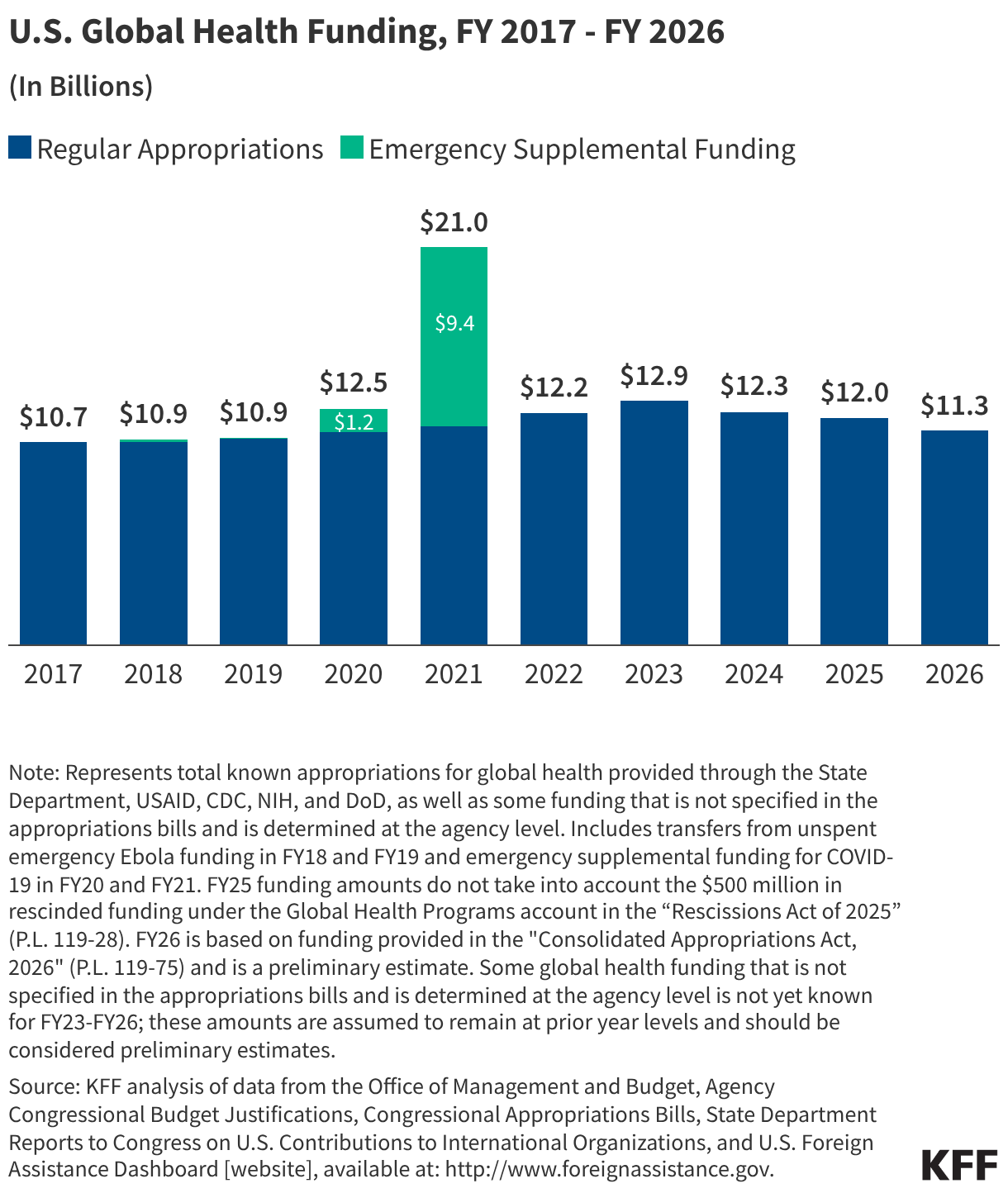
Figure 2
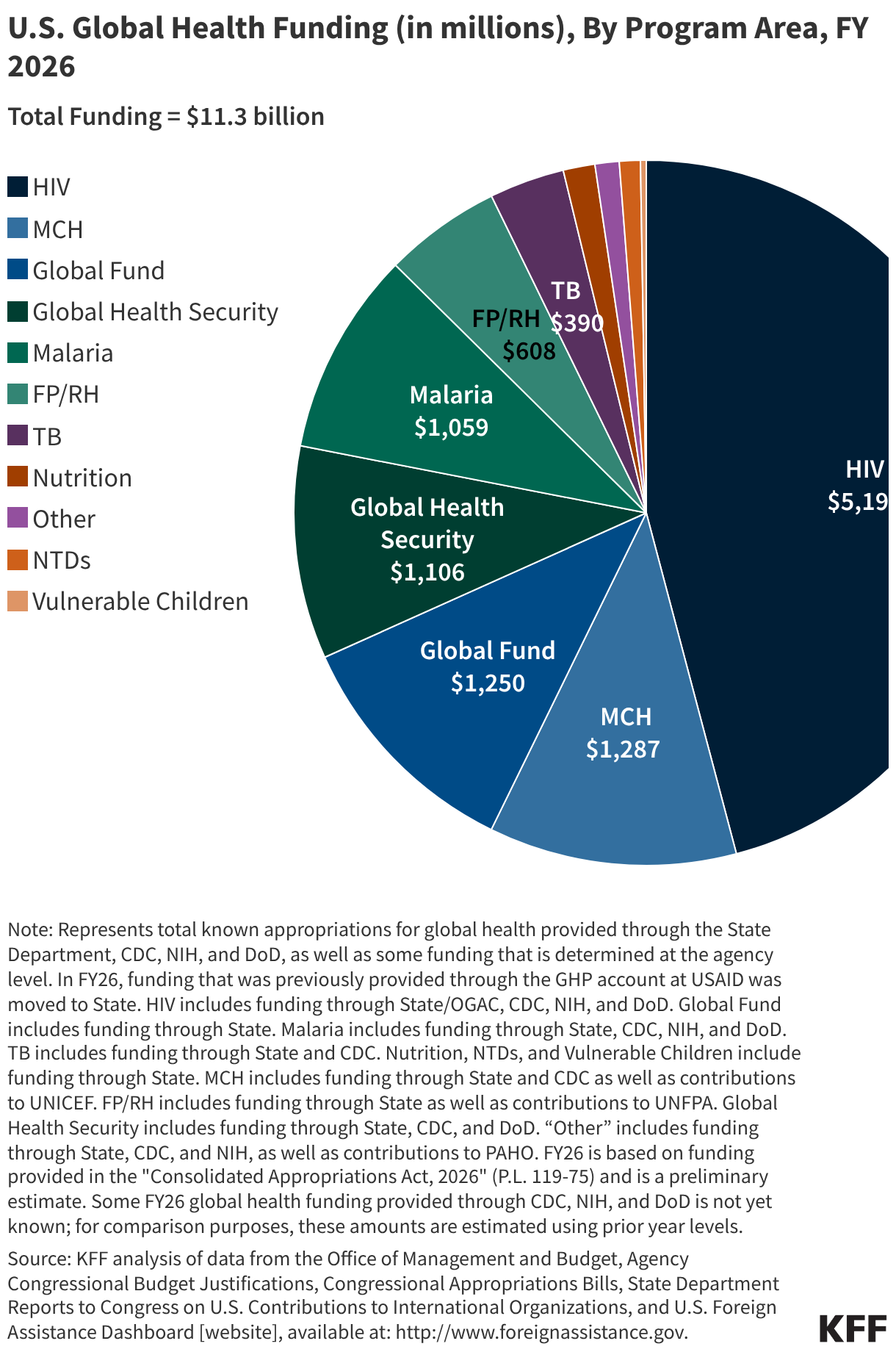
Table 1
Global HIV Funding, Including PEPFAR
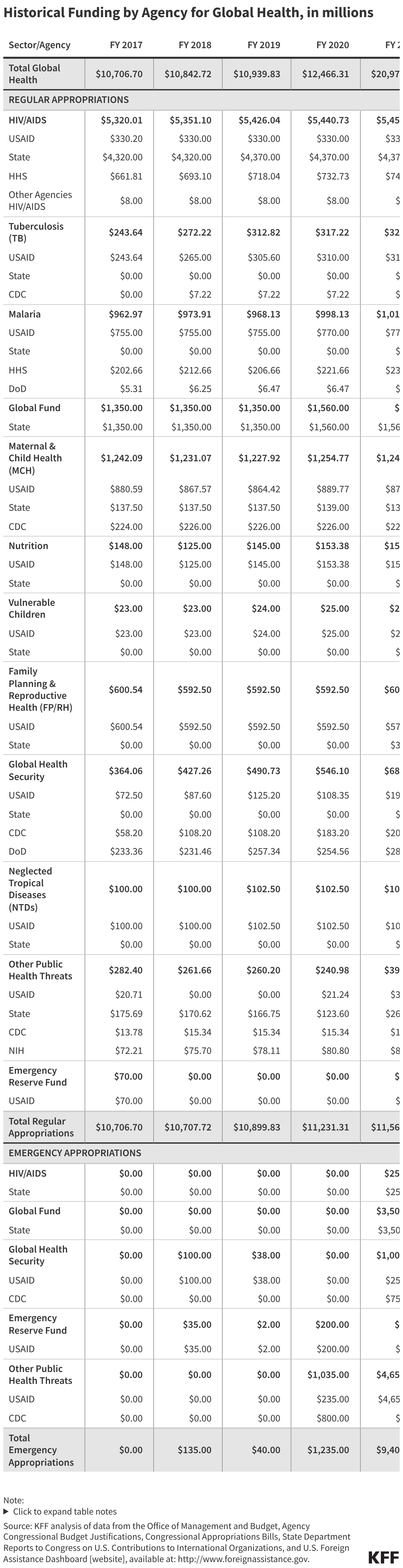
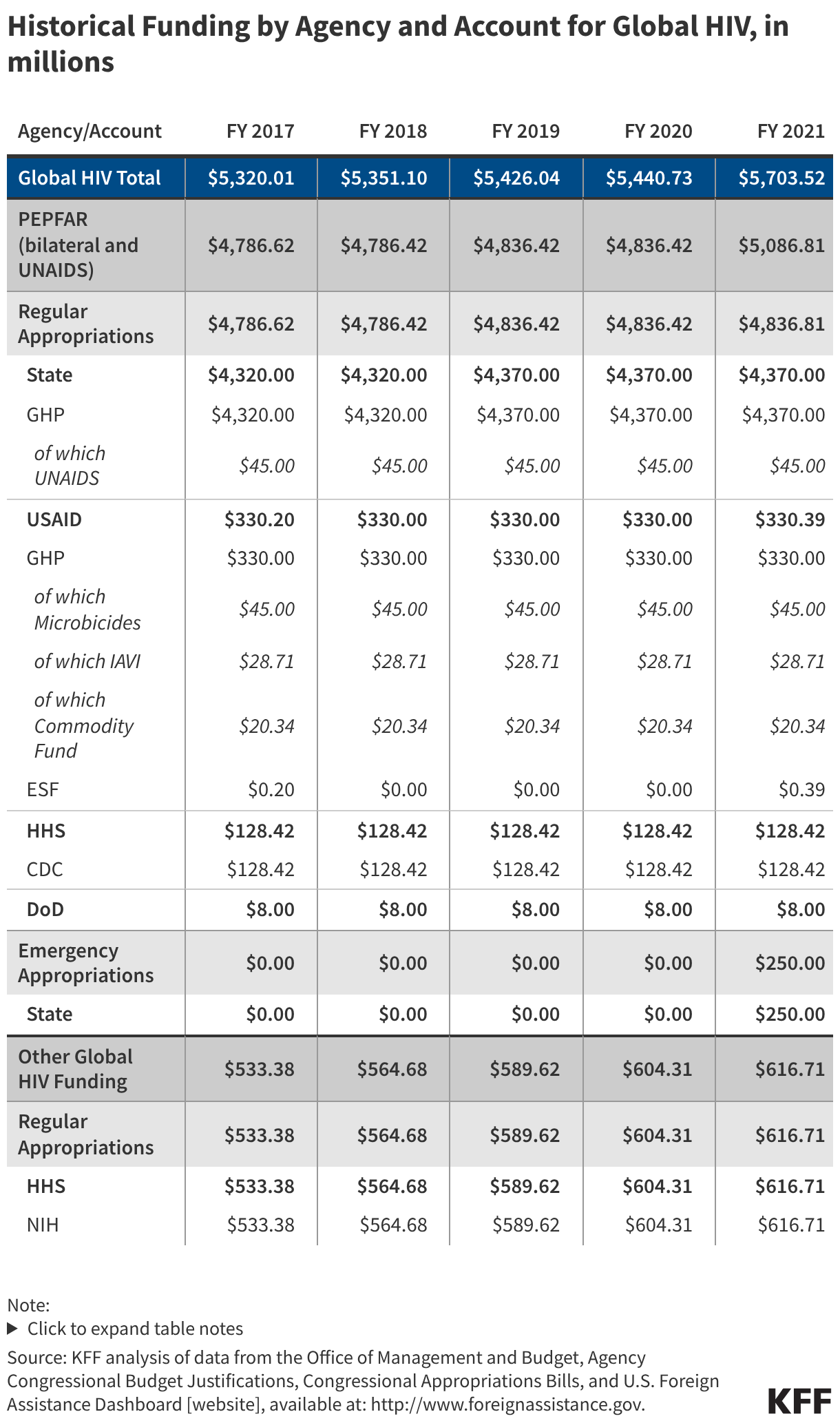
The U.S. first provided funding to address the global HIV epidemic in 1986. U.S. efforts and funding increased slowly over time until the launch of the U.S. President’s Emergency Plan for AIDS Relief (PEPFAR) in 2003, which initiated a period of significant increases and is the largest effort devoted to a single disease in the world. The majority of U.S. global HIV funding has been provided by Congress for PEPFAR bilateral efforts (91%) with additional funding for UNAIDS and international HIV research activities. As part of its global HIV response, the U.S., which is the largest donor to HIV efforts globally, also provides funding to the Global Fund (see below for details).2 PEPFAR funding is specified by Congress in annual appropriations bills and is largely provided to the Department of State, which is responsible, through the Bureau for Global Health Security and Diplomacy (GHSD), for coordinating all U.S. programs, activities, and funding for global HIV efforts. Other agencies that have received HIV funding under PEPFAR include the U.S. Agency for International Development (USAID) (although in FY 2026, following the dissolution of USAID, funding that was previously appropriated to USAID was provided to the State Department), Centers for Disease Control and Prevention (CDC), and Department of Defense (DoD). In addition, the National Institutes of Health (NIH) supports international HIV research activities, (not counted as part of PEPFAR). Global HIV funding through regular appropriations3 has historically accounted for the largest share of the U.S. global health budget (ranging from 42% to 50% between FY 2017 and FY 2026). In FY 2026, global HIV funding totaled $5.2 billion, of which $4.8 billion is for PEPFAR4 ($4.7 billion for bilateral HIV and $45 million for UNAIDS), and approximately $418 million is for international HIV research activities at NIH.
Figure 3
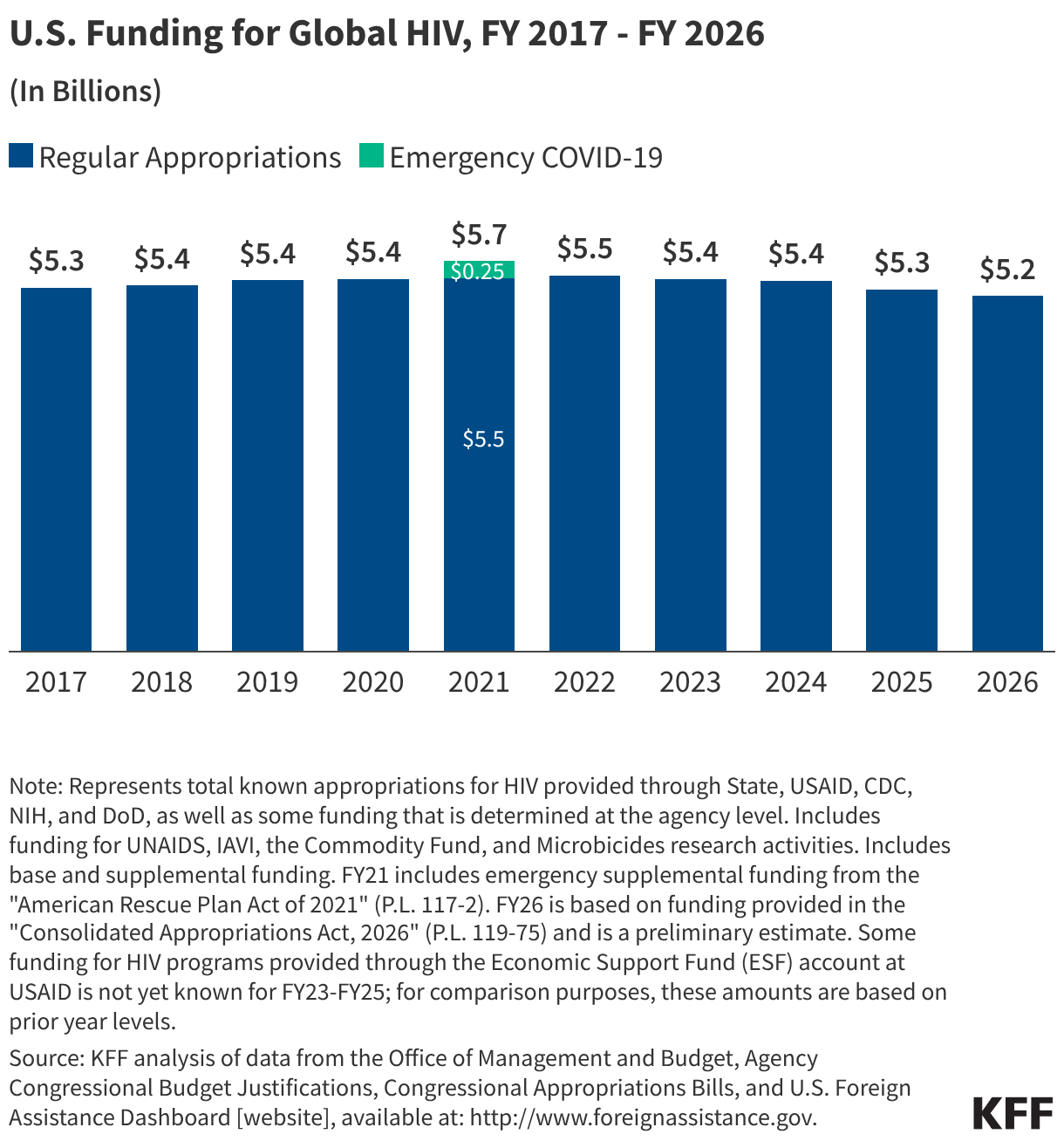
Table 2
Tuberculosis (TB)
Since 1998, when the U.S. Agency for International Development (USAID) began a global tuberculosis (TB) control program, U.S. involvement in global TB efforts has grown and the U.S. has been the largest donor to global TB efforts in the world.5 U.S. bilateral TB funding had been provided by Congress to USAID and included U.S. contributions to the TB Drug Facility (additional U.S. support for TB activities is provided through the U.S. contribution to the Global Fund to Fight AIDS, Tuberculosis and Malaria). In FY 2026, following the dissolution of USAID, funding that was previously appropriated to USAID was provided to the State Department. Over the last decade, U.S. funding for TB has grown, reaching a peak of $406 million in FY 2023, where it remained until decreasing slightly to $390 million in FY 2026. In FY 2026, U.S. funding for TB accounted for approximately 3% of the U.S. global health budget.
Figure 4
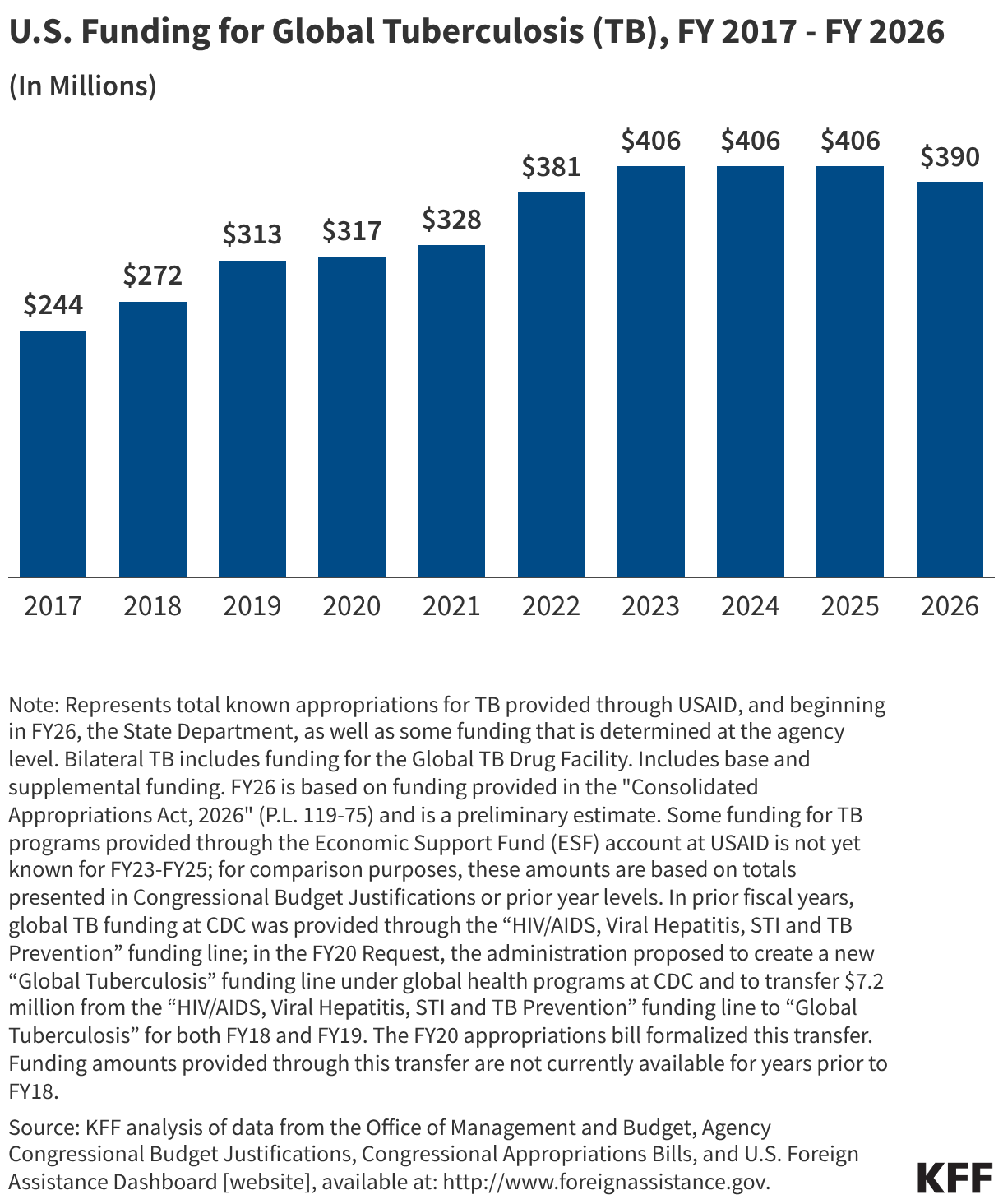
Table 3
Malaria/PMI
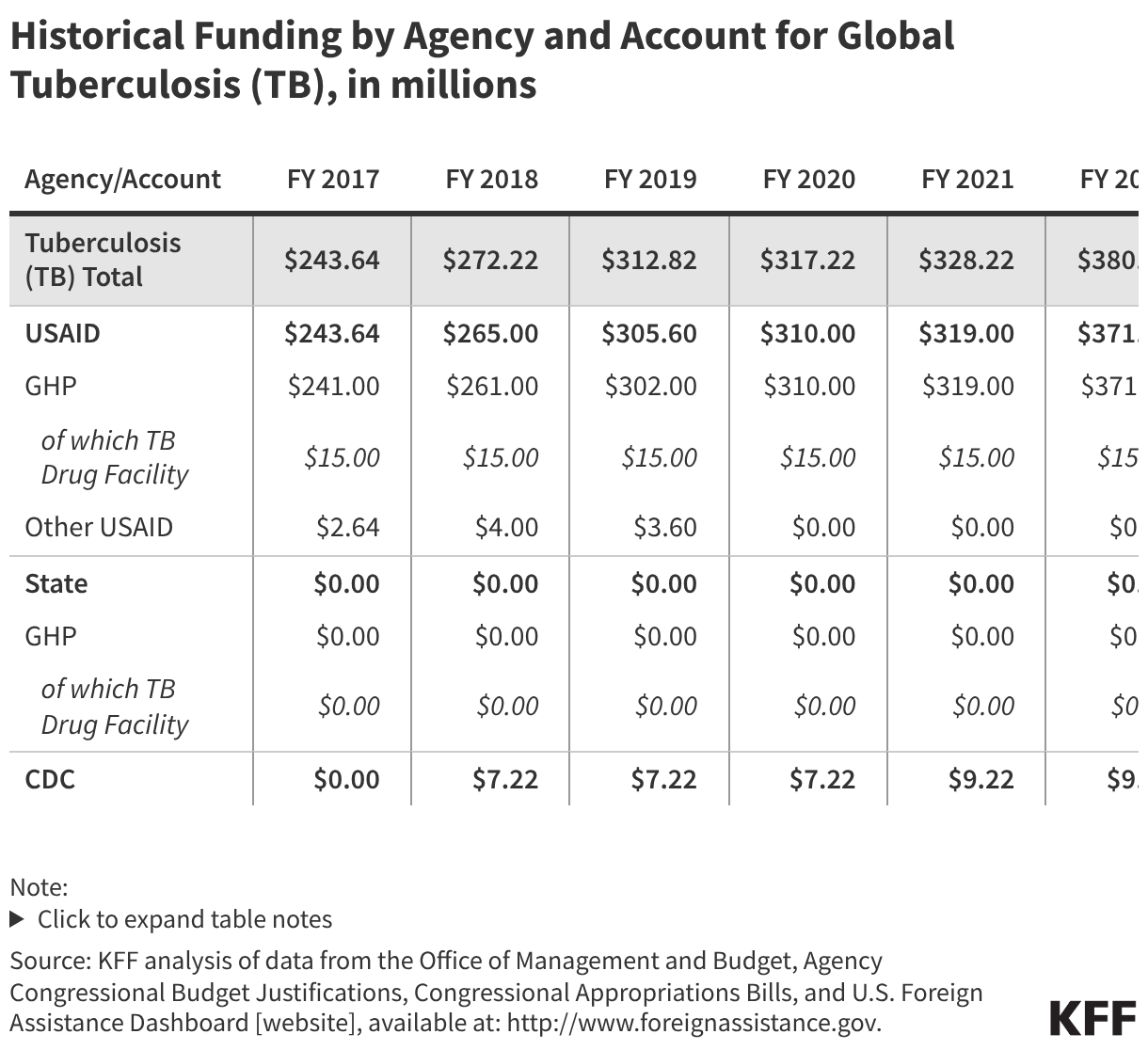
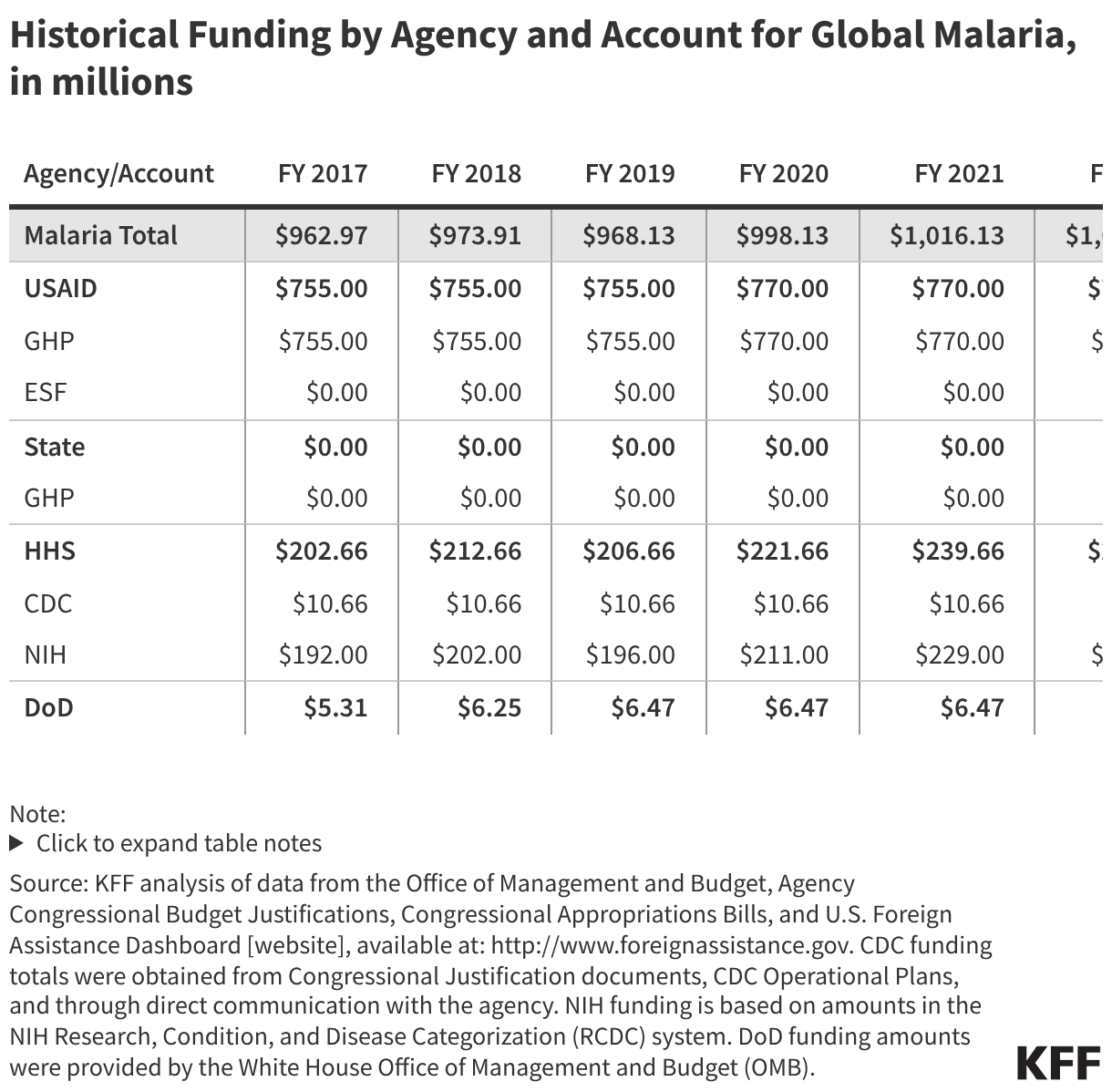
The U.S. government has been involved in global malaria activities since the 1950s and, today, is the largest donor government to global malaria efforts in the world (in addition, the U.S. is the largest donor to the Global Fund to Fight AIDS, Tuberculosis and Malaria, which in turn is the largest overall funder of global malaria efforts).6 The U.S. response to malaria had been driven by the President’s Malaria Initiative (PMI), an interagency initiative created in 2005 to address global malaria. PMI was led by the U.S. Agency for International Development (USAID), and co-implemented with the Centers for Disease Control and Prevention (CDC), with additional activities provided by the National Institutes of Health (NIH) and Department of Defense (DoD). In addition to bilateral funding, the U.S. also supports malaria programs through its contribution to the Global Fund to Fight AIDS, Tuberculosis and Malaria. In FY 2026, following the dissolution of USAID, funding that was previously appropriated to USAID was provided to the State Department. U.S. bilateral funding for malaria increased slightly over the past decade from $963 million in FY 2017 to approximately $1 billion in FY 2026. In FY 2026, malaria accounted for 9% of the U.S. global health budget.
Figure 5
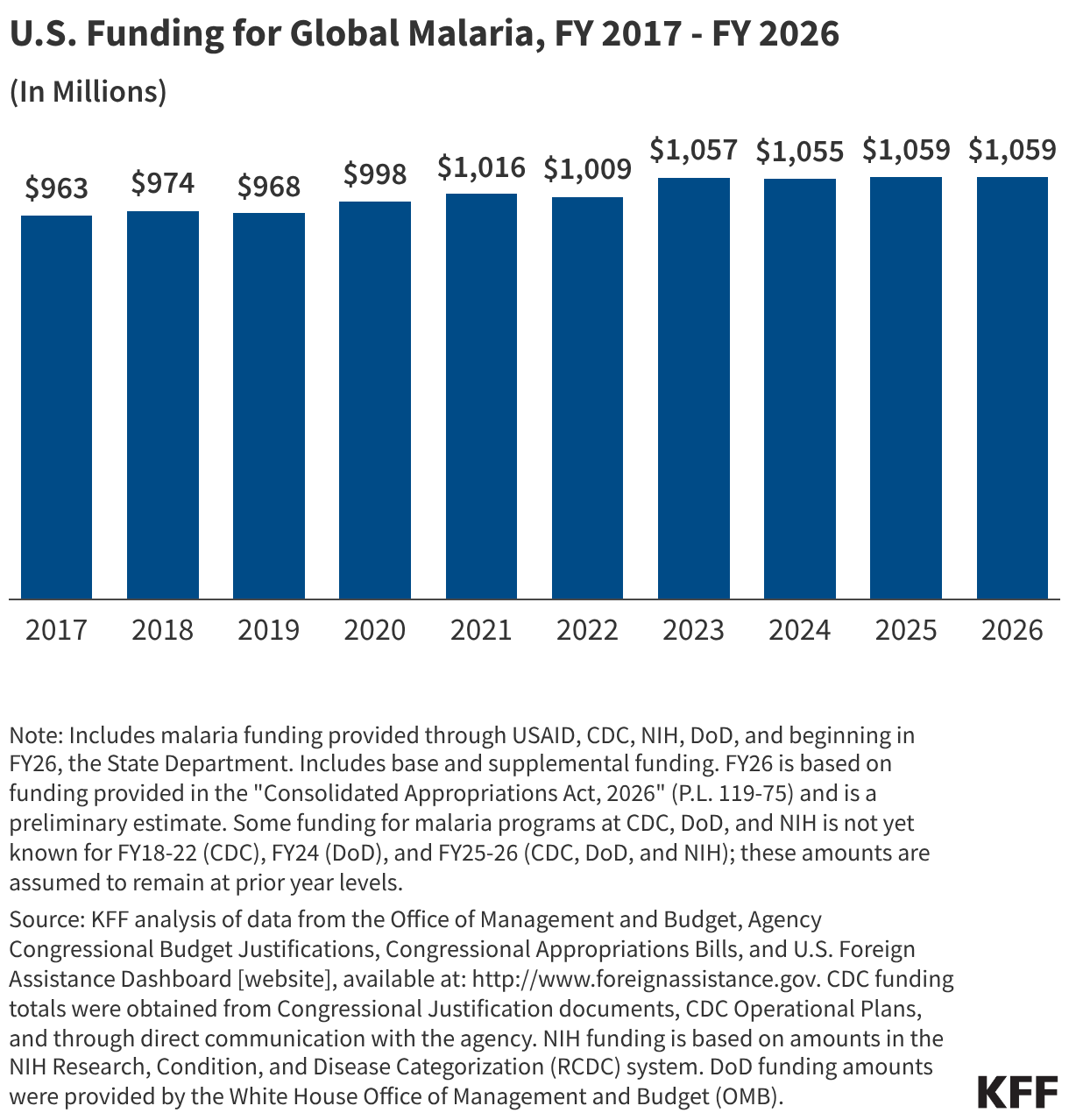
Table 4
The Global Fund to Fight AIDS, Tuberculosis and Malaria
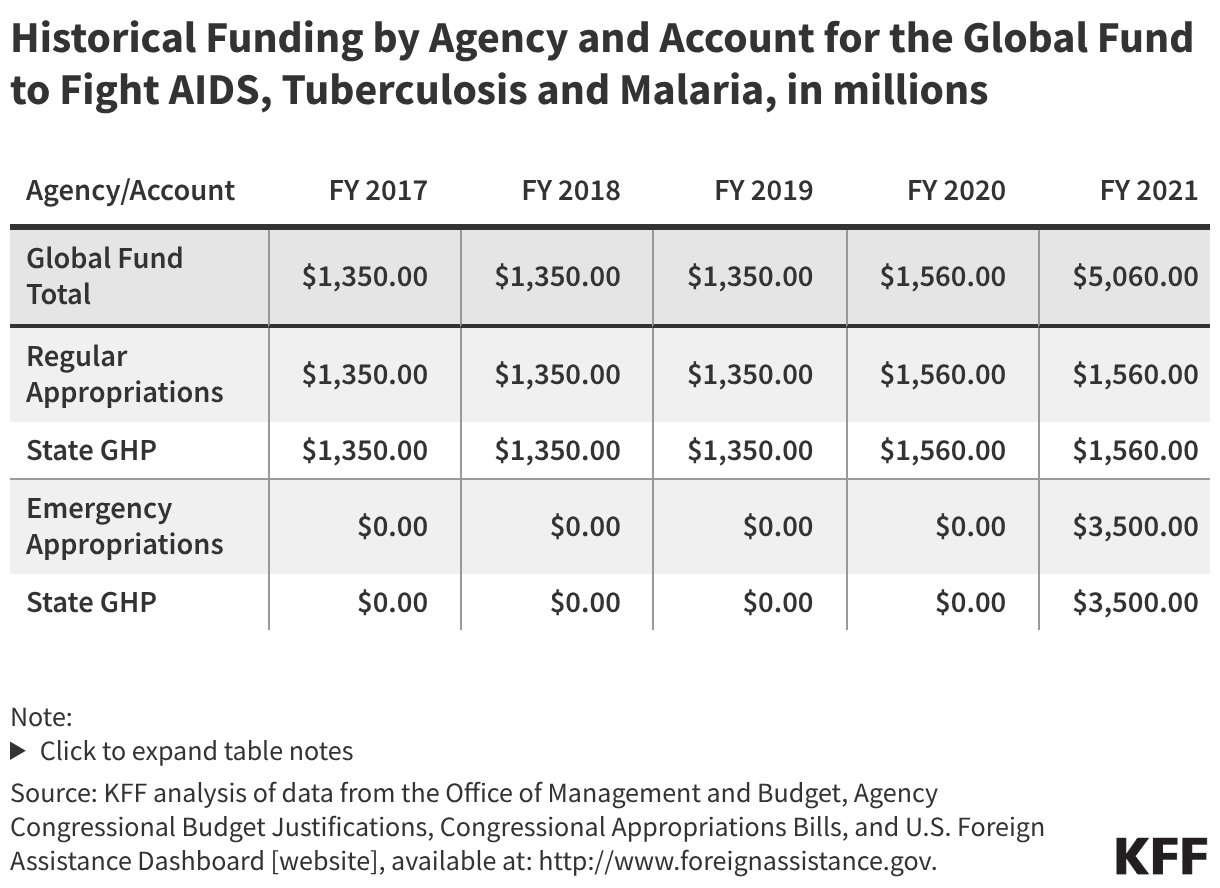
The Global Fund to Fight AIDS, Tuberculosis and Malaria (Global Fund) is an independent, public-private, multilateral institution which finances HIV, TB, and malaria programs in low- and middle-income countries. The Global Fund receives contributions from public and private donors and in turn provides funding to countries based on country-defined proposals. The U.S. provided the Global Fund with its founding contribution in 2001 and has since been its largest single donor (U.S. contributions to the Global Fund are counted as part of PEPFAR, although the Global Fund also supports TB and malaria efforts). The U.S. contribution to the Global Fund through regular appropriations has fluctuated over the past decade but reached its highest level to date ($2.0 billion) in FY 2023. In FY 2026, funding for the Global Fund was $1.25 billion, $750 million less than its peak level in FY 2023 and $400 million below the prior year level (FY 2025), in support of the administration’s pledge of $4.6 billion for the Global Fund’s eighth replenishment. In addition to regular appropriations, Congress provided $3.5 billion in emergency supplemental funding to the Global Fund to address the impacts of COVID-19 on HIV programs in FY 2021.
Figure 6
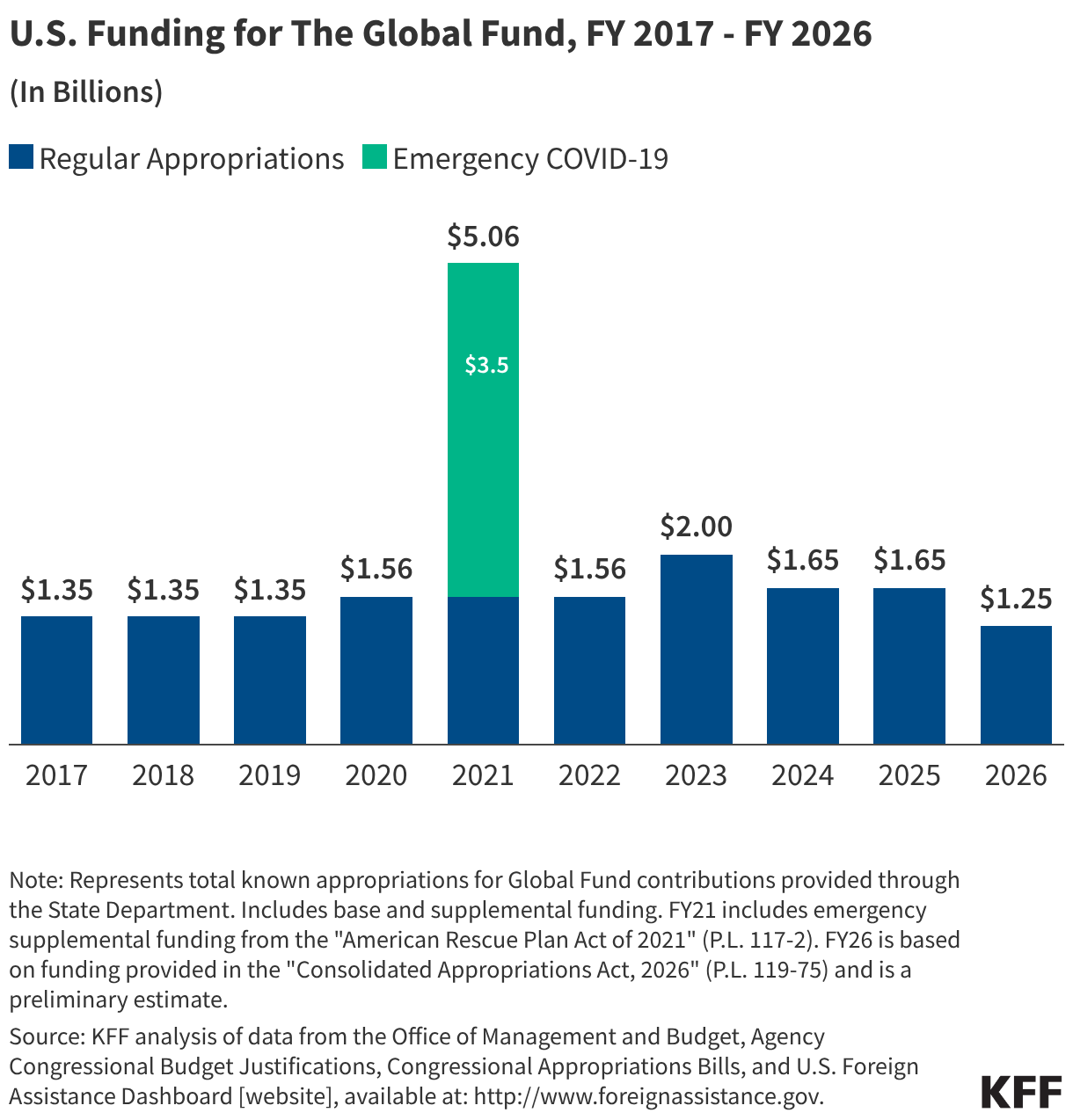
Table 5
Maternal & Child Health (MCH)
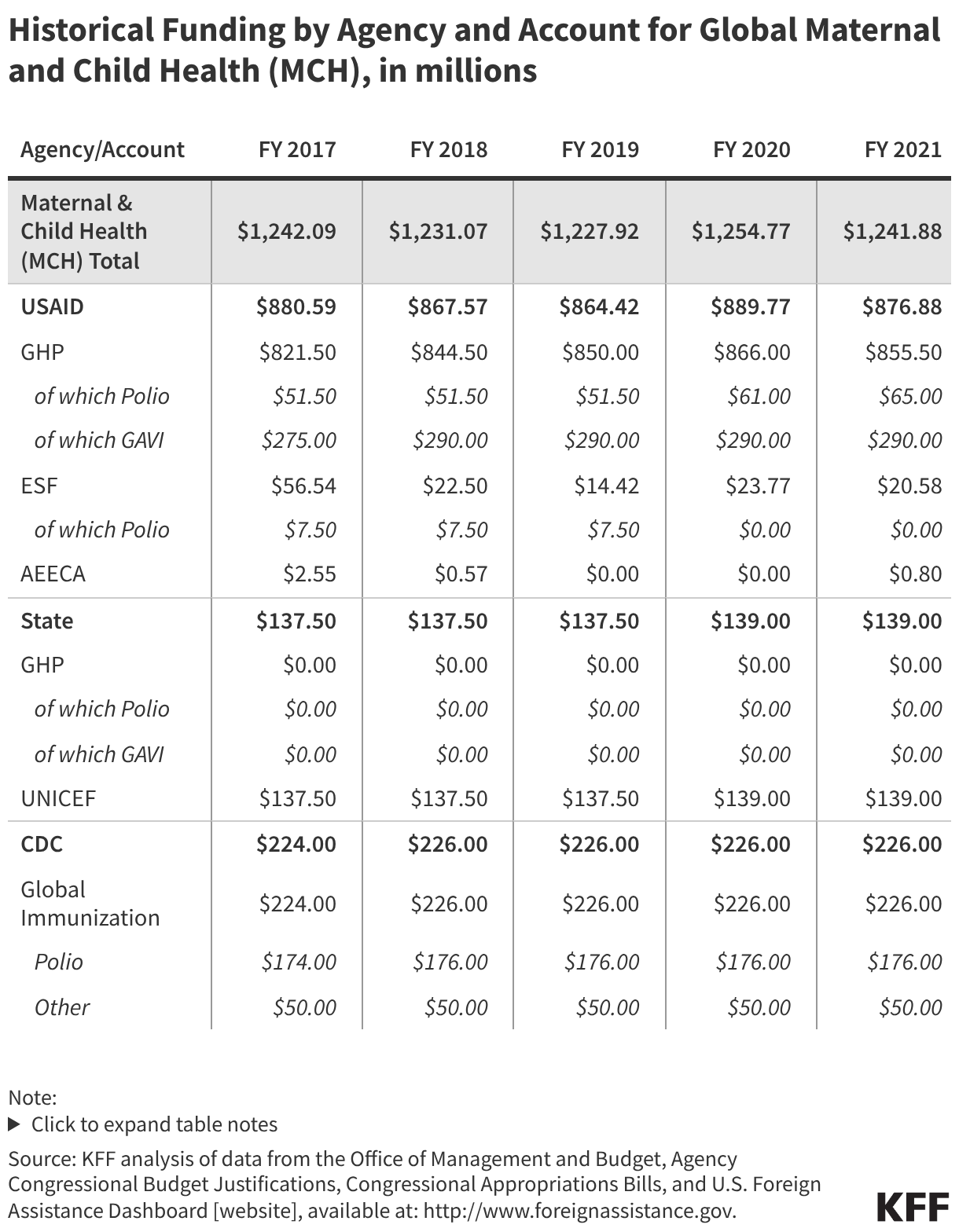
The U.S. has been involved in Maternal & Child Health (MCH) efforts since the 1960s (and has been a top donor to MCH activities in the world). MCH funding from Congress, which includes funding for polio and U.S. contributions to Gavi, the Vaccine Alliance (GAVI) and the United Nations Children’s Fund (UNICEF), had been appropriated to the U.S. Agency for International Development (USAID), the Centers for Disease Control and Prevention (CDC), and the State Department. In FY 2026, following the dissolution of USAID, funding that was previously appropriated to USAID was provided to the State Department. U.S. funding for MCH has been relatively flat over the past decade and totaled $1.29 billion in FY 2026, accounting for the third largest share of U.S. funding for global health (11%).
Figure 7
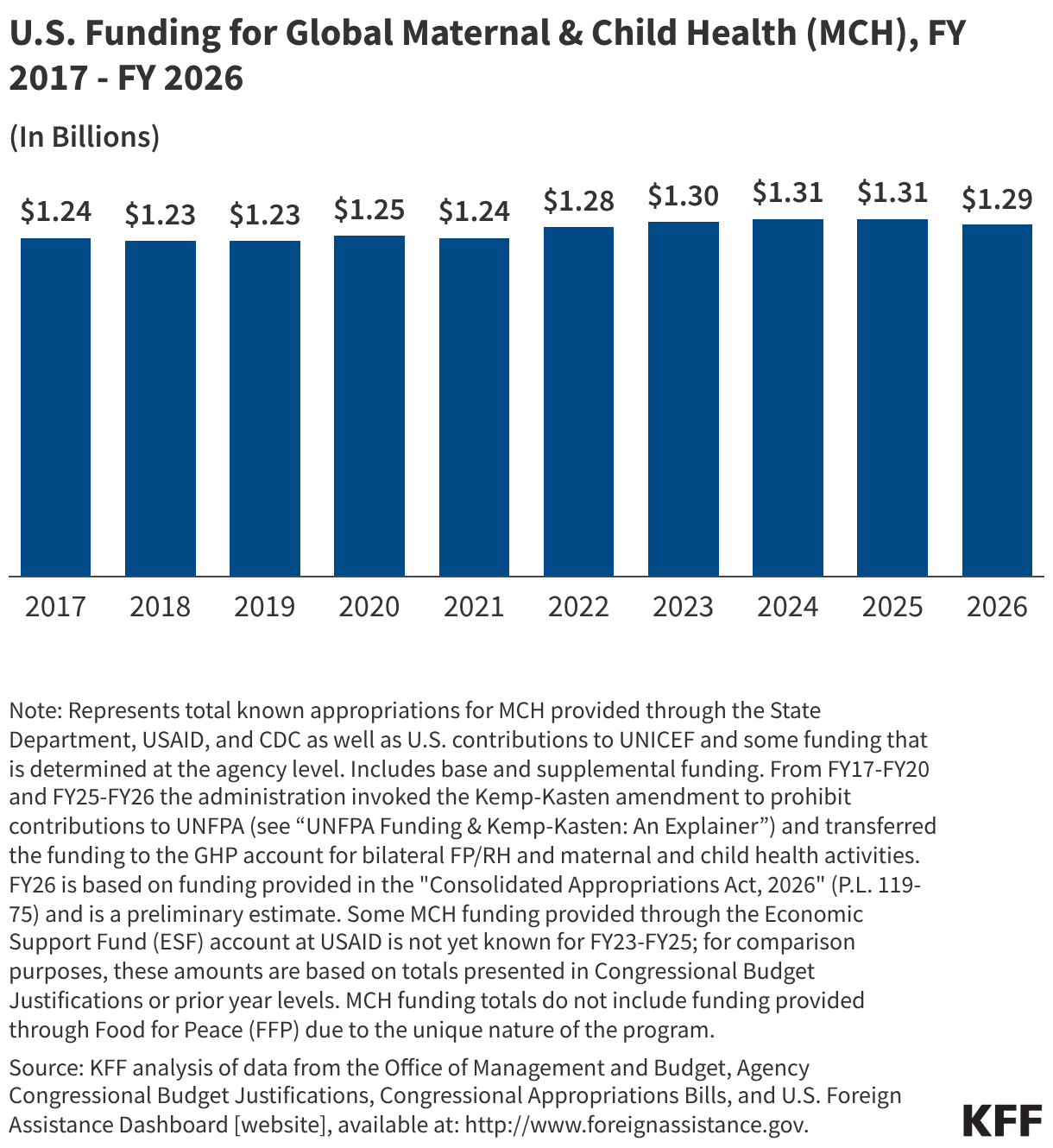
Table 6
Nutrition
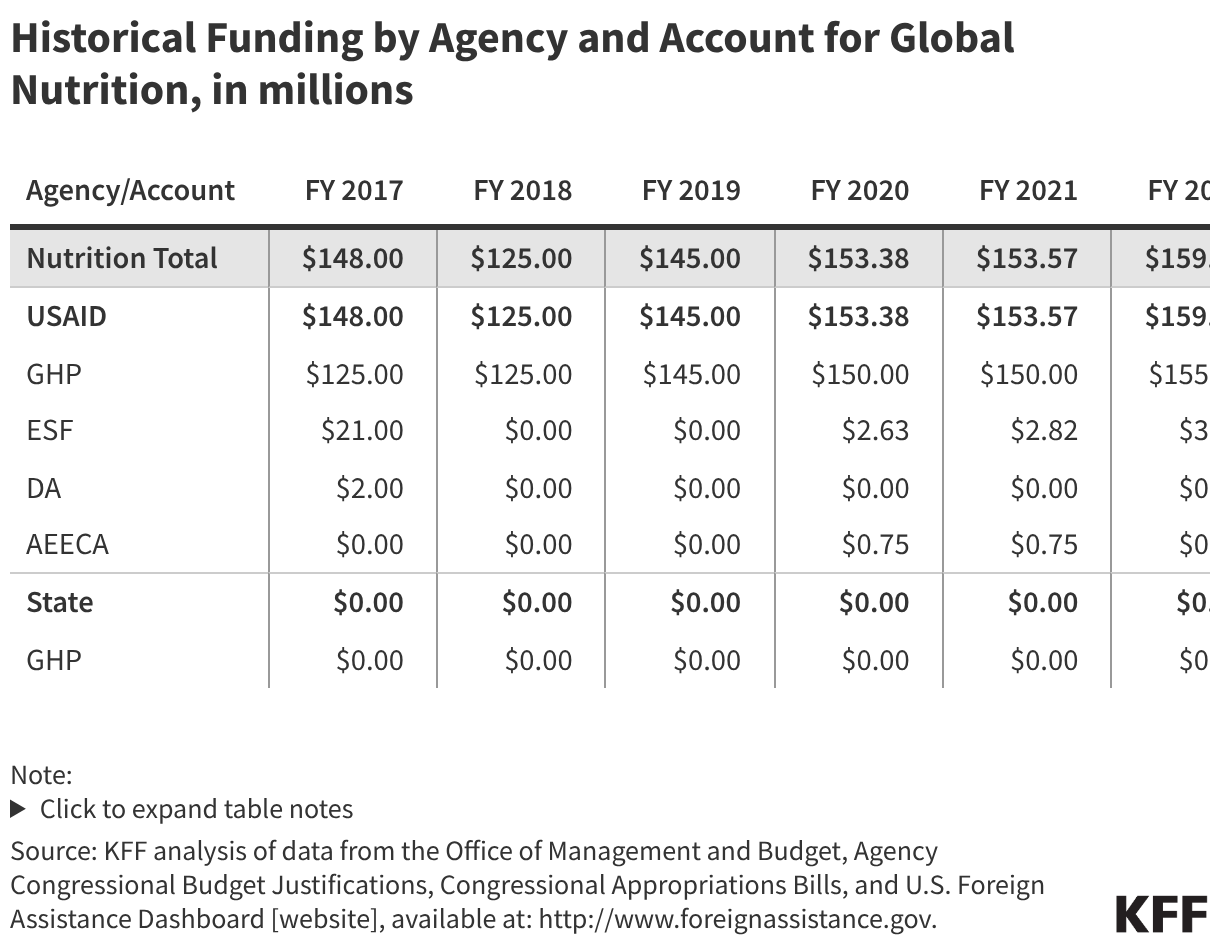
The U.S. has a long history of supporting global efforts to improve nutrition and has been the largest donor to nutrition efforts in the world. Starting in 2010, support for U.S. global nutrition activities had been appropriated through the U.S. Agency for International Development (USAID).7 In FY 2026, following the dissolution of USAID, funding that was previously provided through USAID was provided to the State Department. U.S. funding for nutrition increased from $148 million in FY 2017 to $165 million in FY 2026 and has accounted for relatively small share (approximately 1%) of the total U.S. global health budget over the period.
Figure 8
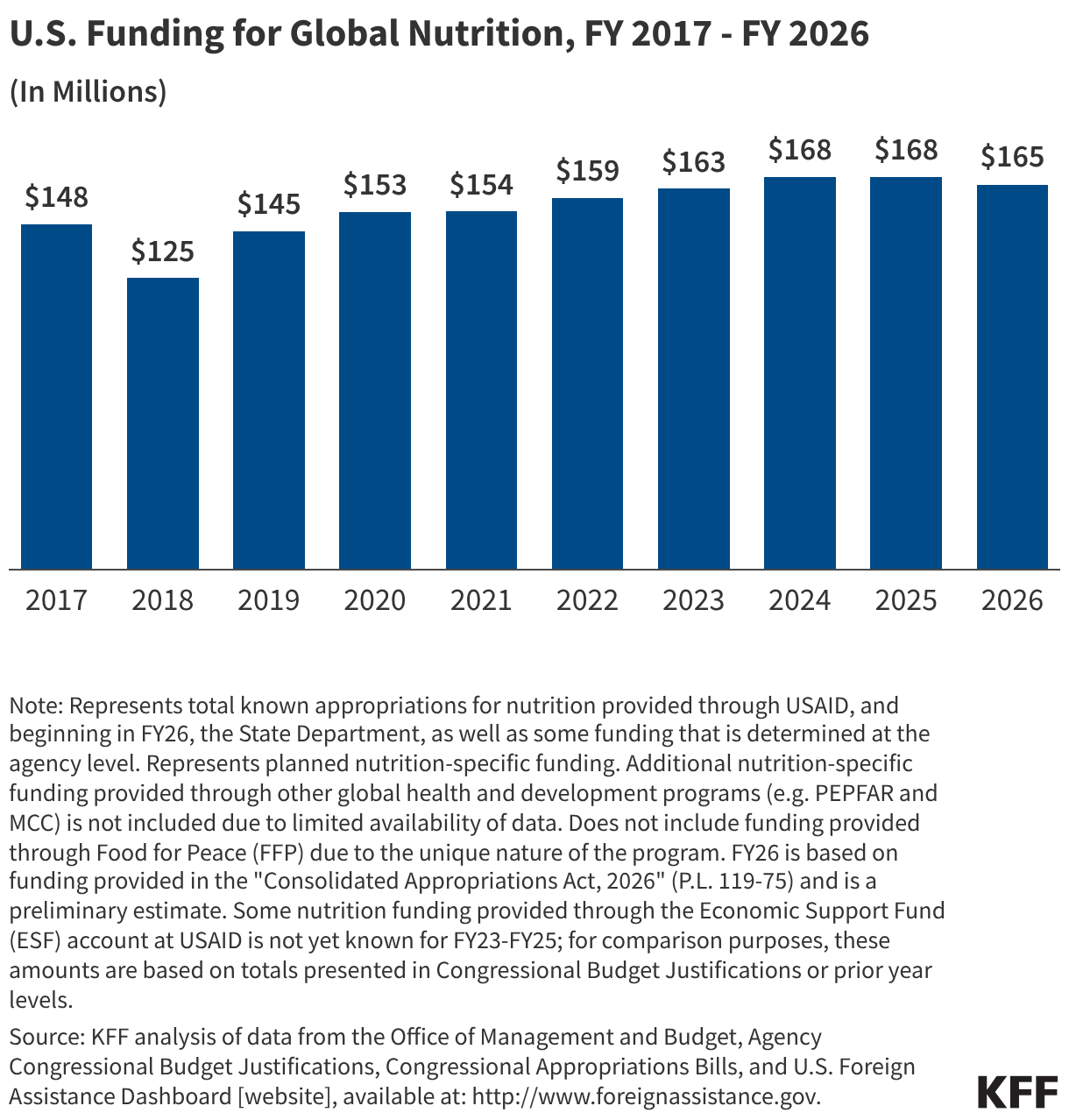
Table 7
Family Planning & Reproductive Health (FP/RH)
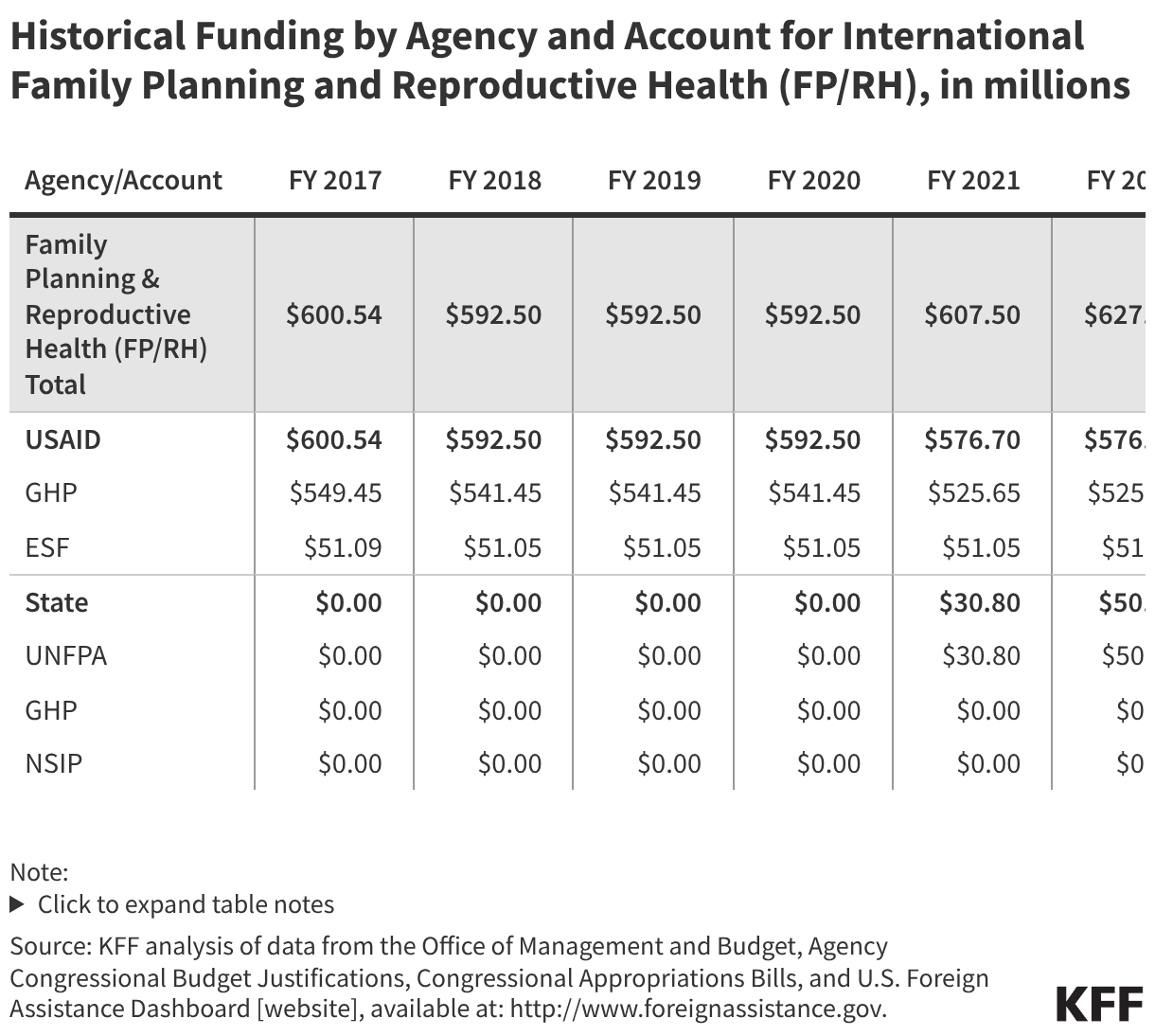
The U.S. has been involved in Family Planning & Reproductive Health (FP/RH) efforts since the 1960s and has been the largest donor to global FP/RH in the world.8 The majority of U.S. FP/RH funding has been provided by Congress to the U.S. Agency for International Development (USAID) for bilateral activities, with additional funding provided through the State Department for a U.S. contribution to the United Nations Population Fund (UNFPA).9 In FY 2026, following the dissolution of USAID, funding that was previously appropriated to USAID was provided to the State Department. U.S. funding for FP/RH rose steadily in its first two decades10 and more recently, has remained relatively flat at just about $600 million, accounting for approximately 5-6% of the U.S. global health budget each year from FY 2017-FY 2026.11 (Unlike most other areas of global health, the Trump administration stopped all global FP/RH funding and activities in 2025, even though Congress continues to appropriate funding for this purpose).
Figure 9
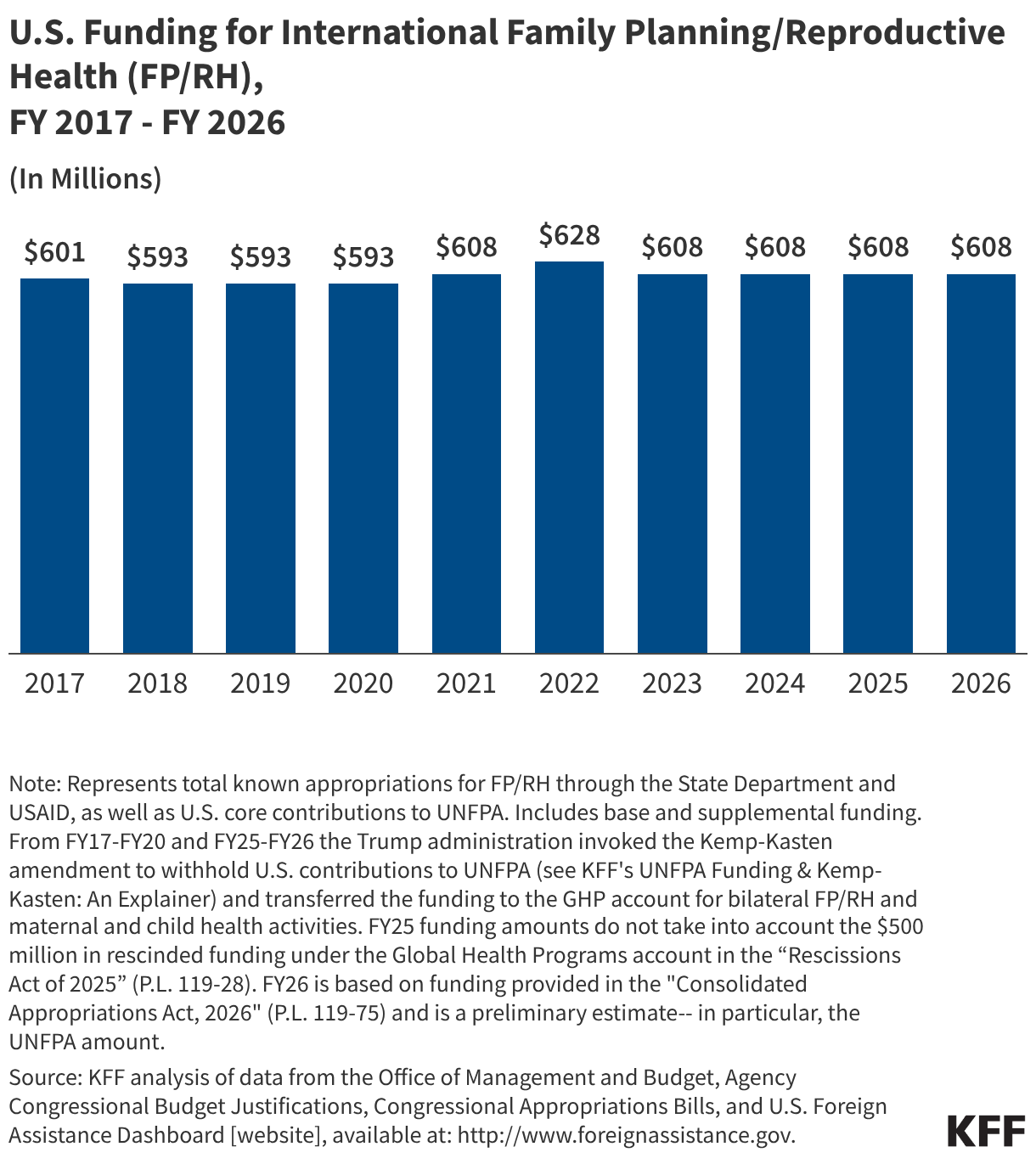
Table 8
Global Health Security
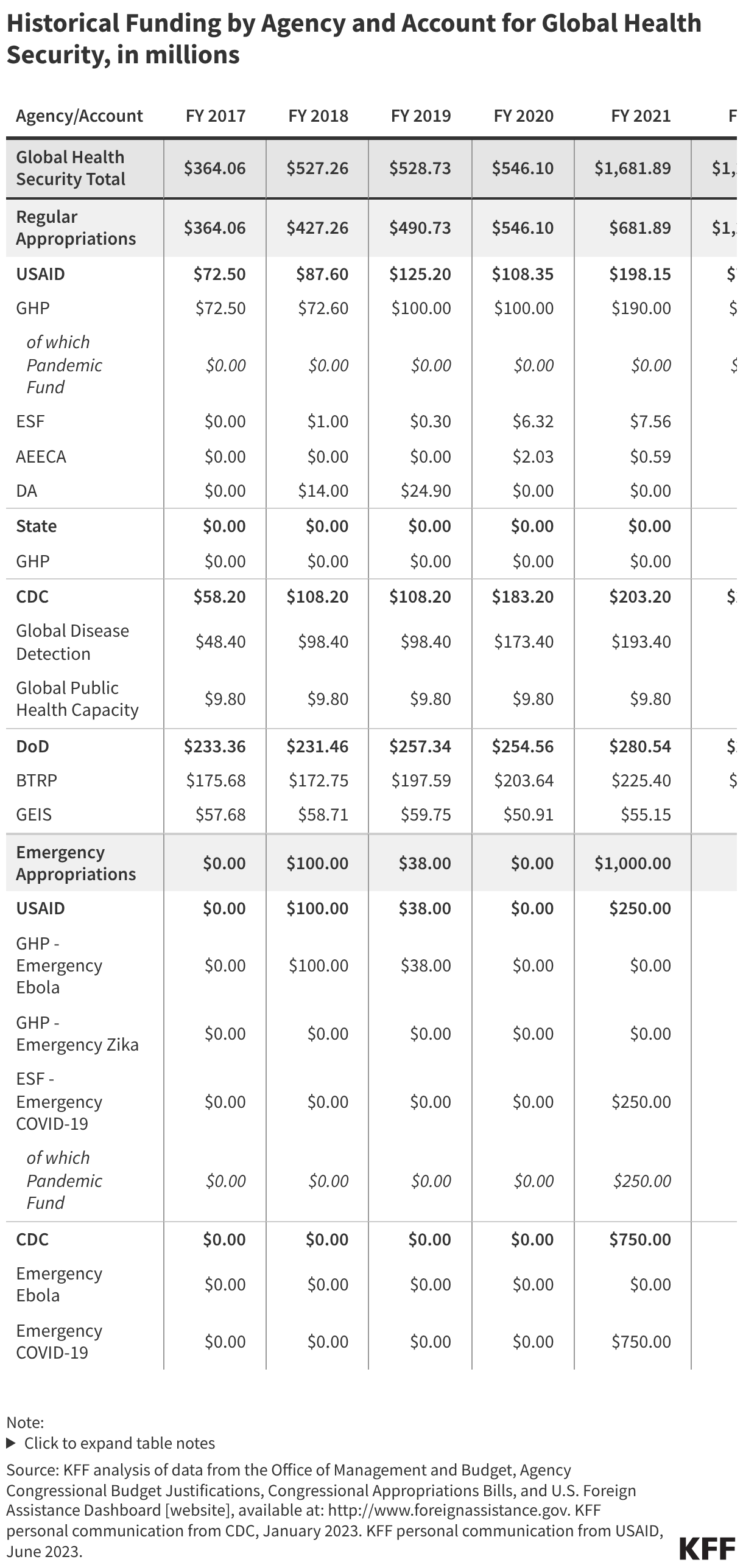
Since the 1990s, there has been growing concern about new infectious diseases that threaten human health including, in more recent years, the emergence and spread of threats such as Ebola, Zika, H1N1 influenza, COVID-19, and antibiotic resistance. U.S. global health security efforts aim to reduce the threat of emerging infectious diseases by supporting preparedness, detection, and response capabilities worldwide. Global health security funding had been provided by Congress to the U.S. Agency for International Development (USAID), the Centers for Disease Control and Prevention (CDC), and Department of Defense. In FY 2026, following the dissolution of USAID, funding that was previously appropriated to USAID was provided to the State Department. Over the past decade, funding designated by Congress for global health security through both emergency and regular appropriations has fluctuated over time, rising largely in response to outbreaks, including Ebola, Zika, and COVID-19.12 Funding for global health security as a share of the global health budget has increased over time, rising from 3% in FY 2017 to 10% in FY 2026 (after significant increases in funding during the COVID-19 pandemic, the overall amount has fallen annually over the past few years).13 In FY 2026, funding for global health security was $1.1 billion.
Figure 10
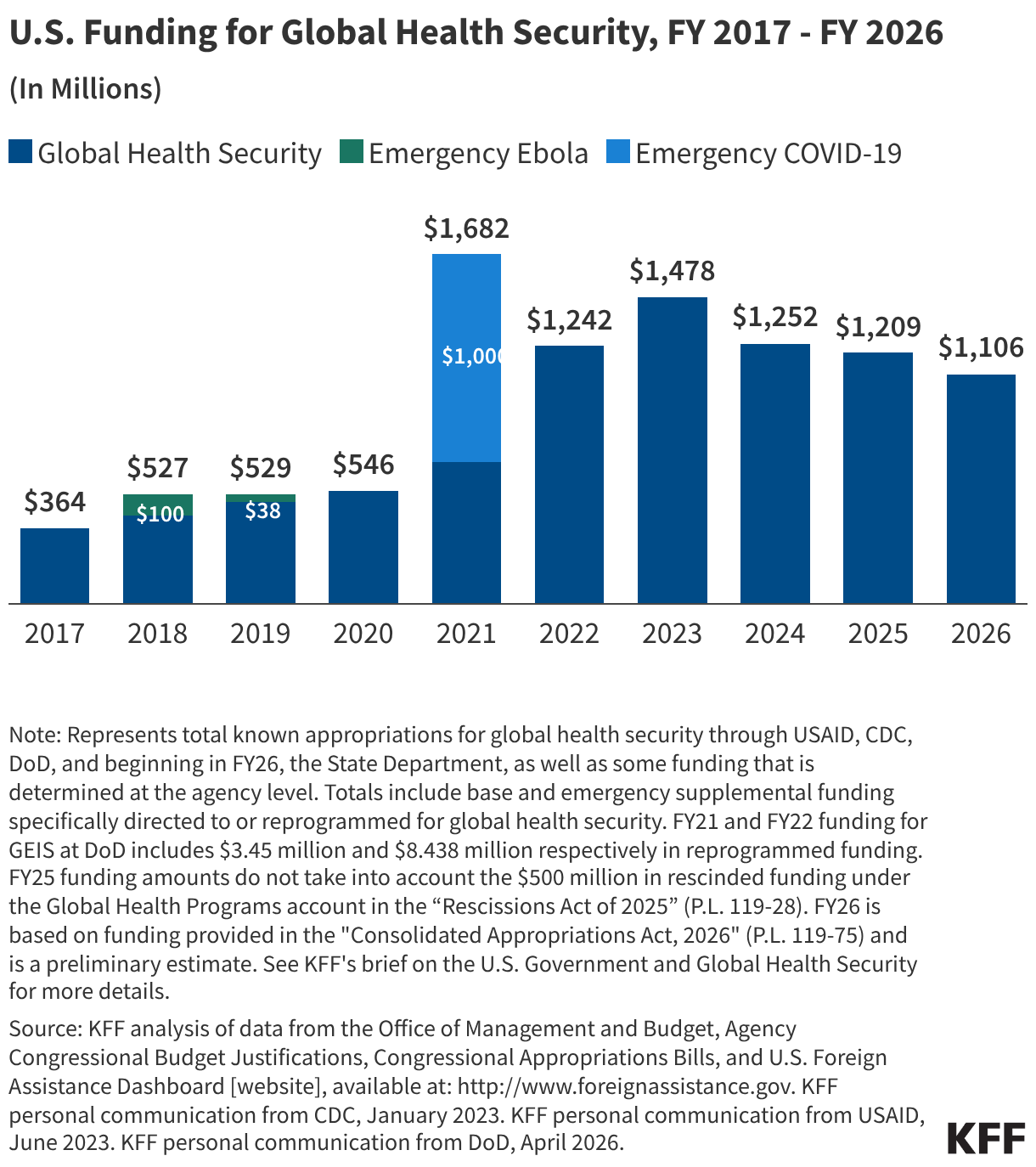
Table 9
Neglected Tropical Diseases (NTDs)
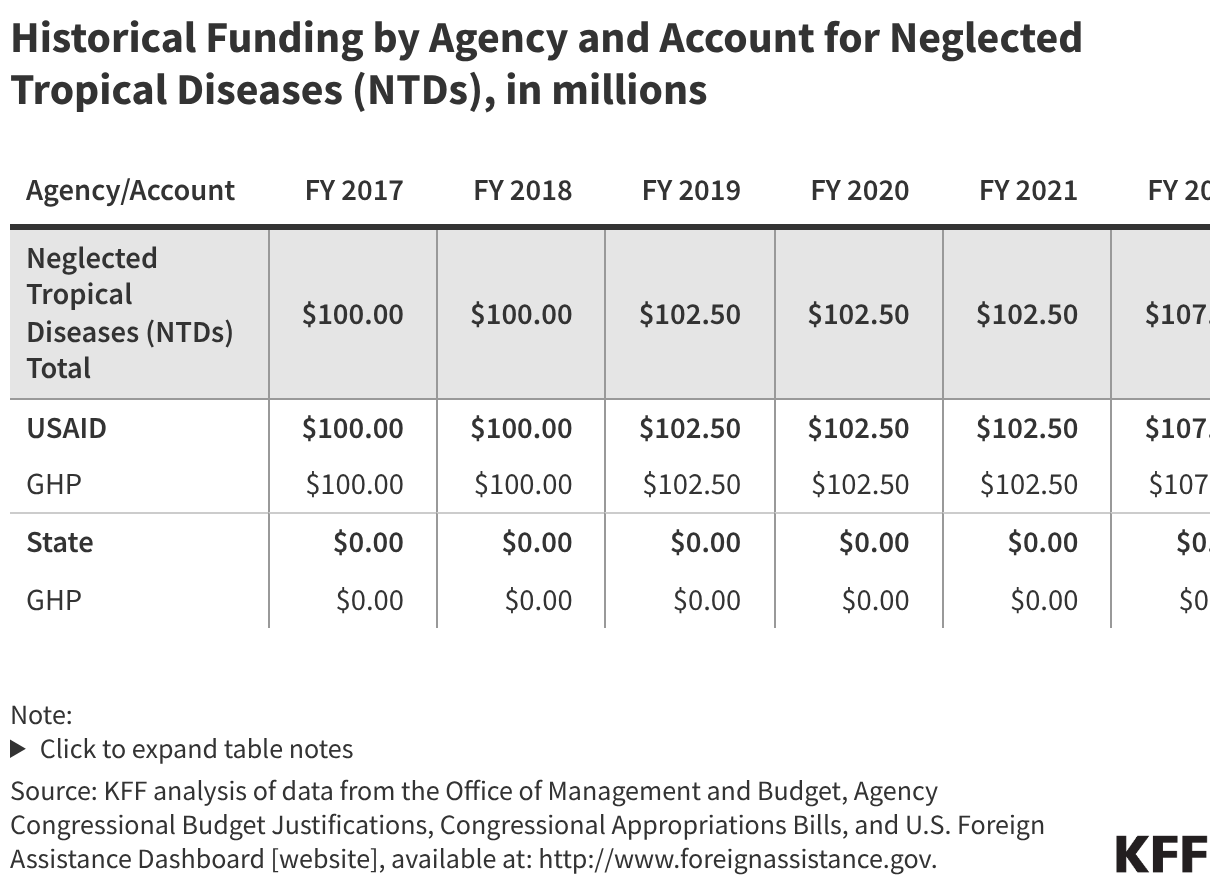
NTDs are a group of parasitic, bacterial, and viral infectious diseases that primarily affect the most impoverished and vulnerable populations in the world. The U.S. Congress first designated funding to address NTDs in 2006, through the U.S. Agency for International Development (USAID).14 In FY 2026, following the dissolution of USAID, funding that was previously appropriated to USAID was provided to the State Department. Funding for NTDs has remained relatively flat over the past decade, fluctuating between $100 million and $115 million.15 Funding for NTDs accounts for a relatively small share of the U.S. global health budget (1% in FY 2026). Since NTDs efforts were not specifically mentioned in the new America First Global Health Strategy or accompanying bilateral global health agreements, it is unclear whether funding for NTDs will continue despite Congress providing the funding.
Figure 11
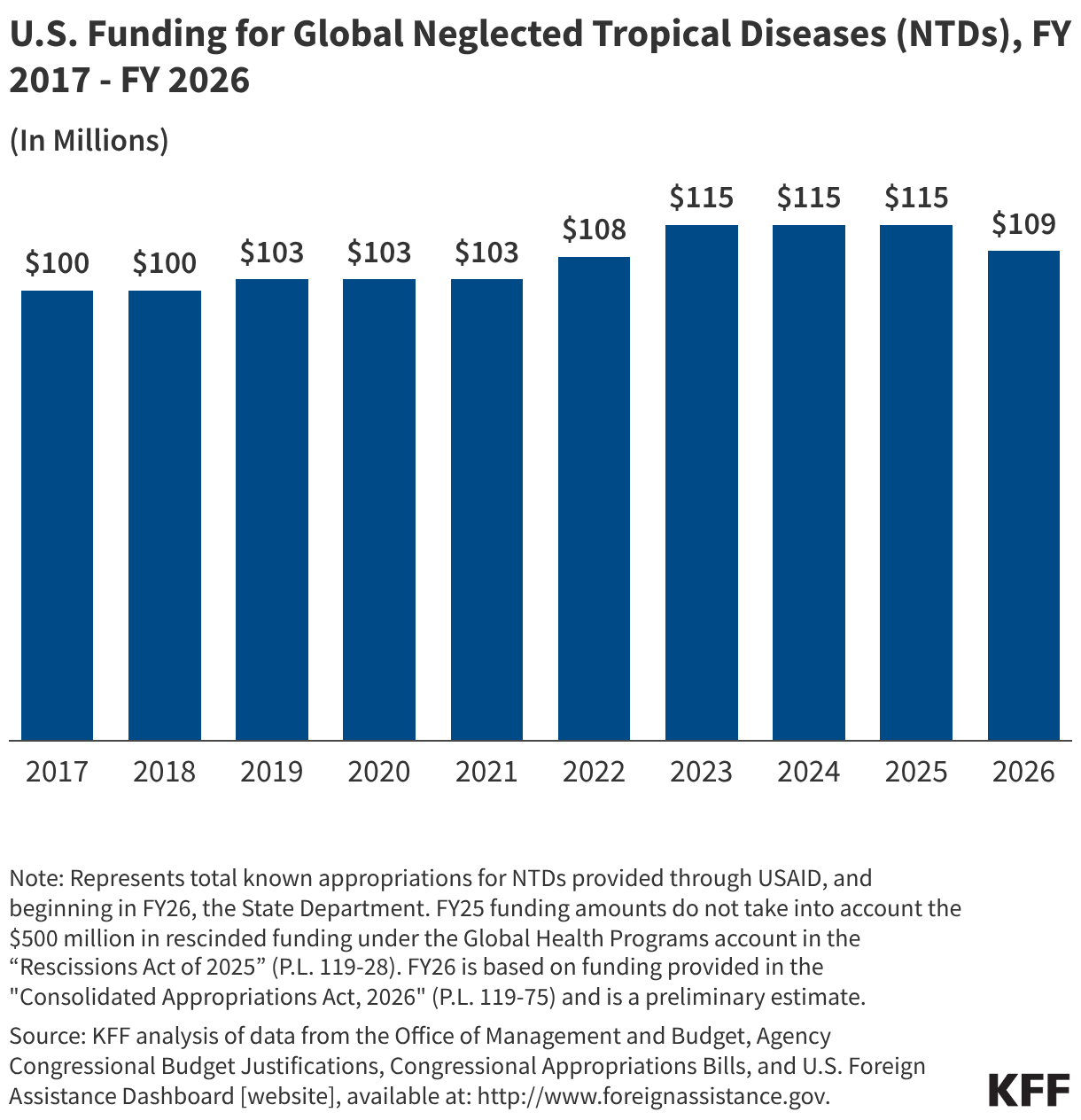
Table 10
Endnotes
- FY 2025 funding amounts do not take into account the $500 million in rescinded funding under the Global Health Programs account in the “Rescissions Act of 2025” (P.L. 119-28); areas that could be impacted by the rescissions include funding for family planning and reproductive health, global health security, the vulnerable children program, and neglected tropical diseases. ↩︎
- KFF, Donor Government Funding for HIV in Low- and Middle-Income Countries in 2024, July 2025. ↩︎
- In addition to regular appropriations, Congress provided $250 million in emergency supplemental funding to address the impacts of COVID-19 on U.S. bilateral HIV programs in FY 2021. ↩︎
- Total PEPFAR funding in FY 2026 is $6.0 billion ($4.7 billion for bilateral HIV, $45 million for UNAIDS, and $1.25 billion for the Global Fund). ↩︎
- World Health Organization, Global Tuberculosis Report 2025, 2025. ↩︎
- World Health Organization, World Malaria Report 2025, 2025. ↩︎
- Totals do not include funding provided through Food for Peace (FFP) due to the unique nature of the program. ↩︎
- KFF, Donor Government Funding for Family Planning in 2024, November 2025. ↩︎
- Under current law, any U.S. funding withheld from UNFPA is to be made available to other family planning, maternal health, and reproductive health activities (see the KFF fact sheet on U.S. government international family planning and reproductive health statutory requirements and policies). ↩︎
- PAI. Cents and Sensibility: U.S. International Family Planning Assistance from 1965 to the Present. Accessed September 2022 at https://pai.org/cents-and-sensibility ↩︎
- FY 2025 funding amounts do not take into account the $500 million in rescinded funding under the Global Health Programs account in the “Rescissions Act of 2025” (P.L. 119-28); areas that could be impacted by the rescissions include funding for family planning and reproductive health, global health security, the vulnerable children program, and neglected tropical diseases. ↩︎
- In FY15, Congress provided $5.4 billion in emergency funding to address the Ebola outbreak, of which $909.0 million was specifically designated for global health security. In FY16, Congress provided $1.1 billion in emergency funding to address the Zika outbreak, of which $145.5 million was specifically designated for global health security. In FY18, Congress provided $100 million in unspent Emergency Ebola funding for “programs to accelerate the capabilities of targeted countries to prevent, detect, and respond to infectious disease outbreaks.” In FY19, Congress provided $38 million in unspent Emergency Ebola funding for “programs to accelerate the capacities of targeted countries to prevent, detect, and respond to infectious disease outbreaks.” In FY20, Congress provided $1.235 billion in emergency COVID-19 funding to “prevent, prepare for, and respond to coronavirus” globally, and in FY21, Congress provided $9.4 billion in emergency COVID-19 funding “to prevent, prepare for, and respond to coronavirus, including for vaccine procurement and delivery.” While none of the FY20 funding was designated for global health security, all of the FY21 funding provided through CDC ($750 million) was designated by CDC as global health security. ↩︎
- FY 2025 funding amounts do not take into account the $500 million in rescinded funding under the Global Health Programs account in the “Rescissions Act of 2025” (P.L. 119-28); areas that could be impacted by the rescissions include funding for family planning and reproductive health, global health security, the vulnerable children program, and neglected tropical diseases. ↩︎
- Additional NTD funding is used for NTD research at the Centers for Disease Control and Prevention (CDC) and National Institutes of Health (NIH), although this funding is not specified by Congress. ↩︎
- FY 2025 funding amounts do not take into account the $500 million in rescinded funding under the Global Health Programs account in the “Rescissions Act of 2025” (P.L. 119-28); areas that could be impacted by the rescissions include funding for family planning and reproductive health, global health security, the vulnerable children program, and neglected tropical diseases. ↩︎