


VOLUME 57
Recently Released KFF Poll Shows Uncertainty Over Established Safety of COVID-19 Vaccines During Pregnancy
Highlights
KFF’s recently released Tracking Poll on Health Information and Trust finds that amid continued polarization over the safety of COVID-19 vaccines, public confidence in the safety of these vaccines for use during pregnancy has fallen, and many are uncertain about a false claim linking the vaccines with higher risk of miscarriage.
Separately, conversations about childhood vaccines continue to shift toward framing vaccination as an individual parental decision, placing greater emphasis on the conversations parents may have with their child’s pediatrician. Pediatricians remain the most trusted source among parents for vaccine information, and understanding strategies for effective communication may help them navigate these conversations with parents.
Featured
New KFF Poll Shows Decreased Confidence in Safety of COVID-19 Vaccines During Pregnancy Amid Uncertainty Over False Claim Linking Vaccines to Miscarriage Risk
COVID-19 vaccines have long been the subject of false claims, including those related to pregnancy and reproductive health. Recently, the false claim that the COVID-19 vaccines are linked with an increased risk of miscarriage was resurfaced by some Republican senators amid a U.S. Senate investigation into Dr. Anthony Fauci.
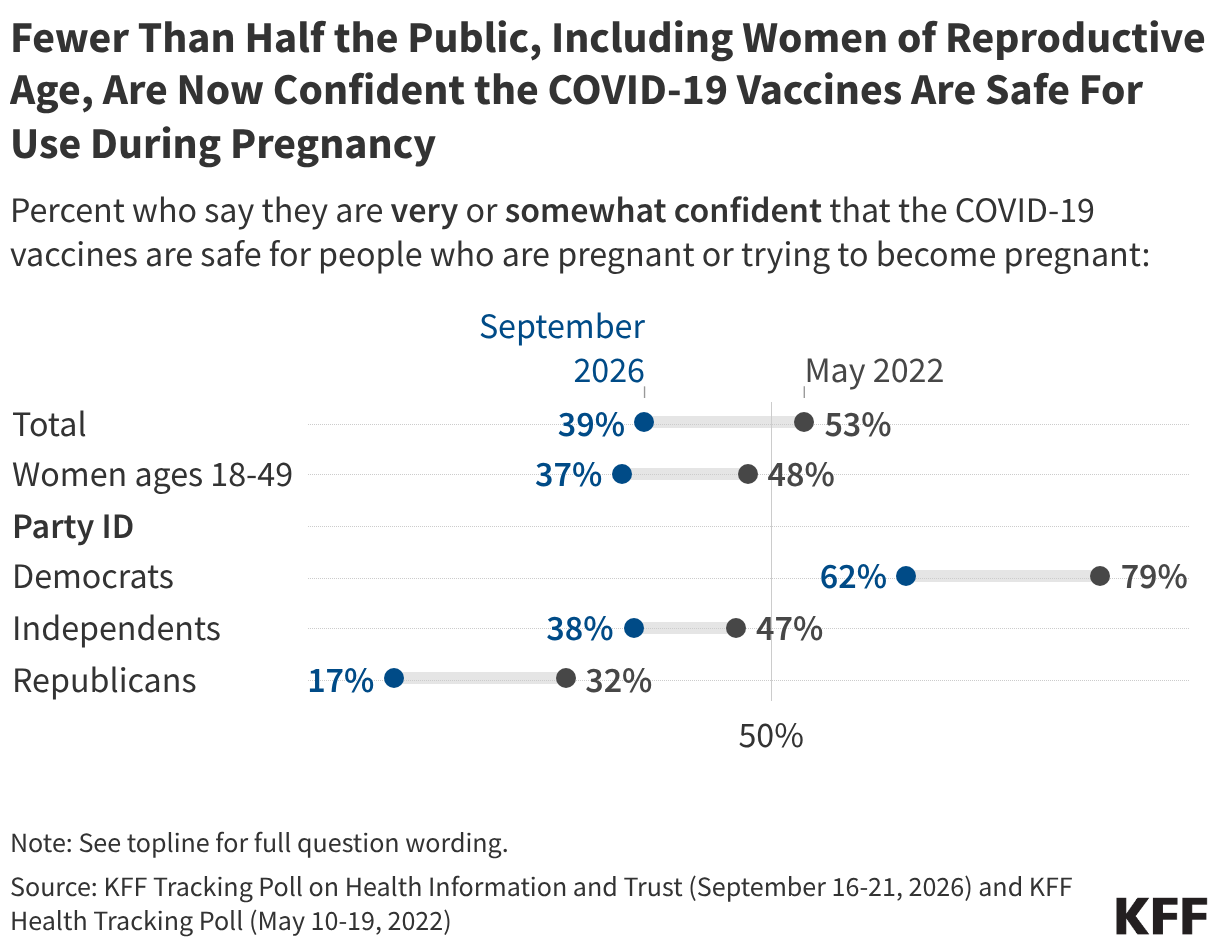
Public confidence in the safety of COVID-19 vaccines for use during pregnancy has dropped in recent years, including among women of reproductive age and across partisanship. KFF’s latest Tracking Poll on Health Information and Trust finds that fewer than half (39%) of adults, including similar shares of women ages 18-49 (37%), say they are at least “somewhat confident” that COVID-19 vaccines are safe for those who are pregnant or trying to become pregnant. This reflects a drop from four years ago, when roughly half of adults (53%) and women of reproductive age (48%) expressed confidence that the COVID-19 vaccines were safe for use during pregnancy.
As with general views on the COVID-19 vaccines’ safety, views on the vaccines’ safety during pregnancy are divided along partisan lines, with most (62%) Democrats expressing confidence compared to about four in ten independents (38%) and just one in six (17%) Republicans, though confidence has declined across each of these groups in the past four years.
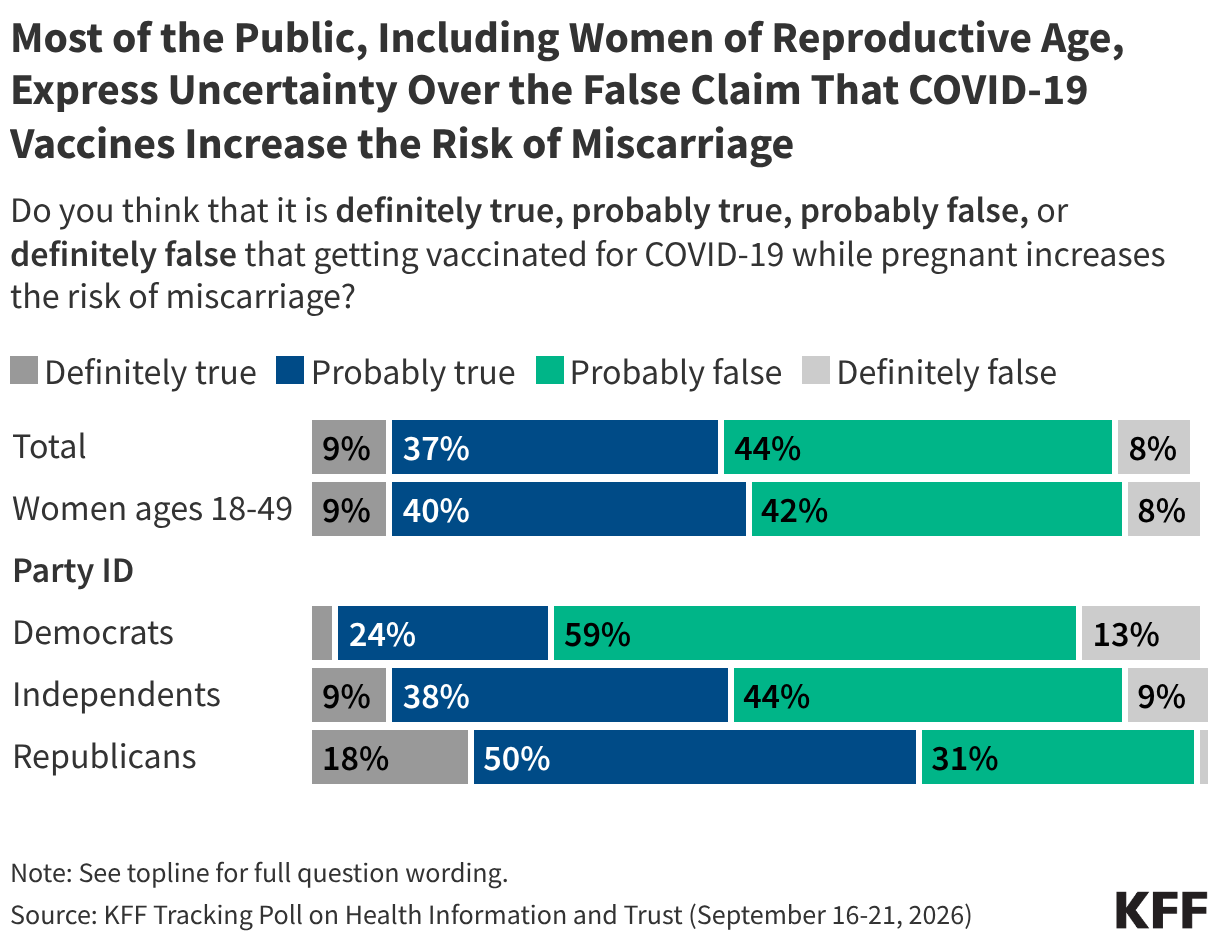
In line with past KFF polling on a wide array of false or unproven health claims, most of the public expresses some uncertainty over the myth that COVID-19 vaccines increase the risk of miscarriage in those who are pregnant. While few adults say this false claim is “definitely true” (9%), a large majority express some uncertainty, saying it is either “probably true” (37%) or “probably false” (44%). Among women of reproductive age (ages 18-49) and across partisanship, majorities express uncertainty in this false claim. Compared to other false health claims related to COVID-19 and vaccines measured in past KFF surveys, a relatively small share of the public say this false claim is “definitely false” (8%).
What We're Watching
How Pediatricians Communicate Can Shape Parents’ Vaccine Decisions
As some federal and state policymakers increasingly frame childhood vaccination in terms of individual choice, parents and pediatricians are navigating vaccine decisions amid changing recommendations and widespread exposure to false and misleading claims. At the state level, at least nine states have enacted policies since 2025 making non-medical exemptions to school vaccination requirements more permissive, and vaccine requirements are facing additional challenges in policy proposals and ongoing court cases. Even as large majorities of parents say they support some common vaccine requirements for school attendance, the share of U.S. kindergarteners with an exemption from at least one required vaccine reached a record high 4.2% in the 2025-26 school year, according to Centers for Disease Control and Prevention (CDC) data.
Among parents of children younger than 18, pediatricians remain the most trusted source of information about vaccines, and research indicates that how clinicians talk with parents about vaccination may be an important factor in a parent’s vaccination decisions. A 2025 scoping review of studies about interventions to increase vaccination rates found that clinician communication was the most common feature. Multiple studies found higher vaccination rates when clinicians used language that presumed parents would vaccinate their children, rather than language that invited discussion before making a recommendation. Both the American Academy of Pediatrics (AAP) and the CDC have recommended that pediatricians lead with a presumptive approach, before moving into a more participatory conversation if a parent expresses uncertainty.
Why This Matters
Parents are making vaccine decisions in an information environment where false and misleading claims can circulate widely, and many people remain uncertain about what to believe. KFF’s June 2026 Tracking Poll on Health Information and Trust found that large shares of parents who skipped or delayed vaccines for their children expressed inconsistent or uncertain beliefs over a range of vaccine myths, underscoring the connection between uncertainty and decisions to forgo recommended vaccines. Pediatricians may play an important role in helping parents evaluate competing claims and make an informed decision.
Misleading Claims of Tylenol-Autism Link Show How False Information Can Spread on Social Media
Claims linking acetaminophen use during pregnancy to autism reached a large share of the public after the Trump administration raised the claim in September 2025. KFF’s September 2025 Tracking Poll on Health Information and Trust, conducted days after the announcement, found that three-quarters of adults (77%) had heard or read that taking Tylenol during pregnancy increased the risk of autism, making it the most commonly heard false health claim measured in KFF surveys over the past several years.
Relatively few children’s hospitals or health organizations posted about the claim on their Instagram accounts, researchers found in a study that was first presented at the American Academy of Pediatrics annual meeting this month. Across 62 health organizations, only 12 (19%) posted about the issue, with some not posting until 51 days after the initial claim.
At the same time, other research presented at the meeting this month showed how the claim moved through the information environment. In an abstract from a not-yet-published paper presented at the conference, researchers found that on TikTok, more than half (52.8%) of videos they identified about the topic from the day of the announcement through November 2025 contained accurate information, while smaller shares contained false claims (28.3%) or mixed or uncertain information (18.9%). But despite making up fewer overall videos, those containing false claims received more than half (52.4%) of the overall views, with three-quarters of the videos containing false claims originating from influencers. One video alone was viewed 10.3 million times, making up more than a third (36.6%) of views across the analyzed videos. Another abstract presented at the meeting demonstrated clinicians reporting that such claims were among the false information they encountered during patient visits between May 2025 and March 2026.
Why This Matters
Misleading claims made by government officials and amplified by social media influencers can receive outsized attention online, even if accurate information is more prevalent. For providers and health organizations, responding to these claims quickly and effectively may depend on anticipating what claims patients are likely to encounter online and having timely, accessible information available when those claims enter clinical conversations.
AI & Emerging Technology
People Want Transparency About AI in Health Care, but Disclosure May Affect Perceptions
Most Americans say it is important for their health care providers to tell them when they use artificial intelligence (AI) in their care, according to a recent Pew Research Center survey. About seven in ten adults (72%) said it was “extremely” or “very” important that a doctor or healthcare provider disclosed AI use. At the same time, almost half (46%) said they weren’t sure if their doctors or providers had used AI, even as industry surveys report growing use by doctors and providers.
A study conducted in November 2025 and recently published in npj Digital Medicine offered one example of how people might respond to such disclosure. In an online experiment, people evaluated fictional family doctor advertisements that either stated the doctor used AI for diagnosis and therapy or explicitly stated that the doctor never used AI. Participants rated doctors who disclosed AI use as less warm and competent and said they would be less likely to make an appointment, follow the doctor’s treatment plan, or recommend them to others. They were also more likely to say they would seek a second opinion.
The experiment presented AI use as an all-or-nothing distinction, without explaining how the technology would be used, what role the physicians would retain in clinical decisions, or what benefits it might offer patients. The authors suggested that a more detailed disclosure, tailored to the specific situation, may mitigate some patient concerns about AI use, though the study did not test these approaches.
The study’s exploratory analyses also suggested that the negative effects of AI disclosure were more pronounced among those under age 45, which the authors theorized may be the result of younger adults being more familiar with AI’s limitations and more skeptical of its use in health care settings. KFF’s May Tracking Poll on Health Information and Trust found that use of AI for health information was more common among adults under 50 compared to older adults.
Why This Matters
Transparency about clinical AI use may be important to patients as the technology becomes more integrated into patient care, and understanding how people react to various forms of disclosure may help providers consider how best to introduce and communicate their use of AI and the role it plays in their decision-making.
California Enacts New Requirements for AI Clinical Decision Tools
California has enacted new laws around the use of AI in health care, including requiring health care facilities to take steps so that licensed health professionals maintain independent judgment over decisions influenced by AI. The changes come as policymakers and health care organizations consider the accuracy and reliability of AI tools and how much autonomy these systems should have in clinical care.
Under the new requirements, health care facilities cannot use AI to independently perform functions that California law reserves for licensed health professionals. The state is also requiring developers of AI clinical decision support systems with known or potential risks of bias to take reasonable steps to reduce it, and to give organizations that use these systems information on intended uses, risks, and limitations. Health organizations using these tools are also required to monitor the systems and take reasonable steps to address bias.
Why This Matters
California’s approach is one example of how policymakers are setting new rules to address several challenges that come with incorporating AI into clinical care, including potential bias and the desire to preserve clinicians’ independent judgment.
More From KFF
- KFF Column: From Drew Altman: A Guide to the Role of Health in the Midterms
- KFF Fact Sheet: Midterm Election Update: Vaccines
- KFF Policy Watch: How Is The Federal Government Counting Measles Deaths?
About The Health Information and Trust Initiative: the Health Information and Trust Initiative is a KFF program aimed at tracking health misinformation in the U.S., analyzing its impact on the American people, and mobilizing media to address the problem. Our goal is to be of service to everyone working on health misinformation, strengthen efforts to counter misinformation, and build trust.
The Monitor is a report from KFF’s Health Information and Trust initiative that focuses on recent developments in health information. It’s free and published twice a month.
Sign up to receive KFF Monitor
email updates
Support for the Health Information and Trust initiative is provided by the Robert Wood Johnson Foundation (RWJF). The views expressed do not necessarily reflect the views of RWJF and KFF maintains full editorial control over all of its policy analysis, polling, and journalism activities. The data shared in the Monitor is sourced through media monitoring research conducted by KFF.