A Guide to the Role of Health in the Midterms
Elections, obviously, are partly about voter choice and partly about which side’s voters turn out to vote in greater numbers. Without a presidential race to galvanize attention, midterms especially are about turnout. Democrats currently appear to have an advantage on voter enthusiasm, and worries about health care costs—as part of voter concerns about the cost of living—are one big reason why.
But let’s backup.
Issues like health care are only one factor that motivates voting. Quite obviously, partisan affiliation does. And candidate qualities and characteristics do. The general mood of the country and the standing of the president do as well. And all kinds of local factors can play a role in races. Even when issues do matter, often it’s not the candidate’s specific plan or position on an issue that moves voters. Instead, voters take candidate’s positions on issues as cues or signals: Does the candidate care about me? Are they for bigger or smaller government? Will they save or cost me money?
Even with these caveats, voters’ concerns about health care costs are having a moment, and will continue to do so through 2028, because voters see them as a dimension of their worries about the cost of living, which is their dominant concern right now.
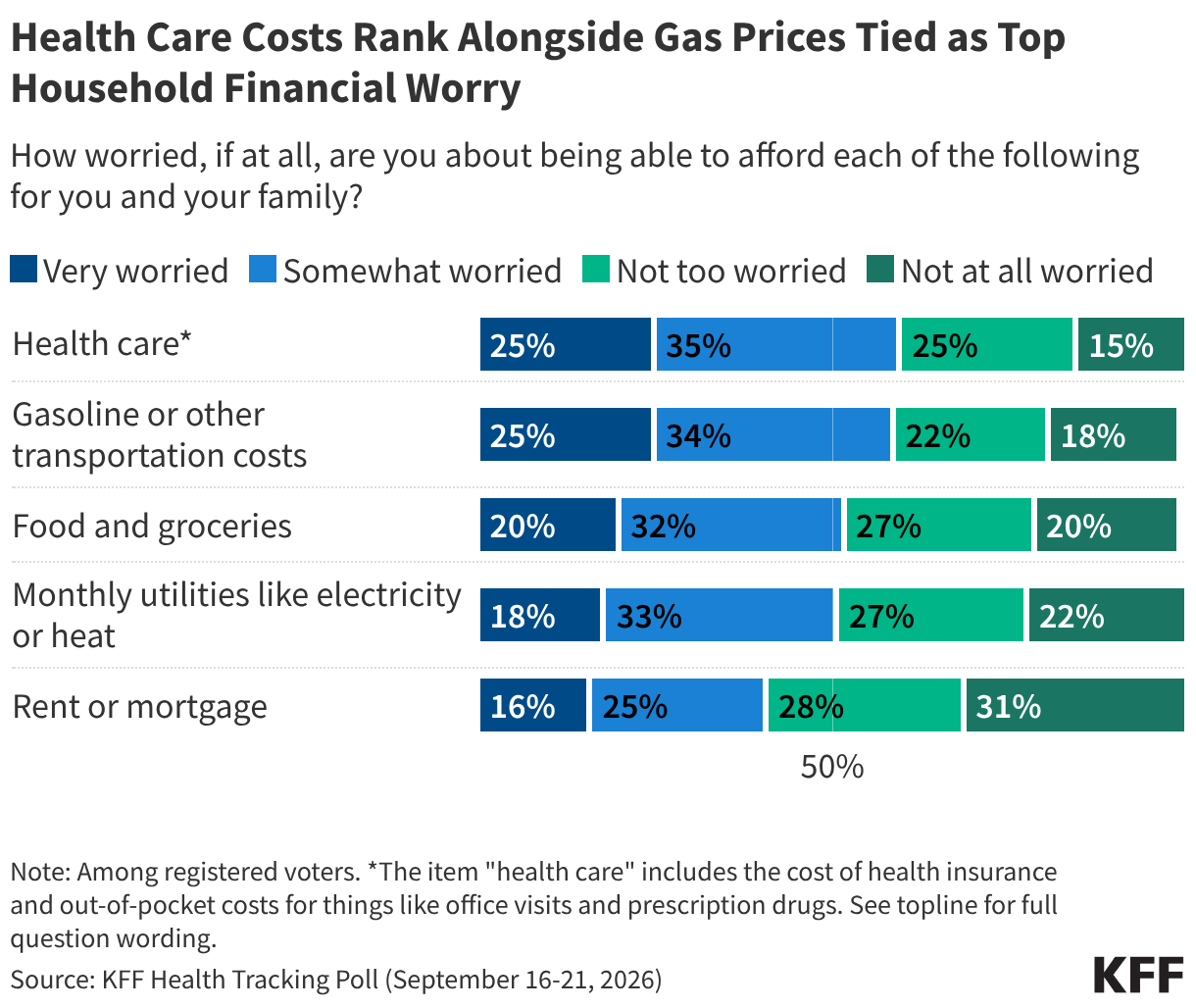
When we ask voters what their top financial worry is in our latest poll, health costs are tied with the cost of gas at the top of the list, and ahead of the cost of food, utilities, rent or mortgage. When you step back a bit from the rankings, you can see that all five of these worries are closely clumped together. That’s because, in the real world for families trying to pay the bills, they hit families together and are connected. There are also other costs families struggle with, such as childcare or education. When one of these costs goes up, it makes other expenses more difficult to afford. People confront a bundle of costs together, which we label “cost of living” or more recently “affordability.” I predict that polls around the election and exit polls will list “health care” as a separate issue and rank it third or fourth. That downplays the importance of voter concern because voters now see health care costs not as a separate issue but as a dimension of their cost-of-living concerns.
There is, however, one important way in which worries about health costs are different: Health care costs are far less predictable than other costs of living. Anyone could have a major accident or be diagnosed with a major illness and face a big medical bill. This, I suspect, is why health costs, surprisingly, rank up there with the cost of gas, which is in the news every day. Health costs are a special kind of financial worry.
Note that the costs voters care about are their own health care bills, not national health spending, or employer premiums, or value, or federal or state health spending. The cost of health care is a multifaceted problem, but the health cost problem vying with gas prices as a force in this election is very specific—it’s about people’s out-of-pocket costs. I suspect that frustration with the health care and insurance systems also figure into voter discontent. In another poll, we found that people say prior authorization was their single biggest burden getting health care other than costs.
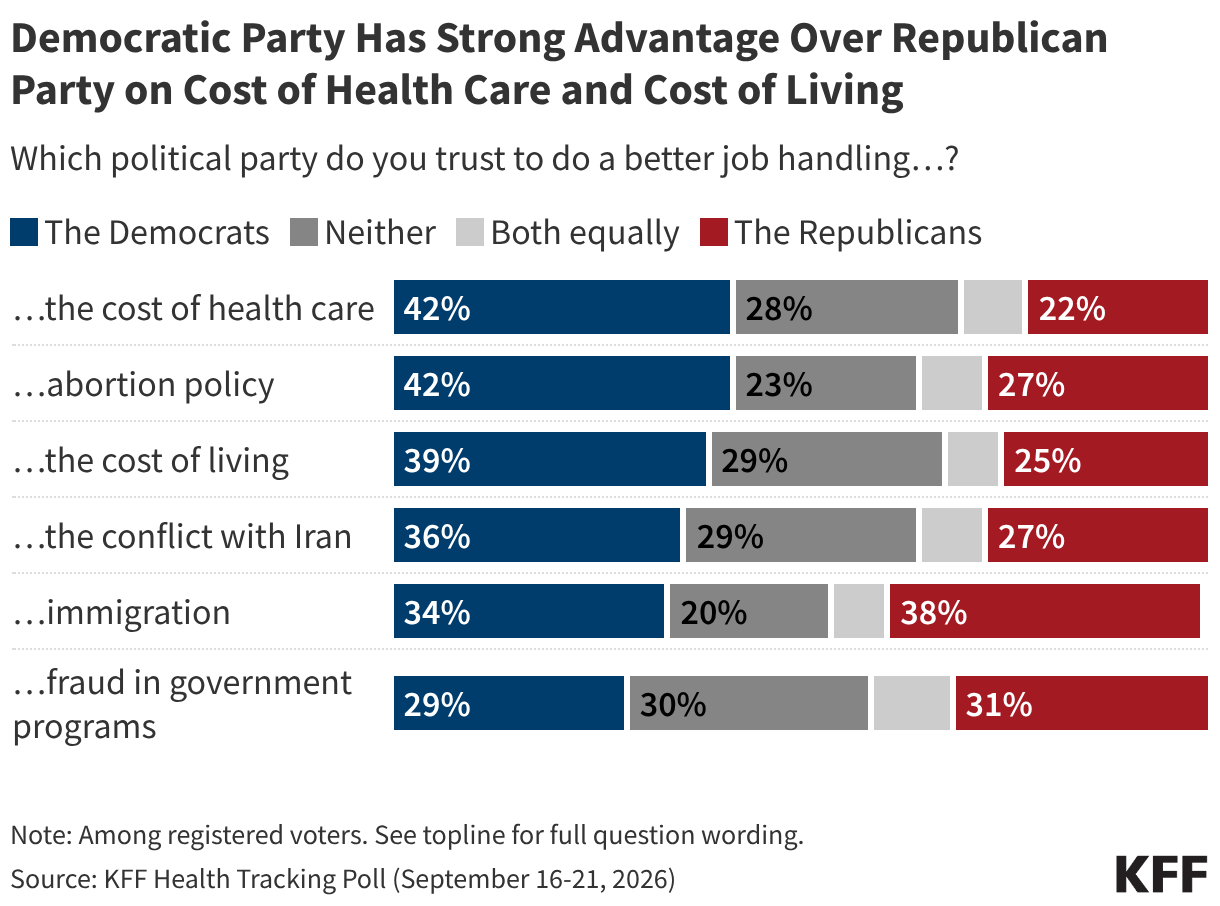
Democrats have a significant advantage over Republicans in voter trust to handle the cost of health care, and it has increased in recent months. Republicans are more even with Democrats on addressing fraud in government programs (31% to 29%), but voters don’t see that as lowering their own health care costs, according to our polling.
Democrats have been pressing this advantage in their campaign ads, which have focused on health cuts and on the cost of living, while Republicans have been focusing more on taxes and crime. And, of course, both sides have more than their fair share of attack ads.
It’s a target-rich environment for Democrats on health on the campaign trail; almost anything that addresses public concern about health costs can resonate. Republicans either concede the territory and emphasize other issues they feel play to their advantage or focus on fraud, which has some traction with voters and especially with their base. That’s largely to try to neutralize the Democratic advantage on health at a time when health costs are on voters’ minds, not to “win” the issue.
The Democratic advantage on cost of living and health care costs is one of many reasons why Republican turnout may be tepid. In a poll of rural voters we recently conducted with the Associated Press, we found that 8 in 10 rural Democratic voters said they were “absolutely certain” to vote, compared with 74% percent for Republicans. More than half of rural voters also disapprove of President Trump’s handling of health care. And perhaps even more tellingly, rural Republicans who disapprove of Trump on the economy (27%) are much less likely to say they are certain to vote than those who approve of it (59% to 79%). Democratic enthusiasm exceeding Republican enthusiasm in rural America, a Republican and Trump stronghold, could be a canary in the coal mine for the midterms.
Progressive Democrats advancing Medicare-for-All proposals are also garnering attention, and whether those ideas go anywhere or not, they are moving health care up on the national agenda. Even differences between progressive and moderate Democrats about health elevates health issues overall. In our September poll, we found the highest level of support for Medicare-for-All we have seen—66%—although as always, we also found that opinion is malleable and moves up and down when voters are presented with the familiar arguments made by critics and proponents.
We found something else that may be significant as well: People have long supported health reform in the abstract but have been unwilling to change their own medical and insurance arrangements when health reform proposals were made, a third rail often exploited by opponents. In polling about Medicare-for-All, for example, we typically find that support drops dramatically if people believe it would mean eliminating private insurance. In our latest poll, that changed somewhat. Support also dropped, but a slight majority continued to favor Medicare-for-All even when they heard private insurance might go away. That could be because anti-insurance company fervor has been whipped up recently, or because frustrations with the insurance system have risen, or for a host of reasons. It’s a change to keep an eye on.
It’s wise to be cautious about the importance of issues in elections and of policy plans advanced by candidates. Partisanship, the appeal of the candidates themselves in each race, the general mood of the electorate, local factors, and other variables will likely matter as much or more in many races. But issues do matter. And voters do want to have some confidence that a candidate, if elected, will do something about their problems. The “issue” that matters most in this election is the cost of living, and the cost of health care is a central element of it for voters.