

VOLUME 55
KFF Women’s Health Survey Explores How Women Navigate Contraceptive Information
Highlights
The 2026 KFF Women’s Health Survey finds that health care providers remain the most trusted source of reliable health information for reproductive-age women. Large shares, though, also report using online sources and social media, and many report being exposed to false or misleading information that can lead to changes in contraceptive use, like starting, changing, or stopping a birth control method.
And as AI tools become more embedded in health care and government, some institutions are developing new AI governance policies around their use, but most government AI policies do not address health, and those that do are largely not public. One Ohio health department’s new AI policy offers a rare look at a health-specific policy, explicitly addressing accuracy and public trust.
Featured
KFF Women’s Health Survey Explores Trusted Sources of Information and Exposure to Contraceptive Misinformation
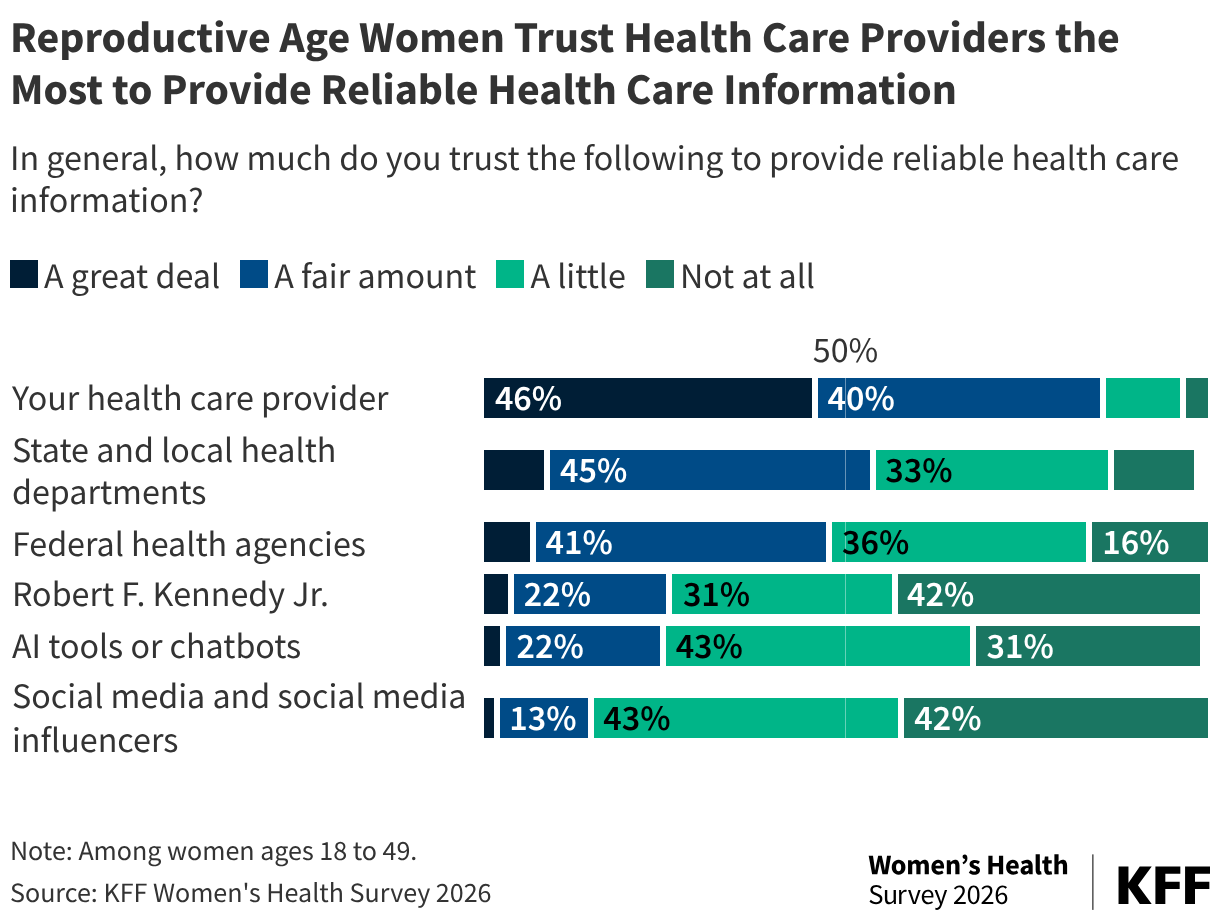
Health care providers remain the most trusted source for reliable health information among reproductive-age women ages 18 to 49. According to the 2026 KFF Women’s Health Survey, more than eight in ten (86%) reproductive-age women said they trust health care providers “a great deal” or “a fair amount” for reliable information, compared with a quarter (25%) who said the same about AI tools and chatbots and fewer (15%) about social media and social media influencers. These findings largely mirror KFF polling among the general public, which has found similarly high trust in doctors and relatively lower trust in AI chatbots for health information.
Still, use of online sources for health information is widespread despite this limited trust. A majority (87%) report looking for health information or advice online through internet search engines, social media, or AI tools. Many reproductive-age women report seeing information about contraception on social media, regardless of whether they were looking for it. About a third (35%) say they’d seen or heard something about contraception on social media in the past year, rising to four in ten (42%) among younger women ages 18 to 25.
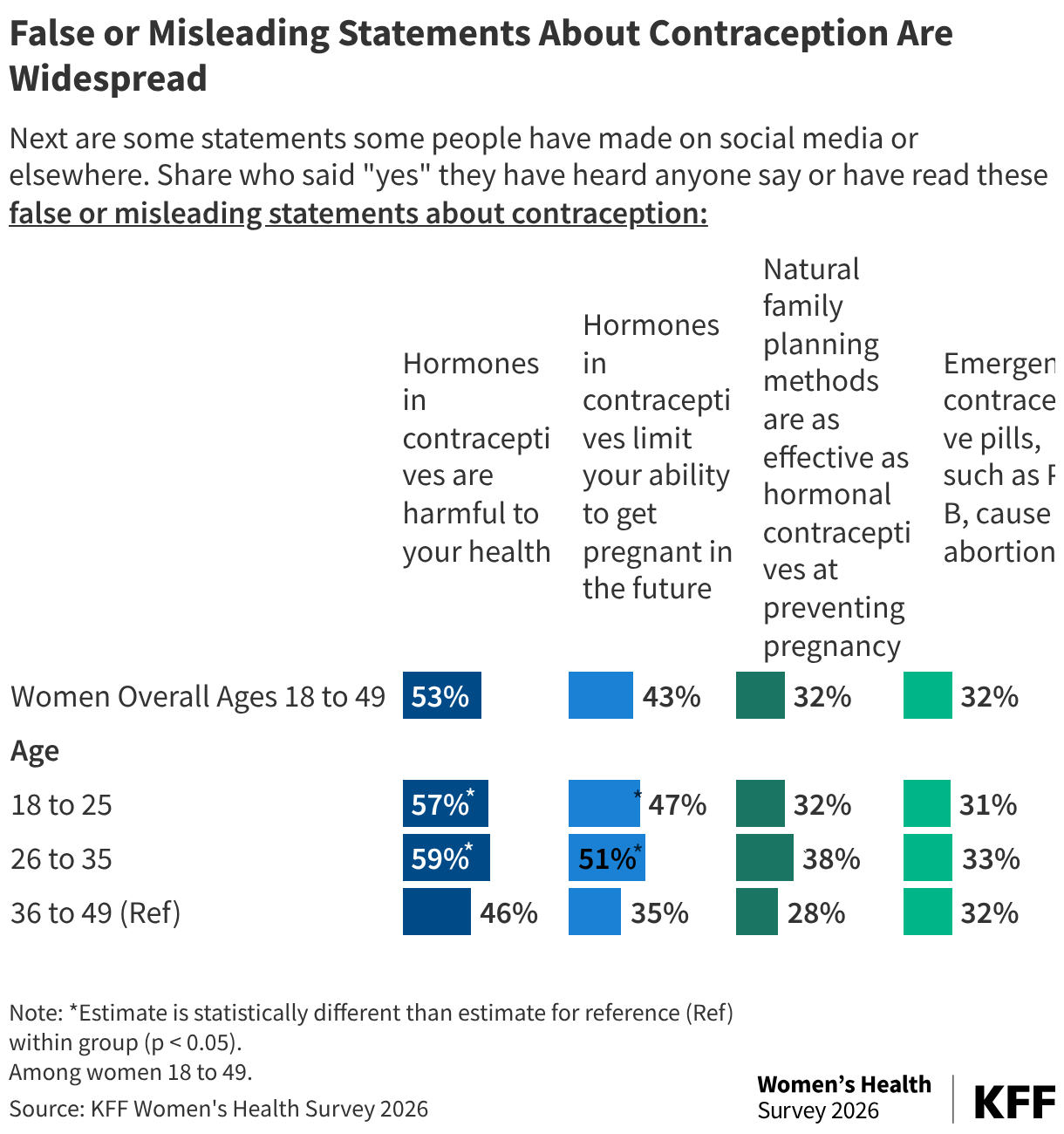
Many reproductive-age women also report being exposed to false and misleading statements about contraception on social media and elsewhere. About half (53%) of reproductive-age women say they’ve heard the false claim that hormonal contraceptives are harmful to your health, and four in ten (43%) have encountered the incorrect claim that they limit your ability to get pregnant in the future. Both of these claims are contradicted by current evidence. Roughly a third (32%) have seen false claims that natural family planning is as effective as hormonal contraception at preventing pregnancy and that emergency contraceptive pills, such as Plan B, cause abortions, neither of which is accurate.
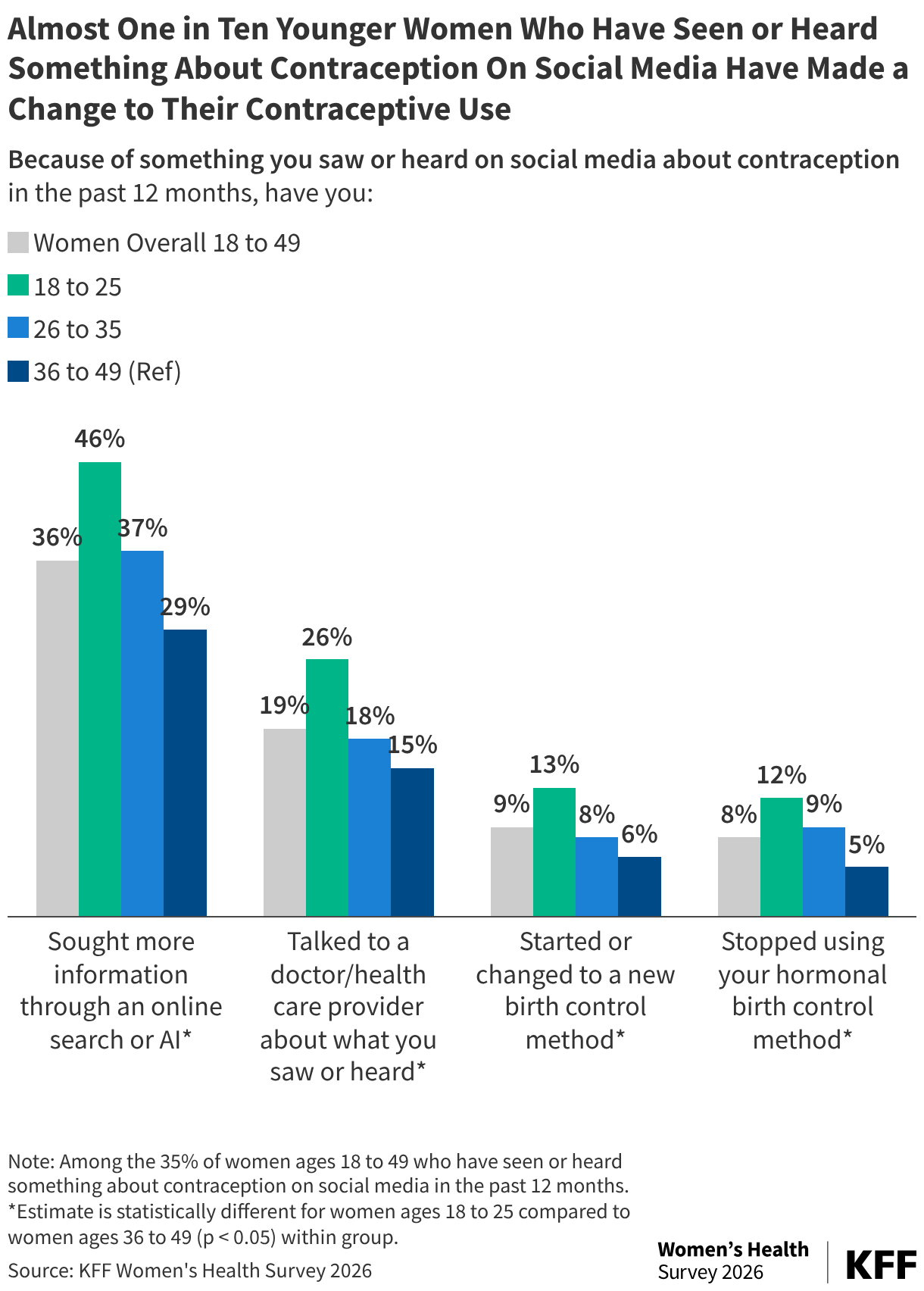
Among women who saw contraception-related content on social media, more than a third (36%) went on to search for more information online, one in five (19%) talked to a doctor about what they’d seen, and about one in ten either started or changed to a new birth control method (9%) or stopped using their hormonal birth control (8%) because of what they’d seen, with higher shares of young women ages 18 to 25 doing each of these.
AI & Emerging Technology
Most State AI Policies Overlook Health-Specific Guidance, but One New Example Focuses on Accuracy and Trust
Questions about how generative AI tools could affect public trust and the accuracy of AI-generated information are among factors contributing to new governmental policies around AI use. According to an analysis of publicly available AI policies published last month by the Association of State and Territorial Health Officials (ASTHO), most of these plans focus on government-wide issues, such as data privacy and security, procurement, and vendor requirements. Some provisions, like requirements for human review and disclosure of AI use, may apply to health agencies within those jurisdictions. The analysis found, though, that few of the policies addressed health-specific applications directly, such as evaluating AI tools for disease surveillance or outbreak detection, and most health-specific policies that do exist are not public.
One publicly available example from a health agency comes from the public health department of Ashland County, Ohio, which unanimously approved and released its own AI governance policy last month. The policy provides a look at how one health agency is approaching AI use, explicitly identifying public trust and the accuracy of AI-generated information as core considerations for the responsible use of AI in health care. The policy states that AI should be used in ways that “promote transparency, accountability, and community confidence.” Among other rules, staff are required to verify factual claims, citations, and statistics generated by AI before relying on them, and human review is required for most non-minor uses of AI to ensure accuracy. The policy also establishes an incident reporting framework for when AI-assisted work might include false information, treating errors where hallucinations enter published materials as incidents to be tracked and addressed. Beyond these general rules, the policy lays out health-specific approved AI use cases, including de-identified data analysis in epidemiology, health promotion content in nursing, and inspection communication templates in environmental health. It also states that no AI system may independently make clinical, regulatory, or public health decisions on behalf of the agency.
Because the Ashland County policy is publicly available, it offers the public, other health organizations, and researchers a look at how one health agency is trying to maintain accuracy and protect trust in its use of the technology, which has relatively low trust among the public overall for health information. KFF’s March 2026 Tracking Poll on Health Information and Trust found that a third of adults (33%) said they had a “great deal” or “fair amount” of trust in AI tools or chatbots to provide reliable information about health.
What to Watch Out For
As health agencies continue incorporating AI tools into their work and developing their own more tailored guidelines, could transparently communicating about their approaches to governing AI use impact public trust? More research on what the public expects from agencies using AI could help clarify how these policies might affect confidence in health agencies (which has declined since the COVID-19 pandemic) and the information they provide.
Some Medical Journals Are Responding to a Rise in AI-Generated Citations
Researchers have documented a rise in fabricated references across medical research, with some citations referencing studies that do not exist or do not support the claims attributed to them. One correspondence published earlier this year identified thousands of fake citations across millions of papers, with the rates climbing sharply after generative AI tools became widely available. Many of the references were difficult to distinguish from legitimate studies, pairing real authors and plausible titles with studies that were never published.
Some medical journals have begun to respond to the challenge of AI-fabricated citations, including by requiring disclosure when AI is used, but an analysis of 5,114 journals and over 5.2 million papers found that AI use without disclosure continues despite these policies. JAMA updated its guidance for authors last month in response to the journal’s own experience receiving manuscripts with inaccurate or nonexistent references and research showing that rates of author disclosure of AI use in submissions to their journal have remained low. Rather than requiring disclosure when AI contributes to references, JAMA’s approach advises against using AI to generate, format, or manage citations, and directs authors to standard reference managers instead.
Why This Matters
Fabricated citations carry the appearance of legitimate sourcing, making them difficult to catch without deliberate verification. Disclosure policies alone have not solved the problem, leading one major journal to move toward restricting AI’s use for generating references rather than asking authors to report it.
What We're Watching
As Trust in Federal Health Information Declines, Poll Suggests That Transparency and Data Can Make Information Seem Trustworthy
Public trust in information from the federal government has declined since 2024, according to a new survey from the AP-NORC Center for Public Affairs Research and USAFacts. The share of adults expressing “a great deal” or “quite a bit” of trust in federal information about health care has fallen ten points in the past two years, from 26% to 16%, with similar declines for federal information about the environment (21% to 12%), jobs and unemployment (25% to 15%), and elections and politics (22% to 13%). The findings mirror trends in KFF’s own polling on Health Information and Trust.
The NORC survey also points to what factors shape whether people consider information credible. When asked to rate the importance of various factors when considering whether information was factual, explaining how the information was gathered ranked highest, with seven in ten (71%) saying this was “extremely” or “very” important. Information presenting more than one viewpoint was also important to most adults (63%), as was not including opinions (56%).
A separate question asked how likely people would be to consider information factual given specific characteristics. Being based in data ranked highest, with six in ten (60%) saying that would be “extremely” or “very” likely to consider such information factual. Verification mattered too, though importance differed by source. About half (49%) said they would consider information factual if it was verified by scientists, while fewer said the same about academic institutions (39%) or the federal government (19%). The smallest shares said they would consider information factual if it was verified by AI chatbots (9%).
Why This Matters
As trust in federal health agencies continues to decline, health communicators may need to consider what factors could make their communication appear more credible. The NORC survey indicates that explaining how information was gathered or offering data-based verification may be effective in building credibility.
More From KFF
- KFF Podcast: AI’s Role in Health Care: What Keeps You Up at Night?
- KFF Video Series: Are Health Insurers to Blame for Our Health System Problems?
About The Health Information and Trust Initiative: the Health Information and Trust Initiative is a KFF program aimed at tracking health misinformation in the U.S., analyzing its impact on the American people, and mobilizing media to address the problem. Our goal is to be of service to everyone working on health misinformation, strengthen efforts to counter misinformation, and build trust.
The Monitor is a report from KFF’s Health Information and Trust initiative that focuses on recent developments in health information. It’s free and published twice a month.
Sign up to receive KFF Monitor
email updates
Support for the Health Information and Trust initiative is provided by the Robert Wood Johnson Foundation (RWJF). The views expressed do not necessarily reflect the views of RWJF and KFF maintains full editorial control over all of its policy analysis, polling, and journalism activities. The data shared in the Monitor is sourced through media monitoring research conducted by KFF.