Exploring Insulin Cost-Sharing Caps for Patients with Private Coverage
Nearly 29 million adults in the U.S. have been diagnosed with diabetes, with 32% of them taking insulin to manage it. The cost of insulin has been a barrier to care for many Americans. A monthly cap on patient cost sharing is one approach aimed at reducing cost-related barriers for people using insulin. While caps do not directly address the underlying price of insulin, they may make patient costs more affordable and support consistent access to this medication. Since 2023, people with Medicare generally have a $35 monthly cap on the cost of insulin. A 2024 KFF poll found that 3 in 4 adults support expanding this cap beyond just those with Medicare. Public support for these protections is also notably bipartisan, with 84% of Democrats and 70% of Republicans in favor.
Applying a cost-sharing cap on insulin to private insurance coverage, including employer coverage, has been gaining momentum among policymakers. Since 2019, an increasing number of state laws have limited cost-sharing for insulin in state-regulated plans, and a federal insulin cost-sharing cap for consumers with private coverage has advanced in Congress this year. This Issue Brief explains the evolution of insulin cost-sharing caps in recent years, including existing state laws and their limitations, the proposed federal legislation, and key policy considerations when assessing whether this approach may improve insulin affordability for consumers.
Background
Insulin affordability has long concerned policymakers. Between 2007 and 2018, the list prices of some forms of insulin increased by more than 260%, according to one study. In Medicare Part D alone, aggregate patient out-of-pocket spending for insulin products quadrupled between 2007 and 2020, according to a KFF analysis.
Examinations have linked high insulin costs, in part, to increasing drug manufacturer list prices and certain contracting and other business practices by pharmacy benefit managers (PBMs). In 2019, the Senate Finance Committee began an investigation into rising insulin prices, culminating in a 2021 report examining the roles of the three major insulin manufacturers (Eli Lilly, Novo Nordisk, and Sanofi) and the major pharmacy benefit managers (CVS Caremark, Express Scripts, and Optum Rx) that administer pharmacy benefits for insurers and employers. The committee concluded that the three drug manufacturers “aggressively” raised the list price of their insulin products, often in lockstep with each other. The “list price” (also called the Wholesale Acquisition Cost (WAC)) is the starting price set by drug manufacturers, later reduced through various discounts and negotiations with PBMs.
The committee also stated that the three largest PBMs have significant marketing power to negotiate rebates with drug manufacturers. Rebates are discounts off the list price that PBMs negotiate with drug manufacturers in exchange for preferred placement of the drug on a health plan formulary. The committee determined that, “… the practice of offering rebates in the insulin therapeutic class appears to be contributing to both increasing insulin WAC prices and limited uptake of lower-priced products.” This, among other factors, the report concluded, can keep insulin out-of-pocket costs high for individual consumers partly because plan formularies often favor higher-cost insulins (with the highest rebates) while excluding or disadvantaging lower-priced insulins.
Other studies have highlighted insulin affordability issues for those who have to pay for it out of pocket at a high list price before meeting their deductible, when insurance begins to pay, as well as those whose cost sharing is pegged to a high list price (e.g., coinsurance). Additionally, privately insured patients typically pay for insulin based on a negotiated rate that does not reflect manufacturer rebates, which may reduce what a plan pays for the insulin but are not necessarily passed through to the patient.
In the years since these evaluations, federal efforts to lower insulin out-of-pocket costs have progressed, notably the passage of the Inflation Reduction Act of 2022 (IRA). Among other prescription drug cost reforms, the IRA established a cost-sharing cap for a month’s supply of any covered insulin for Medicare beneficiaries beginning in 2023. The law limits monthly copayments to the lesser of $35 or 25% of the negotiated price for the insulin in the Medicare Part D plan, or 25% of the price for the insulin negotiated if it is part of the Medicare price negotiation program. A KFF analysis found that out-of-pocket insulin costs for Medicare beneficiaries decreased by half between 2020 and 2024.
Although earlier versions of the IRA would have put the same cap on monthly cost sharing for those in private plans (e.g., employer-sponsored plans and on- and off-Marketplace individual market coverage), this was dropped from the IRA prior to passage. A Peterson-KFF Health System Tracker analysis of 2018 claims data found that a $35 cap would have financially benefited at least 1 in 5 enrollees in private insurance plans who use insulin.
While those with private coverage do not have the cost-sharing protection that Medicare Part D beneficiaries have, Internal Revenue Service (IRS) guidance has allowed those with health savings accounts (HSAs) to access certain preventive services before paying their annual deductible, including insulin and certain supplies (if implemented by their employer or other plan sponsor). Congress added this pre-deductible insulin provision, which is limited only to those with HSAs, in the Inflation Reduction Act. According to the 2026 KFF Employer Health Benefits Survey, 29% of covered workers are enrolled in HSA-qualified high-deductible plans.
Voluntary drug manufacturer price reductions starting in 2023 lower the cost of certain insulins. In March 2023, the three major insulin manufacturers announced that they would significantly cut the list price of certain insulins and expand their existing discount programs for those with private coverage, capping patient cost sharing for insulin at $35 per month at certain retail pharmacies. While the introduction of biosimilar and unbranded insulin also likely played a role in reducing costs, this voluntary manufacturer price reduction has largely been attributed to a change in how Medicaid rebates are calculated. Under the Medicaid Drug Rebate program, drug manufacturers give rebates to federal and state governments in exchange for coverage of their drug under the Medicaid program. The amount to be paid in rebates was limited under a formula in place since 2010. The American Rescue Plan Act of 2021 eliminated the limit on these rebates to Medicaid. This would have substantially increased what drug manufacturers pay to Medicaid in rebates for certain insulins if drug manufacturers did not reduce the price of insulin available to commercial payors.
Other federal action and state litigation aim to address insulin prices and costs. While congressional actions focused on reducing costs for prescription drugs broadly—including a PBM transparency and rebate reform law passed earlier this year and efforts to bring more lower-cost biosimilars to market—likely impact insulin costs, other activity focused specifically on insulin pricing includes:
Federal Trade Commission (FTC) action. The FTC filed an administrative complaint in September 2024 against the three largest PBMs (and their subsidiaries) alleging that they systematically prefer high-list-price insulin products with high rebates over lower-priced ones. According to the FTC, these PBMs artificially inflated prices, shifting costs to consumers and constituting an unfair act or practice and unfair method of competition under federal law. In 2026, the FTC settled with two of these PBMs (Express Scripts and CVS Caremark), which agreed to make specific changes to their prescription drug pricing and rebate practices by 2028, including providing broader access to existing PBM programs that cap enrollee out-of-pocket payments for insulin at a set dollar level, some as low as $25 for a month’s supply. PBMs also agreed to count cash payments made for medications using TrumpRx coupons toward a patient’s deductible and out-of-pocket maximum if certain legal and regulatory changes are made. It is not clear whether and how this will be implemented.
Separate state litigation. Some state attorneys general (AGs), cities, school districts, and other plaintiffs have sued the leading insulin manufacturers and PBMs, alleging anticompetitive and/or deceptive practices related to high insulin prices. State AGs in Republican-led and Democratic-led states have filed actions over the past three years, many of which have been consolidated with hundreds of other similar cases in a federal district court. These cases largely allege violations of state antitrust and consumer protection laws, seeking both to stop drug manufacturer and PBM practices that they allege inflate insulin prices, and to secure damages for affected consumers and employers. No major court decisions or settlement agreements have been issued yet in these cases.
Alternative pathways to lower-cost insulin are gaining momentum. New approaches to insulin production and distribution are opening new access points for patients. For instance, California recently began producing its own biosimilar insulin (glargine) through its CalRx program, allowing patients who use this specific type of insulin to purchase it at a lower cost, with or without insurance. PBMs and other third parties are also manufacturing private-label biosimilar insulins, but their long-term impacts on patient costs are unclear: with financial incentives to promote their own private-label drugs, PBMs are not inherently incentivized to pass on savings to insurers and their enrollees.
A growing direct-to-consumer sales market gives patients another avenue to purchase insulin at discounted prices, mostly on a cash-pay basis outside of insurance, from online pharmacies such as Amazon Pharmacy and certain drug manufacturers. Additionally, discount platforms like GoodRx and TrumpRx provide coupons that consumers can use to purchase medications from participating pharmacies. Certain consumers, such as those with low incomes, may find even lower costs from manufacturer-sponsored patient assistance programs and through other pathways.
State Insulin Cost-Sharing Caps
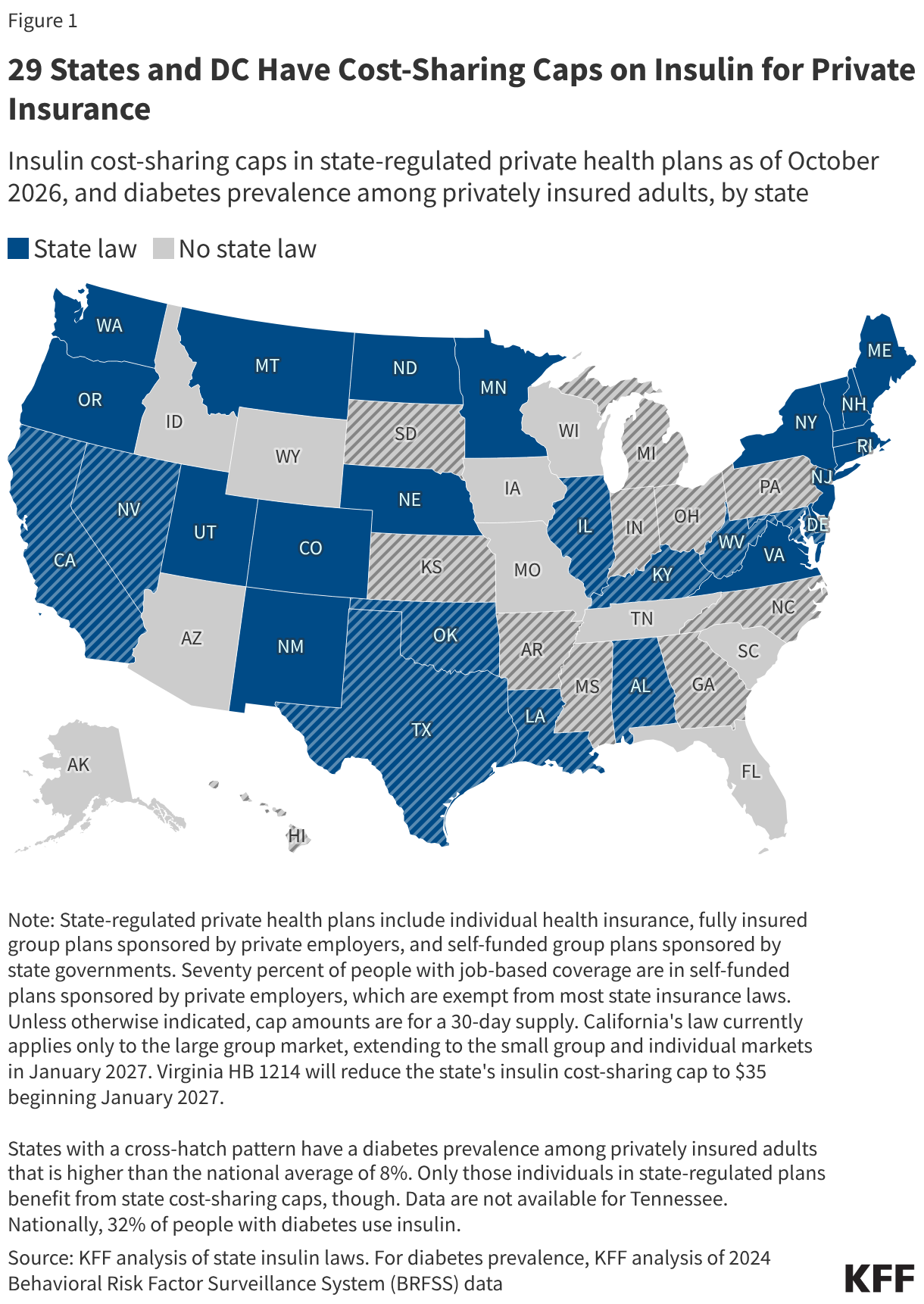
According to KFF analysis of state laws, as of October 2026, 29 states (nearly 60%) and the District of Columbia have enacted laws that cap cost sharing for insulin for privately insured patients, beginning with Colorado in 2019 (Figure 1). At least 11 states with relatively high rates of diabetes do not have laws capping insulin cost sharing. While state cost-sharing protections can provide a useful framework for developing federal policy, as discussed below, their reach is limited to a relatively small share of people with private health coverage. Separately, some states have eliminated cost sharing for insulin in certain types of ACA Marketplace plans and/or have implemented other programs to help uninsured and underinsured patients afford their insulin.
Cost-sharing Caps for Those with Private Insurance
Dollar Cap Amounts
The dollar amounts of insulin cost-sharing caps vary by state. While some states have lowered their caps since enacting their first laws, caps currently range from $0 in New York and Massachusetts (generic only) to $100 in Alabama, Colorado, Delaware, and Vermont for a 30-day supply (Figure 1). The most common cap amount for a 30-day supply is $35. About three-quarters of states with insulin cost-sharing caps currently limit out-of-pocket spending to $35 or less, while seven states have caps higher than $35. (One of these states, VA, will reduce its cost-sharing cap to $35 beginning January 2027.) Two states (OK and OR) also extend corresponding out-of-pocket caps for a 90-day supply of insulin. Links to current state laws are included in the map below.
Dollar Cap Structure
The structure of insulin cost-sharing caps is relevant for people who use multiple insulins each month. While caps in most states are structured as a separate amount for each prescription, at least four states (CO, DE, VT, and WV) currently have aggregate caps that apply to total out-of-pocket spending for all covered insulin products a patient may purchase in a month. (VA’s cap will change from separate to aggregate in 2027.) For example, under a $35 aggregate cost-sharing cap, a patient who uses two different types of insulin would pay no more than $35 per month, compared to no more than $70 per month under a separate per-prescription cap.
Drugs and Other Items Covered by Caps
Many state caps apply broadly to prescription drugs containing insulin used to treat diabetes, regardless of form (e.g., vial, pen, inhaled) or type (e.g., rapid-acting, short-acting, intermediate-acting, long-acting). Some states have additional requirements. For example, Connecticut’s cost-sharing cap also applies to noninsulin diabetes drugs (e.g., glucagon). Most caps apply only to the actual drug product itself, but five states (CT, DE, MN, ND, and WV) and DC also have separate out-of-pocket caps for diabetes-related medical supplies and equipment such as glucometers, testing strips, pens and syringes, and laboratory testing for diabetes-related markers, ranging from $25 (ND) to $100 (WV and DC) per monthly supply of covered items. (VA will institute a $35 cost-sharing cap for supplies beginning in 2027.)
Limitations of State Caps
According to KFF analysis of the 2024 Behavioral Risk Factor Surveillance System (BRFSS) data, 8% of privately insured adults have been diagnosed with diabetes, ranging from 4% in the District of Columbia to 12% in West Virginia (Figure 1). Although state cost-sharing caps generally apply to both the individual and group markets, in practice, only a small fraction of those individuals benefit from these laws. A key limitation of state insurance laws is that they generally don’t apply to most people with employer-sponsored coverage, the largest source of coverage for those under age 65. Federal law (the Employee Retirement Income Security Act of 1974, or ERISA) exempts self-funded health plans established by private employers (but not public employers) from most state insurance laws. In 2026, 7 in 10 (70%) workers with job-based coverage are enrolled in this type of plan. Put into perspective, this means only 3 in 10 (30%) workers with employer-sponsored insurance, plus the much smaller share of people with state-regulated individual coverage, such as ACA Marketplace plans, are reached by state cost-sharing caps. Absent a federal cost-sharing cap, which would extend to plans governed by ERISA, the scope and application of state cost-sharing protections will remain limited.
No Cost Sharing for Insulin in Some State ACA Marketplace Plans
In addition to the broadly applicable statutory cost-sharing caps described above, at least three state-based ACA Marketplaces have used their administrative authority to eliminate all cost sharing for specific chronic condition maintenance drugs, including insulin, for certain enrollees. For example, enrollees in specific Marketplace plan types or cost-sharing tiers in the District of Columbia and Maryland have $0 cost sharing for select insulins (and certain related supplies). Cost sharing was also eliminated for lower-income Marketplace enrollees in Massachusetts.
Out-of-pocket Insulin Caps for the Uninsured and Underinsured
According to KFF’s analysis of 2024 BRFSS data, 7% of uninsured adults have been diagnosed with diabetes. Uninsured individuals generally receive less health care than those with insurance. In 2024, 42% of uninsured adults under age 65 with diabetes delayed or avoided receiving needed care due to the cost, compared to 11% of those with insurance. At least three states—CO, ME (until 2027), and MN—have implemented separate affordability programs that cap insulin costs for uninsured, as well as certain underinsured patients.
Affordability Safety Net Programs
Laws in Minnesota and Maine require large insulin manufacturers to establish insulin patient assistance programs for uninsured and underinsured residents of those states with family income of 400% or less of the federal poverty level. Under these “continuing needs” programs, eligible patients receive a 90-day supply of insulin at no charge from the manufacturer for up to a year, though pharmacies may charge the patient a dispensing fee of up to $50 per fill. Colorado also has a continuing-needs insulin program for uninsured and underinsured individuals, but with some differences, including that eligibility is not limited to those with lower incomes and the optional dispensing fee is based on a 30-day supply.
Urgent Need Programs
Minnesota, Maine (until 2027), and Colorado require insulin manufacturers to establish “emergency” insulin programs that provide one 30-day supply of insulin per year to eligible uninsured and underinsured residents who have less than a 7-day supply of insulin readily available. While there is no charge for the insulin itself, pharmacies are permitted to charge the patient a dispensing fee of up to $35.
Proposed Federal Insulin Cost-Sharing Cap
Bipartisan federal legislation known as the Improving Needed Safeguards for Users of Lifesaving Insulin Now (INSULIN) Act of 2026 would impose a national insulin cost-sharing cap for private insurance and establish a pilot program to assist the uninsured. Similar bills have been introduced in previous years, but this year’s was considered and approved by the Senate Health, Education, Labor and Pensions (HELP) Committee over the summer; a companion bill was subsequently introduced in the House. Whether Congress will try to advance this legislation in the remaining lame-duck session this year or start over with the new Congress next year is unknown. Key provisions of the INSULIN Act include:
A requirement for private plans to cover “selected insulin products.” Plans would be required to cover at least one insulin of each dosage form of each insulin type. Plans and insurers make the selection, so coverage of specific insulins would likely differ by plan. The requirement extends to all employer-sponsored health plans (insured and self-funded), including non-Federal governmental plans, as well as individual market plans (including Marketplace plans). The legislation does not apply to non-insulin diabetes medications or supplies.
A $35 cost-sharing cap for a 30-day supply of insulin across all private insurance coverage. The INSULIN Act would require plans to cap enrollee cost-sharing payments for the plan’s selected insulin products at $35 per 30-day supply, or 25% of the plan’s negotiated price, whichever is less. Plans are not required to apply this cap for insulins delivered by an out-of-network provider. While the legislation does not define “negotiated price,” it requires that the negotiated price is “net of all price concessions received by or on behalf of the plan or issuer,” including PBMs and third-party administrators. This likely means that the negotiated price must take into account all rebates received by these entities.
No deductibles would apply before cost sharing starts. Health plans would be prohibited from applying a deductible to their selected insulins. This would apply even to catastrophic plans available on ACA Marketplaces where, currently, enrollees must pay a high deductible ($10,600 for an individual or $21,200 for a family in 2026) before their coverage kicks in. The exemption from the deductible for the selected insulins cannot be treated as increasing the actuarial value of a qualified health plan.
Selected insulin would be treated as an essential health benefit. The legislation also states that the selected insulin product should be treated “as though such benefits were required to be provided” as an essential health benefit (EHB). Insurers in the individual and small group market are required to cover EHBs and count patient cost sharing for them toward the ACA’s required patient out-of-pocket maximum ($10,600 for an individual or $21,200 for a family in 2026).
Limits on prior authorization for selected insulins. The legislation would prohibit plans and insurers from imposing prior authorization requirements on the selected insulin products except as “clinically justified for safety reasons, to ensure reasonable quantity limits and as specified by the Secretary.” While this does not ban prior authorization, it might put new requirements on plans to justify why prior authorization is required for the plan’s selected insulins.
New pilot program for the uninsured. The bill would also create a temporary program to help address barriers for uninsured people using insulin. The 5-year, $100 million pilot program would be implemented across 10 states with high rates of uninsured people with diabetes. States would direct grant funds to assist in obtaining insulin and expanding access to on-site pharmacies at federally qualified health centers, provide additional support to community pharmacies where uninsured individuals obtain low-cost insulin, and assist low-income patients in accessing manufacturer drug discounts on insulin. The bill would also establish a separate $2 million national insulin resource center and hotline project to connect patients with outreach and assistance programs.
Changes to increase access to biosimilars. The INSULIN Act also proposes changes to Food and Drug Administration (FDA) approval processes to provide quicker access to new biosimilar medications. The FDA has approved a total of six insulin biosimilars since it implemented a new regulatory pathway to approval for biologic drugs in 2020.
Policy Considerations
Expanding out-of-pocket caps at the state level, or passing a federal out-of-pocket cap for insulin, could make insulin more affordable for consumers and provide some assurance that their out-of-pocket costs for insulin should not exceed a certain threshold. While the INSULIN Act of 2026 would fill the gaps in the current patchwork of state insulin cost-sharing caps and provide a federal floor of protections, it does not regulate the price of insulin or directly address the current dynamics of manufacturer rebates and formulary placement that may have led to high prices. Some considerations for policymakers include:
The extent to which a federal cap would substantially change what patients with private coverage pay for insulin. In recent years, some studies of state out-of-pocket caps on insulin showed only modest reductions in consumer out-of-pocket costs, possibly because many with private insurance already had relatively low cost sharing for some insulin types. A Department of Health and Human Services (HHS) analysis estimated that average out-of-pocket spending for a monthly supply of insulin was under $20 in 2025, which it attributed to a range of factors including manufacturer list price reductions and patient assistance programs, state cost-sharing caps, biosimilar competition, and pre-deductible coverage of insulin for those with health savings accounts. However, another recent analysis found that even though the share of insulin users with employer-sponsored coverage who spent over $35 out of pocket for a 30-day supply decreased from 2019 to 2023, about four in ten (41%) still spent over $35 per month in 2023, including more than two in ten (23%) who spent more than $50 per month. Although the 2023 claims data predate some of the more recent voluntary manufacturer price reductions and state-level insulin cost-sharing caps, some of these individuals could likely still benefit from the proposed federal cost-sharing cap.
Although direct-to-consumer (DTC) options offered by some manufacturers and online pharmacies may provide some insulin users with a less expensive alternative than the proposed $35 cost-sharing cap, federal law does not currently require cash payments made through these channels to count toward a private health plan’s deductible or out-of-pocket maximum. The INSULIN Act would not change this. Furthermore, it remains to be seen whether manufacturer-sponsored DTC options are an attempt to foreclose additional state and federal cost-sharing caps or whether they could affect the durability of voluntary price reductions.
How other federal actions could intersect with the proposed cost-sharing cap and impact insulin prices for privately insured and uninsured consumers. The inclusion of insulin on the Medicare drug price negotiation list, another federal law that will require PBMs to pass through all rebates to health plans sponsored by private employers, and new requirements on PBMs under FTC settlements are just some of the moving parts that could influence insulin pricing going forward. This shifting policy landscape operates alongside an evolving supply-side landscape. Beyond the scope of this issue brief are equally complex dynamics in FDA approval, manufacturing, and patient use of biosimilars and unbranded insulin, such as those developed under California’s new public program and by PBMs.
The impact of an out-of-pocket insulin cap on enrollees’ private insurance premiums and other out-of-pocket costs. Although the Congressional Budget Office (CBO) has not released a cost estimate for the INSULIN Act of 2026, insurers and employers could face increased plan costs, which they could pass on to enrollees through higher monthly premiums. In addition, to the extent that a federal insulin cost-sharing cap shifts more plan sponsor spending toward insulin, enrollees could see higher cost sharing for other items and services if plans seek to maintain their overall actuarial value (the average share of health care expenses for covered services that are paid by the plan, as opposed to those paid out-of-pocket by the enrollee). These dynamics could increase the overall financial burden on all consumers, including those taking other high-cost medications for diabetes (e.g., GLP-1s), cancer, or other illnesses that lack out-of-pocket caps.