The Advancing Global Health Annual Program Statement (AGH/APS) Mechanism: Supplementing the America First MOUs
Key Points
- In September 2025, the State Department released the America First Global Health Strategy (AFGHS), its new approach for U.S. engagement in global health, anchored to bilateral agreements negotiated directly with countries (through memoranda of understanding, or MOUs), although limited information is available on their status. To supplement and support MOU implementation, the State Department is also using an Annual Program Statement (APS) mechanism, an open-ended competitive funding opportunity, to solicit applications in support of AFGHS goals. To shed greater light on U.S. global health efforts under the AFGHS, this analysis examines the Advancing Global Health APS (AGH/APS) award opportunities announced to date by looking at how funding may be directed across countries and selected areas of global health programming, painting a fuller picture of how continued U.S. global health investment may look in a post-USAID foreign aid landscape.
- The State Department anticipates using the AGH/APS to provide up to $4.5 billion across four funding windows from March 2026 to February 2027. A range of entities are eligible to apply for funding, including governments and non-governmental organizations, and funding opportunities are made available through specific addenda.
- To date, 12 addenda have been released across three funding rounds, totaling up to $1.43 billion and representing up to 122 possible awards.
- Seven of the 12 are focused on specific MOU countries – Cameroon, Cote d’Ivoire, Malawi, Mozambique, Nigeria, the Philippines, and Uganda.
- Five are focused on specific health areas – child development, care, and protection; neglected tropical diseases (NTDs); nutrition; population-based surveys and surveillance; and rapid outbreak response (the NTDs and nutrition addenda identify specific geographic areas and countries for support).
- Objectives and activities across the addenda are varied and range from enhancing the delivery of health services across disease programs; supporting high-impact NTD interventions; strengthening the systems and workforce that protect vulnerable children through improved laws, policies, and services; and strengthening global health security through improved infection prevention and control, immunization for outbreak response, point-of-entry screening, and risk communication. Some addenda include mentions of key, focus, and vulnerable populations (including women and children, and people living with HIV, tuberculosis, and malaria).
- These findings provide insight into how the U.S. intends to further operationalize its global health efforts under the AFGHS, including which MOU countries will be the focus of this work, which global health areas have been selected for cross-cutting support, and what objectives and activities might be supported with more focused, additional support within and beyond MOU countries. Still, the APS process remains underway, and additional addenda are expected as part of the last funding round. At this time, no awards have been publicly announced, and it is not known what will actually be funded. How this APS mechanism and specific awards ultimately operate to support or supplement the MOUs and other aspects of the AFGHS will be important to monitor going forward.
Introduction
Starting early on during his second administration, President Trump made a number of sweeping changes to U.S. foreign aid, which reverberated across U.S. and broader global health efforts. These included the reduction in the number of supported projects and organizations, dissolution of the U.S. Agency for International Development (USAID), and the shifting of responsibility for remaining efforts to the State Department. In September 2025, following months of uncertainty, the State Department launched the America First Global Health Strategy (AFGHS), outlining a fundamental shift in how the U.S. is planning to carry out its global health work. This new approach is anchored to bilateral agreements negotiated directly with countries receiving U.S. global health assistance. To date, 36 such agreements, through Memoranda of Understanding (MOUs) totaling $26.7 billion, have been signed (although limited information is available on their status), with their implementation plans to come. These bilateral agreements each identify and prioritize global health needs to be financed jointly by the U.S. and partner country, with the U.S. committing $15.9 billion and partner countries committing to co-invest $10.3 billion so far.1 The State Department has indicated that a main mechanism for implementing the MOUs will be through government-to-government (G2G) funding agreements, although these are still nascent and expected to take some time to develop. As such, the Department has also released – through an “Annual Program Statement” (APS), an open-ended competitive funding mechanism – a supplemental framework to support MOU implementation called the “Advancing Global Health APS” (AGH/APS) to solicit applications in support of AFGHS goals.
Announced in March 2026, the State Department anticipates using the AGH/APS to provide up to $4.5 billion (subject to the availability of funds) over four funding windows from March 2026 through February 2027, with awards ranging from $500,000 to $250 million over 5 years. Some of the funding will be part of a country’s overall MOU funding envelope, while other funding may sit outside this envelope. Eligible applicants are U.S. and foreign private for-profit enterprises; U.S. and foreign public and private institutions of higher education; U.S and foreign organizations, including faith-based organizations; Public International Organizations (PIOs); and governmental institutions.
To shed greater light on U.S. global health efforts under the AFGHS, this policy brief provides an analysis of the AGH/APS award opportunities (“addenda”) announced to date by looking at how funding may be directed across countries and selected areas of global health programming, painting a fuller picture of how continued U.S. global health investment may look in a post-USAID foreign aid landscape.
Analysis
As of November 2026, 12 addenda with up to 122 possible awards have been announced across three funding rounds, totaling up to $1.43 billion (see Box 1). This funding represents almost a third (32%) of the anticipated funding of $4.5 billion. Addenda include both country- and area-specific solicitations.
Box 1: AGH/APS Addenda, by Funding Window
12 Addenda released to date – providing up to $1.43 billion and 122 awards
WINDOW 1 (March 5 – May 31, 2026) – up to $542,650,000 and 21 awards
- Addendum A: Child Development, Care, and Protection
- Addendum B: Rapid Outbreak Response
- Addendum C: Advancing Integrated and Sustainable Health System in the Philippines
WINDOW 2A (June 2 – July 31, 2026) – up to $295,000,000 and 39 awards
- Addendum D: Health Foreign Assistance MOU Implementation in Nigeria
- Addendum E: Health Foreign Assistance MOU Implementation in Uganda
- Addendum F: Health Foreign Assistance MOU Implementation in Malawi
WINDOW 2B (July 1 – Sept. 15, 2026) – up to $315,400,000 and 25 awards
- Addendum G: Health Foreign Assistance MOU Implementation in Cameroon
- Addendum H: Health Foreign Assistance MOU Implementation in Cote d’Ivoire
- Addendum I: Innovations in Population-Based Surveys and Surveillance
- Addendum J: Health Foreign Assistance MOU Implementation in Mozambique
WINDOW 3 (Aug. 15 – Oct. 30, 2026) – up to $277,000,000 and 37 awards
- Addendum K: Accelerating the Elimination of Neglected Tropical Diseases2
- Addendum L: Accelerating Nutrition Progress3
WINDOW 4 (expected Nov. 15, 2026 – Jan. 29, 2027)
Notes: AGH/APS means Advancing Global Health Annual Program Statement. Addenda released as of Oct. 22, 2026.
Source: KFF analysis of the State Department’s Bureau of Global Health Security and Diplomacy’s AGH/APS funding opportunities.
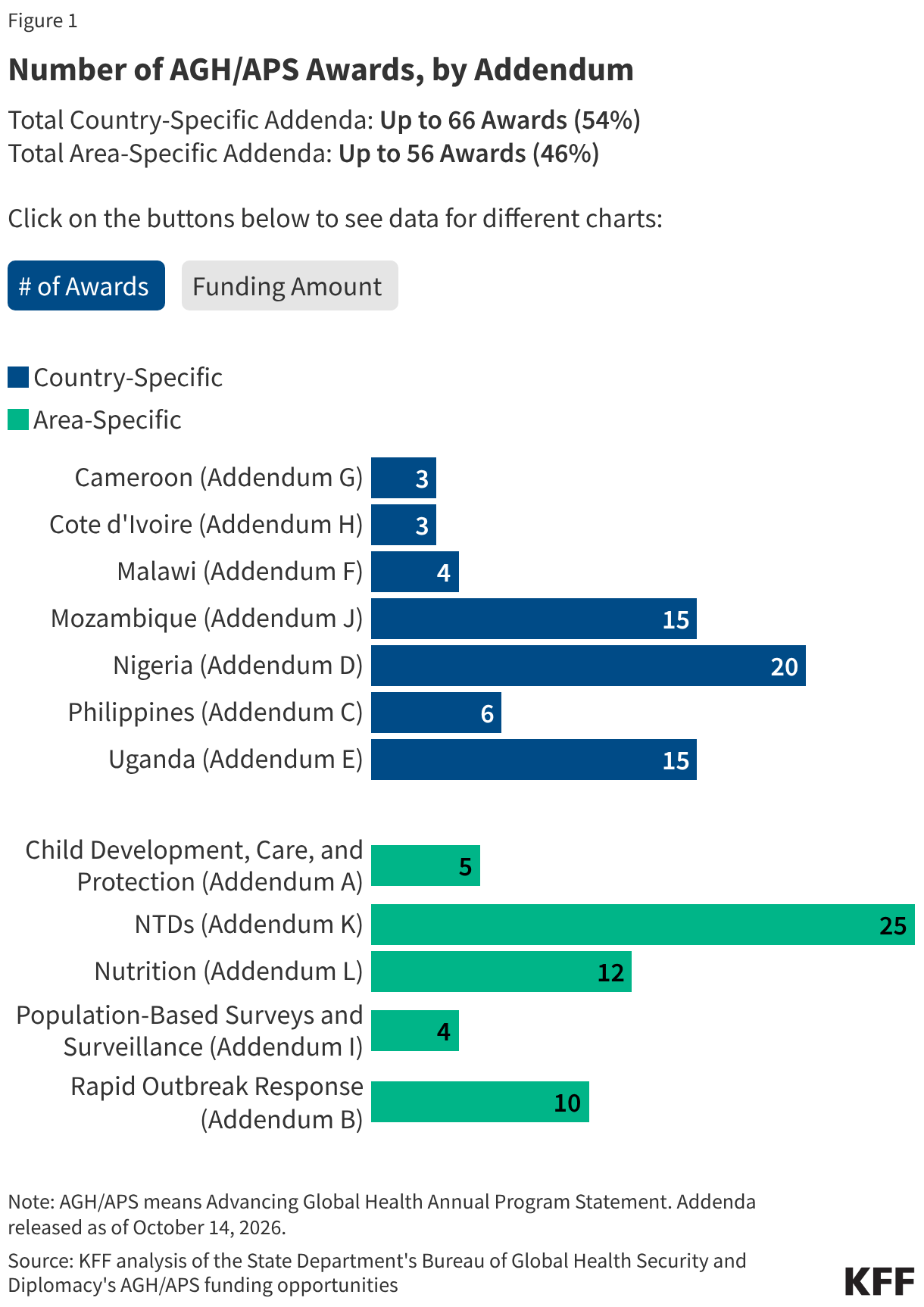
Of the 12 addenda (see Figure 1 and Tables 1-2):
- seven identify specific countries for potential funding – Cameroon, Cote d’Ivoire, Malawi, Mozambique, Nigeria, the Philippines, and Uganda (all seven countries have signed MOUs with the U.S.4 over the past year). Slightly more than half (54%, up to 66 awards) of potential awards and about half (51%, up to $730 million) of total announced funding are for country-specific addenda, which will be supported by funding that falls under the announced MOU funding envelopes. The largest number of potential awards are for Nigeria (up to 20), followed by Mozambique and Uganda (up to 15 each). The largest amounts of potential funding are for the Philippines and Nigeria (up to $200 million each), followed by Mozambique (up to $180 million). Across the seven countries, $7.3 billion in U.S. government funding is expected to be provided under their bilateral U.S. global health MOUs; as such, the funding in the addenda could represent a potential 10% (up to $730 million) of this MOU funding.
- five identify specific areas for potential funding – child development, care, and protection; neglected tropical diseases, or NTDs; nutrition; rapid outbreak response; and population-based surveys and surveillance. Slightly less than half (46%, up to 56 awards) of potential awards and about half of funding (49%, up to $700 million) are for area-specific addenda, which are expected to be supported by funding that is outside of the MOUs. The largest number of potential awards are for NTDs (up to 25), followed by nutrition (12) and rapid outbreak response (10). The largest amounts of potential funding are for rapid outbreak response (up to $290 million), followed by NTDs (up to $162 million) and nutrition (up to $115 million).
These addenda specify a range of objectives and activities, target populations, and, in some cases, particular geographic areas and countries. See Tables 1-2 and Appendix.
Across the seven country-specific addenda (see Table 1 and Appendix Table 1):
- Objectives are varied and range from enhancing the delivery of health services across disease programs and improving country supply chain systems; to building government capacity to manage and sustain health programs and functions including financing, surveillance, and data systems. Specifically:
- Cameroon – using a One Health approach, aims to strengthen integrated public health systems in order to ensure global health security and strengthen outbreak and other emergency preparedness and response systems.
- Cote d’Ivoire – aims to strengthen disease surveillance, detection, and response to prevent cross-border spread; enhance integrated health service delivery across disease programs in order to improve efficiency; provide integrated technical support to strengthen management capacity across levels of health governance to support localized, community-centered health delivery; and sustain integrated service delivery in faith- and community-based facilities.
- Malawi – aims to provide strategic assistance to strengthen management capacity across several levels of health governance to standardize and support integrated service delivery platforms and transition responsibilities to the government; strengthen the government’s integrated health commodity supply chain system to ensure sustained commodity availability across all public health programs; and strengthen data systems integration and interoperability for data-driven decision making and sustained government-led digital health coordination and oversight.
- Mozambique – aims to strengthen integrated service delivery and support transition of functions to the government; enhance global health security through integrated disease surveillance and outbreak response; strengthen and scale interoperable digital health systems, and operationalize data-driven decision-making; and strengthen integrated supply chain systems, health systems, and institutional capacity for sustainable service delivery, including integrated health delivery in the Gorongosa district.
- Nigeria – aims to enhance faith- and community-based health service delivery; expand health insurance access for women, children, and their families; enhance global health security through disease surveillance and outbreak response; strengthen digital health systems, supply chains, laboratory networks, and health infrastructure; and improve health workforce financing.
- The Philippines –aims to strengthen disease surveillance and outbreak response to prevent cross-border spread; integrate health service delivery across disease programs to improve efficiency; strengthen domestic capacity to fund and manage health systems; and establish performance accountability mechanisms to monitor service delivery, epidemiology, supply chain, and domestic resource mobilization.
- Uganda –aims to support sustainable faith- and community-based health systems through establishing and scaling health financing mechanisms, sustaining integrated service delivery, building organization and network capacity; and to support enabling systems for accountable, government-led programming through strengthening and scaling interoperable, fit-for-purpose digital health systems, expanding sustainable power solutions for health facilities, institutionalizing supply chain improvements, conducting district-level risk assessments and independent verification for performance-based financing, and providing indoor residual spraying (IR) quality assurance.
- Activities in support of these objectives include, for example, strengthening disease surveillance, laboratory capacity, supply chain systems, and integrated health service delivery; scaling digital health systems to improve data use and sharing; training and support for health workforce management, planning, and retention; increasing quality assurance; supporting community platforms; improving infrastructure; and enhancing sustainable financing and accountability mechanisms.
- Some addenda mention key, focus, and vulnerable populations to include or target, such as vulnerable populations (including underserved communities, rural populations, women and children, and people living with HIV, tuberculosis, and malaria) in Mozambique and Nigeria; and high-risk populations (including “underserved, fragile and high-risk areas” and “populations with the greatest disease burden”) in the Philippines.
- While most country addenda mention working with faith-based organizations, three addenda – Cote d’Ivoire, Nigeria, and Uganda – specifically emphasize strengthening partnerships with faith-based organizations and cite them directly in their objectives.
Across the five area-specific addenda (see Table 2 and Appendix Table 2):
- Objectives range from scaling and implementing programs addressing nutrition and child development to supporting high-impact NTD interventions, and from expanding routine and programmatic surveillance systems to building stronger outbreak detection and response capacity. Specifically:
- Child Development, Care, and Protection –aims to strengthen child protection systems; implement comprehensive programs to prevent malnutrition and poor development during the critical 1000 days (conception to age two), including interventions fostering secure, stimulating parent-child relationships; and prevent child-family separation and reduce reliance on residential care.
- NTDs –aims to accelerate the elimination of priority NTDs through integrated, high-impact interventions.
- Nutrition –aims to deliver integrated, high-impact, scalable, and sustainable nutrition services through existing health and community platforms (e.g., maternal and child health, HIV, tuberculosis or TB, malaria, immunization, and community health platforms).
- Population-Based Surveys and Surveillance –aims to advance innovative population-based survey methodologies and build strengthened routine and programmatic surveillance systems.
- Rapid Outbreak Response –aims to enhance rapid activation and surge response; improve early detection, containment, and mitigation; strengthen coordinated and operationally effective response; and build capacities that reinforce the system and support transition.
- Activities in support of these objectives include strengthening the systems and workforce that protect vulnerable children through improved laws, policies, and services; providing intensive support to the most vulnerable children and their families, alongside broader comprehensive efforts to focus on the first 1,000 days of children’s lives; delivering high-impact nutrition interventions, such as maternal nutrition and prenatal micronutrient supplementation; supporting the elimination of NTDs through strengthened laboratories, surveillance, and diagnostics; modernizing population health data systems; and strengthening global health security through improved infection prevention and control, immunization for outbreak response, point-of-entry screening, and risk communication.
- As with the country addenda, some include specific mention of key, focus, and vulnerable populations to include or target, such as children (including children under 2 and “children vulnerable to violence, exploitation, abuse, and neglect”) under the Child Development addendum; and high- and at-risk populations as a group for which it is important to ensure data is captured under surveillance projects, under the Population-Based Surveys and Surveillance addendum.
- Two addenda identify specific geographic areas and countries for support (the remaining three are not specific):
- The NTDs addendum identifies 10 countries in the Western Hemisphere, 18 countries in Africa, and four countries in Asia and the Pacific; of these 32 countries, 11 have not signed MOUs, though some may do so at a future time;5 and
- The nutrition addendum identifies 11 countries in Africa and 1 country in the Western Hemisphere; of these 12 countries, 2 have not signed MOUs.6
These findings provide insight into how the U.S. intends to further operationalize its global health efforts under the AFGHS, including which MOU countries will be the focus of this work, which global health areas have been selected for cross-cutting support, and what objectives and activities might be supported with more focused, additional support within and beyond MOU countries. Still, the APS process remains underway, and additional addenda are expected as part of the last funding round. At this time, no awards have been publicly announced,7 and it is not known what will actually be funded. How this APS mechanism and specific awards ultimately operate to support or supplement the MOUs and other aspects of the AFGHS will be important to monitor going forward.
| Table 1: AGH/APS Snapshot – Country-Specific Addenda | |||
| Country | $ Amount | # Awards | Purpose |
| Health Foreign Assistance MOU Implementation in Cameroon (Addendum G) | 5.4M | 3 | Purpose: To strengthen integrated disease surveillance for outbreak preparedness, and emergency, response systems through a comprehensive One Health approach. Target population: Populations at increased risk |
| Health Foreign Assistance MOU Implementation in Cote d’Ivoire (Addendum H) | 50M | 3 | Purpose: To accelerate Cote d’Ivoire’s transition to a sustainable, accountable, and government-led health system by 2030, as outlined in the U.S. Government–Government of Cote d’Ivoire MOU Implementation Plan. Target population: Underserved and high-burden populations, rural populations, women and children, people living with HIV and malaria |
| Health Foreign Assistance MOU Implementation in Malawi (Addendum F) | 35M | 4 | Purpose: To accelerate Malawi’s transition to a sustainable, accountable, and government-led health system capable of sustaining gains in HIV, tuberculosis, malaria, vaccine-preventable diseases, MNCH, and outbreak preparedness and response under the U.S. Government–Government of Malawi MOU Implementation Plan. |
| Health Foreign Assistance MOU Implementation in Mozambique (Addendum J) | 180M | 15 | Purpose: Strengthen Mozambique’s national, provincial, and subnational health systems to deliver integrated, resilient, and high-quality health services across public, private, faith- and community-based facilities that reduce morbidity and mortality, sustain gains against infectious diseases, improve maternal and neonatal outcomes, strengthen biosafety and biosecurity and readiness for public health threats, with particular focus on improving HIV, TB, GHS, Malaria, MNCH and immunization health outcomes by 2030. Target population: Vulnerable populations, including underserved communities, rural populations, women and children, and people living with HIV, tuberculosis, and malaria |
| Health Foreign Assistance MOU Implementation in Nigeria (Addendum D) | 200M | 20 | Purpose: Expand access to quality, affordable, integrated health services and systems across public, private, faith- and community-based health facilities in Nigeria by 2030 through strengthened partnerships, sustainable financing, and strategic health assistance that improve health outcomes, particularly for women and children. Target population: Underserved, high-burden, and vulnerable populations, including underserved communities, rural populations, women and children, and people living with HIV, tuberculosis, and malaria |
| Advancing Integrated and Sustainable Health System in the Philippines (Addendum C) | 200M | 6 | Purpose: To leverage partnerships with U.S. and Philippine firms to pilot and scale up digital health, laboratory, supply chain, and regulatory innovations that strengthen disease outbreak readiness, surveillance, and responses while expanding the use of U.S. technologies and standards Target population: High-risk populations including underserved, fragile and high-risk areas, and populations with the greatest disease burden |
| Health Foreign Assistance MOU Implementation in Uganda (Addendum E) | 60M | 15 | Purpose: To accelerate Uganda’s transition to a sustainable, accountable, and government-led health system capable of sustaining gains in HIV, tuberculosis, malaria, MNCH, immunization, and outbreak preparedness and response under the U.S. Government–Government of Uganda MOU Implementation Plan. |
| Notes: AGH/APS means Advancing Global Health Annual Program Statement. Addenda released as of Oct. 22, 2026. Source: KFF analysis of the State Department’s Bureau of Global Health Security and Diplomacy’s AGH/APS funding opportunities. | |||
| Table 2: AGH/APS Snapshot – Area-Specific Addenda | |||
| Area | $ Amount | # Awards | Purpose |
| Child Development, Care, and Protection (Addendum A) | 52.65M | 5 | Purpose: To significantly improve the safety and well-being of vulnerable children and their families globally by strengthening national child protection systems and approaches that promote children’s development, care, and protection, focusing on both prevention and response. Target population: Children, including children under two and children vulnerable to violence, exploitation, abuse, and neglect |
| Accelerating the Elimination of Neglected Tropical Diseases (Addendum K) | 162M | 25 | Purpose: To accelerate progress toward the elimination and interruption of transmission of priority NTDs, through integrated, strategically targeted, and country-led interventions that reduce disease burden, strengthen health systems, and advance health security and economic resilience in high-burden settings. Target population: Individuals at high risk for NTD infections Geographic area: Western Hemisphere: Bolivia, Brazil, Colombia, Dominican Republic, Guatemala, Haiti, Honduras, Mexico, Peru, and Venezuela Africa: Burkina Faso, Cameroon, Cote d’Ivoire, Democratic Republic of the Congo, Ethiopia, Ghana, Kenya, Madagascar, Malawi, Mali, Niger, Nigeria, Senegal, Sierra Leone, South Sudan, Tanzania, Uganda, Zambia Asia and Pacific: Bangladesh, Indonesia, Nepal, Papua New Guinea |
| Accelerating Nutrition Progress (Addendum L) | 115M | 12 | Purpose: To accelerate reductions in maternal and child mortality, infectious disease burden, and malnutrition through sustainable nutrition financing and integrated delivery of high-impact nutrition interventions in high-burden countries. Target population: Pregnant and breastfeeding women, children under five years (with a focus on children under two years) Geographic area: Burkina Faso, Côte d’Ivoire, Democratic Republic of the Congo, Ethiopia, Haiti, Madagascar, Mali, Mozambique, Niger, Nigeria, South Sudan, Tanzania |
| Innovations in Population-Based Surveys and Surveillance (Addendum I) | 80M | 4 | Purpose: Enable countries to develop comprehensive, self-run health data strategies to generate timely, high-quality, and actionable population health data that strengthen countries’ ability to detect and respond to health threats, assess epidemiologic status and progress, improve population health outcomes, and reduce risks to the United States. Target population: High- and at-risk populations |
| Rapid Outbreak Response (Addendum B) | 290M | 10 | Purpose: To enable rapid, effective, and coordinated outbreak response actions that contain infectious disease threats, reduce morbidity and mortality, and limit cross-border spread during the earliest stages of an outbreak. |
| Notes: AGH/APS means Advancing Global Health Annual Program Statement. Addenda released as of Oct. 22, 2026. Source: KFF analysis of the State Department’s Bureau of Global Health Security and Diplomacy’s AGH/APS funding opportunities. | |||
Appendix
| Appendix Table 1: Objectives of AGH/APS Country-Specific Addenda | ||
| Country | Objective(s) | |
| Health Foreign Assistance MOU Implementation in Cameroon (Addendum G) | Objective: Strengthen Integrated Public Health Systems to Ensure Global Health Security Preparedness and Response | |
| Health Foreign Assistance MOU Implementation in Cote d’Ivoire (Addendum H) | Objective 1: Strengthen Disease Surveillance, Detection, and Outbreak Response to Prevent Cross-Border Spread Objective 2: Enhance Integrated Health Service Delivery Across Disease Programs in Clinical and Community-Based Facilities to Improve Efficiency Objective 3: Provide Integrated Technical Support to Strengthen Ministry of Health and District-Level Capacity for Localized, Community-Centered Health Delivery Objective 4: Sustain Integrated Service Delivery in Faith- and- Community-Based Facilities | |
| Health Foreign Assistance MOU Implementation in Malawi (Addendum F) | Objective 1: Provide Strategic Assistance to Strengthen MOHS, Mofepd, and District-Level Capacity to Standardize and Support Integrated Service Delivery Platforms and Transition Responsibilities to GOM Objective 2: Strengthen the GOM’s Integrated Health Commodity Supply Chain System to Ensure Sustained Commodity Availability Across All Public Health Programs Objective 3: Strengthen Data Systems Integration and Interoperability for Data-Driven Decision Making and Sustained GOM-Led Digital Health Coordination and Oversight | |
| Health Foreign Assistance MOU Implementation in Mozambique (Addendum J) | Objective 1: Provide Integrated Service Delivery and then Transition of Functions to GRM Objective 2: Enhance Global Health Security Through Integrated Disease Surveillance and Outbreak Response Objective 3: Strengthen and Scale Interoperable Digital Health Systems, and Operationalize Data-Driven Decision-Making Objective 4: Strengthen Integrated Supply Chain Systems Objective 5: Strengthen Health Systems and Institutional Capacity for Sustainable Service Delivery Objective 6: Strengthen Integrated Health Delivery in Gorongosa District | |
| Health Foreign Assistance MOU Implementation in Nigeria (Addendum D) | Objective 1: Enhance Faith- and Community-Based Integrated Health Service Delivery to Improve Health Outcomes Objective 2: Expand Health Insurance Access for Women, Children and Their Families Objective 3: Enhance Global Health Security Through Integrated Disease Surveillance and Outbreak Response Objective 4: Strengthen Digital Health Systems, Interoperability, and Data-Driven Decision-Making Objective 5: Strengthen Integrated Supply Chain Systems Objective 6: Strengthen Laboratory Network Infrastructure and Quality Systems Objective 7: Improve Health Facility Infrastructure Objective 8: Improve Health Financing and Budget Allocation of Health Workforce | |
| Advancing Integrated and Sustainable Health System in the Philippines (Addendum C) | Objective 1: Strengthen Disease Surveillance, Detection, and Outbreak Response to Prevent Cross-Border Spread Objective 2: Integrate Health Service Delivery Across Disease Programs in Private and Community-Based Facilities to Improve Efficiency Objective 3: Strengthen Domestic Capacity to Fund and Manage Health Systems Objective 4: Establish Robust Performance Accountability Mechanisms | |
| Health Foreign Assistance MOU Implementation in Uganda (Addendum E) | Objective 1: Establish and Scale Sustainable Community-Based Health Financing Mechanisms Objective 2: Sustain Integrated Service Delivery in Faith- and Community-Based Facilities Objective 3: Build Faith- and Community-Based Organization and Network Capacity Objective 4: Strengthen and Scale Interoperable, Fit-for-Purpose Digital Health Systems Objective 5: Expand Sustainable Power Solutions for Health Facilities Objective 6: Institutionalize Supply Chain Accountability, GS-1 Traceability, and Annual Audit Objective 7: Conduct District-Level Risk Assessments and Independent Verification for Performance-Based Financing Objective 8: Provide Indoor Residual Spraying (IRS) Quality Assurance | |
| Appendix Table 2: Objectives of AGH/APS Area-Specific Addenda | ||
| Area | Objective(s) | |
| Child Development, Care, and Protection (Addendum A) | Objective 1: Strengthen Child Protection Systems Objective 2: Implement Comprehensive Programs to Prevent Malnutrition and Poor Development During the Critical 1000 Days (Conception to Age Two), Including Interventions Fostering Secure, Stimulating Parent-Child Relationships Objective 3: Prevent Child-Family Separation and Reduce Reliance on Residential Care | |
| Accelerating the Elimination of Neglected Tropical Diseases (Addendum K) | Objective: Accelerate the Elimination of Priority NTDs Through Integrated, High-Impact Interventions | |
| Accelerating Nutrition Progress (Addendum L) | Objective: Deliver Integrated High-Impact Scalable and Sustainable Nutrition Services Through Existing Health and Community Platforms | |
| Innovations in Population-Based Surveys and Surveillance (Addendum I) | Objective 1: Innovative Population-Based Survey Methodologies Objective 2: Strengthened Routine and Programmatic Surveillance Systems | |
| Rapid Outbreak Response (Addendum B) | Objective 1: Rapid Activation and Surge Response Objective 2: Early Detection, Containment, and Mitigation Objective 3: Coordinated and Operationally Effective Response Objective 4: System Reinforcement and Transition | |
- U.S. and country co-financing amounts do not sum to the overall total, which includes the Philippines ($685m), for which no U.S./country split is available, and excludes Vietnam, for which only the U.S. amount ($98.75m, included in U.S. funding) is available. See more details on the KFF Tracker: America First MOU Bilateral Global Health Agreements. ↩︎
- Geographic focus is Western Hemisphere (Bolivia, Brazil, Colombia, the Dominican Republic, Guatemala, Haiti, Honduras, Mexico, Peru, and Venezuela); Africa (Burkina Faso, Cameroon, Cote d’Ivoire, the Democratic Republic of the Congo, Ethiopia, Ghana, Kenya, Madagascar, Malawi, Mali, Niger, Nigeria, Senegal, Sierra Leone, South Sudan, Tanzania, Uganda, and Zambia); and Asia and the Pacific (Bangladesh, Indonesia, Nepal, and Papua New Guinea). ↩︎
- Geographic focus is Burkina Faso, Côte d’Ivoire, the Democratic Republic of the Congo, Ethiopia, Haiti, Madagascar, Mali, Mozambique, Niger, Nigeria, South Sudan, and Tanzania. ↩︎
- The Philippines did not sign an official MOU but rather a “Strategic Objective Agreement.” See KFF, KFF Tracker: America First MOU Bilateral Global Health Agreements. ↩︎
- See endnote 1 for country listing. Countries that have not signed an MOU include Western Hemisphere (Brazil, Colombia, Haiti, Mexico, Peru, and Venezuela); Africa (Ghana and Mali); and Asia and the Pacific (Bangladesh, Indonesia, and Nepal). Ghana rejected its proposed MOU; see Kerry Cullinan, “Despite the Deadline, US Bilateral Health Deals Are Not Ready for Implementation,” Health Policy Watch, Sept. 30, 2026, https://healthpolicy-watch.news/despite-the-deadline-us-bilateral-health-deals-not-ready-for-implementation/. ↩︎
- See endnote 2 for country listing. Countries that have not signed an MOU include Haiti and Mali. ↩︎
- Some have been cited in a media report, however; see Sharon Lerner, Anna Maria Barry-Jester and Robert Faturechi, “Firm Linked to Trump’s Sons Got Nearly $40 Million in Federal Contracts to Screen for Ebola and Other Diseases,” ProPublica, Nov. 9, 2026, https://www.propublica.org/article/trump-sons-xwell-xprestest-government-contracts. ↩︎