What We Know about Trump’s $500 ACA Checks and the User Fees Funding Them
In September 2026, President Trump announced he would send one-time $500 “refund checks” to about 1 million Americans in 30 states. According to the announcement, the checks refund unsubsidized consumers for the excess user fees collected from HealthCare.gov insurers under the Biden administration. About 5% of all Affordable Care Act (ACA) Marketplace enrollees will receive these payments—specifically, those who enrolled through HealthCare.gov in 2026 and did not receive premium tax credits. The remaining 95% of enrollees are not receiving a payment, nor are people who were enrolled in previous years but dropped their coverage.
This issue brief explains insurer user fees, how they are collected, the accumulation of a surplus over time, and how the $500 payments compare to the premium increases unsubsidized enrollees have faced.
Key findings include:
- The $500 checks are smaller than the premium increases most of these enrollees faced when enhanced premium tax credits expired heading into 2026 and are also smaller than the average premium increases expected in 2027. Under the enhanced premium tax credits, enrollees with incomes above four times the poverty level had their premiums for a benchmark plan capped at 8.5% of income. They are now ineligible for subsidies altogether.
- In fiscal years (FY) 2018–2020, the federal government collected more in user fee revenue than it obligated, likely contributing to a large surplus. The first Trump administration oversaw spending in each of these fiscal years, significantly cutting funding for consumer information and outreach. The first Trump administration also oversaw user fee rates in plan years (PY) 2019 and 2020, lowering the rate in 2020 but not by enough to avoid a surplus.
- In FY 2021–2023, the trend reversed: The federal government spent more than was collected in user fees. Spending commitments in these years were largely set by the Biden administration, which significantly increased spending on consumer information and outreach activities. User fee rates simultaneously decreased from PY 2021 to 2022 under the Biden administration.
- In FY 2024 and 2025, spending commitments more closely matched revenue from user fees. The Biden administration set user fee rates for each of the overlapping plan years and oversaw spending in FY 2024 and part of 2025.
- For most recipients, the $500 checks likely exceed the amount the recipients indirectly paid in total user fees this year.
Determination and collection of user fees
The ACA allows Marketplaces to charge participating issuers “user fees” to fund Marketplace operations, such as eligibility determinations, enrollment processes, information technology support, consumer information and outreach, and program integrity activities. The Department of Health and Human Services (HHS) collects monthly user fees from issuers offering plans on HealthCare.gov, including (since 2017) state-based Exchanges using the federal platform (SBM-FPs). Insurers build these fees into monthly premiums, some of which are paid for by enrollees, but a large share is effectively paid by taxpayers through premium subsidies. In states that use HealthCare.gov in 2026, about 82% of premium dollars are paid by the advance premium tax credit.
HHS updates the user fee rates for states using HealthCare.gov annually based on projected operating costs, premiums, and enrollment. States that run their own ACA Marketplaces have discretion to set their own user fees. (Because the small number of state-based Exchanges that use the HealthCare.gov platform are responsible for financing their own independent operations and can levy their own state user fees, their federal user fee rates have been lower than those for most states that use HealthCare.gov and whose operations are federally funded.)
The federal government is not required to return any unused user fees to insurers, consumers, or taxpayers. No administration has done so in the past and it is not clear what legal authority exists to issue these checks. In past years, user fee revenue that exceeded spending has been carried over to subsequent years. Administrations can use the surplus to increase spending on marketplace operations, reduce it by lowering future user fees, or both.
User fees for a given plan year are set far in advance of the plan year beginning, through a rulemaking process that includes a proposal and comment period. User fees are published in the annual Notice of Benefit and Payment Parameters, which is typically issued as a proposed rule about a year in advance and finalized about nine months before the plan year begins.
Because of this long lead time, the rules that govern user fees in the first year or two of a given presidential administration are set by the predecessor. The Obama, Biden, and first Trump administrations each issued rules at the tail end of their presidencies that would affect premiums and user fees in the second year of the incoming president’s term. However, the 2022 user fee, which was originally set by the first Trump administration, was changed by the Biden administration (discussed more below). By contrast, presidential administrations can and have made rapid changes to how much of the user fee revenue is spent out, particularly spending on consumer outreach and assistance programs.
User fee rate over time
The Federally Facilitated Marketplace (FFM) user fee has been 3.5% or less since the ACA Marketplace began in 2014, reaching a low of 1.5% in 2025 (Figure 1).
During the entire Obama administration and the early part of the first Trump administration, the FFM user fee was consistently 3.5%. The first FFM user fee rate change occurred in Plan Year 2020, when the Trump administration lowered it to 3%. In a press release during the first Trump administration, the Centers for Medicare and Medicaid Services (CMS) stated that the FFM user fee rate would be lowered because of “increased operational efficiency, a more efficient approach to outreach, and investments focused on proven methods to achieve a seamless enrollment experience and high consumer satisfaction.” The Notice of Benefit and Payment Parameters for 2020, finalized in April 2019, also indicated that the lower user fee rate reflected estimates of premium increases and enrollment decreases for the 2020 benefit year. The first Trump administration kept user fees constant from 2020 to 2021.
In January 2021, shortly before leaving office, the Trump administration lowered the 2022 FFM user fee rate from 3.0% to 2.25% to reflect enrollment, premium and contract estimates for the year. However, later that year, the Biden administration changed the 2022 user fee to be 2.75% (lower than the Trump administration’s 3.0% in 2021, but higher than the Trump administration’s 2.25% in 2022) due to “new analysis of the increased contract costs and projected premiums and enrollment.”
The Biden administration held user fees steady for 2023 and subsequently lowered the user fee rate for the 2024 (2.2%) and 2025 benefit years, reaching an all-time low of 1.5%. In the 2026 payment notice finalized shortly before leaving office in January 2025, the Biden administration set two different user fee rates for 2026 depending on whether the enhanced premium tax credits were extended, reasoning that enrollment would decrease without the enhanced subsidies. If the enhanced premium tax credits were extended, the user fee rate for the FFMs would have been 2.2%. Since the enhanced premium tax credits were not extended, the user fee rate was 2.5%.
The second Trump administration initially proposed holding user fees constant at 2.5% but ultimately lowered the user fee to 1.9% for plan year 2027. The finalized 1.9% is lower than most prior years, but higher than the 2025 user fee set by the Biden administration (1.5%).
Changes in Marketplace Spending and User Fee Utilization
To analyze user fee collections and spending obligations, we review the Justification of Estimates for Appropriations Committees (see Methods for sources). In these files, CMS reports total Marketplace spending by activity (e.g., consumer information and outreach, information technology, administrative costs) and the total amount of user fee collected from issuers. CMS does not report how user fee revenue is spent across specific activities. A consistent series of actual user fee obligations in congressional justification documents is only found starting in fiscal year (FY) 2018. Three factors can contribute to changes in the total amount of user fee revenue generated: the user fee rate (percent of premium) set by an administration, changes in average premiums, and changes in the number of people with HealthCare.gov coverage. As premiums were mostly flat 2018 through 2025, changes in the total amount of user fees collected during this period largely resulted from changes to the user fee rate (shown in Figure 1) and, in 2021-2025, by rapid enrollment growth.
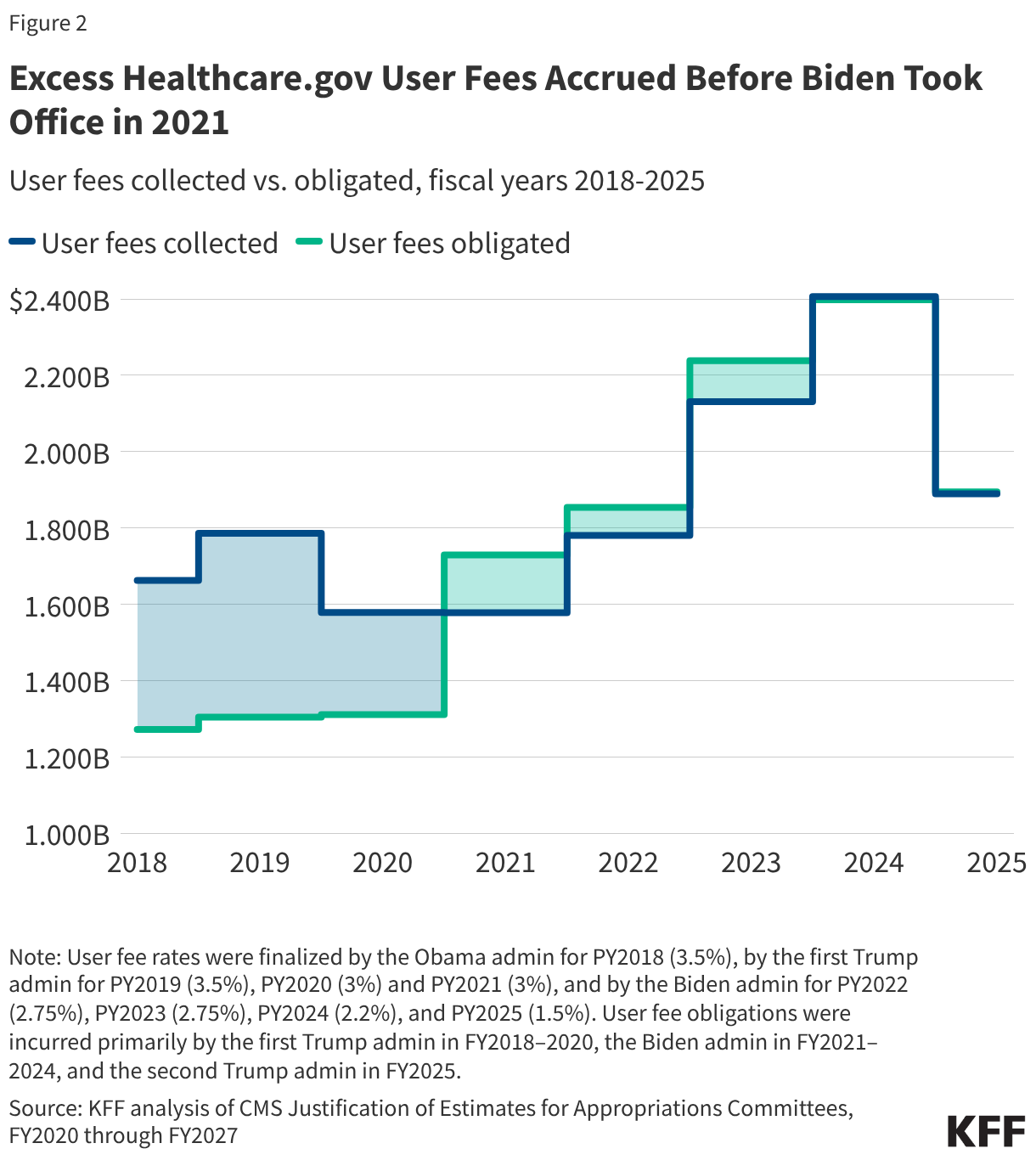
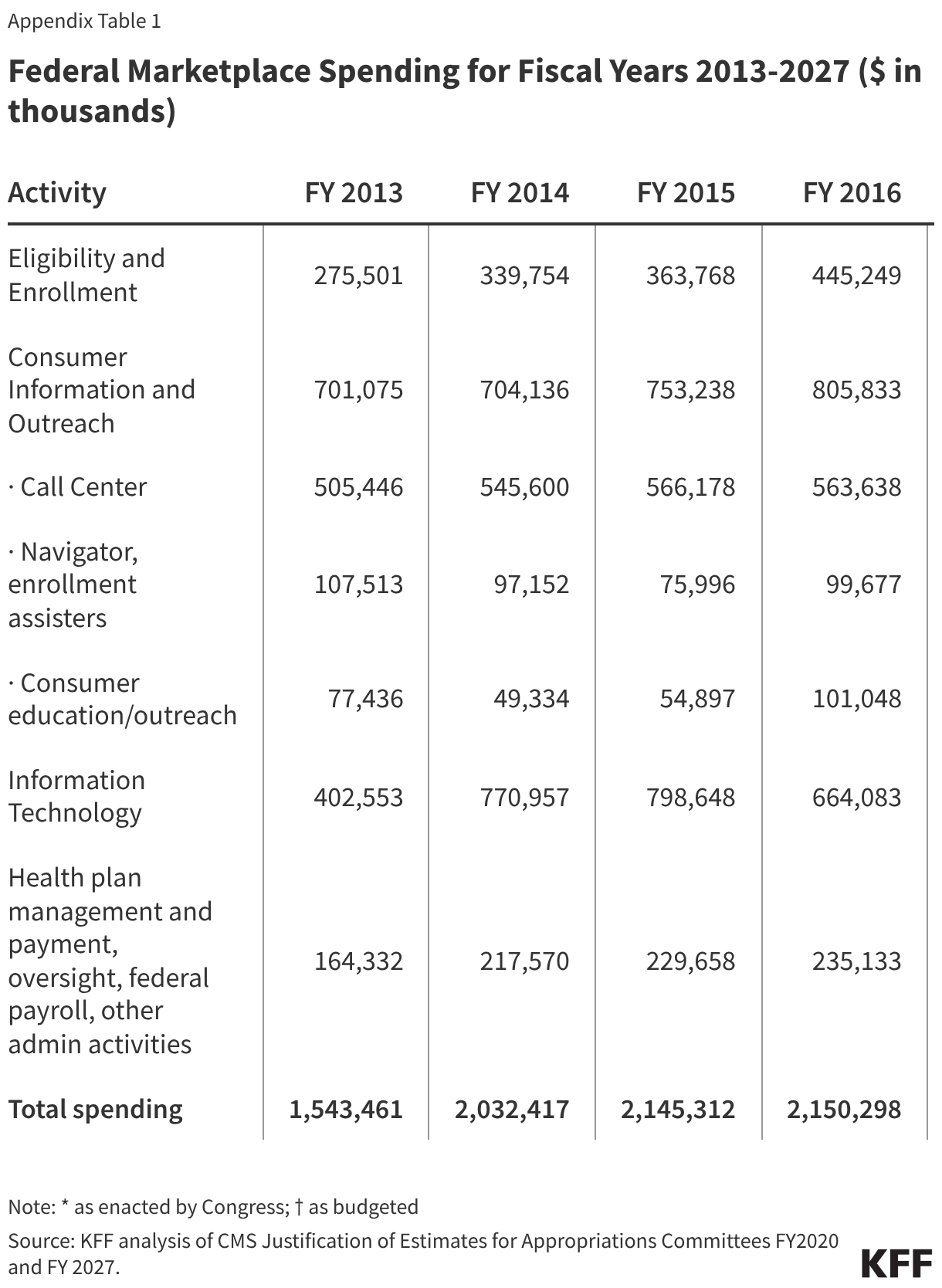
In FY 2018–2020, the federal government collected more revenue in user fees than it spent. The Trump administration oversaw spending in each of these years. The user fee rate (which determines how much was collected) was set by the Obama administration for plan years 2017 and 2018 and by the Trump administration in plan years 2019 and 2020. The Trump administration significantly reduced spending on consumer information and outreach activities, including spending on Navigators and other enrollment assisters. For example, between FY 2016 (the last full fiscal year of the Obama administration) and FY 2020 (the last full fiscal year of the first Trump administration), spending for Navigators and other enrollment assisters decreased from almost $100 million to approximately $20 million and overall spending on Consumer Information and Outreach decreased almost 40%, from approximately $806 million to $503 million between FY 2016 and FY 2020.
In FY 2021–2023, the federal government spent more user fee revenue than it collected. The Biden administration was largely responsible for spending during these years and significantly increased spending on consumer assistance and outreach. Spending on consumer information and outreach increased from $503 million in FY 2020 to $1.2 billion in FY 2023. The Trump administration set user fees in plan year 2021, while the Biden Administration set user fees in plan years 2022 and 2023. Even as the user fee rate (percent of premium) was lowered during this period, the total amount of user fee revenue collected increased due to growing enrollment spurred by the enhanced premium tax credits.
In FY 2024 and 2025, spending more closely matched user fee collections. The Biden Administration set user fees in each of the overlapping plan years and oversaw spending in FY 2024 and part of 2025. However, spending on consumer information and outreach decreased again in FY 2025, mostly during the second Trump administration, with spending on consumer information and outreach overall decreasing from $1.2 billion in 2024 to $778 million in FY 2025.
Most of the variation in total Marketplace spending comes from how much each administration spends on consumer information and outreach, including spending on outreach and Navigators and other enrollment assisters. The single largest source of funds for Exchange activities is user fees, although other sources contribute. The following charts show spending irrespective of source of funds.
Spending and user fee collections are not yet final for FY 2026. The $500 checks (whether attributed to FY 2026 or FY 2027) will have a downward effect on any surplus. The Trump administration’s budget for FY 2027 shows continuing reductions to spending for consumer information and outreach in 2027.
The $500 Payments in Context
In September 2026, the Trump administration announced that it would send one-time $500 payments to about 1 million Marketplace enrollees, billing them as a “refund” of surplus user fees collected under the Biden administration. However, the administration has provided little explanation for how the flat $500 amount was determined. Because the user fee is a fixed percentage of the gross premium, and premiums vary significantly by factors like age and location, the amount unsubsidized enrollees pay toward a user fee varies greatly from person to person.
The checks are not adjusted proportionately to the amount of user fee a recipient paid. The $500 checks will go to approximately 1 million enrollees who signed up without a tax credit for coverage in 2026 in a state using HealthCare.gov. However, the source of the funds (unspent user fees accumulated over many years) has been paid not only by the people receiving the checks, but also by the millions of HealthCare.gov enrollees who paid for at least part of their premium in this or in past years (including those who are no longer enrolled or who are enrolled in states that have transitioned to state based marketplaces), and—in large part—by taxpayers in the form of a premium tax credit to offset some or all of the premium for subsidized enrollees. It is also worth noting that some enrollees who are not receiving an advance payment of the premium tax credit in 2026 and are therefore receiving a $500 check may still receive a tax credit when they file their 2026 taxes if their income ends up below 400% of the federal poverty line (FPL).
The $500 checks likely exceed the amount of user fees most check recipients will pay this year. The average premium payment among HealthCare.gov enrollees not receiving a premium tax credit is $8,844 in 2026, which includes a $221 average user fee (based on the 2.5% 2026 user fee set by the Biden administration). How much the recipients of these checks have paid over time in user fees depends on many factors including how long they have been enrolled, the amount of their premium, and whether they were receiving premium tax credits.
The $500 checks are likely much smaller than the increase in premium payments these enrollees experienced this year, following steep premium increases and the expiration of enhanced premium tax credits. The average annual premium among HealthCare.gov enrollees not receiving a tax credit in 2025 was $6,660, while the average annual premium among those not receiving a tax credit in 2026 was $8,844, a difference of $2,184. However, this likely understates the increase in premium payments many of the $500 check recipients faced. Some enrollees who do not qualify for a subsidy in 2026 did qualify for one in 2025 and therefore would have seen an even greater increase in the premium payments for 2026 with the loss of enhanced premium tax credits. Additionally, beyond increases in premiums, some enrollees also likely saw higher deductibles if they bought down to a lower level of coverage.
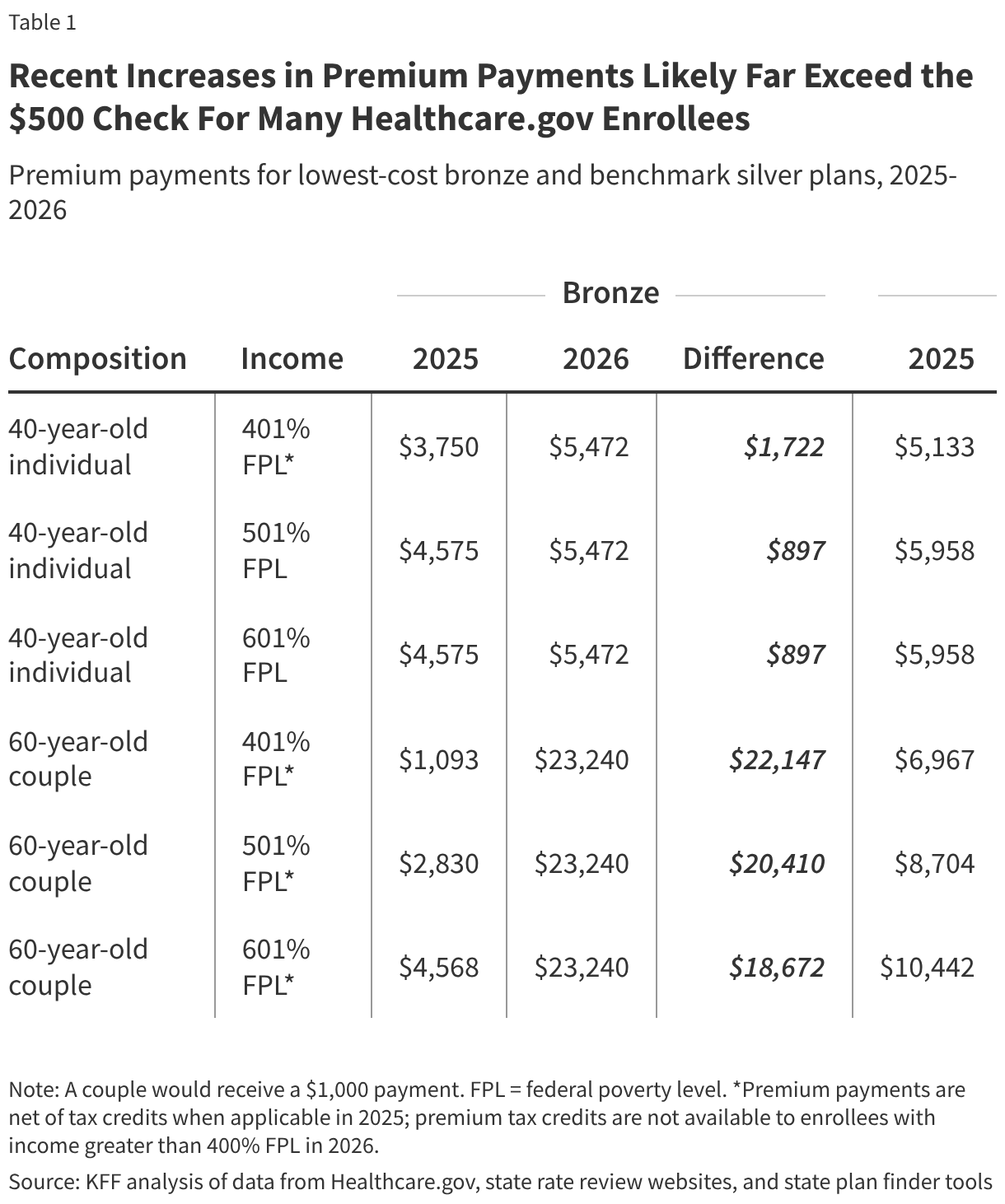
As shown in Table 1, premium payment increases from 2025 to 2026 vary based on several factors including whether the enrollee received a premium tax credit in 2025, their income, family size, and age. At 401% FPL, the national average premium for the lowest-cost bronze plan for a 40-year-old enrollee after enhanced premium tax credits was $3,750 in 2025, compared with $5,472 in 2026, an increase of $1,722. A $500 payment would offset only 29% of this increase. These $500 payments would offset an even smaller share of premium increases for benchmark silver plans.
A large share of ACA enrollees with incomes above four times poverty are older adults and many older adults also purchase bronze plans. A 60-year-old couple would face even more substantial premium increases. With income at 401% FPL, the national average annual bronze premium for two 60-year-olds increased from $1,093 in 2025 to $23,240 in 2026. If both individuals received a $500 payment, the combined $1,000 payment would offset only about 4% of the increase in their premium payments.
Premiums for unsubsidized enrollees in HealthCare.gov states are expected to continue to increase into 2027, by more than $500 on average. The average benchmark premium in 2027 for a 40-year-old in one of the 29 states using the HealthCare.gov platform in 2026 and 2027 is projected to increase by 11% in 2027, or about $876 annually, according to CMS documents cited by the Washington Sun. Because older adults have higher premiums, this could mean the oldest HealthCare.gov enrollees without a subsidy face more than $2,000 in benchmark silver premium increases from 2026 to 2027. Premium increases for bronze plans in 2027 are not yet available, though if they increase at a similar rate, the increases would also likely be more than the $500 check for a 40-year-old.
Methods
The share of ACA enrollees who receive a $500 payment was determined from ACA February effectuated enrollment. Although the exact number of recipients is not known, for this analysis, it is assumed to be 1 million. We expect diminishing effectuated enrollment throughout 2026, so the share may be higher than estimated.
Total user fee collected and obligated were obtained from CMS Justifications of Estimates for Appropriations Committees. User fee revenue was taken from the All-Purpose (Comparable) table. Final amounts for a fiscal year (FY) were taken from the congressional justification document two years subsequent; for example, spending in FY 2025 was taken from the FY 2027 congressional justification. For FY 2018, the revenue for Marketplace user fees was combined with the risk adjustment fees; these values were disaggregated in the CMS Program Management Amounts Available for Obligation table. The value of user fees obligated were obtained from the Federal Exchanges account narrative. Dollar amounts associated with Marketplace activities were collected from the congressional justification documents for FY 2020 and FY 2027. Each of these years had a longitudinal record of final spending by activity. CMS Justification of Estimates for Appropriations Committees are available at:
The average premium paid by consumers without advance premium tax credits (APTC) was derived from CMS Open Enrollment Public Use Files for 2025 and 2026. Average gross premium for all consumers using HealthCare.gov was decomposed to a weighted average of the gross premium for consumers with and without APTC, with the gross premium for consumers with APTC calculated from the average net premium and the average APTC. The calculated gross premium for 2025 included consumers in Illinois, which switched from using HealthCare.gov to its own platform in 2026. The state-level gross premium for consumers without APTC was also calculated and weighted by the number of consumers without APTC in all HealthCare.gov states excluding Illinois to estimate the impact of its inclusion. Excluding Illinois in the 2025 average gross premium for consumers without APTC resulted in a difference of $2,062 between average 2025 and 2026 premiums. To calculate the share of premium dollars that are paid by advance premium tax credits in 2026, the average premium after premium tax credits was divided by the average premium before tax credits for states using HealthCare.gov.
National average premiums for 2025 and 2026 are based on data from HealthCare.gov, state-based exchanges, and state plan finder tools to collect premiums. See https://www.kff.org/interactive/subsidy-calculator/ for further details.
Appendix