Medigap Guaranteed Issue Requirements: An Overview of Federal and State Rules
Overview
Medicare supplement insurance, known as Medigap, helps cover Medicare Part A and Part B cost-sharing requirements, including deductibles, copayments, and coinsurance. Medigap policies, which are sold by private insurance companies, are a key source of supplemental coverage for people in traditional Medicare without employer-sponsored retiree benefits or Medicaid (Medigap does not work with Medicare Advantage). In 2024, 12.9 million Medicare beneficiaries, or 46% of all traditional Medicare beneficiaries, had a Medigap policy. While there are federal and state rules that govern the issuance of Medigap policies, including around the use of medical underwriting by insurers when issuing Medigap policies, guaranteed issue protections are generally time-limited and do not extend to beneficiaries in all age cohorts equally. (For more information on the basics of Medigap, see Key Facts About Medigap Enrollment and Premiums for Medicare Beneficiaries).
This issue brief analyzes federal and state rules related to guaranteed issue requirements for Medigap policies and how they impact beneficiaries’ access to Medigap, including the implications for Medicare beneficiaries with pre-existing medical conditions and those under age 65 with long-term disabilities. This analysis is based on KFF review of federal and state insurance regulations and other publicly available information.
Key Takeaways
- Federal law provides some guaranteed issue protections for Medicare beneficiaries who seek to purchase a Medigap policy, such as during the first six months when first enrolling in Medicare Part B, and for certain qualifying events, such as during the Medicare Advantage trial period or if a Medicare Advantage plan terminates coverage in their area.
- Federal law allows Medigap insurers to use medical underwriting to either deny Medicare beneficiaries a policy or charge higher premiums outside of guaranteed issue periods. For example, beneficiaries may be denied a Medigap policy if they have a pre-existing condition and choose to switch from Medicare Advantage to traditional Medicare outside the initial 12-month trial period or seek to purchase a Medigap policy beyond the six-month window after enrolling in Medicare.
- States can go beyond minimum federal requirements to establish broader guaranteed issue protections, including continuous or annual guaranteed issue requirements, establishing guaranteed issue periods for certain qualifying events, or providing guaranteed issue protections to people under age 65.
- Eight states have relatively generous continuous or annual guaranteed issue protections.
- Four states (CT, MA, ME, NY) require either continuous or annual guaranteed issue protections for Medigap for all beneficiaries ages 65 and older, regardless of medical history.
- Four other states (DE, IL, MN, and RI) have expanded guaranteed issue protections, though they are not as comprehensive as in CT, MA, ME, and NY. For example, Rhode Island enacted legislation in 2025 to institute annual guaranteed issue protections for people 65 and older with Medicare Advantage to purchase a Medigap policy (though they do not apply to people with traditional Medicare who do not have a Medigap policy). And in Minnesota, there are annual guaranteed issue protections for individuals ages 65 to 70, which went into effect August 1, 2026.
- Thirty-seven states require Medigap insurers to issue policies to Medicare beneficiaries ages 65 and older due to certain qualifying events, such as when an applicant has a change in their employer retiree coverage (29 states) or when beneficiaries lose their Medicaid eligibility (13 states).
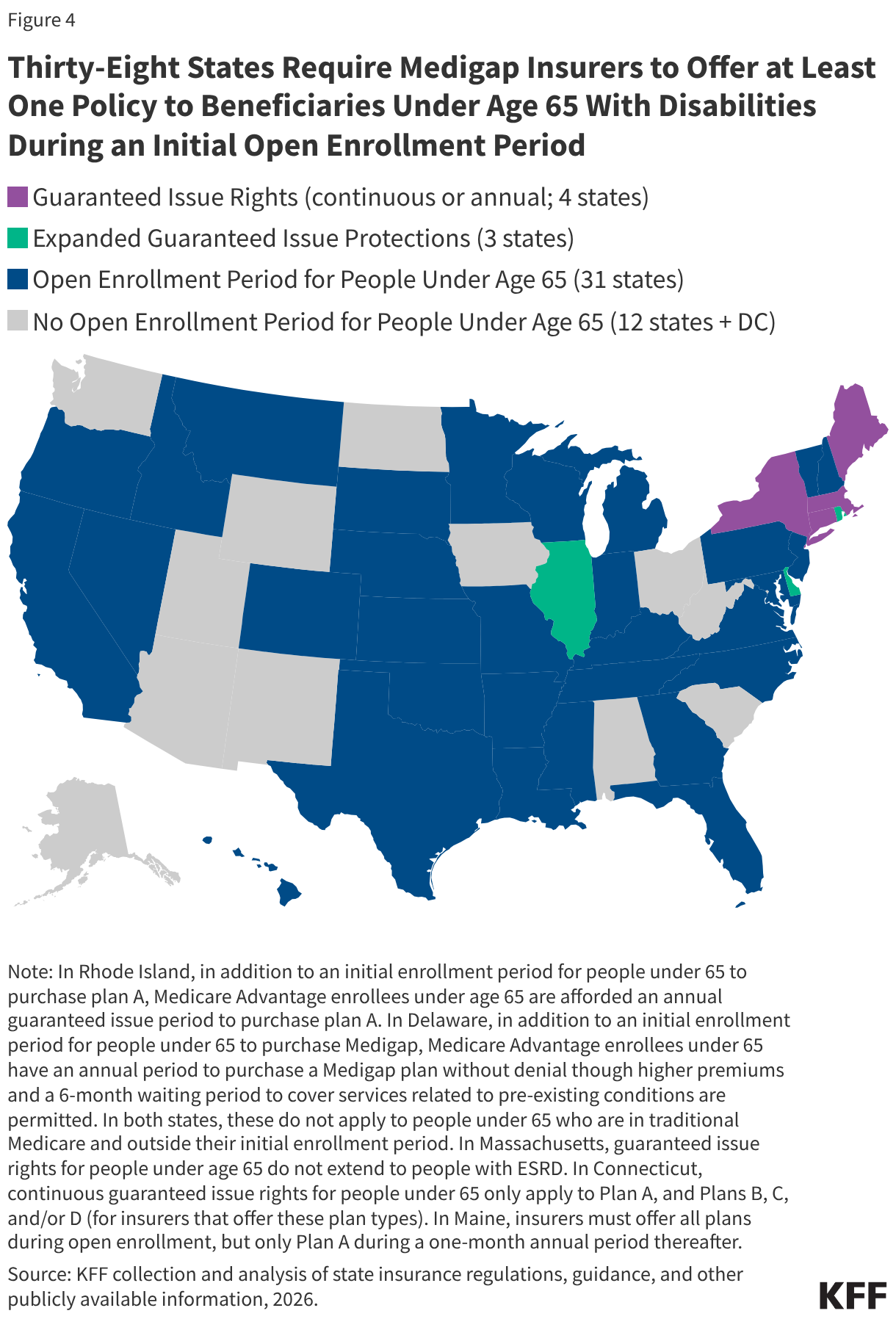
- Thirty-eight states require insurance companies to offer at least one kind of Medigap policy to Medicare beneficiaries under age 65 with disabilities during an initial open enrollment period, regardless of medical conditions. When these beneficiaries turn age 65, federal law entitles them to the same six-month open enrollment period for Medigap that is available to new beneficiaries ages 65 and older.
- Eight states have relatively generous continuous or annual guaranteed issue protections.
Federal Regulations Related to Medigap
Medigap insurance is subject to certain federal minimum requirements:
- A six-month open enrollment period beginning the first month a beneficiary is enrolled in Medicare Part B, for beneficiaries ages 65 and older
- A standardized set of benefits across Medigap policies, with 10 standard Medigap policies available to newly eligible beneficiaries. (Three states – Massachusetts, Minnesota, and Wisconsin – have a different set of standardized policies.)
- Guaranteed plan renewability
- Minimum medical loss ratio requirements
- Limiting the waiting period for coverage for pre-existing medical conditions to six months for applicants that do not have at least six months of prior continuous creditable coverage
- Prohibiting insurers from issuing new policies that cover the full Part B deductible, making Plans C and F no longer available to beneficiaries who turned age 65 on or after January 1, 2020.
During the one-time, six-month Medigap open enrollment period for beneficiaries ages 65 and older and certain other qualifying events, Medigap insurers cannot deny a Medigap policy to any qualifying applicant based on factors such as age, gender, or health status, nor can they vary premiums based on an applicant’s pre-existing medical conditions or exclude coverage for a pre-existing medical condition (i.e., medical underwriting).
The one-time, six-month guaranteed issue period is intended to mitigate potential selection issues in the Medigap market. Rather than waiting to incur high health care costs before purchasing a Medigap policy, beneficiaries must generally purchase a policy during the initial open enrollment period, or they risk not being able to purchase a Medigap policy later. This also has the effect of ensuring that the risk pool includes a mix of both healthier and sicker enrollees, which could keep premiums lower, on average.
However, as discussed in more detail below, the one-time open enrollment period also has the effect of locking people out of the Medigap market who might not be at higher risk of incurring high medical expenses in the short term. This could include, for example, a beneficiary who has been enrolled in a Medicare Advantage plan for a few years and wants to switch to traditional Medicare, but faces medical underwriting based on having pre-existing medical conditions.
Certain Circumstances Trigger Guaranteed Issue Protections
In addition to the one-time 6-month open enrollment period, there are a variety of situations that can trigger a guaranteed issue period, based on federal requirements. (States may establish additional guaranteed issue protections; see section Many States Provide Broader Guaranteed Issue Protections Than Minimum Federal Standards). In general, for qualifying events that trigger guaranteed issue rights, people ages 65 and older in Medicare generally have 63 days to apply for a Medigap policy (Table 1).
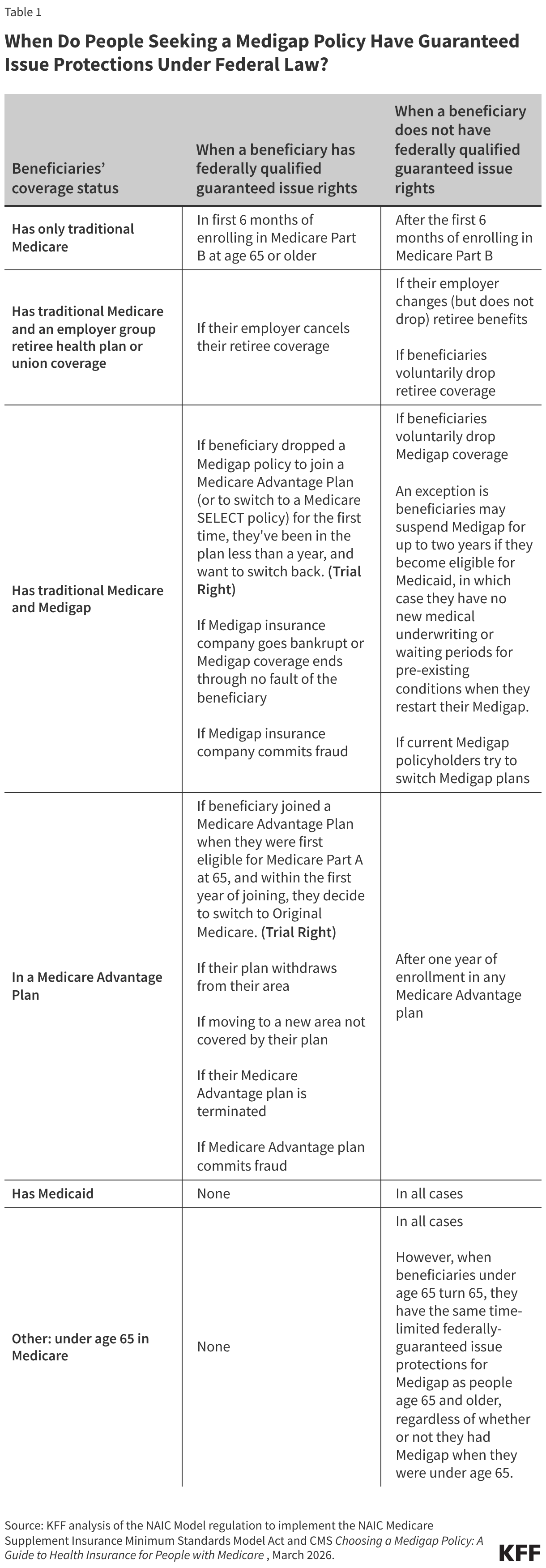
Beneficiaries with Traditional Medicare and Employer Retiree Coverage: Medicare beneficiaries have federally qualified guaranteed issue rights to purchase Medigap if their employer cancels their retiree coverage. However, they do not have guaranteed issue rights to purchase Medigap if their retiree coverage changes or if they voluntarily drop retiree coverage. This includes Medicare Advantage enrollees who voluntarily leave a retiree health plan through Medicare Advantage and who seek to purchase a Medigap policy.
Beneficiaries with Traditional Medicare and Medigap: Federal law requires that a trial period applies to Medicare beneficiaries in traditional Medicare who cancel their Medigap policy when they enroll in a Medicare Advantage plan (this is not limited to just the first year of enrolling in Medicare). These beneficiaries have time-limited guaranteed issue rights to purchase their same Medigap policy if, within a year of first signing up for a Medicare Advantage plan, they decide to disenroll to return to traditional Medicare. Guaranteed issue rights also apply if their Medigap insurance company goes bankrupt or Medigap coverage ends through no fault of their own, or their Medigap insurance company commits fraud.
Beneficiaries who currently have Medigap do not have federal guaranteed issue protections to switch Medigap policies. They also do not have guaranteed issue protections if they voluntarily drop Medigap and wish to purchase a policy again later.
Beneficiaries with Medicare and Medicaid: Medicare beneficiaries who are dual-eligible individuals, meaning they have both Medicare and Medicaid, typically have coverage of premium and cost-sharing requirements from their state Medicaid program. Therefore, they do not need Medigap and in general, Medigap insurers cannot sell Medigap policies to people with Medicaid. If dual-eligible individuals lose their Medicaid eligibility, they are not entitled to a guaranteed issue period to purchase Medigap unless they had a Medigap policy prior to becoming eligible for Medicaid. In this case, a beneficiary could suspend Medigap for up to two years and would face no new medical underwriting or waiting periods for pre-existing conditions if they lose Medicaid and choose to restart their Medigap within those two years. Outside of that two-year window, medical underwriting would apply.
Beneficiaries with Medicare Advantage. Federal law requires that Medigap policies be sold with guaranteed issue rights during a specified trial period for Medicare Advantage plans. During the trial period, Medicare beneficiaries can try a Medicare Advantage plan, but if they disenroll within the first year, they have guaranteed issue rights to purchase any Medigap policy that is sold in their state. This trial period typically begins if a Medicare beneficiary joins a Medicare Advantage plan when they are first eligible for Medicare Part A at 65.
Medicare Advantage enrollees also have guaranteed issue rights to purchase a Medigap policy to supplement coverage under traditional Medicare if:
- their Medicare Advantage plan discontinues coverage in their area
- they move to a new area and can no longer access coverage from their Medicare Advantage plan
- their Medicare Advantage plan is terminated
- their Medicare Advantage plan commits fraud.
Medigap Insurers Can Deny Coverage Based on Pre-Existing Conditions, Except Under Limited Circumstances
Under federal law, insurance companies that sell Medigap policies may deny selling a policy to an applicant with certain medical conditions outside of a guaranteed issue period. This contrasts with other insurance products, like plans sold in the ACA Marketplace or Medicare Advantage, which are not permitted to deny coverage based on pre-existing conditions at any time. In most states that allow medical underwriting for Medigap, Medicare Advantage enrollees with pre-existing conditions may be reluctant to switch to traditional Medicare if they are unable to purchase a Medigap policy. This is because Medigap provides added financial protection as a supplement to traditional Medicare, which does not have an out-of-pocket spending cap for services covered under Medicare Parts A and B. In contrast, Medicare Advantage plans are required to have an out-of-pocket limit for Parts A and B.
According to KFF analysis, nearly three quarters (74%) of Medicare Advantage enrollees or 20.9 million people have a medical condition that could result in a denial for Medigap, based on 2023 data. At least one in five Medicare Advantage enrollees have a diagnosis for peripheral vascular disease (25%), chronic kidney disease (24%), coronary artery disease (21%), or diabetes with related complications (21%) documented in the Medicare Advantage encounter data, all of which could trigger a Medigap denial. Other deniable conditions include Alzheimer’s disease and dementia, atrial fibrillation, chronic obstructive pulmonary disease (COPD) and emphysema, carotid artery disease, cancers such as breast and prostate, heart failure, heart valve disorders, multiple sclerosis, Parkinson’s disease, spinal stenosis, stroke, among others. Further, Medigap plans may deny applicants for other reasons that are not related to having a specific condition including recent medical service use (e.g., inpatient hospitalizations, use of home health services, or being treated in a nursing facility) or receiving medical advice, such as a recommendation to get further evaluation, diagnostic testing, treatment or surgery for any condition, but has not yet been performed.
Access to Medigap Is More Limited for Medicare Beneficiaries Under Age 65 with Disabilities
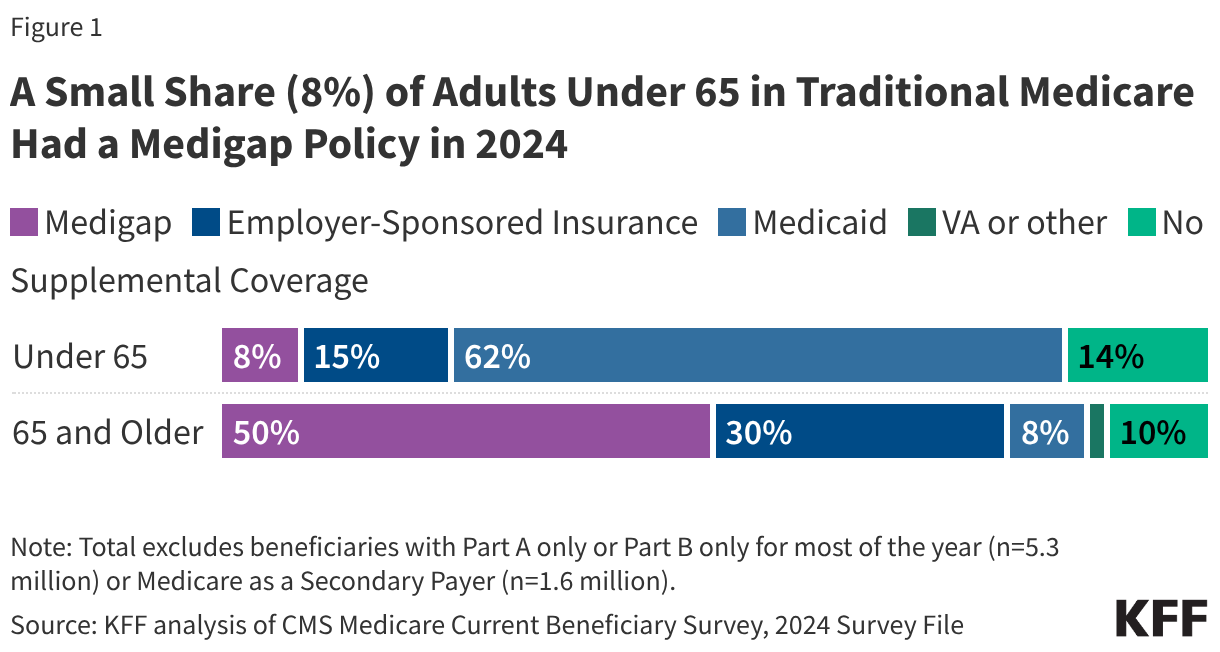
Under federal law, Medigap insurers are not required to sell Medigap policies to the just under 7 million Medicare beneficiaries who are under age 65, a majority of whom qualify for Medicare based on having a long-term disability and receiving Social Security disability benefits (a small number qualify due to having ESRD or ALS). Higher rates of Medicaid coverage among these beneficiaries, who tend to have relatively low incomes, also contribute to low enrollment in Medigap among beneficiaries under age 65. For these reasons, a significantly smaller share of traditional Medicare beneficiaries under age 65 have Medigap compared to beneficiaries with traditional Medicare ages 65 and older: 8% vs. 50% in 2024 (Figure 1).
However, when these beneficiaries turn 65 and become age-eligible for Medicare, the six-month Medigap open enrollment period becomes available. While there are no federal guaranteed issue protections in place for beneficiaries under age 65, many states have rules in place that require insurance companies to offer at least one kind of Medigap policy to Medicare beneficiaries under age 65 with disabilities during an initial open enrollment period, regardless of medical conditions, as described below.
Many States Provide Broader Guaranteed Issue Protections Than Minimum Federal Standards
Eight States Have Relatively Generous Guaranteed Issue Protections on an Either Continuous or Annual Basis
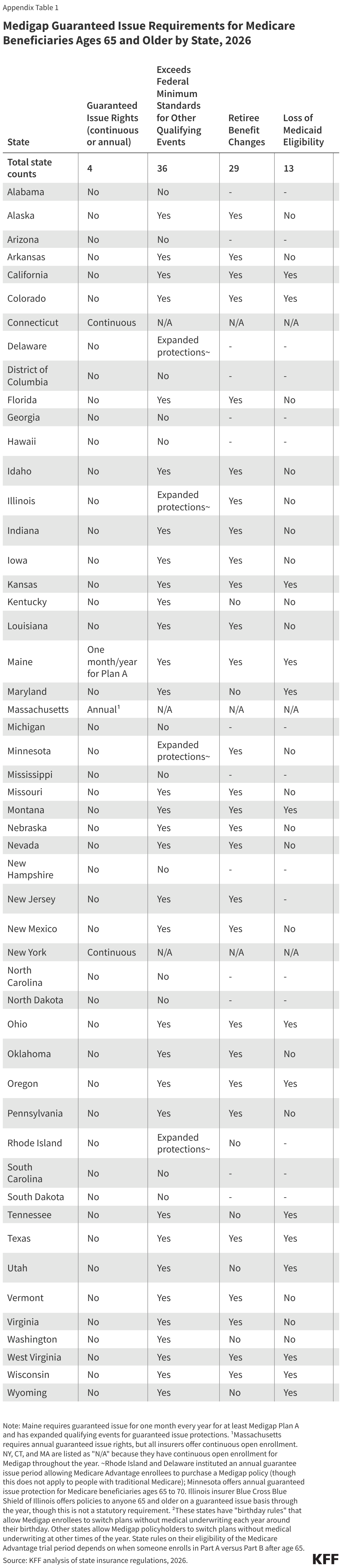
Four states – Connecticut, Massachusetts, Maine, and New York – require Medigap insurers to offer policies either continuously throughout the year or once per year to Medicare beneficiaries ages 65 and older without regard to their medical conditions (Figure 2; Appendix Table 1). Another four states — Delaware, Illinois, Minnesota, and Rhode Island — have relatively comprehensive expanded consumer protections that provide additional Medigap guaranteed issue periods for Medicare beneficiaries.
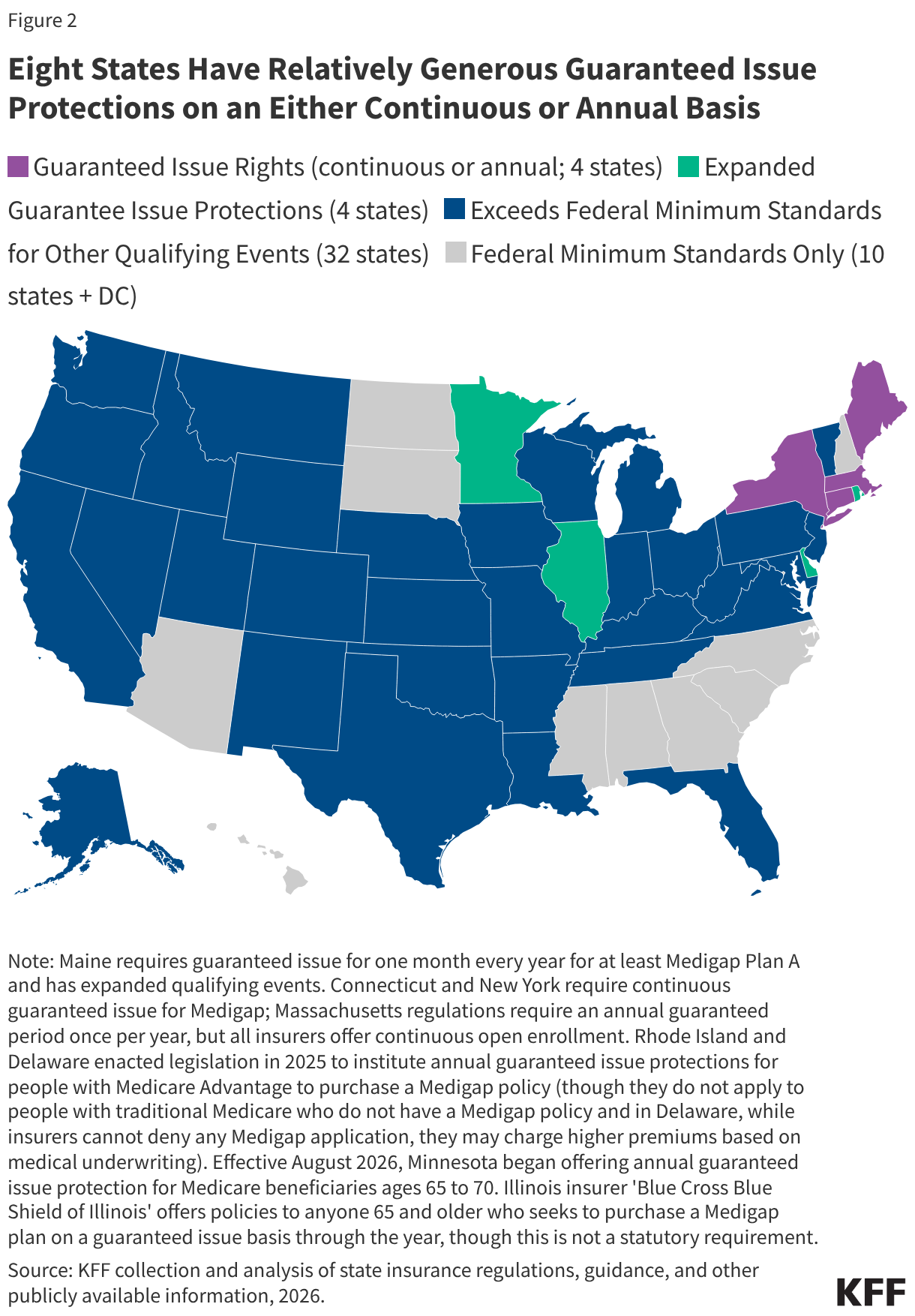
Connecticut and New York have continuous open enrollment, with guaranteed issue rights throughout the year. Massachusetts regulation requires an annual guaranteed issue open enrollment period from February 1 to March 31, but all insurers in Massachusetts offer continuous open enrollment throughout the year. Maine requires insurers to issue Medigap Plan A during an annual one-month open enrollment period of the insurer’s choosing. Plan A is less comprehensive than some Medigap plans, such as Plan G – the most popular policy in 2025.
In 2025, Rhode Island enacted legislation that provides an annual guaranteed issue period for Medicare Advantage enrollees 65 and older to purchase a Medigap plan (though this protection does not apply to people with traditional Medicare who do not have a Medigap policy). This annual guaranteed issue period is during the Medicare open enrollment period from October 15 to December 7.
In 2025, Delaware enacted legislation that provides two annual guaranteed issue periods for Medicare Advantage enrollees 65 and older to purchase a Medigap plan (though this protection does not apply to people with traditional Medicare who do not have a Medigap policy). These periods are during the Medicare open enrollment period and during the Medicare Advantage open enrollment period (January 1 to March 31). While insurers cannot deny any Medigap application, they may charge higher premiums based on medical underwriting and impose a 6-month waiting period to cover costs related to pre-existing conditions.
Minnesota enacted legislation that includes the institution of a guaranteed issue open enrollment period for individuals age 65 to 70. The opportunity to purchase a Medigap policy falls during the annual Medicare open enrollment period and can only be used one time. The law also permits insurers to charge individuals 15% more in premiums than the standard community rate beginning in 2026, with premiums increasing annually by 5%, until 2030 and subsequent years, when the premium penalty is 35%. These premiums are in effect for the duration of the policy. These new rules went into effect August 1, 2026, and represent a scaled-back version of previous legislation that would have established broader guaranteed-issue rights in the state, which passed but was not implemented.
In Illinois, one insurer – Blue Cross Blue Shield of Illinois – offers policies to anyone 65 and older who seeks to purchase a Medigap plan on a guaranteed issue basis through the year, though this is not a statutory requirement and is potentially subject to change.
States establish certain rules for Medigap insurers, including how to set premiums, and premiums may be based on factors such as a policyholder’s age, smoking status, gender, residential area, and rating system, even during open enrollment and guaranteed issue periods. Due to the variety of factors at play, KFF analysis shows that there is not a clear relationship between states with continuous or annual guaranteed issue protections and having consistently higher premiums for Medigap than in other states. However, three of the states with more robust guaranteed issue protections (New York, Connecticut, and Maine) do have the highest average premiums for Plan G. Further, Minnesota commissioned a study on the impact of instituting annual guaranteed issue protections and estimated that average annual premiums across all Minnesota Medigap plans would be 6% higher during the first year of implementation, with enrollment in Medigap expected to be 32% higher without these changes in effect.
Thirty-Seven States Require Medigap Insurers to Issue Medigap Policies to Beneficiaries Ages 65 and Older Due to Certain Qualifying Events
Thirty-seven states (including Delaware, Illinois, Maine, Minnesota, Rhode Island since they do not have continuous guaranteed issue protections) require Medigap insurers to offer policies to eligible applicants ages 65 and older based on certain qualifying events beyond the minimum federal standards (Figure 3, Appendix Table 1):
- Twenty-nine states require Medigap insurers to issue policies when an applicant has a change in their employer retiree coverage, such as a reduction in benefits or an increase in costs, depending on the state. Some states also provide guaranteed protections for individuals who choose to voluntarily leave their retiree health plan. This qualifying event is more expansive than federal law, which applies only when retiree coverage is completely eliminated by the employer.
- Thirteen states require Medigap insurers to issue policies if Medicare beneficiaries lose their Medicaid eligibility. Medicare beneficiaries who are dually-eligible individuals would no longer have premium and cost-sharing protections through Medicaid if they lose their Medicaid coverage.
- Nineteen states offer the Medicare Advantage trial period to beneficiaries older than 65. Typically, the Medicare Advantage trial period applies only when people enroll in Medicare Advantage when they are first eligible for Part A at 65. However, 12 states tie eligibility for the trial period to Part B enrollment, meaning those who delay Part B enrollment, because they are still working for example, could still be eligible for the Medicare Advantage trial period, even if they are older than 65 when they enroll in Part B. An additional state (Wisconsin) has a specific regulation that requires the trial period to be available to those who recently left employer coverage and enroll in a Medicare Advantage plan for the first time. The remaining six states still tie eligibility for the trial period to when someone first enrolls in Part A, but enrollees can be older than 65.
- Six states have guaranteed issues rules for other types of qualifying events. For example, Maine extends the federally-required Medicare Advantage trial period from one year to three years. California allows Medicare Advantage enrollees to purchase a Medigap policy from the same Medicare Advantage insurer they are enrolled in (if it sells one) if their Medicare Advantage plan reduced any of its benefits, increased cost sharing, or terminated a contract with a provider currently treating them. In Maryland, there is a new guaranteed issue period for individuals who became eligible for Medicare before January 1, 2020, and have a qualifying federal Special Enrollment Period. These individuals would typically only be able to purchase Plans F or C following a qualifying event, but this new guaranteed issue period would allow them to purchase Plans G or D.
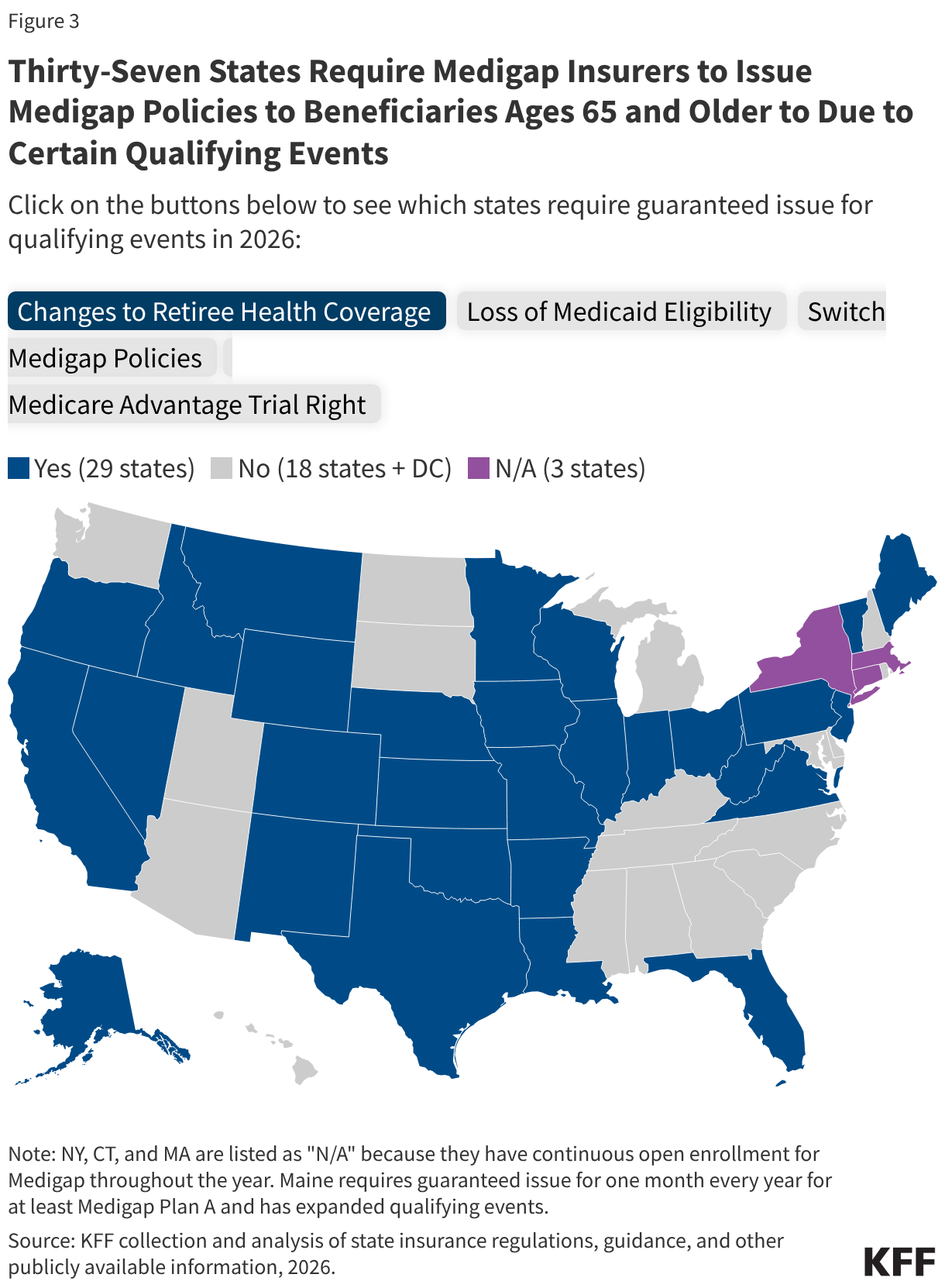
Twenty of these states provide guaranteed issue protections for current Medigap policyholders who want to switch policies (Figure 3, Appendix Table 1):
- Sixteen states have what are called “birthday rules” (CA, DE, ID, IL, IN, KY, LA, MD, NV, NM, OK, OR, UT, VA, WV, WY), which require Medigap insurers to allow current policyholders to switch each year to a different Medigap policy with equal or lesser benefits from either the same or different insurance carrier, depending on the state, around the time of their birthday. Depending on the state, these Medigap policyholders have between 30 and 63 days to switch policies. (This allowance does not enable beneficiaries who do not already have Medigap to newly purchase a Medigap policy).
- Rhode Island requires Medigap insurers to allow current Medigap policyholders to switch to any Medigap policy made available by any insurer during the Medicare open enrollment period.
- Missouri requires Medigap insurers to allow current Medigap policyholders to switch to an equivalent policy from a different insurer within 30 days before or after the annual anniversary date of their policy.
- Maine requires Medigap insurers to allow current Medigap policyholders to switch to a policy with equal or less generous benefits at any time during the year if there is less than a 90-day gap in coverage.
- Washington requires Medigap insurers to allow Medigap policyholders to switch to a policy with equal or less generous benefits at any time during the year if there is less than a 90-day gap in coverage, though policyholders with Medigap Plan A are limited to switching to another Plan A, while those with Plans B through N can switch to any other Plan B through N.
Thirty-Eight States Require Medigap Insurers to Offer an Initial Guaranteed Issue Period to Purchase Medigap to People Under Age 65 with Disabilities
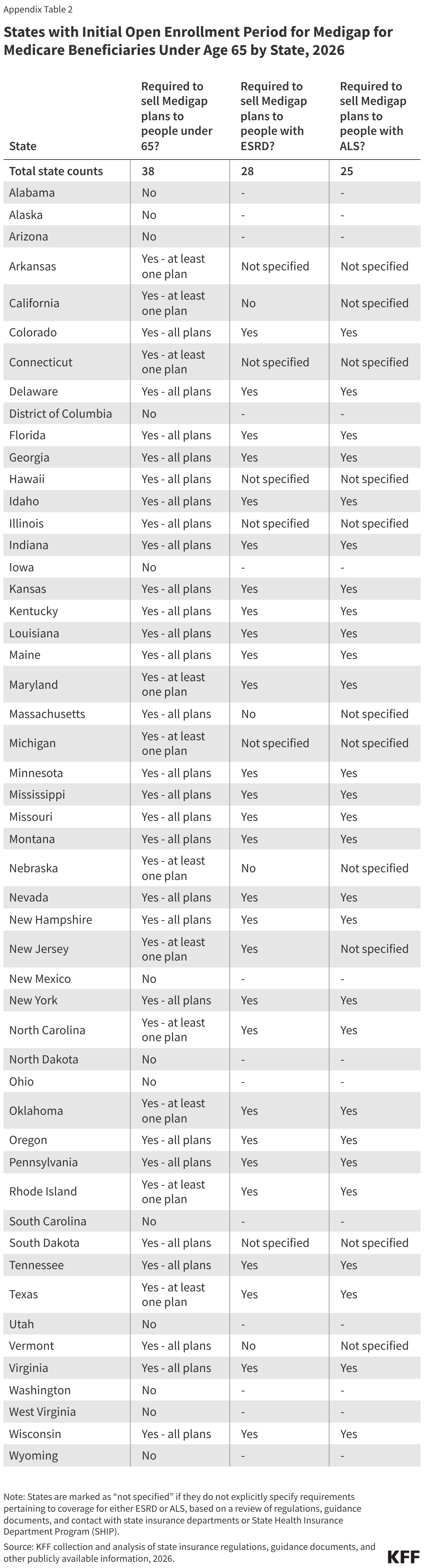
Thirty-eight states require insurers to issue at least one kind of Medigap policy to beneficiaries under age 65, typically through an initial open enrollment period (Figure 4, Appendix Table 2). Of these 38 states, 27 require insurers to sell all plan types to people under age 65 during the guaranteed issue period. The remaining 12 states and DC do not require insurers to sell a Medigap policy to people under age 65 with disabilities, including people with ESRD and ALS.
Requirements for People with ESRD and ALS:
Of the 38 states that require insurers to issue at least one kind of Medigap policy to people under age 65 with disabilities, 28 states explicitly require insurers to also sell these policies to people with ESRD and 25 states specify they must be sold to people with ALS. Four states (CA, MA, VT, and NE) explicitly state that insurers are not required to sell policies to people with ESRD, and the remaining six states are silent on whether insurers must sell at least one policy to people with ESRD. Thirteen states (including CA, MA, and VT) are silent on whether insurers must sell policies to people with ALS.
The same four states that have expanded Medigap guaranteed issue rights most broadly for beneficiaries ages 65 and older also require broader access to Medigap for people under age 65.
In addition to offering an initial guaranteed issue period to purchase Medigap, Massachusetts, Maine, New York, and Connecticut require continuous or annual guaranteed protections for people under age 65 with disabilities, though with slightly different requirements than for people ages 65 and older: in Massachusetts, insurers are not required to issue policies to people with ESRD, while in Connecticut, insurers must issue Plan A to people under age 65, as well as Plans B, C, and/or D for insurers that sell these plan types to people ages 65 and older. In Maine, all Medigap plan types must be available to beneficiaries under age 65 with disabilities during the open enrollment period, but after this period, insurers are only required to issue Medigap Plan A to beneficiaries under age 65 during the one-month open enrollment period that happens each year (the same as for people ages 65 and older).
Another three states provide more expansive Medigap guaranteed issue protections for people under age 65.
In Rhode Island, in addition to an initial enrollment period for people under 65 to purchase plan A, Medicare Advantage enrollees under age 65 are afforded an annual guaranteed issue period to purchase plan A. In Delaware, in addition to an initial enrollment period for people under 65 to purchase Medigap, Medicare Advantage enrollees under 65 who try to enroll in Medigap outside this period cannot be denied a Medigap plan, though insurers may charge higher premiums based on medical underwriting and a 6-month waiting period to cover services related to pre-existing conditions is permitted. In both states, these protections do not apply to people under 65 who are in traditional Medicare and outside their initial enrollment period. In Illinois, in addition to an initial enrollment period for people under 65 to purchase Medigap, beneficiaries under 65 can purchase a Medigap plan from Blue Cross Blue Shield annually from October 15 to December 7.
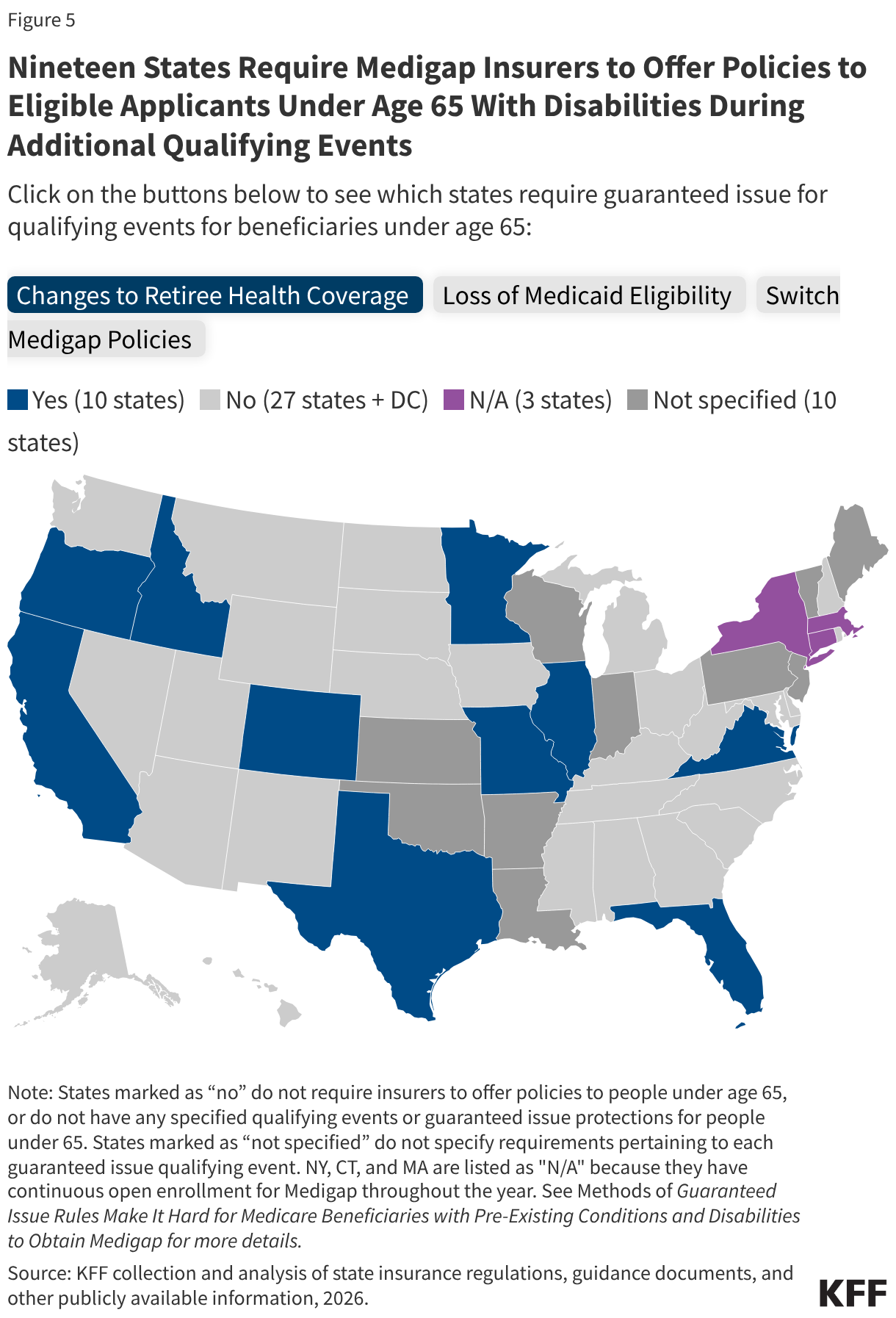
19 of the 38 States That Require Medigap Insurers to Offer Policies to Eligible Applicants Under Age 65 During an Initial Open Enrollment Period Also Do So for Certain Qualifying Events
Nineteen states require Medigap insurers to offer policies to eligible applicants under age 65 based on certain qualifying events (Figure 5, Appendix Table 3):
- Ten states require Medigap insurers to issue policies when an applicant under age 65 has a change in their employer retiree coverage – the same states that also offer guaranteed issue rights for applicants ages 65 and older who have a change in their employer (retiree) coverage. However, some states have more restrictive policies for people under age 65. For example, in Texas, this guaranteed issue right applies only for Medigap Plan A for people under age 65 with ESRD or ALS (this right does not apply to those under 65 with other disabilities).
- Eight states require insurers to issue Medigap policies to beneficiaries under age 65 who lose their Medicaid eligibility. These eight states also offer the same guaranteed issue protections for people ages 65 and older, but in the case of Texas, the guaranteed issue right for people under age 65 applies only in the case of Plan A for people under age 65 with ESRD or ALS (this right does not apply to those under 65 with other disabilities).
- Eleven states provide guaranteed issue protections for current Medigap policyholders who want to switch policies, including seven states that require Medigap insurers to allow Medigap policyholders under age 65 to switch to a policy with equal or less generous benefits (e.g., under “birthday rules”).
- Some states have other types of qualifying events for beneficiaries under age 65:
- Illinois extends the same federal Medicare Advantage guaranteed issue protections that are available to people ages 65 and older, to people under age 65 in the state. For example, Medicare Advantage enrollees under age 65 in Illinois who move out of their Medicare Advantage plan’s service area, or whose Medicare Advantage plan goes out business, have a 6-month guaranteed issue right to purchase a Medigap policy.
- Oregon requires that insurers offer a guaranteed issue period to individuals who move to Oregon from a state that does not require Medigap insurers to issue policies to people under age 65.
Methods
The state-level analyses on guaranteed issue protections for people ages 65 and older and people under age 65 with disabilities are based on a review of each state’s regulations, guidance documents/manuals, directives, and other publicly accessible government-issued documents.
Additionally, KFF staff contacted states’ insurance departments or State Health Insurance State Health Insurance Department Program (SHIP) offices for clarity in cases where publicly accessible documents were silent on a particular issue.
For the state-level analysis for people ages 65 and older:
- States are marked as “no” if their regulations or other publicly accessible documents do not specify any additional qualifying events (beyond the federal standard).
For the state-level analysis for people under age 65:
- States are marked as “no” to having any special qualifying events if 1) they do not require insurers to offer Medigap policies to people under age 65, or 2) they do not have any specified qualifying events or guaranteed issued protections for people under age 65, based on KFF review of state regulations, guidance documents, and contact with insurance departments or State Health Insurance Department Program (SHIP).
- States are marked as “not specified” if publicly accessible documents do not specify requirements pertaining to each guaranteed issue qualifying event. These qualifying events were identified based on whether they are available to people 65 and older in that state.
Although best efforts were made to check each state’s regulations, guidance documents, and call insurance departments/SHIP offices, it is possible that states marked as “not specified” have rules that were not identified by the research team.
Appendix