Racial Equity and Health Policy

Survey of Immigrants

KFF-New York Times Survey: Immigrants Report Rising Fear, Negative Economic and Health Impacts, and Changing Political Views During the First Year of President Trump’s Second Term

The 2025 Survey of Immigrants, a partnership between KFF and The New York Times, takes an in-depth look at the experiences of immigrants during the first year of President Trump’s second term, including their worries related to increased immigration enforcement, their health and economic wellbeing, and the political views and preferences of immigrant voters. The survey paints a portrait of families under strain — where fear of detention and economic instability are negatively impacting immigrants’ health and reshaping immigrant families’ daily lives and views of U.S. political parties.

Read the News Release | Explore The New York Times’ Reporting
the Essentials
  • Disparities in Health and Health Care: 5 Key Questions and Answers

    This brief provides an introduction to what health and health care disparities are, why it is important to address them, what the status of disparities is today, recent federal actions to address disparities, and key issues related to addressing disparities in the future.
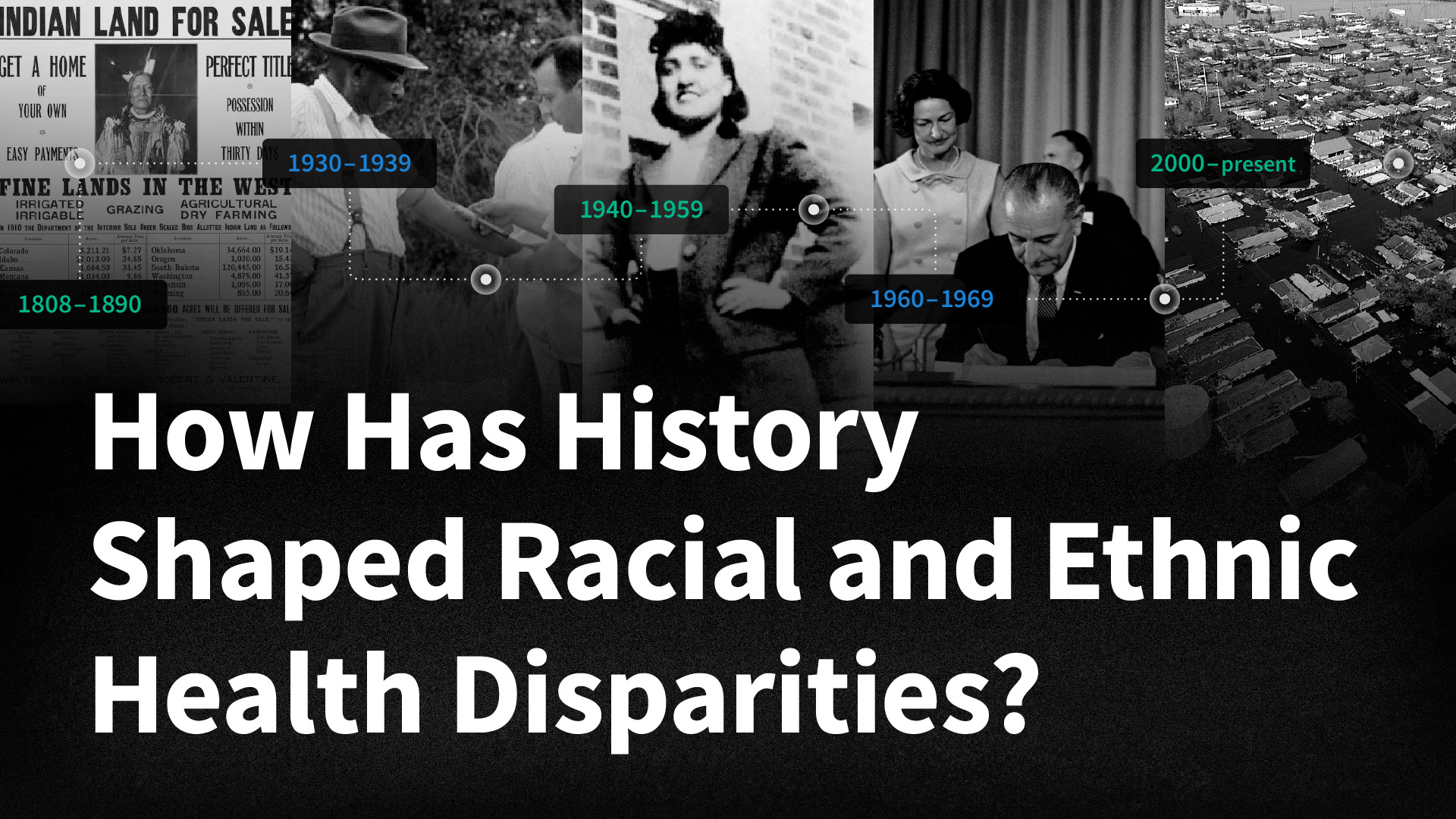
  • Timeline: How History Has Shaped Racial and Ethnic Health Disparities

    This timeline offers a historical view of significant U.S. federal policies and events spanning the early 1800s to today that have influenced present-day health disparities.
  • Health Policy 101: Chapter on Race, Inequality and Health

    Addressing persistent racial and ethnic disparities in health and health care is important for improving the nation’s health and economic prosperity. KFF explains such disparities and the factors that drive them, examines the actions to address them, and outlines future considerations.
  • Key Data on Health and Health Care by Race and Ethnicity

    Racial and ethnic disparities in health and health care remain a persistent challenge in the United States. An updated KFF resource examines how people of color fare compared to White people across 64 measures of health, health care, and social determinants of health.

Subscribe to KFF Emails

Choose which emails are best for you.
Sign up here

Filter

81 - 90 of 599 Results

  • State Policies Connecting Justice-Involved Populations to Medicaid Coverage and Care

    Issue Brief

    The COVID-19 pandemic has magnified pre-existing health disparities for justice-involved populations, with coronavirus infection rates among incarcerated populations higher than overall infection rates in nearly all states. Justice-involved individuals are disproportionately low-income and often have complex and/or chronic conditions, including behavioral health needs. Although the statutory inmate exclusion policy prohibits Medicaid from covering services provided during incarceration (except for inpatient services), states may take other steps to leverage Medicaid to improve continuity of care for justice-involved individuals.

  • Rethinking the Use of Race in Medicine

    News Release

    The COVID-19 pandemic has shined a spotlight on racial disparities in health and health care, but disparities are hardly new. They have been driven by longstanding inequities within and beyond the health care system that are rooted in racism.

  • Racial Disparities in Cancer Outcomes, Screening, and Treatment

    Issue Brief

    This brief provides an overview of recent data on cancer incidence and mortality, risk factors, screening, treatment, and outcomes by race and ethnicity. Racial disparities in cancer incidence and outcomes are well-documented, with research showing that they are driven by a combination of structural, economic, and socioenvironmental inequities that are rooted in racism and discrimination, as well as genetic and hereditary factors that may be influenced by the environment.

  • Health and Health Coverage in the South: A Data Update

    Issue Brief

    This brief provides key data on the South and the current status of health and health coverage in the South to provide greater insight into the health needs in the region and the potential coverage gains that may be achieved through the ACA. It includes data on the uninsured, Medicaid expansion and eligibility for coverage.

  • Kaiser Health Tracking Poll: February 2013

    Feature

    The February Kaiser Health Tracking Poll focuses on some of the health policy implications of this winter’s national debate over gun violence, gun control and the adequacy of the nation’s response to the needs of those living with serious mental illness. The survey finds that one in five Americans have some connection to a victim of gun violence, a share that doubles to 42 percent among blacks.

  • Pulling it Together: About Kaiser Health News

    Perspective

    There is lots of apocalyptic talk these days about the collapse of the newspaper industry and the challenges facing news organizations.  There is even talk of the unimaginable, my hometown paper The Boston Globe shutting down. Surely they know that Red Sox Nation cannot exist without the Globe Sports pages.

  • Kaiser Health Security Watch

    Feature

    The Kaiser Health Security Watch uses Kaiser Health Tracking Poll data to measure the public's health care-related problems and worries, including problems paying medical bills, skipping or delaying health care due to cost, and worrying about their future ability to pay for care and keep insurance.