Racial Equity and Health Policy

Survey of Immigrants

KFF-New York Times Survey: Immigrants Report Rising Fear, Negative Economic and Health Impacts, and Changing Political Views During the First Year of President Trump’s Second Term

The 2025 Survey of Immigrants, a partnership between KFF and The New York Times, takes an in-depth look at the experiences of immigrants during the first year of President Trump’s second term, including their worries related to increased immigration enforcement, their health and economic wellbeing, and the political views and preferences of immigrant voters. The survey paints a portrait of families under strain — where fear of detention and economic instability are negatively impacting immigrants’ health and reshaping immigrant families’ daily lives and views of U.S. political parties.

Read the News Release | Explore The New York Times’ Reporting
the Essentials
  • Disparities in Health and Health Care: 5 Key Questions and Answers

    This brief provides an introduction to what health and health care disparities are, why it is important to address them, what the status of disparities is today, recent federal actions to address disparities, and key issues related to addressing disparities in the future.
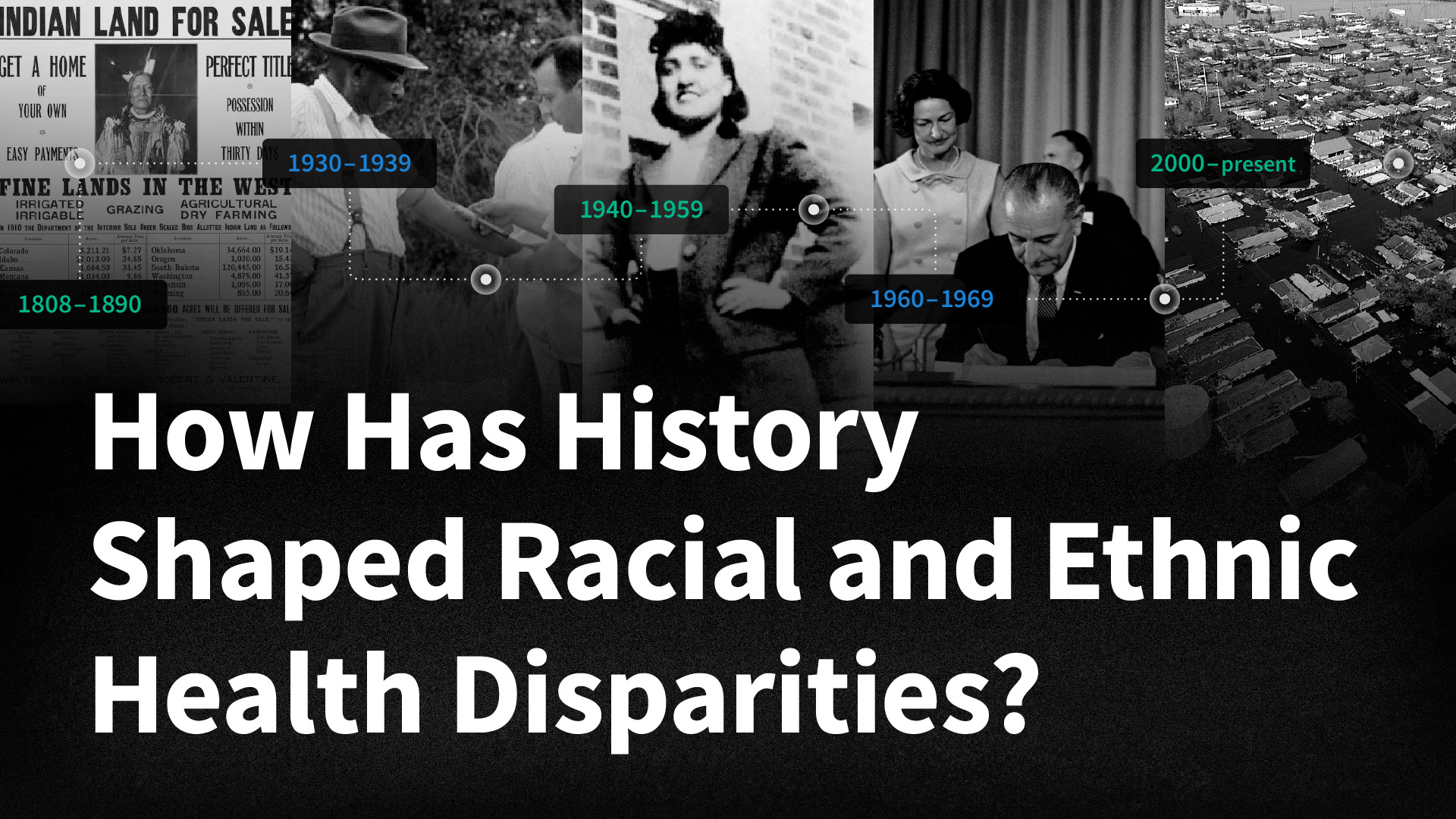
  • Timeline: How History Has Shaped Racial and Ethnic Health Disparities

    This timeline offers a historical view of significant U.S. federal policies and events spanning the early 1800s to today that have influenced present-day health disparities.
  • Health Policy 101: Chapter on Race, Inequality and Health

    Addressing persistent racial and ethnic disparities in health and health care is important for improving the nation’s health and economic prosperity. KFF explains such disparities and the factors that drive them, examines the actions to address them, and outlines future considerations.
  • Key Data on Health and Health Care by Race and Ethnicity

    Racial and ethnic disparities in health and health care remain a persistent challenge in the United States. An updated KFF resource examines how people of color fare compared to White people across 64 measures of health, health care, and social determinants of health.

Subscribe to KFF Emails

Choose which emails are best for you.
Sign up here

Filter

591 - 600 of 601 Results

  • Data as of February 1 on State Vaccinations by Race/Ethnicity

    News Release

    Updated analysis of state-reported data as of February 1, 2021 on COVID-19 vaccinations, cases, and deaths by race/ethnicity is now available. Based on nearly half of states reporting vaccination data by race/ethnicity, Black and Hispanic people continue to receive smaller shares of vaccinations compared to their shares of cases and deaths and compared to their proportions of the total population. In all 23 states reporting data, Black people account for a smaller share of vaccinations compared…

  • Health and Health Care Experiences of Hispanic Adults

    Poll Finding

    The COVID-19 pandemic has exposed and exacerbated longstanding underlying disparities in health and health care facing Hispanic people. Using data from the COVID-19 Vaccine Monitor, this report provides insights into the health care experiences of Hispanic adults and examines how they vary by key factors, including insurance and immigration status.

  • Medicaid Authorities and Options to Address Social Determinants of Health

    Issue Brief

    Social determinants of health (SDOH) are the conditions in which people are born, grow, live, work and age. While there are limits, states can use Medicaid – which, by design, serves a primarily low-income population with greater social needs – to address social determinants of health. This brief outlines the range of Medicaid authorities and flexibilities that can be used to add benefits and design programs to address the social determinants of health.

  • Addressing Racial Equity in Vaccine Distribution

    Issue Brief

    This brief provides an overview of barriers to vaccination that disproportionately affect people of color and discusses how current national recommendations and state vaccine allocation plans address racial equity.

  • Web Briefing: Racism and Discrimination in Health Care – Experiences Today and Actions to Address Going Forward

    Event Date:
    Event

    Approaching the end of 2020, two of the most pressing concerns facing the country are the long-standing issue of racial discrimination and the ongoing coronavirus pandemic. The issues have merged with the pandemic taking a disproportionate health and economic toll on people of color. As vaccines become available, prioritizing racial equity will become increasingly important for mitigating these disparities and preventing further widening of the going forward, especially as early polling indicates that people of…

  • KFF COVID-19 Vaccine Monitor: December 2020

    Report

    This initial survey for the KFF COVID-19 Vaccine Monitor tracks the public’s attitudes and experiences with COVID-19 vaccinations, with a focus on sub-groups of Americans. It explores confidence in vaccines, assesses trust in messengers, and highlights key challenges for vaccination efforts.

  • KFF Launches New COVID-19 Vaccine Monitor to Track the Public’s Confidence in the Vaccine and Experiences for the Duration of the Pandemic

    News Release

    Republicans and Black Americans are More Likely to Be Hesitant but Even Among These Groups Reasons Vary KFF has launched a new COVID-19 Vaccine Monitor to dive deeply into the public’s views about the vaccine and experiences getting it for as long as the pandemic lasts. First results released today show that Americans’ enthusiasm for getting a COVID-19 vaccination varies substantially across groups, with Republicans and Black Americans among those most hesitant. Overall, 71% of…

  • Hispanic People are Facing Widening Gaps in Health Coverage

    Policy Watch

    New analysis shows that, in 2019, the number of uninsured continued to increase for the third year in a row. Much of the coverage loss between 2018 and 2019 was among Hispanic people, and these data point to significant increased barriers to health care for Hispanic people.