Racial Equity and Health Policy

the Essentials
  • How Experiencing Racial Discrimination Impacts Health

    This brief highlights research examining mechanisms underlying health outcomes linked to self-reported experiences of racial discrimination, including biological changes, chronic stress, mental health, substance use, pregnancy-related outcomes, and sleep.
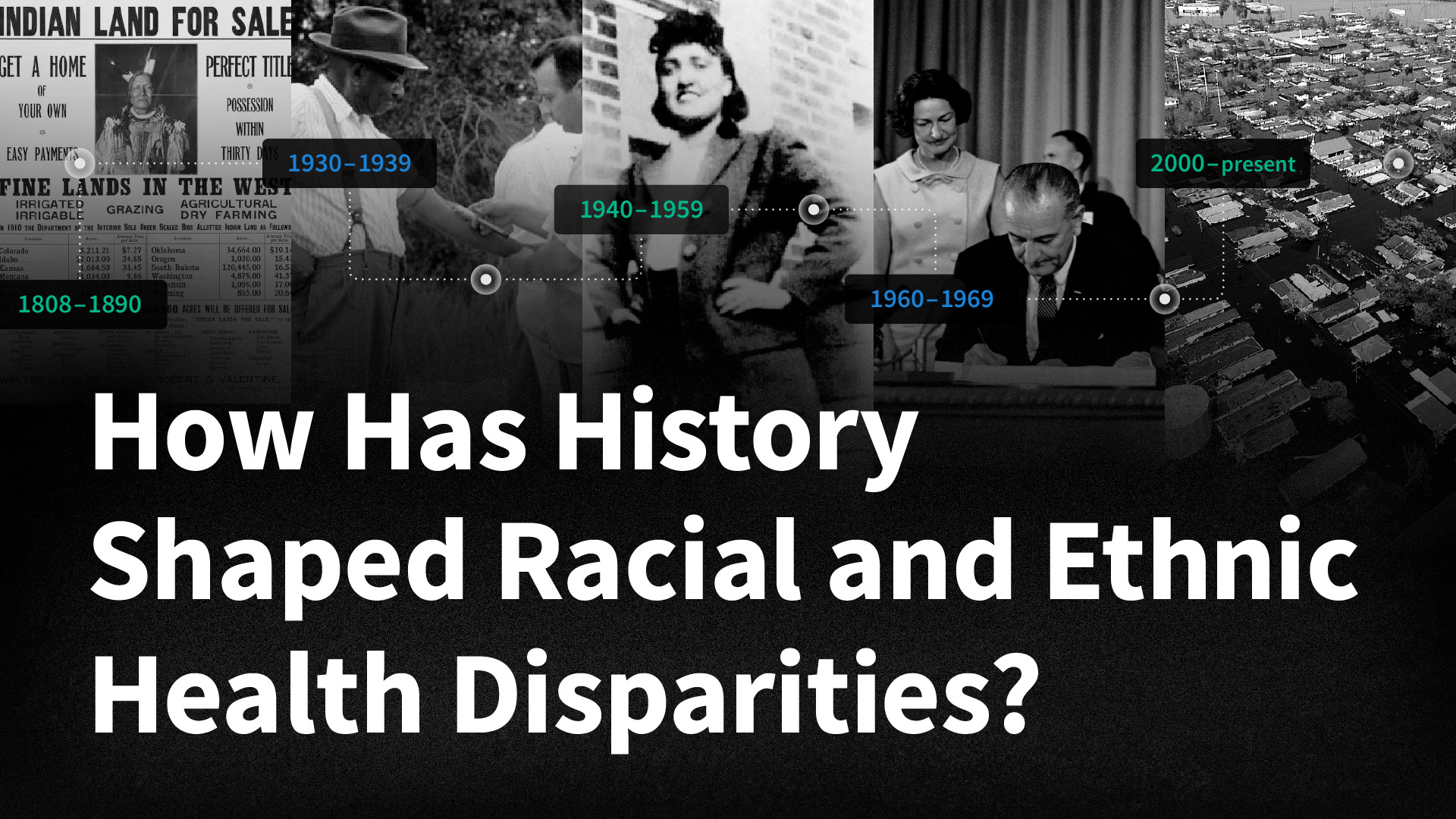
  • Timeline: How History Has Shaped Racial and Ethnic Health Disparities

    This timeline offers a historical view of significant U.S. federal policies and events spanning the early 1800s to today that have influenced present-day health disparities.
  • Health Policy 101: Chapter on Race, Inequality and Health

    Addressing persistent racial and ethnic disparities in health and health care is important for improving the nation’s health and economic prosperity. KFF explains such disparities and the factors that drive them, examines the actions to address them, and outlines future considerations.
  • Key Data on Health and Health Care by Race and Ethnicity

    Racial and ethnic disparities in health and health care remain a persistent challenge in the United States. An updated KFF resource examines how people of color fare compared to White people across 64 measures of health, health care, and social determinants of health.

Survey of Immigrants

KFF-New York Times Survey: Immigrants Report Rising Fear, Negative Economic and Health Impacts, and Changing Political Views During the First Year of President Trump’s Second Term

The 2025 Survey of Immigrants, a partnership between KFF and The New York Times, takes an in-depth look at the experiences of immigrants during the first year of President Trump’s second term, including their worries related to increased immigration enforcement, their health and economic wellbeing, and the political views and preferences of immigrant voters. The survey paints a portrait of families under strain — where fear of detention and economic instability are negatively impacting immigrants’ health and reshaping immigrant families’ daily lives and views of U.S. political parties.

Read the News Release | Explore The New York Times’ Reporting
Stay informed.

Stay informed.

Filter

551-560 of 605 results

  • National Survey of Physicians Part I: Doctors on Disparities in Medical Care

    Other Post

    Selected findings from the Kaiser Family Foundation's forthcoming National Survey of Physicians reveal that most physicians are aware of racial disparities in medical treatment for specific conditions, but they don't believe it is a widespread problem. In sharp contrast, African American physicians disagree with their fellow physicians with nearly eight in ten (77%) believing race and ethnicity impact how people are treated at least somewhat often. Physicians see insurance status as a key determinate of…

  • Latinos and HIV/AIDS in the United States

    Other Post

    Capitol Hill Briefing HIV remains a leading cause of death among Latinos in the United States, and Latinos with HIV are less likely than whites to receive early care. The rate of AIDS cases among Latinos is almost four times the rate among whites. In addition, Latinos face many unique hurdles to reducing the impact of HIV/AIDS in their communities. Representative Ciro D. Rodriguez (D-Texas) delivers the opening remarks and Ingrid M. Duran, president and…

  • Women’s Health Data Book: A Profile of Women’s Health in the United States

    Fact Sheet

    The Women's Health Data Book: A Profile of Women's Health in the United States, offers the latest data and trends on the wide range of health issues that affect women across their life spans. Published by the Kaiser Family Foundation and the Jacobs Institute of Women's Health, the Data Book is edited by Dawn Misra, Ph.D. This book addresses social and economic factors and provides up-to-date information on chronic conditions, reproductive health, mental health, violence,…

  • Disparities in Women’s Health

    Other Post

    Disparities in Women's Health Disparities in health and health care continue to burden women, particularly affecting women of color or those who are poor. To shed more light on the factors contributing to inequalities in health and access to care for women, the Kaiser Family Foundation provided support for the newest issue of the Journal of the American Medical Women's Association (JAMWA) Disparities in Women's Health. This special issue features an editorial by Surgeon General…

  • Urban Indian Health

    Report

    More than half (57%) of the 2.5 million people who identify themselves solely as American Indian and Alaska Native in the 2000 Census live in metropolitan areas. This issue brief describes the large and growing urban Indian population, their health status, and the major federal health programs and federal-state programs that are available to improve Native Americans' access to needed health services. Report Introductory Letter  

  • Key Facts: Latinos and HIV/AIDS

    Report

    This report provides an overview of the impact of the HIV/AIDS epidemic on Latinos in the United States. It presents current snapshots and trends over time, drawing from recent data and research on the epidemiology of HIV/AIDS among Latinos, including data on AIDS cases and deaths; health services use and coverage; and attitudinal data from a recent national survey. 6008

  • African Americans  Views of the HIV/AIDS Epidemic at 20 Years:  Findings from a National Survey

    Poll Finding

    This report, African Americans Views of the HIV/AIDS Epidemic at 20 Years: Findings from a National Survey, examines African Americans views and knowledge of HIV/AIDS, including analysis by race/ethnicity, of trends over time, and among African American subgroups. The report is based a nationally representative survey of 2,683 adults, ages 18 and older, including 431 African Americans. This report serves as a companion document to The AIDS Epidemic at 20 Years: The View From America.…

  • Latinos  Views of the HIV/AIDS Epidemic at 20 Years:  Findings from a National Survey

    Poll Finding

    This report, Latinos Views of the HIV/AIDS Epidemic at 20 Years: Findings from a National Survey, examines Latinos views and knowledge of HIV/AIDS, including analysis by race/ethnicity, of trends over time, and among Latino subgroups. The report is based a nationally representative survey of 2,683 adults, ages 18 and older, including 549 Latinos. Interviews were completed in both English and Spanish according to respondent preference, and the report is available in both English and Spanish.…

  • The AIDS Epidemic at 20 Years: THE VIEW FROM AMERICA Survey

    Report

    Twenty years into the AIDS epidemic, the Kaiser Family Foundation conducted its most recent survey of Americans about HIV/AIDS. This report summarizes the key findings from the survey, including analysis of trends over time and across race/ethnicity, age, and gender. It describes Americans' concerns about HIV/AIDS as a personal, national, and global issue. It also assesses Americans' knowledge about HIV/AIDS, their information needs, and their perspective on important policy issues and spending priorities. Report (.pdf) Timeline (.pdf)…