Racial Equity and Health Policy

the Essentials
  • Health Coverage by Race and Ethnicity, 2010-2024

    There have been longstanding racial and ethnic disparities in health coverage that contribute to disparities in health. This brief examines trends in health coverage by race and ethnicity from 2010 through 2024 and discusses the implications for such disparities.
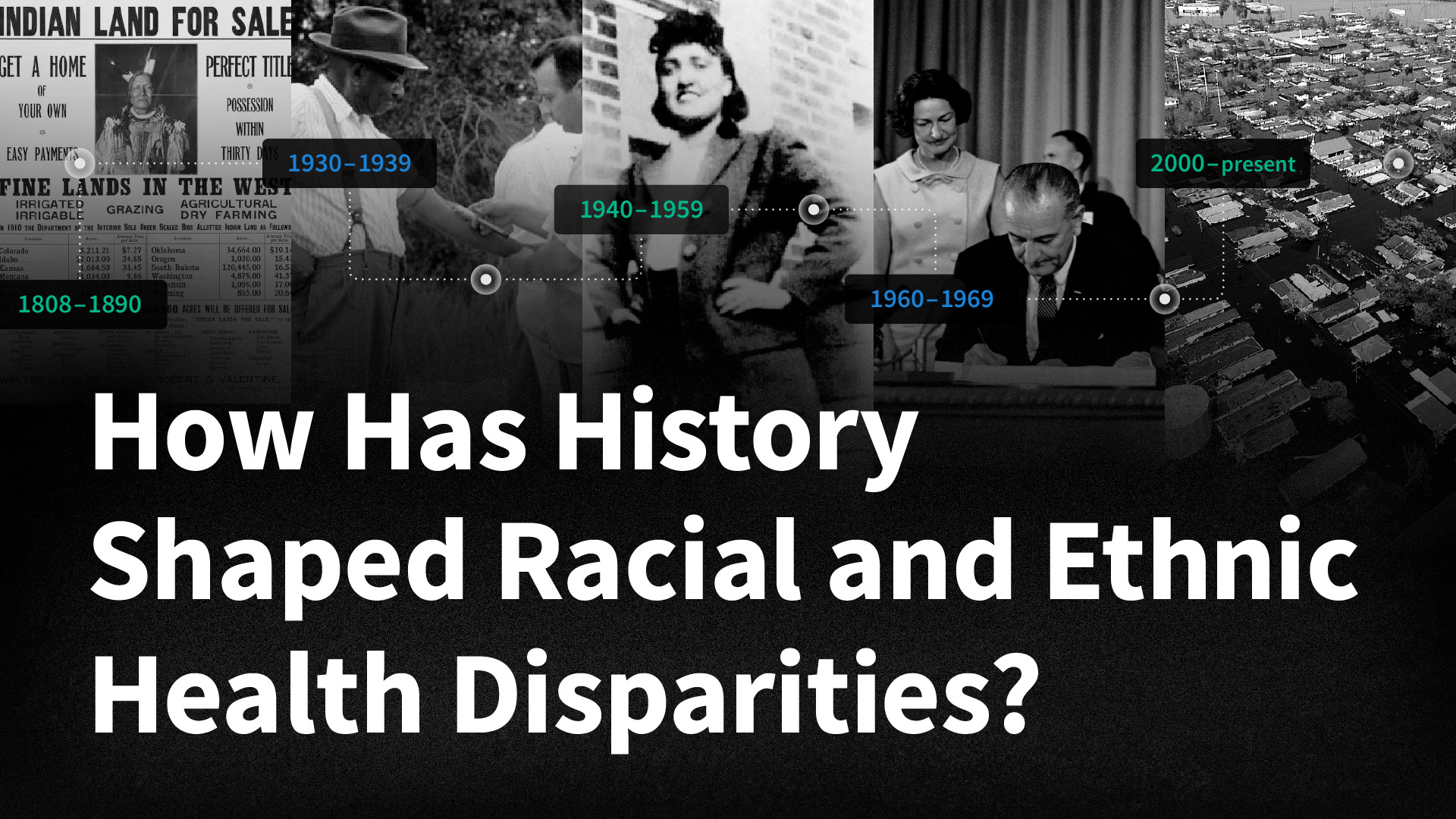
  • Timeline: How History Has Shaped Racial and Ethnic Health Disparities

    This timeline offers a historical view of significant U.S. federal policies and events spanning the early 1800s to today that have influenced present-day health disparities.
  • Health Policy 101: Chapter on Race, Inequality and Health

    Addressing persistent racial and ethnic disparities in health and health care is important for improving the nation’s health and economic prosperity. KFF explains such disparities and the factors that drive them, examines the actions to address them, and outlines future considerations.
  • Key Data on Health and Health Care by Race and Ethnicity

    Racial and ethnic disparities in health and health care remain a persistent challenge in the United States. An updated KFF resource examines how people of color fare compared to White people across 64 measures of health, health care, and social determinants of health.

Survey of Immigrants

KFF-New York Times Survey: Immigrants Report Rising Fear, Negative Economic and Health Impacts, and Changing Political Views During the First Year of President Trump’s Second Term

The 2025 Survey of Immigrants, a partnership between KFF and The New York Times, takes an in-depth look at the experiences of immigrants during the first year of President Trump’s second term, including their worries related to increased immigration enforcement, their health and economic wellbeing, and the political views and preferences of immigrant voters. The survey paints a portrait of families under strain — where fear of detention and economic instability are negatively impacting immigrants’ health and reshaping immigrant families’ daily lives and views of U.S. political parties.

Read the News Release | Explore The New York Times’ Reporting
Subscribe to KFF Emails

Choose which emails are best for you.
Sign up here

Filter

531 - 540 of 602 Results

  • D.C. Health Care Access Survey, 2003

    Report

    The Henry J. Kaiser Family Foundation District of Columbia Health Care Access Survey, 2003, is based on a representative sample of 1,581 adults, ages 18 and older, living in Washington, DC. The survey is intended to inform discussion of health care issues in the District of Columbia by examining the views and experiences of some of the city's most vulnerable populations, as well as the general population. It provides an opportunity to assess health care…

  • National Survey of Latinos: Politics and Civic Participation, Summary and Chartpack

    Poll Finding

    The chartpack and summary of findings from a comprehensive survey that assesses Latino attitudes in the 2004 election year. The third annual survey of Latinos from the Pew Hispanic Center and the Kaiser Family Foundation, the new survey examines political issues and the presidential election campaign, the economy, health care, Iraq and immigration. Summary and Chartpack (.pdf)

  • Survey of Asians in the Bay Area

    Report

    Survey of Asians In the Bay Area This survey explores the attitudes and experiences of the Asian community in the Bay Area, which has the largest Asian population in the country. The Kaiser Family Foundation and San Jose Mercury News collaborated on the survey. The Bay Area is home to the largest Asian population in the continental United States. In 2002, the census estimated that roughly one in five Bay Area adults was of Asian…

  • Racial Ethnic Difference in Cardiac Care:  The Weight of the Evidence

    Fact Sheet

    Racial Ethnic Difference in Cardiac Care: The Weight of the Evidence Numerous studies over the past two decades have documented racial and ethnic differences in care for heart conditions. To assess the quality of the evidence and to summarize the information for a physician audience, the Henry J. Kaiser Family Foundation collaborated with the American College of Cardiology Foundation to review the body of research on racial/ethnic differences in cardiac care. There is credible evidence…

  • How Do Patterns of Prescription Drug Coverage and Use Differ for White, African American, and Latino Medicare Beneficiaries Under 65 and 65+

    Report

    This chartpack provides a snapshot of racial/ethnic differences in Medicare beneficiaries? prescription drug coverage, use, and spending. It examines patterns separately for beneficiaries under age 65 and 65+. The summary discusses the relevance of the key findings to the current policy debates about prescription drug coverage. Chartpack (.pdf)

  • Key Facts: HIV/AIDS and African Americans

    Other Post

    provides an overview of recent data and research on the impact of the HIV/AIDS epidemic on African Americans. The Key Facts document also presents trends in the HIV/AIDS epidemic over time, racial differences in the access to and quality of HIV/AIDS services and includes the attitudes toward and perceptions of HIV/AIDS by race. Report

  • Welfare Reform and American Indian Tribes

    Fact Sheet

    American Indian tribes have new options under the 1996 Welfare Reform legislation that created Temporary Assistance for Needy Families (TANF), a block grant enacted to replace the Aid to Families with Dependent Children (AFDC). TANF, which expires in September of this year, provides cash assistance to poor families with children, including poor American Indian Families, and gives tribes the option to design and administer their own family assistance programs following approval of the plan by…

  • Welfare Reform and Elderly Legal Immigrants – Report

    Report

    Welfare Reform and Elderly Legal Immigrants Prepared by: Robert B. Friedland and Veena Pankaj National Academy on Aging, Washington DC July 1997 Prepared for: The Henry J. Kaiser Family Foundation The Henry J. Kaiser Family Foundation, based in Menlo Park, California, is an independentnational health philanthropy and is not associated with Kaiser Permanente or Kaiser Industries. Established in 1948 by industrialist Henry J. Kaiser and his wife Bess, the Foundation focusesits work on four main…