Racial Equity and Health Policy

the Essentials
  • How Experiencing Racial Discrimination Impacts Health

    This brief highlights research examining mechanisms underlying health outcomes linked to self-reported experiences of racial discrimination, including biological changes, chronic stress, mental health, substance use, pregnancy-related outcomes, and sleep.
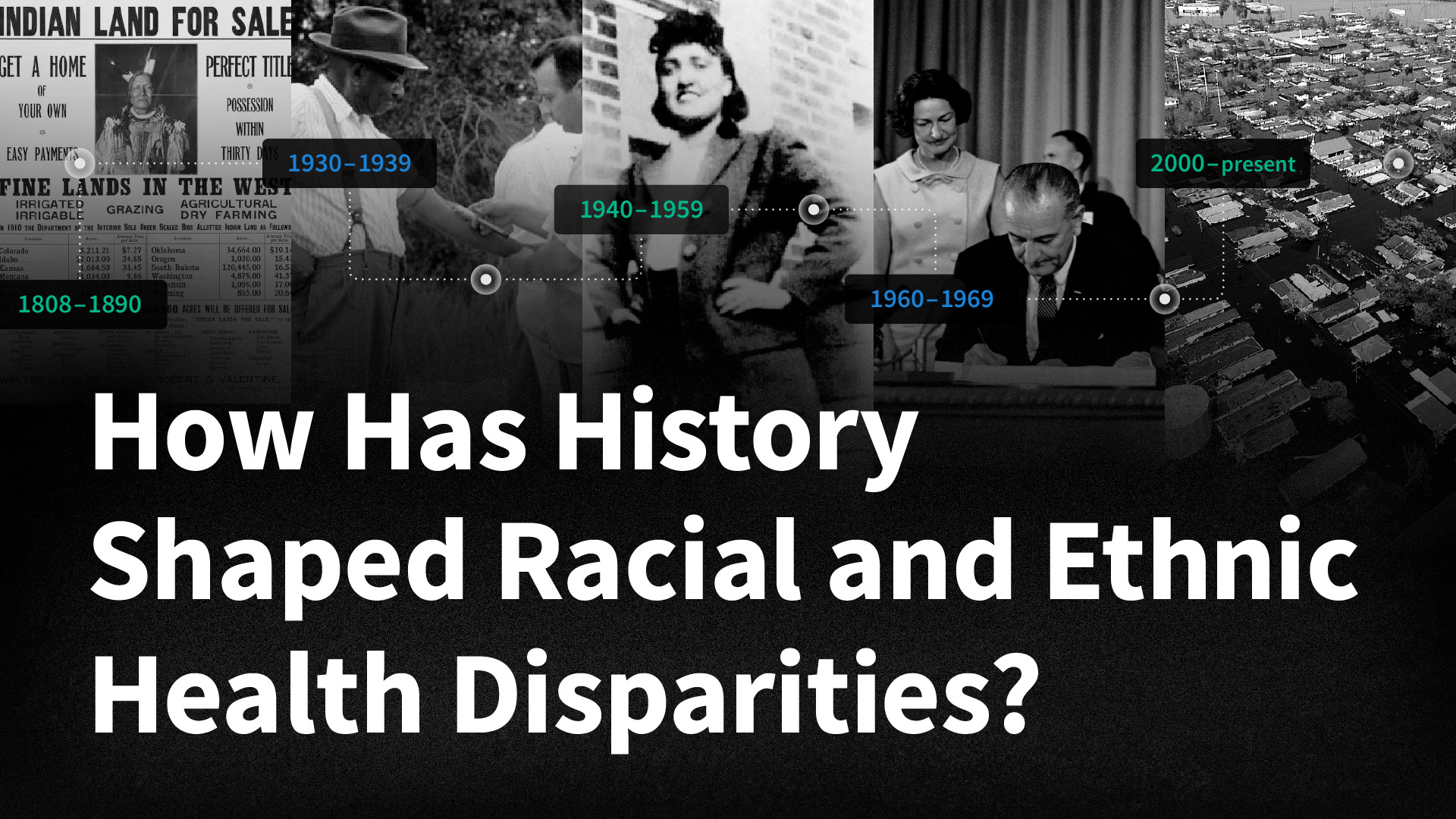
  • Timeline: How History Has Shaped Racial and Ethnic Health Disparities

    This timeline offers a historical view of significant U.S. federal policies and events spanning the early 1800s to today that have influenced present-day health disparities.
  • Health Policy 101: Chapter on Race, Inequality and Health

    Addressing persistent racial and ethnic disparities in health and health care is important for improving the nation’s health and economic prosperity. KFF explains such disparities and the factors that drive them, examines the actions to address them, and outlines future considerations.
  • Key Data on Health and Health Care by Race and Ethnicity

    Racial and ethnic disparities in health and health care remain a persistent challenge in the United States. An updated KFF resource examines how people of color fare compared to White people across 64 measures of health, health care, and social determinants of health.

Survey of Immigrants

KFF-New York Times Survey: Immigrants Report Rising Fear, Negative Economic and Health Impacts, and Changing Political Views During the First Year of President Trump’s Second Term

The 2025 Survey of Immigrants, a partnership between KFF and The New York Times, takes an in-depth look at the experiences of immigrants during the first year of President Trump’s second term, including their worries related to increased immigration enforcement, their health and economic wellbeing, and the political views and preferences of immigrant voters. The survey paints a portrait of families under strain — where fear of detention and economic instability are negatively impacting immigrants’ health and reshaping immigrant families’ daily lives and views of U.S. political parties.

Read the News Release | Explore The New York Times’ Reporting
Stay informed.

Stay informed.

Filter

41 - 50 of 603 Results

  • Living in an Undocumented Immigrant Family Under the Second Trump Administration: Fear, Uncertainty, and Impacts on Health and Well-Being

    Issue Brief

    During his second term, President Trump has implemented an array of immigration policy changes focused on restricting immigration and increasing interior immigration enforcement efforts. These policy changes include restrictions on both lawful and unlawful immigration into the U.S., increased interior enforcement activities to support mass deportation, attempts to end birthright citizenship for the children of noncitizen immigrants, and rescinding protections against enforcement action in previously protected areas such as schools, churches, and health care facilities.…

  • KFF/ESPN Survey of 1988 NFL Players

    Poll Finding

    The Survey of 1988 NFL players, conducted by KFF in partnership with ESPN, looks at the overall health and well-being of former professional football players who played in the 1988 NFL season. While many are grappling with the immense toll the sport has taken on their physical and neurological health, most say they would do it all over again.

  • How the Use of Race in Clinical Care Can Contribute to Health Care Disparities

    News Release

    A new KFF brief examines the use of racial classification in medical care and teaching and identifies how these practices can contribute to ongoing racial disparities in health and health care. There are growing efforts within the medical community to examine and revise the use of race in medical care and training and to acknowledge the role of racism in shaping treatment. The overview summarizes how the medical and scientific community have used race to…

  • Racial Disparities in Cancer Outcomes, Screening, and Treatment

    Issue Brief

    This brief provides an overview of recent data on cancer incidence and mortality, risk factors, screening, treatment, and outcomes by race and ethnicity. Racial disparities in cancer incidence and outcomes are well-documented, with research showing that they are driven by a combination of structural, economic, and socioenvironmental inequities that are rooted in racism and discrimination, as well as genetic and hereditary factors that may be influenced by the environment.

  • Health and Health Coverage in the South: A Data Update

    Issue Brief

    This brief provides key data on the South and the current status of health and health coverage in the South to provide greater insight into the health needs in the region and the potential coverage gains that may be achieved through the ACA. It includes data on the uninsured, Medicaid expansion and eligibility for coverage.

  • Kaiser Health Tracking Poll: February 2013

    Feature

    The February Kaiser Health Tracking Poll focuses on some of the health policy implications of this winter’s national debate over gun violence, gun control and the adequacy of the nation’s response to the needs of those living with serious mental illness. The survey finds that one in five Americans have some connection to a victim of gun violence, a share that doubles to 42 percent among blacks.

  • Pulling it Together: About Kaiser Health News

    Perspective

    There is lots of apocalyptic talk these days about the collapse of the newspaper industry and the challenges facing news organizations.  There is even talk of the unimaginable, my hometown paper The Boston Globe shutting down. Surely they know that Red Sox Nation cannot exist without the Globe Sports pages. All kinds of solutions have been proposed, from micro-payments for news stories like songs on iTunes to foundation-endowed daily newspapers.  There is growing talk of…

  • Kaiser Health Security Watch

    Feature

    The Kaiser Health Security Watch uses Kaiser Health Tracking Poll data to measure the public's health care-related problems and worries, including problems paying medical bills, skipping or delaying health care due to cost, and worrying about their future ability to pay for care and keep insurance. The Health Security Watch describes the overall numbers, and examines which types of people are most likely to report these problems and worries. The May 2012 update to the Health…