Racial Equity and Health Policy

the Essentials
  • How Experiencing Racial Discrimination Impacts Health

    This brief highlights research examining mechanisms underlying health outcomes linked to self-reported experiences of racial discrimination, including biological changes, chronic stress, mental health, substance use, pregnancy-related outcomes, and sleep.
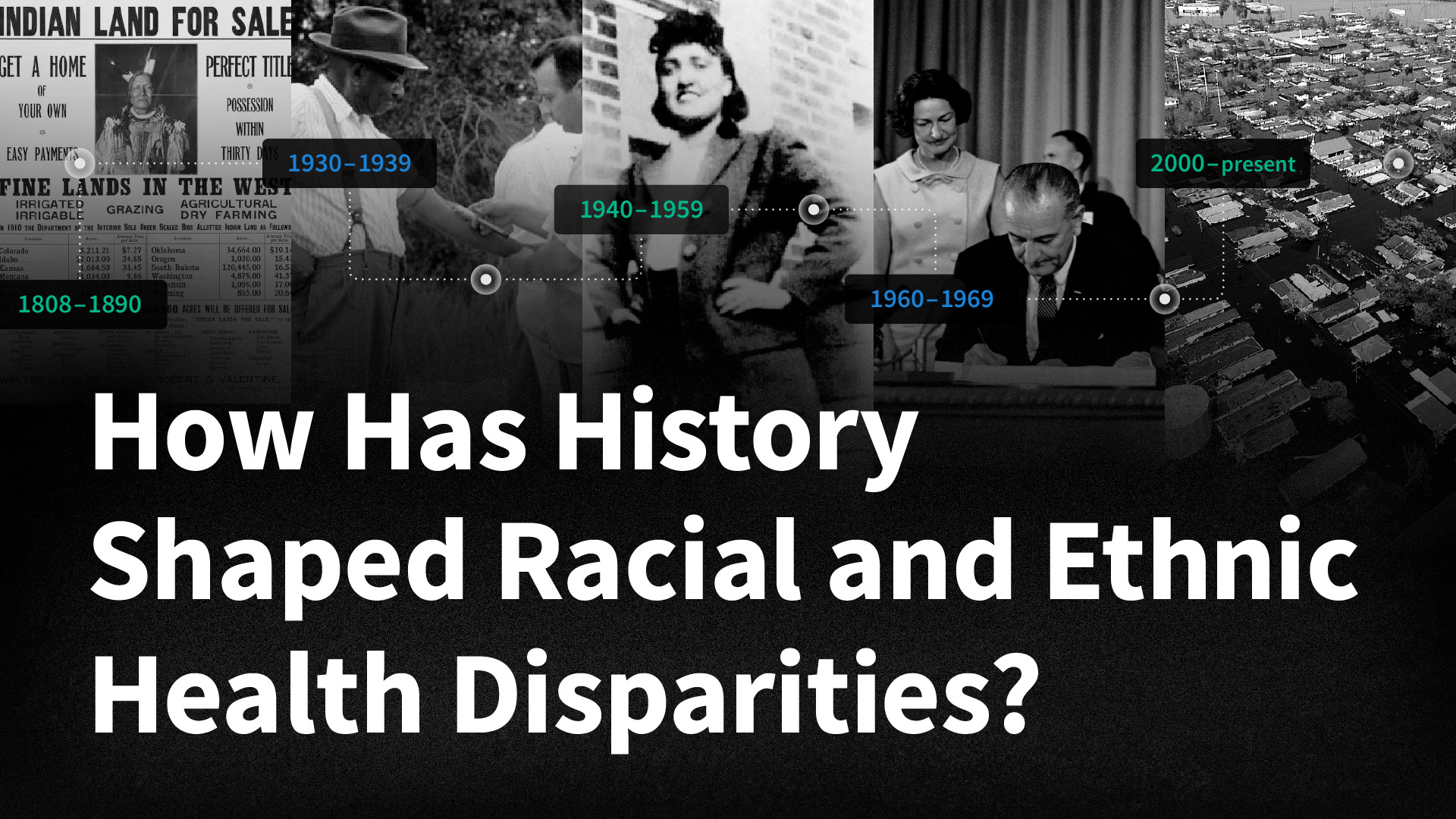
  • Timeline: How History Has Shaped Racial and Ethnic Health Disparities

    This timeline offers a historical view of significant U.S. federal policies and events spanning the early 1800s to today that have influenced present-day health disparities.
  • Health Policy 101: Chapter on Race, Inequality and Health

    Addressing persistent racial and ethnic disparities in health and health care is important for improving the nation’s health and economic prosperity. KFF explains such disparities and the factors that drive them, examines the actions to address them, and outlines future considerations.
  • Key Data on Health and Health Care by Race and Ethnicity

    Racial and ethnic disparities in health and health care remain a persistent challenge in the United States. An updated KFF resource examines how people of color fare compared to White people across 64 measures of health, health care, and social determinants of health.

Survey of Immigrants

KFF-New York Times Survey: Immigrants Report Rising Fear, Negative Economic and Health Impacts, and Changing Political Views During the First Year of President Trump’s Second Term

The 2025 Survey of Immigrants, a partnership between KFF and The New York Times, takes an in-depth look at the experiences of immigrants during the first year of President Trump’s second term, including their worries related to increased immigration enforcement, their health and economic wellbeing, and the political views and preferences of immigrant voters. The survey paints a portrait of families under strain — where fear of detention and economic instability are negatively impacting immigrants’ health and reshaping immigrant families’ daily lives and views of U.S. political parties.

Read the News Release | Explore The New York Times’ Reporting
Stay informed.

Stay informed.

Filter

481-490 of 605 results

  • Health Coverage in an Economic Downturn: Impact of Tight Budgets on Families and States

    Fact Sheet

    The economic downturn has strained family finances and prompted some Americans to cut back on medications and forgo preventive care and visits to the doctor. At the same time, the downturn has triggered declines in tax revenue that inhibit states’ ability to meet rising Medicaid program costs as enrollment spikes during economic hard times. Many states are expected to struggle to close budget gaps despite moves by Congress and the Obama Administration to temporarily boost…

  • President Obama’s Campaign Position on Health Reform and Other Health Care Issues

    Issue Brief

    During the 2008 Presidential campaign now President Barack Obama announced a comprehensive health care reform proposal and laid out his positions on a number of other key health care issues. The two documents below summarize these campaign policies and positions. They were prepared by the Kaiser Family Foundation with the assistance of Health Policy Alternatives, Inc., and are based on information compiled from Obama's campaign Web site, speeches, campaign debates and news reports. They are…

  • Eliminating Racial/Ethnic Disparities in Health Care: What are the Options?

    Issue Brief

     Download PDF Racial and ethnic disparities in health care – whether in insurance coverage, access, or quality of care – are one of many factors producing inequalities in health status in the United States.1  Eliminating these disparities is politically sensitive and challenging in part because their causes are intertwined with a contentious history of race relations in America. Nonetheless, assuring greater equity and accountability of the health care system is important to a growing constituency…

  • Pulling It Together: A Recovery Raises Expectations Too

    Perspective

    New Orleans is a city still struggling with the aftermath of Katrina and the levee breaks. The people of New Orleans feel that the nation and the federal government have largely forgotten them. Those are the results of our 2008 survey of the people of New Orleans, the second in a series we are doing to track progress in the recovery from the perspective of the residents of the city themselves. As the head of a…

  • Addressing Disparities in Health and Health Care — Issues for Reform

    Event

    Marsha Lillie-Blanton, Dr.P.H., Kaiser senior advisor on race, ethnicity and health care, testified before the House Ways and Means Health Subcommittee about the role of health insurance in reducing disparities in health care and in health status. The testimony is part of an ongoing health reform hearing series. Testimony (.pdf) Slides (.ppt)

  • Health Coverage and Access to Care Among Asian Americans, Native Hawaiians and Pacific Islanders

    Fact Sheet

    A new analysis by the Kaiser Family Foundation and the Asian & Pacific Islander American Health Forum examines the health coverage, access to health care, and health status of Asian American, Native Hawaiian and Pacific Islander ethnic groups in the United States, and finds that certain subgroups are doing much worse than others in terms of health insurance coverage and access to health care. For example, Korean Americans, Native Hawaiians and Pacific Islanders are about…

  • Five Basic Facts on Immigrants and Their Health Care

    Issue Brief

    As discussions on national health care reform move to the forefront, some have focused on the role of immigrants in the health care system, including their impact on the nation’s uninsured problem, their participation in public health coverage programs, and their use of hospital emergency rooms. To address questions about how immigrants use and affect the health care system, this brief draws on available research and data to highlight five key facts about immigrants’ health…

  • Race, Ethnicity, and Health Care Tutorial

    Interactive

    This tutorial was produced for kaiserEDU.org, a Kaiser Family Foundation website that ceased production in September 2013. The kaiserEDU.org tutorials are no longer being updated but have been made available on kff.org due to demand by professors who are using the tutorials in class assignments. You may search for other tutorials to view on kff.org. To download this or other tutorials, visit the tutorials archive page.  Slides are available for download using the “Download Slides” link within the…

  • Key Health Disparities-Focused Legislation Introduced in the 110th Congress

    Other Post

    This compendium summarizes about a dozen federal legislative initiatives introduced in the 110th Congress to address racial and ethnic disparities in health and health care. Although the 110th Congress's session is half complete, the number of bills introduced that include some attention to “health disparities” is about the same as introduced in the entire 109th Congress. While a number of bills introduced this year may have an impact on health disparities and/or affect minority health,…

  • An Overview of HIV/AIDS in Black America

    Report

    Black Americans account for more HIV and AIDS cases, people estimated to be living with AIDS, and HIV-related deaths than any other racial/ethnic group in the U.S. Today, Black Americans make up about 12 percent of the U.S. population, but account for half of all new AIDS cases. And, despite medical advances which have sharply reduced HIV-related mortality rates for all racial/ethnic groups, HIV death rates are still significantly higher for Black Americans than other…