
Racial Equity and Health Policy

the Essentials
  • Health Coverage by Race and Ethnicity, 2010-2024

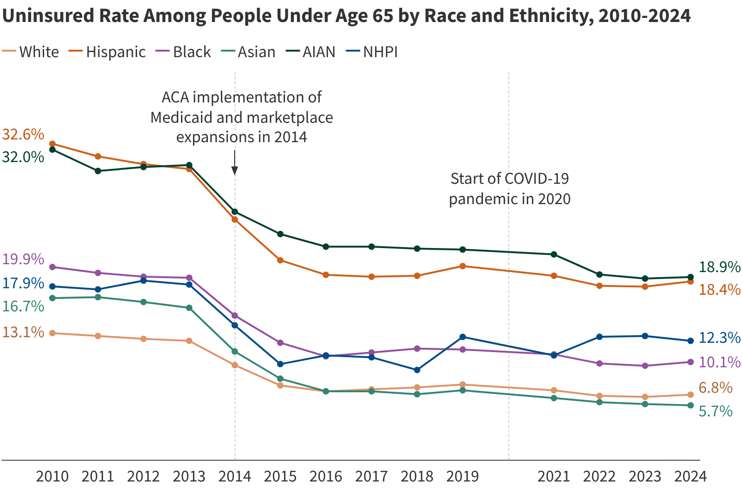
    There have been longstanding racial and ethnic disparities in health coverage that contribute to disparities in health. This brief examines trends in health coverage by race and ethnicity from 2010 through 2024 and discusses the implications for such disparities.
  • Timeline: How History Has Shaped Racial and Ethnic Health Disparities

    This timeline offers a historical view of significant U.S. federal policies and events spanning the early 1800s to today that have influenced present-day health disparities.
  • Health Policy 101: Chapter on Race, Inequality and Health

    Addressing persistent racial and ethnic disparities in health and health care is important for improving the nation’s health and economic prosperity. KFF explains such disparities and the factors that drive them, examines the actions to address them, and outlines future considerations.
  • Key Data on Health and Health Care by Race and Ethnicity

    Racial and ethnic disparities in health and health care remain a persistent challenge in the United States. An updated KFF resource examines how people of color fare compared to White people across 64 measures of health, health care, and social determinants of health.

Survey of Immigrants

KFF-New York Times Survey: Immigrants Report Rising Fear, Negative Economic and Health Impacts, and Changing Political Views During the First Year of President Trump’s Second Term

The 2025 Survey of Immigrants, a partnership between KFF and The New York Times, takes an in-depth look at the experiences of immigrants during the first year of President Trump’s second term, including their worries related to increased immigration enforcement, their health and economic wellbeing, and the political views and preferences of immigrant voters. The survey paints a portrait of families under strain — where fear of detention and economic instability are negatively impacting immigrants’ health and reshaping immigrant families’ daily lives and views of U.S. political parties.

Read the News Release | Explore The New York Times’ Reporting
Subscribe to KFF Emails

Choose which emails are best for you.
Sign up here

Filter

471 - 480 of 602 Results

  • Physician Willingness and Resources to Serve More Medicaid Patients: Perspectives from Primary Care Physicians

    Issue Brief

    This issue brief attempts to assess how primary care physicians will respond to the entry of 32 million newly insured people into the health care system under health reform. The increase in the number of people with health coverage is expected to intensify competition among patients and payers for primary care resources. The brief analyzes data from a nationally representative survey of physicians to assess which adult-care primary care physicians are most likely to respond…

  • Resources Examine Racial and Ethnic Disparities Among Men at the State Level

    Other Post

    The Foundation has created a package of resources, including a comprehensive report, fact sheets and other materials, that document the persistence of disparities on 22 indicators between white men and men of color, including rates of diseases such as diabetes, heart disease, AIDS and cancer, and access to health insurance and health screenings. The resources provide a rare look at state-level variations, quantifying where disparities are greatest. Also available are state-level data for men of…

  • Women and Health Care: A National Profile

    Report

    A new national survey of women on their health finds that a substantial percentage of women cannot afford to go to the doctor or get prescriptions filled. Although a majority of women are in good health and satisfied with their health care, many have health problems and do not get adequate levels of preventive care. The report also examines women’s health status, health care costs, insurance, access to care, prevention, and their role in family…

  • Unwinding of the PHE: Maintaining Medicaid for People with Limited English Proficiency

    Issue Brief

    Provisions in the Families First Coronavirus Response Act (FFCRA) require states to maintain continuous Medicaid enrollment for enrollees until the end of the month when the COVID-19 public health emergency (PHE) ends. When the continuous enrollment requirements end and states resume redeterminations and disenrollments, individuals with LEP may be at increased risk of losing Medicaid coverage or experiencing a gap in coverage due to barriers completing these processes, even if they remain eligible for coverage.

  • ‘In Focus with KFF’: Rethinking the Use of Race in Medicine

    Video

    KFF Vice President Samantha Artiga discusses how the medical system continues to use race in ways that may perpetuate disparities, including through provider and institutional bias, clinical guidelines, and medical education and training approaches.

  • Rethinking the Use of Race in Medicine

    News Release

    The COVID-19 pandemic has shined a spotlight on racial disparities in health and health care, but disparities are hardly new. They have been driven by longstanding inequities within and beyond the health care system that are rooted in racism. KFF Vice President Samantha Artiga, who directs the Racial Equity and Health Policy Program, in this new video discusses how the medical system continues to use race in ways that may perpetuate disparities, including through provider…

  • Updated Brief on Racial Disparities in Maternal and Infant Health

    News Release

    An updated KFF issue brief on racial disparities in maternal and infant health includes new and updated analysis of data on pregnancy-related mortality, birth risks and infant mortality. The brief reviews the underlying factors contributing to maternal and infant health racial disparities, ranging from historical and ongoing racism to differences in access to health care and coverage and other social and economic factors that drive health. With recent attention to this issue by federal and state…

  • The U.S.-Mexico Border Region Faced a Range of Health Challenges Long Before the Current Immigration Surge

    News Release

    With intense immigration activity at the U.S.-Mexico border this year and attention focused on the plight of newly arriving migrants, a new KFF analysis finds communities along the border faced an array of socioeconomic challenges and weak health infrastructures well before this year’s surge. Texas – which has the most counties along the border and is the only border state that has not expanded Medicaid under the Affordable Care Act – stands out as facing…