Racial Equity and Health Policy

the Essentials
  • How Experiencing Racial Discrimination Impacts Health

    This brief highlights research examining mechanisms underlying health outcomes linked to self-reported experiences of racial discrimination, including biological changes, chronic stress, mental health, substance use, pregnancy-related outcomes, and sleep.
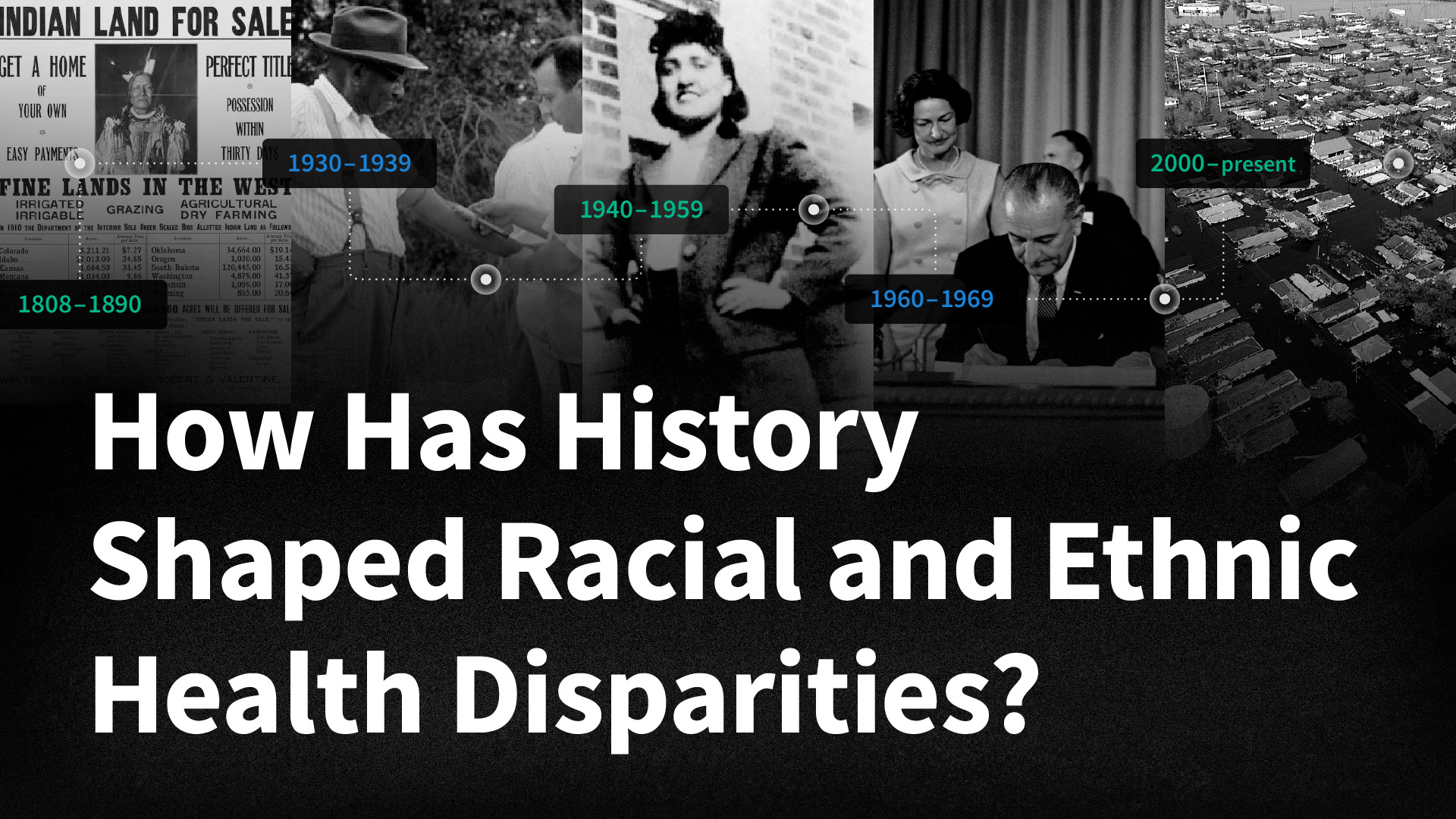
  • Timeline: How History Has Shaped Racial and Ethnic Health Disparities

    This timeline offers a historical view of significant U.S. federal policies and events spanning the early 1800s to today that have influenced present-day health disparities.
  • Health Policy 101: Chapter on Race, Inequality and Health

    Addressing persistent racial and ethnic disparities in health and health care is important for improving the nation’s health and economic prosperity. KFF explains such disparities and the factors that drive them, examines the actions to address them, and outlines future considerations.
  • Key Data on Health and Health Care by Race and Ethnicity

    Racial and ethnic disparities in health and health care remain a persistent challenge in the United States. An updated KFF resource examines how people of color fare compared to White people across 64 measures of health, health care, and social determinants of health.

Survey of Immigrants

KFF-New York Times Survey: Immigrants Report Rising Fear, Negative Economic and Health Impacts, and Changing Political Views During the First Year of President Trump’s Second Term

The 2025 Survey of Immigrants, a partnership between KFF and The New York Times, takes an in-depth look at the experiences of immigrants during the first year of President Trump’s second term, including their worries related to increased immigration enforcement, their health and economic wellbeing, and the political views and preferences of immigrant voters. The survey paints a portrait of families under strain — where fear of detention and economic instability are negatively impacting immigrants’ health and reshaping immigrant families’ daily lives and views of U.S. political parties.

Read the News Release | Explore The New York Times’ Reporting
Stay informed.

Stay informed.

Filter

431 - 440 of 602 Results

  • A Profile of American Indians and Alaska Natives and Their Health Coverage

    Issue Brief

    A Profile of American Indians and Alaska Natives and Their Health Coverage This brief examines the health coverage, access to care and health status of American Indians and Alaska Natives across the country. Although the U.S. government has an established responsibility through tribal agreements to provide health care services to members of federally recognized Indian tribes, many American Indians and Alaska Natives lack access to health care. The brief gives an overview of the some…

  • Today’s Topics In Health Disparities: Is the Health Care System Ready for Health Reform?

    Event Date:
    Event

    On Wednesday, November 4, at 1 p.m. ET, this Today's Topics In Health Disparities live webcast examined how ready the health care system is for the influx of newly covered individuals that health reform aims to deliver. In the health care proposals being considered by Congress, changes to Medicaid alone could mean as many as 15 million people would become newly eligible for the program and many live in medically underserved areas. The program will…

  • Race and Recession Survey

    Poll Finding

    The Washington Post/Kaiser Family Foundation/Harvard University partnership conducted a survey to examine how the recession has reshaped the lives of Americans and takes a closer look at experiences by race and ethnicity. This survey is the 21st in a series of surveys dating back to 1995 that have been conducted as part of The Washington Post/Kaiser Family Foundation Survey Project. Toplines (.pdf) Read The Washington Post articles on the survey:Economy poll: African Americans, Hispanics were…

  • New Publications on Immigrant Health Care and Linguistic Access

    Fact Sheet

    In 2000, there were over 32 million foreign-born residents in the U.S. Immigrants often face barriers to health coverage and health services. The disparities confronting immigrants can be similar to those faced by low-income working families generally, but immigrants also face other barriers, including linguistic issues and eligibility changes that have limited their ability to qualify for Medicaid. These new or updated publications address issues related to how race, immigration status, and language affect insurance…

  • Health Policy Challenges Affecting American Indians and Alaska Natives

    Other Post

    CALL FOR PAPERS: Health Policy Challenges Affecting American Indians and Alaska Natives The American Journal of Public Health (AJPH), in collaboration with the Henry J. Kaiser Family Foundation, is planning to publish a collection of papers on how the United States can more effectively meet the health care needs of American Indians and Alaska Natives (AIANs). The guest editors are soliciting contributions to the “Health Policy and Ethics” and “Research and Practice” sections of the…

  • 2004 National Survey of Latinos: Politics and Civic Participation

    Poll Finding

    This comprehensive survey assesses Latino attitudes in the 2004 election year. The third annual survey of Latinos from the Pew Hispanic Center and the Kaiser Family Foundation, the new survey examines political issues and the presidential election campaign, the economy, health care, Iraq and immigration. News Release Chartpack/Summary of Findings Toplines Election Survey (.pdf) The survey was released at a July 22, 2004 briefing. Agenda (.pdf) Speaker Biographies (.pdf) Event Transcript (.pdf)

  • Distribution of U.S. Population by Race/Ethnicity, 2010 and 2050

    Feature

    Distribution of U.S. Population by Race/Ethnicity, 2010 and 2050 Download Source U.S. Census Bureau, 2008, Projected Population by Single Year of Age, Sex, Race, and Hispanic Origin for the United States: July 1, 2000 to July 1, 2050.  http://www.census.gov/population/www/projections/downloadablefiles.html.