Racial Equity and Health Policy

the Essentials
  • How Experiencing Racial Discrimination Impacts Health

    This brief highlights research examining mechanisms underlying health outcomes linked to self-reported experiences of racial discrimination, including biological changes, chronic stress, mental health, substance use, pregnancy-related outcomes, and sleep.
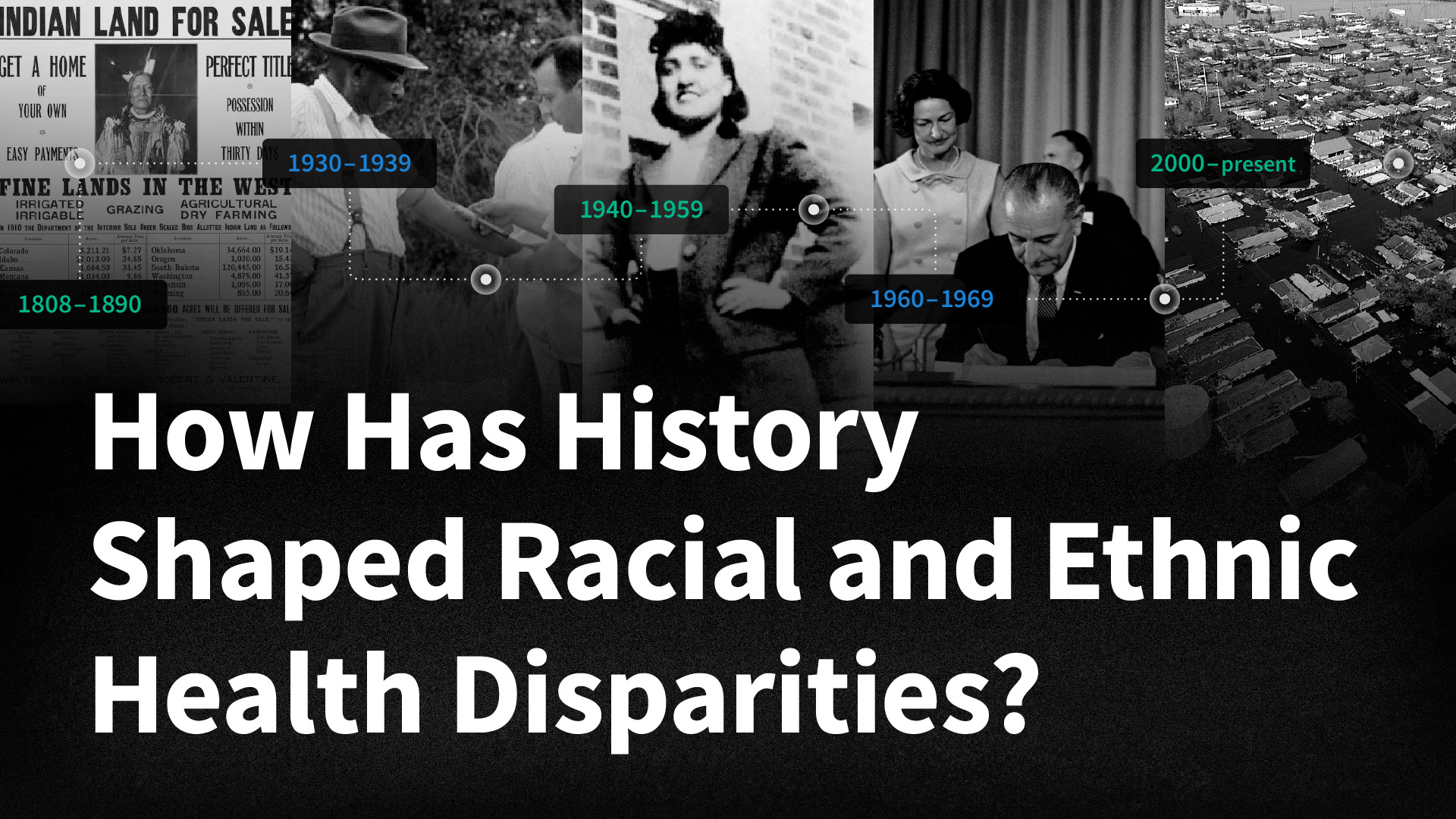
  • Timeline: How History Has Shaped Racial and Ethnic Health Disparities

    This timeline offers a historical view of significant U.S. federal policies and events spanning the early 1800s to today that have influenced present-day health disparities.
  • Health Policy 101: Chapter on Race, Inequality and Health

    Addressing persistent racial and ethnic disparities in health and health care is important for improving the nation’s health and economic prosperity. KFF explains such disparities and the factors that drive them, examines the actions to address them, and outlines future considerations.
  • Key Data on Health and Health Care by Race and Ethnicity

    Racial and ethnic disparities in health and health care remain a persistent challenge in the United States. An updated KFF resource examines how people of color fare compared to White people across 64 measures of health, health care, and social determinants of health.

Survey of Immigrants

KFF-New York Times Survey: Immigrants Report Rising Fear, Negative Economic and Health Impacts, and Changing Political Views During the First Year of President Trump’s Second Term

The 2025 Survey of Immigrants, a partnership between KFF and The New York Times, takes an in-depth look at the experiences of immigrants during the first year of President Trump’s second term, including their worries related to increased immigration enforcement, their health and economic wellbeing, and the political views and preferences of immigrant voters. The survey paints a portrait of families under strain — where fear of detention and economic instability are negatively impacting immigrants’ health and reshaping immigrant families’ daily lives and views of U.S. political parties.

Read the News Release | Explore The New York Times’ Reporting
Stay informed.

Stay informed.

Filter

431-440 of 606 results

  • The Role of Employer-Sponsored Health Coverage for Immigrants: A Primer

    Issue Brief

    Access to employer-sponsored health insurance is declining for all families living in the United States, and this problem is especially acute for immigrant families. Employer-sponsored coverage is a particularly important source of insurance for immigrant families since their eligibility for public coverage through Medicaid and the State Children’s Health Insurance Program (SCHIP) is restricted. This primer examines the role of employer-based coverage for immigrants and the specific hurdles they face in obtaining this coverage. Issue…

  • Putting Men’s Health Care Disparities On The Map: Access and Utilization Highlights

    Fact Sheet

    This fact sheet provides a brief overview of racial disparities in health access and utilization among men of different races in the United States. It draws findings from the report, Putting Men’s Health Care Disparities On the Map, which uses national data sources from multiple years to generate state-level estimates on a range of indicators of health status, access, and well-being for men of different racial and ethnic backgrounds. Men and women use health care…

  • Welfare Reform and Elderly Legal Immigrants

    Report

    This report presents the findings of researchers at the National Academy on Aging on welfare reform and elderly legal imigrants. The Personal Responsibility and Work Opportunity Reconciliation Actof 1996 included an array of structural reforms affecting access to cash assistance programs such as AFDC and SSI as well as Medicaid. This study profiles elderly legal immigrants in the United States and explores the implications of welfare reform for this population. Report Report

  • Health Care Experiences – 2002 National Survey of Latinos Survey Brief

    Poll Finding

    This survey brief of new analysis from the 2002 National Survey of Latinos examines Latinos experiences with health care in the United States. Topics discussed include coverage, accessing health care services, and communicating with health care providers. Survey Brief (.pdf)

  • Survey of Americans on HIV/AIDS — Part Three: Experiences and Opinions by Race/Ethnicity and Age

    Poll Finding

    These findings are the third part of a national survey of Americans’ views on HIV/AIDS, “Survey of Americans on HIV/AIDS,” conducted in spring 2004. It explores the views and experiences of, as well as the key differences among, African Americans, Latinos, Whites, and young people. The first part of the survey, on global HIV/AIDS, was released on June 2, 2004. The second part of the survey, on HIV Testing, was released on June 15, 2004.…

  • Immigrants’ Health Coverage and Health Reform: Key Questions and Answers

    Issue Brief

    As health reform discussions continue, there has been some focus on health coverage for immigrants and how immigrants will be treated under reform plans being considered on Capitol Hill. This issue brief provides an overview of key questions related to immigrants' health coverage and health reform, addressing subjects such as how immigrants receive health coverage, how many of the uninsured are non-citizen immigrants and what would happen to coverage for non-citizen immigrants under current health…

  • Black Women in America

    Poll Finding

    The Washington Post and the Kaiser Family Foundation partnered to conduct a survey examining the opinions of black women around the nation on a wide range of issues including health care. The survey included a large oversample of African Americans to enable accurate analysis of subgroups of this population. This survey is the 23rd in a series of surveys dating back to 1995 that have been conducted as part of The Washington Post/Kaiser Family Foundation…

  • What’s the Diagnosis? Latinos, Media & Health

    Report

    Three reports examining how health issues are handled by the Latino-oriented media today and how Latinos use the media as an information source on health issues. The three new studies were released at the National Association of Hispanic Journalists (NAHJ) conference. The studies are also available separately: A National and Three Region Survey of Latinos on the Media and Health, conducted by Princeton Survey Research Associates (#1410), A Study of Health Coverage in Latino Newspapers,…