Racial Equity and Health Policy

the Essentials
  • How Experiencing Racial Discrimination Impacts Health

    This brief highlights research examining mechanisms underlying health outcomes linked to self-reported experiences of racial discrimination, including biological changes, chronic stress, mental health, substance use, pregnancy-related outcomes, and sleep.
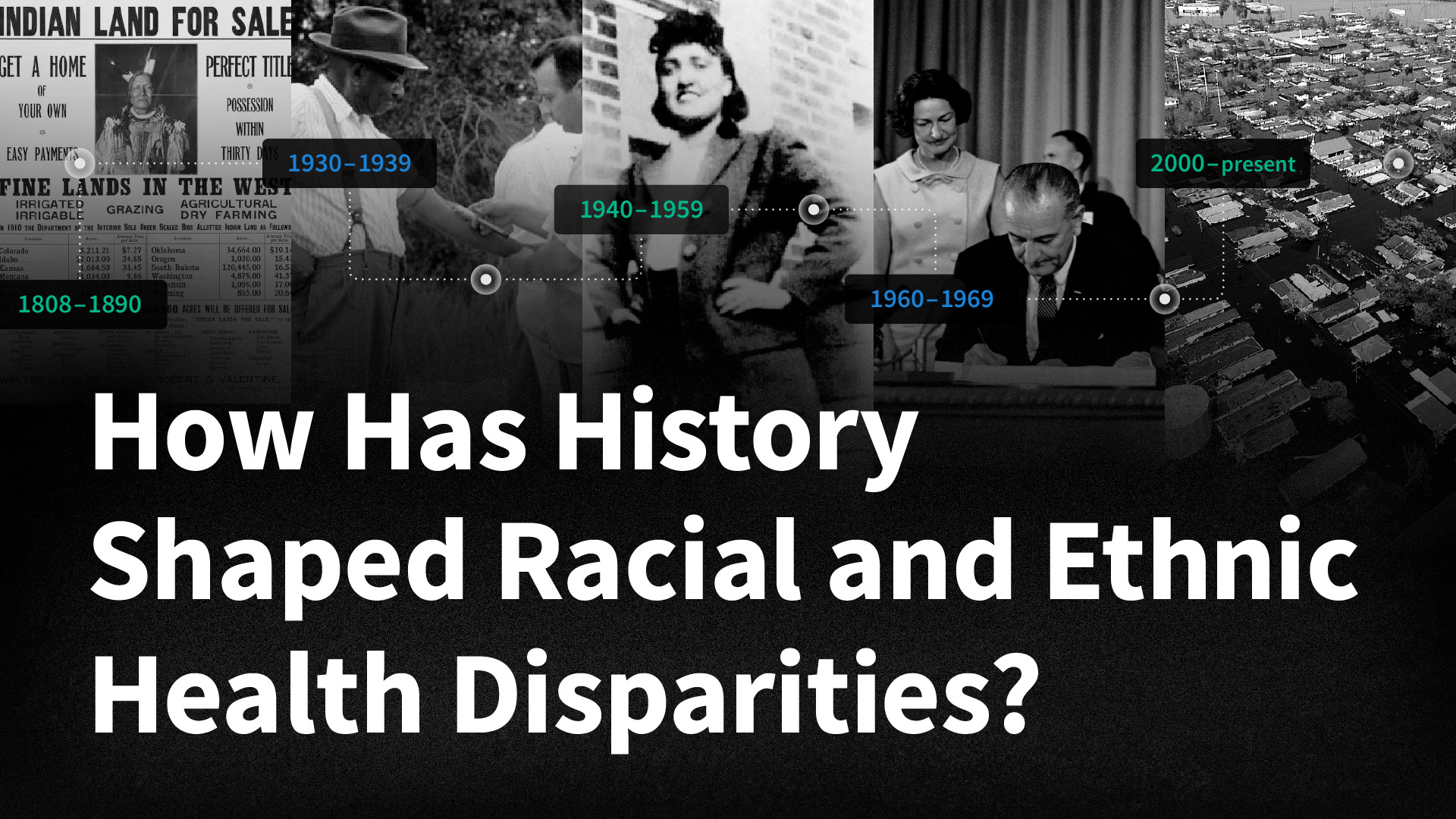
  • Timeline: How History Has Shaped Racial and Ethnic Health Disparities

    This timeline offers a historical view of significant U.S. federal policies and events spanning the early 1800s to today that have influenced present-day health disparities.
  • Health Policy 101: Chapter on Race, Inequality and Health

    Addressing persistent racial and ethnic disparities in health and health care is important for improving the nation’s health and economic prosperity. KFF explains such disparities and the factors that drive them, examines the actions to address them, and outlines future considerations.
  • Key Data on Health and Health Care by Race and Ethnicity

    Racial and ethnic disparities in health and health care remain a persistent challenge in the United States. An updated KFF resource examines how people of color fare compared to White people across 64 measures of health, health care, and social determinants of health.

Survey of Immigrants

KFF-New York Times Survey: Immigrants Report Rising Fear, Negative Economic and Health Impacts, and Changing Political Views During the First Year of President Trump’s Second Term

The 2025 Survey of Immigrants, a partnership between KFF and The New York Times, takes an in-depth look at the experiences of immigrants during the first year of President Trump’s second term, including their worries related to increased immigration enforcement, their health and economic wellbeing, and the political views and preferences of immigrant voters. The survey paints a portrait of families under strain — where fear of detention and economic instability are negatively impacting immigrants’ health and reshaping immigrant families’ daily lives and views of U.S. political parties.

Read the News Release | Explore The New York Times’ Reporting
Stay informed.

Stay informed.

Filter

421 - 430 of 602 Results

  • Survey Briefs From the 2002 National Survey of Latinos

    Poll Finding

    In 2002 the Pew Hispanic Center and the Kaiser Family Foundation conducted a national survey of Latinos, which explored the attitudes and experiences of the Hispanic population in the United States on topics such as identity, assimilation, discrimination, and health care. Five new survey briefs are now available that further examine the findings from the 2002 survey. Latinos in California, Texas, New York, Florida, and New Jersey Generational Differences Health Care Experiences Bilingualism Assimilation and…

  • Children and Oral Health: Assessing Needs, Coverage and Access

    Issue Brief

    This policy brief highlights the prevalence of dental problems among children and examines gaps in oral health coverage and access to dental care, as well as disparities by income and race/ethnicity. It also looks at out-of-pocket costs for dental care, explains the role of Medicaid and CHIP in dental care, coverage and access for children and describes the expansion of oral health coverage for children under the Affordable Care Act. Issue Brief (.pdf)

  • Survey of Asians In the Bay Area – Summary and Chartpack

    Poll Finding

    The summary and chartpack highlights key findings from a survey exploring the attitudes and experiences of the Asian community in the Bay Area, which has the largest Asian population in the country. The Kaiser Family Foundation and San Jose Mercury News collaborated on the survey. Summary and Chartpack (.pdf)

  • HIV/AIDS in Georgia

    Report

    Two reports - "Survey of Georgia Residents on HIV/AIDS" and "Georgia's Minority Health and Health Disparities Report - Facing a Crisis" - show the disproportionate impact HIV is having on minorities in Georgia, and important differences in how minorities view HIV/AIDS compared to whites. The reports were released at a November 30, 2004 briefing held by the National Center for Primary Care (NCPC) at the Morehouse School of Medicine in partnership with the Kaiser Family…

  • Key Facts: Latinos and HIV/AIDS

    Report

    This report provides an overview of the impact of the HIV/AIDS epidemic on Latinos in the United States. It presents current snapshots and trends over time, drawing from recent data and research on the epidemiology of HIV/AIDS among Latinos, including data on AIDS cases and deaths; health services use and coverage; and attitudinal data from a recent national survey. 6008

  • Survey of Asians in the Bay Area

    Report

    Survey of Asians In the Bay Area This survey explores the attitudes and experiences of the Asian community in the Bay Area, which has the largest Asian population in the country. The Kaiser Family Foundation and San Jose Mercury News collaborated on the survey. The Bay Area is home to the largest Asian population in the continental United States. In 2002, the census estimated that roughly one in five Bay Area adults was of Asian…

  • African Americans  Views of the HIV/AIDS Epidemic at 20 Years:  Findings from a National Survey

    Poll Finding

    This report, African Americans Views of the HIV/AIDS Epidemic at 20 Years: Findings from a National Survey, examines African Americans views and knowledge of HIV/AIDS, including analysis by race/ethnicity, of trends over time, and among African American subgroups. The report is based a nationally representative survey of 2,683 adults, ages 18 and older, including 431 African Americans. This report serves as a companion document to The AIDS Epidemic at 20 Years: The View From America.…

  • Racial Ethnic Difference in Cardiac Care:  The Weight of the Evidence

    Fact Sheet

    Racial Ethnic Difference in Cardiac Care: The Weight of the Evidence Numerous studies over the past two decades have documented racial and ethnic differences in care for heart conditions. To assess the quality of the evidence and to summarize the information for a physician audience, the Henry J. Kaiser Family Foundation collaborated with the American College of Cardiology Foundation to review the body of research on racial/ethnic differences in cardiac care. There is credible evidence…

  • Welfare Reform and Elderly Legal Immigrants – Report

    Report

    Welfare Reform and Elderly Legal Immigrants Prepared by: Robert B. Friedland and Veena Pankaj National Academy on Aging, Washington DC July 1997 Prepared for: The Henry J. Kaiser Family Foundation The Henry J. Kaiser Family Foundation, based in Menlo Park, California, is an independentnational health philanthropy and is not associated with Kaiser Permanente or Kaiser Industries. Established in 1948 by industrialist Henry J. Kaiser and his wife Bess, the Foundation focusesits work on four main…

  • 1998 National Survey of Latinos on HIV/AIDS – Report (HTML version)

    Report

    1998 National Survey of Latinos on HIV/AIDSThis Report is also available in PDF in English (.pdf) en Espanol (.pdf) CONTENTS Introduction The Latino Population in the United States Epidemiology and Transmission of HIV/AIDS The Health Gap and Access to Care Latino's Perceptions of the HIV/AIDS Epidemic Methodology Findings Language and Perceptions of HIV/AIDS Regional Location and Perceptions of HIV/AIDS among Latinos Income, Education and Attitudes Towards/Knowledge of HIV/AIDS Among Latinos Religion and Perceptions of HIV/AIDS among Latinos…