Racial Equity and Health Policy

Survey of Immigrants

KFF-New York Times Survey: Immigrants Report Rising Fear, Negative Economic and Health Impacts, and Changing Political Views During the First Year of President Trump’s Second Term

The 2025 Survey of Immigrants, a partnership between KFF and The New York Times, takes an in-depth look at the experiences of immigrants during the first year of President Trump’s second term, including their worries related to increased immigration enforcement, their health and economic wellbeing, and the political views and preferences of immigrant voters. The survey paints a portrait of families under strain — where fear of detention and economic instability are negatively impacting immigrants’ health and reshaping immigrant families’ daily lives and views of U.S. political parties.

Read the News Release | Explore The New York Times’ Reporting
the Essentials
  • Disparities in Health and Health Care: 5 Key Questions and Answers

    This brief provides an introduction to what health and health care disparities are, why it is important to address them, what the status of disparities is today, recent federal actions to address disparities, and key issues related to addressing disparities in the future.
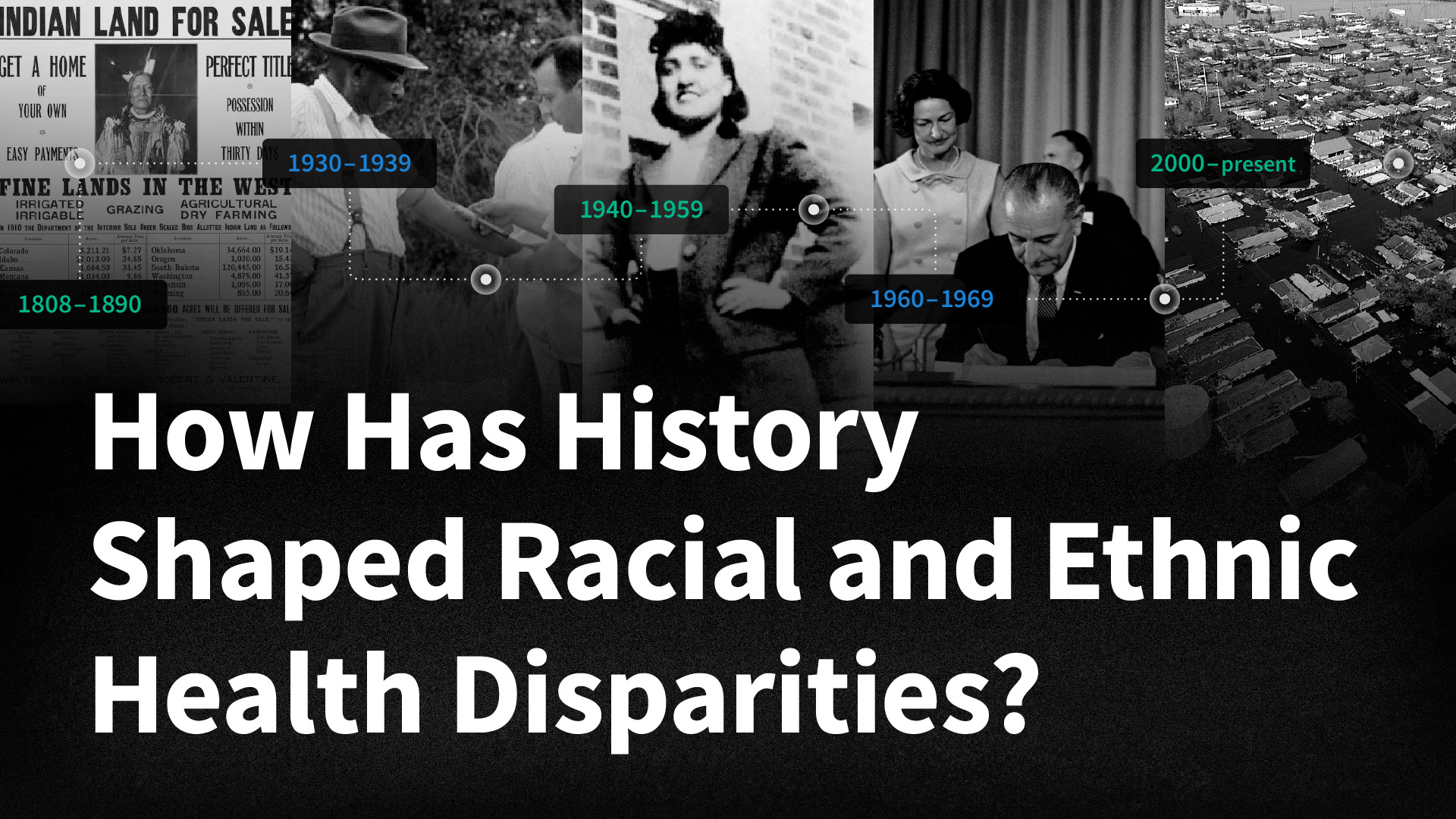
  • Timeline: How History Has Shaped Racial and Ethnic Health Disparities

    This timeline offers a historical view of significant U.S. federal policies and events spanning the early 1800s to today that have influenced present-day health disparities.
  • Health Policy 101: Chapter on Race, Inequality and Health

    Addressing persistent racial and ethnic disparities in health and health care is important for improving the nation’s health and economic prosperity. KFF explains such disparities and the factors that drive them, examines the actions to address them, and outlines future considerations.
  • Key Data on Health and Health Care by Race and Ethnicity

    Racial and ethnic disparities in health and health care remain a persistent challenge in the United States. An updated KFF resource examines how people of color fare compared to White people across 64 measures of health, health care, and social determinants of health.

Subscribe to KFF Emails

Choose which emails are best for you.
Sign up here

Filter

341 - 350 of 601 Results

  • Are Health Centers Facilitating Equitable Access to COVID-19 Vaccinations? A June 2021 Update.

    Issue Brief

    This analysis updates earlier work and examines the extent to which vaccination efforts through community health centers are reaching people of color using data from the federal government’s weekly Health Center COVID-19 Survey. We include data from the survey weeks of January 8 through May 21, 2021, finding that people of color made up the majority of people who received vaccinations at community health centers.

  • Advancing Health Equity Requires More and Better Data

    Policy Watch

    Increasing availability of high-quality comprehensive data disaggregated by race/ethnicity is a prerequisite for efforts to advance health equity, not only related to COVID-19 but in health and health care more broadly.

  • As the COVID-19 Pandemic Enters the Third Year Most Adults Say They Have Not Fully Returned to Pre-Pandemic ‘Normal’

    News Release

    People of Color, Lower Income Adults, and Those With Chronic Conditions Are More Vigilant About COVID-19 Precautions Like Masking, and Want Others to Continue Them as Well The Public Is Divided About Public Transportation Mask Requirement, With Half Wanting the Mandate Extended and the Other Half Wanting to Let it Expire Conventional wisdom may be that Americans are ready to put COVID-19 in the rearview mirror and cast precautions aside, but the latest KFF COVID-19…

  • A Look at Key Maternal and Infant Health Disparities Among Black People

    Feature

    Due to systemic and overt discrimination, Black people are disproportionately affected by high maternal and infant morbidities and mortality. In addition to legislation, addressing systemic discrimination, implicit bias and racism will be integral to achieving equity in maternal health outcomes.

  • Serious Illness in Late Life: The Public’s Views and Experiences

    Report

    In context of the rapidly growing number of older adults in the U.S. and increasing challenges that this population faces, the Kaiser Family Foundation conducted a large scale, nationally representative telephone survey to better understand people’s expectations about later life and efforts they’ve taken to plan for if they become seriously ill. To learn more about the experiences of those with serious illness specifically, this survey also included interviews with adults who are either personally…

  • Public Health in Puerto Rico after Hurricane Maria

    Issue Brief

    This issue brief provides a snapshot of key public health challenges in Puerto Rico after Hurricane Maria. It discusses topics such as mortality, food, water, sanitation, health care infrastructure, and mental health on the island in the wake of the storm.