Racial Equity and Health Policy

the Essentials
  • How Experiencing Racial Discrimination Impacts Health

    This brief highlights research examining mechanisms underlying health outcomes linked to self-reported experiences of racial discrimination, including biological changes, chronic stress, mental health, substance use, pregnancy-related outcomes, and sleep.
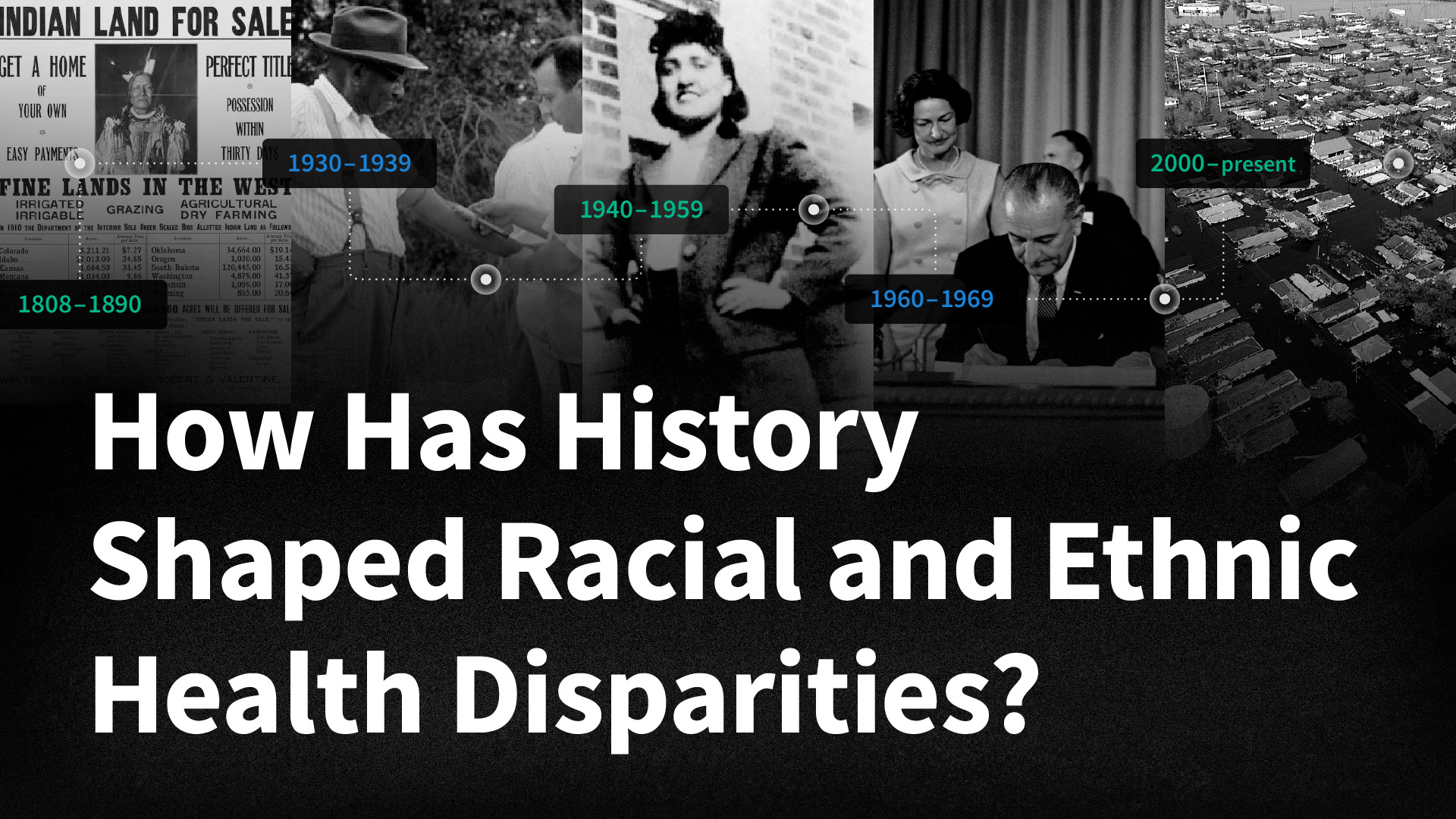
  • Timeline: How History Has Shaped Racial and Ethnic Health Disparities

    This timeline offers a historical view of significant U.S. federal policies and events spanning the early 1800s to today that have influenced present-day health disparities.
  • Health Policy 101: Chapter on Race, Inequality and Health

    Addressing persistent racial and ethnic disparities in health and health care is important for improving the nation’s health and economic prosperity. KFF explains such disparities and the factors that drive them, examines the actions to address them, and outlines future considerations.
  • Key Data on Health and Health Care by Race and Ethnicity

    Racial and ethnic disparities in health and health care remain a persistent challenge in the United States. An updated KFF resource examines how people of color fare compared to White people across 64 measures of health, health care, and social determinants of health.

Survey of Immigrants

KFF-New York Times Survey: Immigrants Report Rising Fear, Negative Economic and Health Impacts, and Changing Political Views During the First Year of President Trump’s Second Term

The 2025 Survey of Immigrants, a partnership between KFF and The New York Times, takes an in-depth look at the experiences of immigrants during the first year of President Trump’s second term, including their worries related to increased immigration enforcement, their health and economic wellbeing, and the political views and preferences of immigrant voters. The survey paints a portrait of families under strain — where fear of detention and economic instability are negatively impacting immigrants’ health and reshaping immigrant families’ daily lives and views of U.S. political parties.

Read the News Release | Explore The New York Times’ Reporting
Stay informed.

Stay informed.

Filter

271 - 280 of 602 Results

  • Compare the Candidates on Health Care Policy

    Feature

    The side-by-side comparison tool provides a quick overview of former President Trump's and Vice President Harris' records, positions, public statements, and proposed policies on a range of key health care topics.

  • Black Americans Are More Skeptical of a Coronavirus Vaccine

    From Drew Altman

    Drew Altman discusses how systemic racism has led to striking levels of reluctance to get a COVID-19 vaccine among Black Americans, including those at highest risk, and the challenge it presents for ending the pandemic.

  • Race, Ethnicity, and Health Care Tutorial

    Interactive

    This tutorial was produced for kaiserEDU.org, a Kaiser Family Foundation website that ceased production in September 2013. The kaiserEDU.org tutorials are no longer being updated but have been made available on kff.org due to demand by professors who are using the tutorials in class assignments. You may search for other tutorials to view on kff.org. To download this or other tutorials, visit the tutorials archive page.  Slides are available for download using the “Download Slides” link within the…

  • Public Health in Puerto Rico after Hurricane Maria

    Issue Brief

    This issue brief provides a snapshot of key public health challenges in Puerto Rico after Hurricane Maria. It discusses topics such as mortality, food, water, sanitation, health care infrastructure, and mental health on the island in the wake of the storm.

  • Adult Children of Immigrants Make Outsized Contributions to the U.S. Health Care Workforce

    News Release

    Adult children of immigrants make up a disproportionately large share of physicians, surgeons and other health care practitioners in the U.S. -- just one reflection of their comparatively high employment, educational attainment and income levels, according to a new KFF analysis. The analysis of 2023 Current Population Survey data shows that U.S.-born nonelderly adults whose parents were both born outside the U.S. comprise 13% of physicians, surgeons, and other health care practitioners. That amounts to…

  • New Interactive Takes a Look at Income and Assets Among Medicare Beneficiaries, Now and in the Future

    News Release

    A small share of the 52.4 million elderly individuals and people with disabilities on Medicare have relatively high incomes, but most are of modest means -- with half living on incomes of less than $23,500 last year. Although the majority of beneficiaries have some savings, the value of their assets varies dramatically, and is much lower for black and Hispanic than white beneficiaries, for widows than for widowers, and for younger Medicare beneficiaries with disabilities…

  • Nearly 8 in 10 Immigrants Who Entered the U.S. Without Legal Permanent Resident Status Have At Least One Characteristic That Could Count Against Them under the New “Public Charge” Rule

    News Release

    Seventy-nine percent of noncitizen residents who originally entered the United States without legal permanent resident status have at least one characteristic that could count against them under the Trump Administration’s new “public charge” rule, according to an updated KFF analysis. Such characteristics – including having an income below 125 percent of the federal poverty level or lacking a high school diploma or private health insurance -- could make it harder for immigrants to obtain admission…