Racial Equity and Health Policy

Survey of Immigrants

KFF-New York Times Survey: Immigrants Report Rising Fear, Negative Economic and Health Impacts, and Changing Political Views During the First Year of President Trump’s Second Term

The 2025 Survey of Immigrants, a partnership between KFF and The New York Times, takes an in-depth look at the experiences of immigrants during the first year of President Trump’s second term, including their worries related to increased immigration enforcement, their health and economic wellbeing, and the political views and preferences of immigrant voters. The survey paints a portrait of families under strain — where fear of detention and economic instability are negatively impacting immigrants’ health and reshaping immigrant families’ daily lives and views of U.S. political parties.

Read the News Release | Explore The New York Times’ Reporting
the Essentials
  • Disparities in Health and Health Care: 5 Key Questions and Answers

    This brief provides an introduction to what health and health care disparities are, why it is important to address them, what the status of disparities is today, recent federal actions to address disparities, and key issues related to addressing disparities in the future.
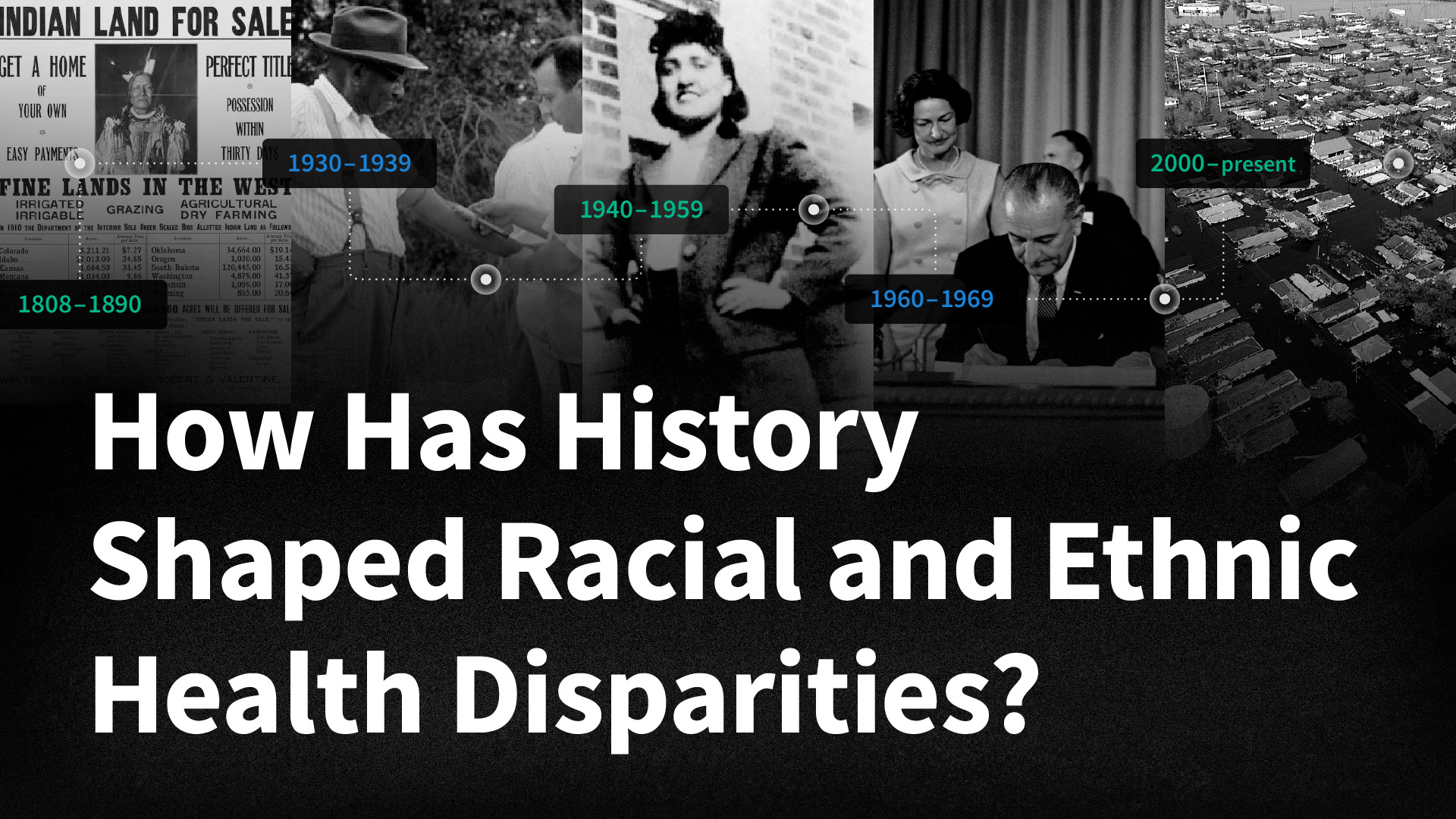
  • Timeline: How History Has Shaped Racial and Ethnic Health Disparities

    This timeline offers a historical view of significant U.S. federal policies and events spanning the early 1800s to today that have influenced present-day health disparities.
  • Health Policy 101: Chapter on Race, Inequality and Health

    Addressing persistent racial and ethnic disparities in health and health care is important for improving the nation’s health and economic prosperity. KFF explains such disparities and the factors that drive them, examines the actions to address them, and outlines future considerations.
  • Key Data on Health and Health Care by Race and Ethnicity

    Racial and ethnic disparities in health and health care remain a persistent challenge in the United States. An updated KFF resource examines how people of color fare compared to White people across 64 measures of health, health care, and social determinants of health.

Subscribe to KFF Emails

Choose which emails are best for you.
Sign up here

Filter

221 - 230 of 601 Results

  • Survey and Event Examine Experiences and Concerns of Asian Immigrants During COVID-19 Pandemic and Amid Rising Incidents of Anti-Asian Hate Crimes

    News Release

    A KFF survey of Asian patients at four community health centers serving a predominantly Asian, low-income population finds a third (33%) of them have felt more discrimination based on their race/ethnicity since the COVID-19 pandemic began. Respondents, 80% of whom were born outside the U.S., reported a range of negative experiences including receiving poorer service in public settings, being denied employment and/or housing, and being verbally or physically attacked. Asian Immigrant Experiences with Racism, Immigration-related…

  • New Analysis: In Pursuit of a National Vaccination Benchmark, Hispanic and Black People’s Rates Projected to Lag Behind

    News Release

    Much attention has focused on President Biden’s stated goal of vaccinating 70% of U.S. adults by July 4th. While achieving a high overall vaccination rate is important for recovery from the COVID-19 pandemic, a new analysis of people ages 12 and older—a different population than President Biden’s goal, but one that is currently eligible for vaccination—projects that 65% will have received at least one dose by July 4th, but 63% of Hispanic people and only…

  • Recent and Anticipated Actions to Reverse Trump Administration Section 1557 Non-Discrimination Rules

    Issue Brief

    The Biden Administration has started taking steps to reverse Trump Administration policy and regulations that significantly narrowed the implementation and administrative enforcement of Section 1557, the Affordable Care Act’s nondiscrimination provision, particularly as the regulations apply to gender identity and sexual orientation. In addition, several lawsuits challenging the regulations, which were initially issued by the Obama Administration and later substantially revised by the Trump Administration, are pending. Section 1557 prohibits discrimination based on race, color,…

  • Are Health Centers Facilitating Equitable Access to COVID-19 Vaccinations? A June 2021 Update.

    Issue Brief

    This analysis updates earlier work and examines the extent to which vaccination efforts through community health centers are reaching people of color using data from the federal government’s weekly Health Center COVID-19 Survey. We include data from the survey weeks of January 8 through May 21, 2021, finding that people of color made up the majority of people who received vaccinations at community health centers.

  • May 20 Web Event: Latinos and the Nation’s COVID-19 Vaccine Rollout

    Event Date:
    Event

    New Campaign from THE CONVERSATION / LA CONVERSACIÓN to Address Information Needs in the Community KFF and UnidosUS presented an interactive web event on Thursday, May 20th on the latest insights on what is working and what barriers must be overcome in ensuring equitable access to the COVID-19 vaccines for Latinos in the U.S., including new KFF survey findings from the community. KFF analysis of state-reported data shows Hispanic and Black people have received smaller…

  • New Campaign from THE CONVERSATION / LA CONVERSACIÓN Responds to Information Needs about COVID-19 Vaccines Among Latinos and Spanish-speaking People in U.S.

    News Release

    News Release May 20, 2021 – THE CONVERSATION / LA CONVERSACIÓN expands to address information needs about the COVID-19 vaccines in the Latinx community with new videos featuring doctors, nurses and promotoras (community health workers) in English and Spanish. This installment of the campaign is produced by KFF (Kaiser Family Foundation) under its Greater Than COVID public information response and presented with UnidosUS. “THE CONVERSATION / LA CONVERSACIÓN campaign—and our efforts with the UnidosUS Esperanza Hope for…

  • How Employer Actions Could Facilitate Equity in COVID-19 Vaccinations

    Policy Watch

    Providing paid time off to employees to get and recover from any side effects could help boost vaccination rates. Overall, nearly three in ten (28%) employed adults who not yet ready to get the vaccine say that they would be more likely to get the COVID-19 vaccine if their employer gave them paid time off to get vaccinated and recover from any side effects.