Racial Equity and Health Policy

Survey of Immigrants

KFF-New York Times Survey: Immigrants Report Rising Fear, Negative Economic and Health Impacts, and Changing Political Views During the First Year of President Trump’s Second Term

The 2025 Survey of Immigrants, a partnership between KFF and The New York Times, takes an in-depth look at the experiences of immigrants during the first year of President Trump’s second term, including their worries related to increased immigration enforcement, their health and economic wellbeing, and the political views and preferences of immigrant voters. The survey paints a portrait of families under strain — where fear of detention and economic instability are negatively impacting immigrants’ health and reshaping immigrant families’ daily lives and views of U.S. political parties.

Read the News Release | Explore The New York Times’ Reporting
the Essentials
  • Disparities in Health and Health Care: 5 Key Questions and Answers

    This brief provides an introduction to what health and health care disparities are, why it is important to address them, what the status of disparities is today, recent federal actions to address disparities, and key issues related to addressing disparities in the future.
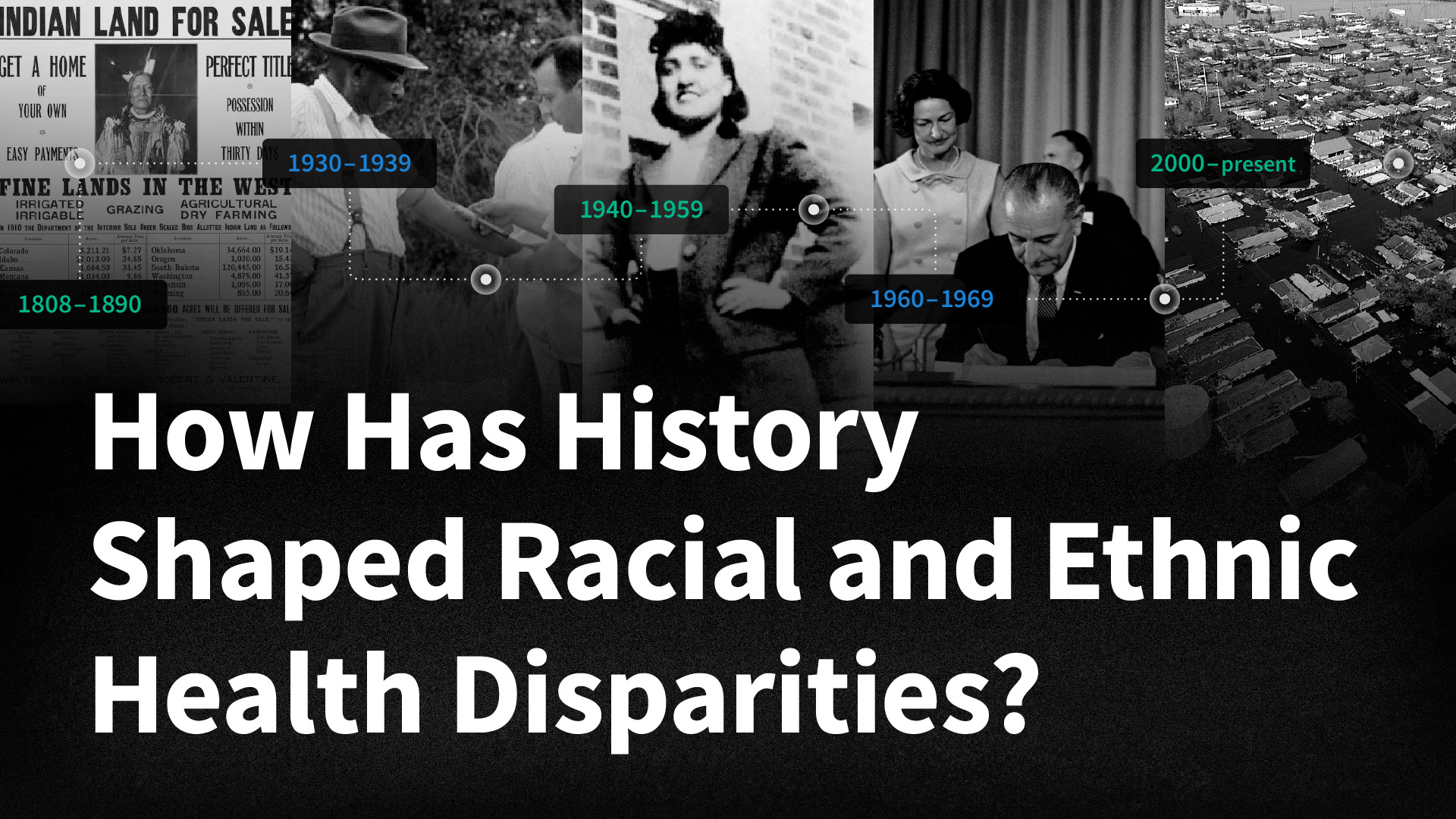
  • Timeline: How History Has Shaped Racial and Ethnic Health Disparities

    This timeline offers a historical view of significant U.S. federal policies and events spanning the early 1800s to today that have influenced present-day health disparities.
  • Health Policy 101: Chapter on Race, Inequality and Health

    Addressing persistent racial and ethnic disparities in health and health care is important for improving the nation’s health and economic prosperity. KFF explains such disparities and the factors that drive them, examines the actions to address them, and outlines future considerations.
  • Key Data on Health and Health Care by Race and Ethnicity

    Racial and ethnic disparities in health and health care remain a persistent challenge in the United States. An updated KFF resource examines how people of color fare compared to White people across 64 measures of health, health care, and social determinants of health.

Subscribe to KFF Emails

Choose which emails are best for you.
Sign up here

Filter

211 - 220 of 601 Results

  • State Policies Connecting Justice-Involved Populations to Medicaid Coverage and Care

    Issue Brief

    The COVID-19 pandemic has magnified pre-existing health disparities for justice-involved populations, with coronavirus infection rates among incarcerated populations higher than overall infection rates in nearly all states. Justice-involved individuals are disproportionately low-income and often have complex and/or chronic conditions, including behavioral health needs. Although the statutory inmate exclusion policy prohibits Medicaid from covering services provided during incarceration (except for inpatient services), states may take other steps to leverage Medicaid to improve continuity of care for…

  • How the Use of Race in Clinical Care Can Contribute to Health Care Disparities

    News Release

    A new KFF brief examines the use of racial classification in medical care and teaching and identifies how these practices can contribute to ongoing racial disparities in health and health care. There are growing efforts within the medical community to examine and revise the use of race in medical care and training and to acknowledge the role of racism in shaping treatment. The overview summarizes how the medical and scientific community have used race to…

  • Advancing Health Equity Requires More and Better Data

    Policy Watch

    Increasing availability of high-quality comprehensive data disaggregated by race/ethnicity is a prerequisite for efforts to advance health equity, not only related to COVID-19 but in health and health care more broadly.

  • As the COVID-19 Pandemic Evolves, Disparities in Cases and Deaths for Black and Hispanic People Have Narrowed

    News Release

    As the COVID-19 pandemic’s focus shifts from urban to rural areas, and more people resume public activities, a new KFF analysis of case and death data from the Centers for Disease Control and Prevention reveals narrower disparities affecting Black and Hispanic people compared to White people now than earlier in the pandemic. The analysis examines trends in cases and deaths since early in the pandemic where race and ethnicity is known. While cumulative data show…

  • COVID-19 Vaccinations by Race/Ethnicity: Differences and Limitations Across Measures

    Issue Brief

    While the federal, state, and survey data all show narrowing racial disparities in COVID-19 vaccination rates over time, they vary in the magnitude of this narrowing, with some surveys showing that gaps have closed, while the administrative data pointing to some remaining differences. This variation in findings reflects both differences and limitations across the datasets.

  • Racial Disparities in COVID-19 Impacts and Vaccinations for Children

    Issue Brief

    COVID-19 has disproportionately negatively affected the physical and mental health, academic growth, and economic security of children of color. At the same time, the limited data available to date suggest some children of color may be less likely to receive a COVID-19 vaccine, leaving them at elevated risk as the virus continues to spread and as many return to in-person school.

  • Health and Health Care Experiences of Hispanic Adults

    Poll Finding

    The COVID-19 pandemic has exposed and exacerbated longstanding underlying disparities in health and health care facing Hispanic people. Using data from the COVID-19 Vaccine Monitor, this report provides insights into the health care experiences of Hispanic adults and examines how they vary by key factors, including insurance and immigration status.

  • June 18 Web Event: Asian Immigrant Experiences with Racism, Immigration-related Fears, and the COVID-19 Pandemic

    Event Date:
    Event

    While the country has collectively experienced health and economic difficulties with the COVID-19 pandemic, certain groups have experienced a disproportionate impact. The Asian American community has had to cope with the burden of pandemic-related racism and, as one of the fastest growing immigrant communities in the nation, immigration-related fears due to policy and regulatory action of recent years. Yet, there is often limited data and focus on the experiences of the expanding Asian immigrant community.…