Racial Equity and Health Policy

Survey of Immigrants

KFF-New York Times Survey: Immigrants Report Rising Fear, Negative Economic and Health Impacts, and Changing Political Views During the First Year of President Trump’s Second Term

The 2025 Survey of Immigrants, a partnership between KFF and The New York Times, takes an in-depth look at the experiences of immigrants during the first year of President Trump’s second term, including their worries related to increased immigration enforcement, their health and economic wellbeing, and the political views and preferences of immigrant voters. The survey paints a portrait of families under strain — where fear of detention and economic instability are negatively impacting immigrants’ health and reshaping immigrant families’ daily lives and views of U.S. political parties.

Read the News Release | Explore The New York Times’ Reporting
the Essentials
  • Disparities in Health and Health Care: 5 Key Questions and Answers

    This brief provides an introduction to what health and health care disparities are, why it is important to address them, what the status of disparities is today, recent federal actions to address disparities, and key issues related to addressing disparities in the future.
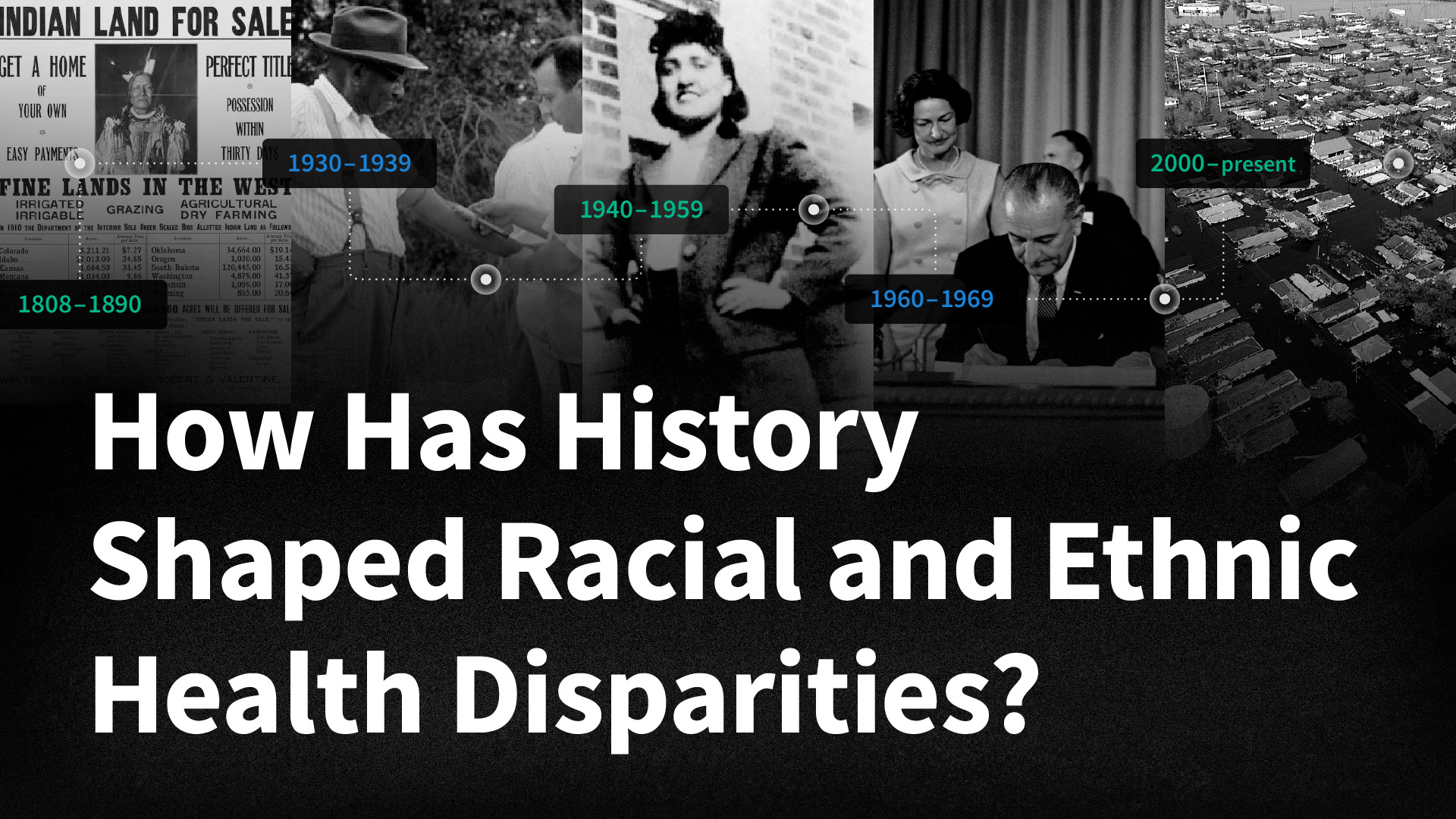
  • Timeline: How History Has Shaped Racial and Ethnic Health Disparities

    This timeline offers a historical view of significant U.S. federal policies and events spanning the early 1800s to today that have influenced present-day health disparities.
  • Health Policy 101: Chapter on Race, Inequality and Health

    Addressing persistent racial and ethnic disparities in health and health care is important for improving the nation’s health and economic prosperity. KFF explains such disparities and the factors that drive them, examines the actions to address them, and outlines future considerations.
  • Key Data on Health and Health Care by Race and Ethnicity

    Racial and ethnic disparities in health and health care remain a persistent challenge in the United States. An updated KFF resource examines how people of color fare compared to White people across 64 measures of health, health care, and social determinants of health.

Subscribe to KFF Emails

Choose which emails are best for you.
Sign up here

Filter

151 - 160 of 591 Results

  • KFF Briefing Examines Progress and Remaining Challenges for the Health Care Systems in Puerto Rico and U.S. Virgin Islands Six Months After Hurricanes Irma and Maria

    News Release

    Six months after hurricanes Irma and Maria made landfall across Puerto Rico and the U.S. Virgin Islands, local officials described progress but also a long road to full recovery of the U.S. territories’ health care systems, economies and infrastructure during a public briefing Monday at the Kaiser Family Foundation’s Washington D.C. offices.

  • U.S. Virgin Islands: Fast Facts

    Fact Sheet

    This fact sheet presents demographic, economic, and health indicators of the U.S. Virgin Islands and briefly discusses some of the territory's short and long-term challenges facing the territory after Hurricanes Irma and Maria struck the island in September 2017.

  • Are Health Centers Facilitating Equitable Access to COVID-19 Vaccinations? A June 2021 Update.

    Issue Brief

    This analysis updates earlier work and examines the extent to which vaccination efforts through community health centers are reaching people of color using data from the federal government’s weekly Health Center COVID-19 Survey. We include data from the survey weeks of January 8 through May 21, 2021, finding that people of color made up the majority of people who received vaccinations at community health centers.

  • Unwinding of the PHE: Maintaining Medicaid for People with Limited English Proficiency

    Issue Brief

    Provisions in the Families First Coronavirus Response Act (FFCRA) require states to maintain continuous Medicaid enrollment for enrollees until the end of the month when the COVID-19 public health emergency (PHE) ends. When the continuous enrollment requirements end and states resume redeterminations and disenrollments, individuals with LEP may be at increased risk of losing Medicaid coverage or experiencing a gap in coverage due to barriers completing these processes, even if they remain eligible for coverage.

  • Health Coverage in an Economic Downturn: Impact of Tight Budgets on Families and States

    Fact Sheet

    The economic downturn has strained family finances and prompted some Americans to cut back on medications and forgo preventive care and visits to the doctor. At the same time, the downturn has triggered declines in tax revenue that inhibit states’ ability to meet rising Medicaid program costs as enrollment spikes during economic hard times.

  • Native Americans and Medicaid: Coverage and Financing Issues

    Other Post

    Native Americans and Medicaid:Coverage and Financing Issues Prepared by Andy Schneider and JoAnn Martinez, The Center on Budget and Policy Priorities for The Kaiser Commission on the Future of Medicaid December 1997 Table 1: Medicaid Eligibility Thresholds Pregnant Women, Infants and Children (Effective October 1997) Other Eligibility Categories State Pregnant Women and Infants Children Under…

  • Five Basic Facts on Immigrants and Their Health Care

    Issue Brief

    As discussions on national health care reform move to the forefront, some have focused on the role of immigrants in the health care system, including their impact on the nation’s uninsured problem, their participation in public health coverage programs, and their use of hospital emergency rooms.

  • National Survey of Latinos: Politics and Civic Participation, Toplines

    Poll Finding

    These include topline findings from a comprehensive survey that assesses Latino attitudes in the 2004 election year. The third annual survey of Latinos from the Pew Hispanic Center and the Kaiser Family Foundation, the new survey examines political issues and the presidential election campaign, the economy, health care, Iraq and immigration. Survey Toplines (.

  • Today’s Topics In Health Disparities: What Might Health Reform Mean for Women of Color?

    Event Date:
    Event

    This December 16, 2009, Today's Topics In Health Disparities webcast examined aspects of the current Senate and House health reform bills that particularly impact women of color. Women tend to be greater users of the health care system than men, have higher rates of some chronic illnesses, and have unique reproductive health care needs.