Racial Equity and Health Policy

Survey of Immigrants

KFF-New York Times Survey: Immigrants Report Rising Fear, Negative Economic and Health Impacts, and Changing Political Views During the First Year of President Trump’s Second Term

The 2025 Survey of Immigrants, a partnership between KFF and The New York Times, takes an in-depth look at the experiences of immigrants during the first year of President Trump’s second term, including their worries related to increased immigration enforcement, their health and economic wellbeing, and the political views and preferences of immigrant voters. The survey paints a portrait of families under strain — where fear of detention and economic instability are negatively impacting immigrants’ health and reshaping immigrant families’ daily lives and views of U.S. political parties.

Read the News Release | Explore The New York Times’ Reporting
the Essentials
  • Disparities in Health and Health Care: 5 Key Questions and Answers

    This brief provides an introduction to what health and health care disparities are, why it is important to address them, what the status of disparities is today, recent federal actions to address disparities, and key issues related to addressing disparities in the future.
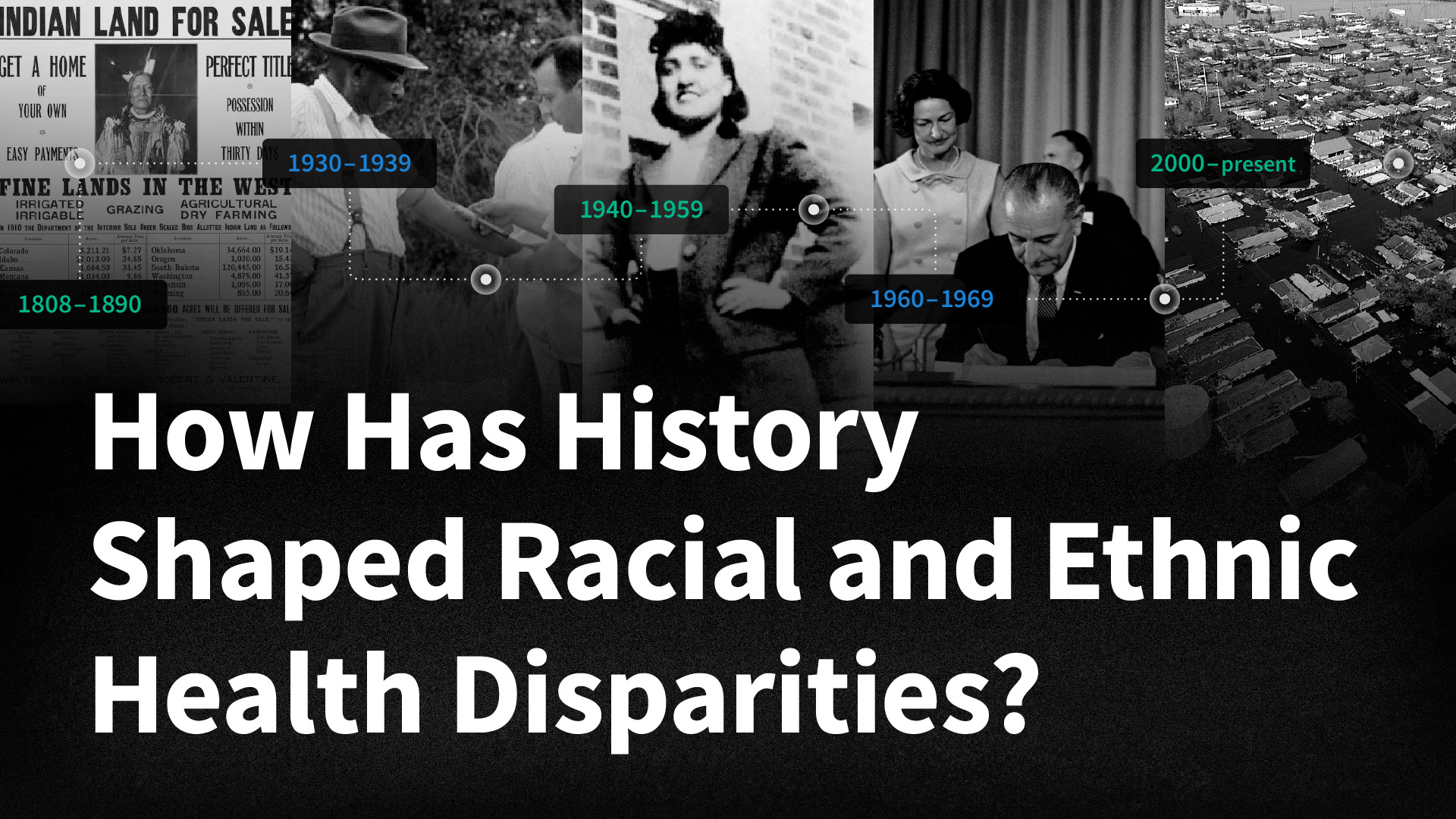
  • Timeline: How History Has Shaped Racial and Ethnic Health Disparities

    This timeline offers a historical view of significant U.S. federal policies and events spanning the early 1800s to today that have influenced present-day health disparities.
  • Health Policy 101: Chapter on Race, Inequality and Health

    Addressing persistent racial and ethnic disparities in health and health care is important for improving the nation’s health and economic prosperity. KFF explains such disparities and the factors that drive them, examines the actions to address them, and outlines future considerations.
  • Key Data on Health and Health Care by Race and Ethnicity

    Racial and ethnic disparities in health and health care remain a persistent challenge in the United States. An updated KFF resource examines how people of color fare compared to White people across 64 measures of health, health care, and social determinants of health.

Subscribe to KFF Emails

Choose which emails are best for you.
Sign up here

Filter

111 - 120 of 599 Results

  • Health and Health Care in the U.S.-Mexico Border Region

    Issue Brief

    The four states along the U.S.-Mexico border are home to over 78 million people of whom 8 million live in 44 counties that adjoin the border and border activity is at an all-time high. KFF's county-level analysis of the region shows that people living in border states fare worse along socioeconomic and health access measures as compared to the rest of the U.S. and that people who live in border counties within these states, especially in Texas, face more challenges than those living in non-border counties. Understanding of who lives in the region and their experiences, including their health and access to health care, may help inform efforts to address their needs and improve socioeconomic and health outcomes in border areas.

  • Kaiser Family Foundation National Survey of Latinos on HIV/AIDS – News Release

    Other Post

    Two New Studies On Latinos And AIDS In America: Survey Of Latinos Finds Widespread Concern About HIV/AIDS; Impact Of Disease Felt "Close To Home" Report Documents Impact Of AIDS/HIV On Hispanics And Offers Guidance For Community Health Providers Embargoed For Release Until:9:30 am, ET, Friday, May 1, 1998 For Further Information Contact: Tina Hoff or…

  • Kaiser Family Foundation National Survey of Latinos on HIV/AIDS

    Poll Finding

    A random-sample national survey of 802 Latino adults, 18 years and older. The survey, designed by staff at the Foundation and conducted by telephone in both English and Spanish by Princeton Survey Research Associates (PSRA), examines Latino's knowledge, values and beliefs with respect to HIV and AIDS.

  • A promotional image for the the KFF Health Policy 101 Race, Inequality, and Health chapter

    Race, Inequality, and Health

    Feature

    This Health Policy 101 chapter provides an overview of racial and ethnic disparities in health and health care and the factors that drive them, including the role of historical events and social and economic factors. It discusses why addressing disparities is important for health and economic prosperity, reviews recent federal policy actions that may impact disparities, and outlines future considerations.

  • Americans’ Challenges with Health Care Costs

    Issue Brief

    This data note reviews our recent polling data that finds that many Americans struggle to afford many aspects of health care, including disproportionate shares of uninsured adults, Black and Hispanic adults and those with lower incomes.

  • What Role Do Immigrants Play in The Direct Long-Term Care Workforce?

    Issue Brief

    To increase understanding of how shifting immigration policies may affect the direct care workforce providing long-term care services, this data note uses the 2023 American Community Survey (ACS) to provide an overview of the role that immigrants play in the direct care workforce for long-term care (LTC) services

  • Summary of HHS’s Final Rule on Nondiscrimination in Health Programs and Activities

    Issue Brief

    On May 18, 2016, the Department of Health and Human Services (HHS) published a final rule to implement Section 1557 of the Affordable Care Act (ACA), which prohibits discrimination in health coverage and care based on race, color, national origin, age or disability, and, for the first time sex. This Issue Brief provides a technical summary of Section 1557 and the final rule and highlights new protections and provisions included in the law and rule. Notably, Section 1557 is the first federal civil rights law to prohibit discrimination on the basis of sex in health care. Moreover, the proposed rule extends the definition of sex discrimination to include discrimination on the basis of gender identity. In addition, the final rule establishes regulations related to the provision of language assistance services based on long-standing HHS policy guidance.