Medicare

NEW AND NOTEWORTHY

Decoding Medicare Advantage Coding Intensity

Federal payments to Medicare Advantage plans, and adjustments for health status, have come under increased scrutiny. This brief answers key questions about coding intensity, recent steps taken by CMS, the effects on beneficiaries, and other proposals to improve payment accuracy.

Data Visualization

The Facts About Medicare Spending

This interactive provides the facts on Medicare spending. Medicare, which serves 67 million people and accounts for 12 percent of the federal budget and 21 percent of national health spending, is often the focus of discussions about health expenditures, health care affordability and the sustainability of federal health programs. Explore data on enrollment growth, Medicare spending trends overall and per person, growth in Medicare spending relative to private insurance, spending on benefits and Medicare Advantage, Part A trust fund solvency challenges, and growth in out-of-pocket spending by beneficiaries.

Read More

Stay informed.

Stay informed.

Filter

301-310 of 1,614 results

  • How Medicare Advantage Rebates Disadvantage Medicare’s Stand-Alone Drug Plan Market

    Issue Brief

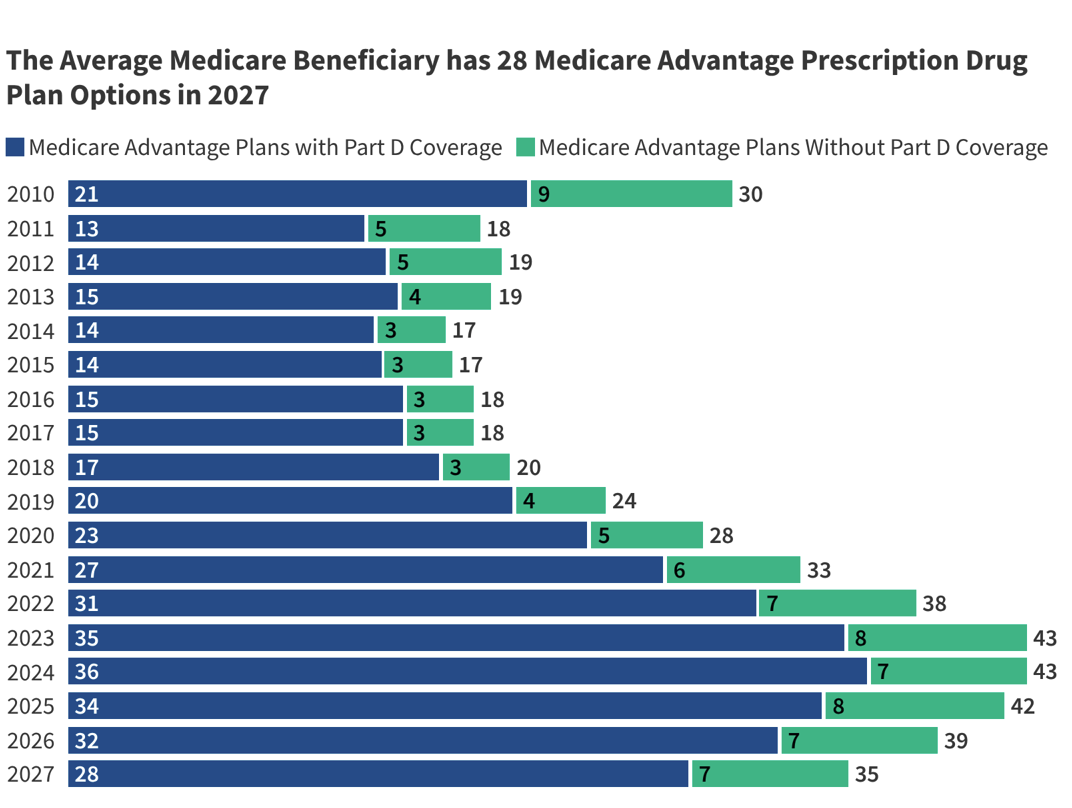
    The private plans that offer the Medicare Part D benefit - stand-alone drug plans and Medicare Advantage drug plans - are increasingly are competing on uneven terms, in part because the payment system for Medicare Advantage plans enables them to lower Part D premiums or reduce Part D cost sharing, making drug coverage from Medicare Advantage plans appear considerably cheaper, or even premium-free, to the beneficiary. This brief discusses the growing instability of the Part…

  • Medicare Part D Enrollment, Premiums, and Cost Sharing in 2026

    Issue Brief

    The Medicare Part D program provides an outpatient prescription drug benefit to 56 million older adults and people with long-term disabilities in Medicare who enroll in private plans. This brief analyzes Medicare Part D enrollment, premiums, and cost sharing in 2026 and trends over time, based on data from the Centers for Medicare & Medicaid Services (CMS).

  • Decoding Medicare Advantage Coding Intensity

    Issue Brief

    Federal payments to Medicare Advantage plans, and adjustments for health status, have come under increased scrutiny. This brief answers key questions about coding intensity, recent steps taken by CMS, the effects on beneficiaries, and other proposals to improve payment accuracy.

  • Medicare Advantage in 2026: Enrollment Update and Key Trends

    Issue Brief

    More than half (55%) of eligible Medicare beneficiaries are enrolled in Medicare Advantage in 2026. To better understand trends in the growth of the Medicare Advantage program, this brief provides current information about enrollment, including by plan type and firm

  • Kaiser Health Tracking Poll — November 2009

    Poll Finding

    The November Kaiser Health Tracking Poll shows little movement in measures of public opinion about health reform from recent months. Among the new findings is a ranking of the public's top priorities from among a list of elements of the legislation. There were both similarities and differences in priorities across partisan groups: while assuring the availability of affordable plans ranked in the top three priorities for Democrats, Republicans and independents, deficit neutrality ranked in the…

  • Nearly Four Million Medicare Beneficiaries Could Be Eligible for the Temporary Medicare GLP-1 Bridge Program Covering These Drugs for Weight Loss

    Issue Brief

    This news release highlights that a KFF analysis finds that 3.8 million Medicare beneficiaries met the criteria to be eligible for the new Medicare GLP-1 Bridge, based on claims data from 2023. The temporary program will provide coverage of three GLP-1 drugs used for weight reduction and weight management to eligible Medicare beneficiaries.