Medicaid

new and noteworthy

Medicaid: What to Watch in 2026

Medicaid: What to Watch in 2026

In this brief, KFF explores how state fiscal pressures are likely to converge with the implementation of the 2025 reconciliation law to affect Medicaid coverage, financing, and access to care over the next year, especially leading up to the midterm elections.

Medicaid Watch

Featuring policy research, polling and news about how Medicaid is changing, and the impact of those changes due to the tax and spending cuts law

Medicaid Work Requirements

Tracking Medicaid Work Requirements: u003cbru003eData and Policies

To implement Medicaid work requirements, states will need to make important policy and operational decisions, implement needed system upgrades or changes, develop new outreach and education strategies, and hire and train staff, all within a relatively short timeframe. The information tracked here can serve as a resource to understand Medicaid work requirements and state options, gauge readiness, and track implementation of the requirements.

understanding medicaid

Medicaid Financing

Medicaid represents $1 out of every $5 spent on health care in the U.S. and is the major source of financing for states to provide health coverage and long-term care. This brief examines key questions about Medicaid financing and how it works.

Medicaid and Provider Taxes

All states except Alaska cover some state Medicaid costs with taxes on health care providers. This brief uses data from KFF’s 2024-2025 survey of Medicaid directors to describe current practices and the federal rules governing them.

5 Facts: Medicaid and Hospitals

Absorbing reductions in Medicaid spending could be challenging for hospitals, particularly for those that are financially vulnerable. This brief provides data on the reach of Medicaid across hospitals, patients, and charity care.

Medicaid Home Care in 2025

This issue brief provides an overview of what Medicaid home care (also known as “home- and community-based services”) is, who is covered, and what services were available in 2025.

5 Facts: Medicaid Program Integrity

This brief explains what is known about improper payments and fraud and abuse in Medicaid and describes ongoing state and federal actions to address program integrity.
2025 Medicaid Home Care survey

Payment Rates Ahead of 2025 Reconciliation Law

This issue brief describes Medicaid payment rates for home care and other workforce supports that are in place in 2025, before the majority of the 2025 reconciliation law provisions start taking effect.

Home Care Support for Family Caregivers in 2025
number of responding states, including DC, that allow payments for family caregivers by type of home care program and type of caregiver.

This issue brief describes the availability of self-directed services and supports for family caregivers in Medicaid home care in 2025, before most provisions in the reconciliation law take effect.

States’ Management of Home Care Spending

This issue brief describes the mechanisms states are currently using to limit Medicaid spending on home care and their plans for adopting new mechanisms in state fiscal year (FY) 2026.

Waiting Lists for Medicaid Home Care, 2016 to 2025
A Look at Waiting Lists for Medicaid Home- and Community-Based Services from 2016 to 2025

This data note provides new information about waiting lists in Medicaid home care before many of the provisions in the 2025 reconciliation law go into effect.

Eligibility and coverage
  • Eligibility, Enrollment, and Renewal Policies

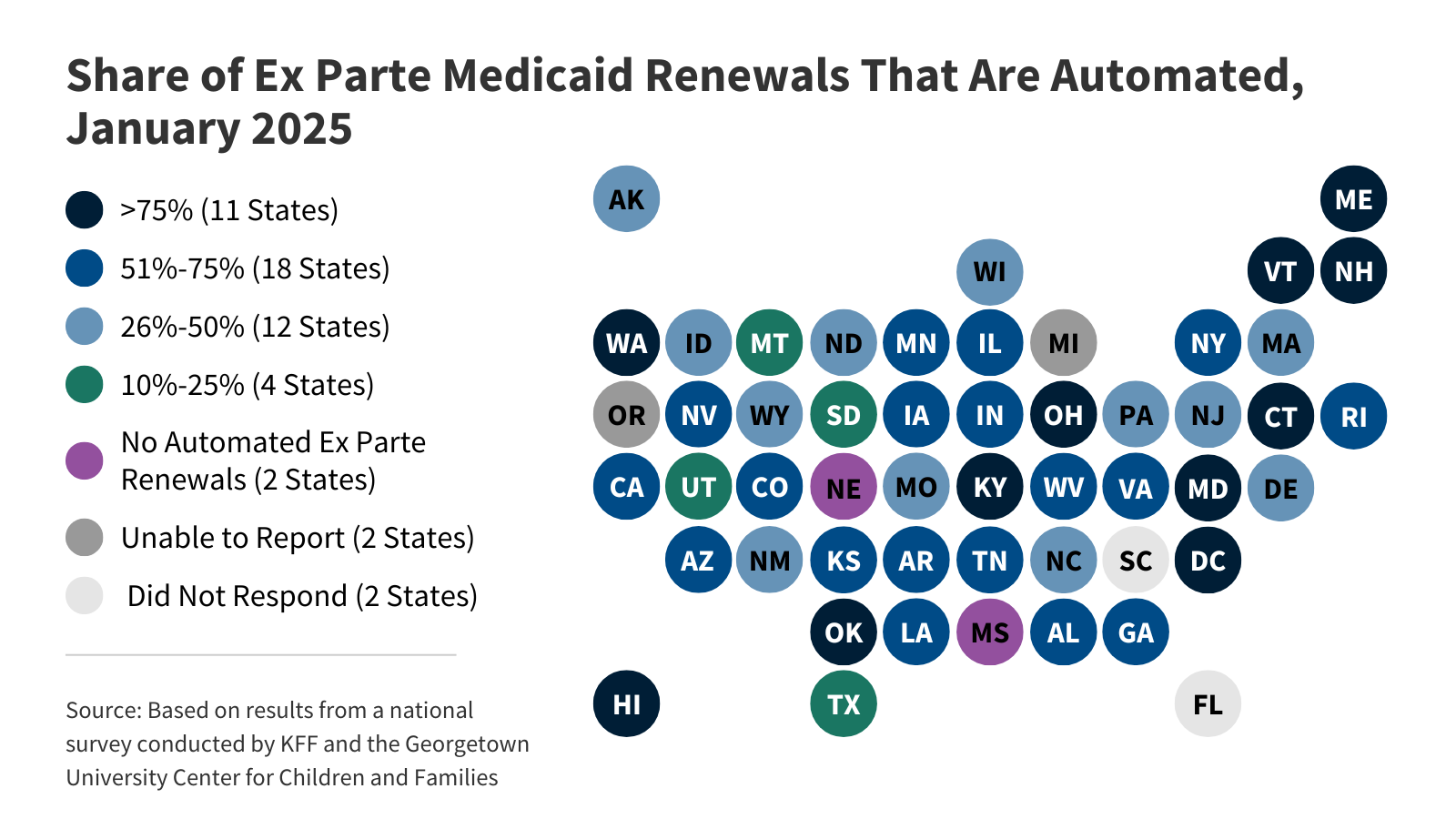
    KFF's survey findings capture state actions that seek to improve the accuracy and efficiency of Medicaid and CHIP enrollment and renewal processes, as of January 2025.
  • Seniors and People with Disabilities

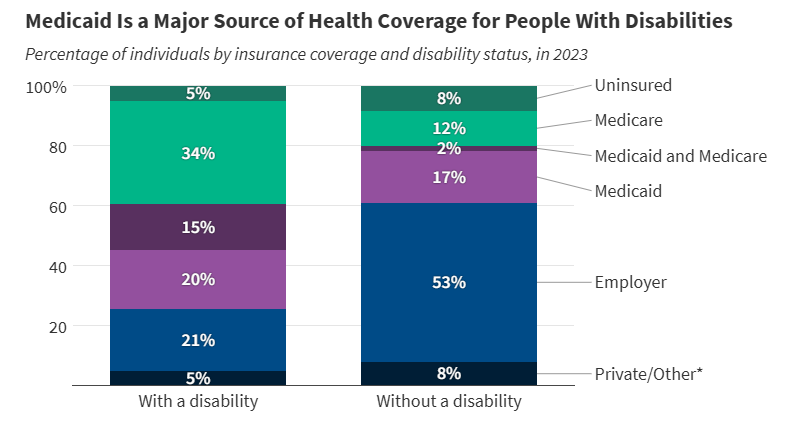
    More than 1 in 3 people with disabilities (15 million) have Medicaid (35%). In comparison, only 19% of people without disabilities have Medicaid.
  • Children with Special Needs

    Amid debates about proposed cuts to federal Medicaid spending, this brief analyzes key characteristics of children with special health care needs and explores how Medicaid provides them with coverage.
  • People With Intellectual and Developmental Disabilities

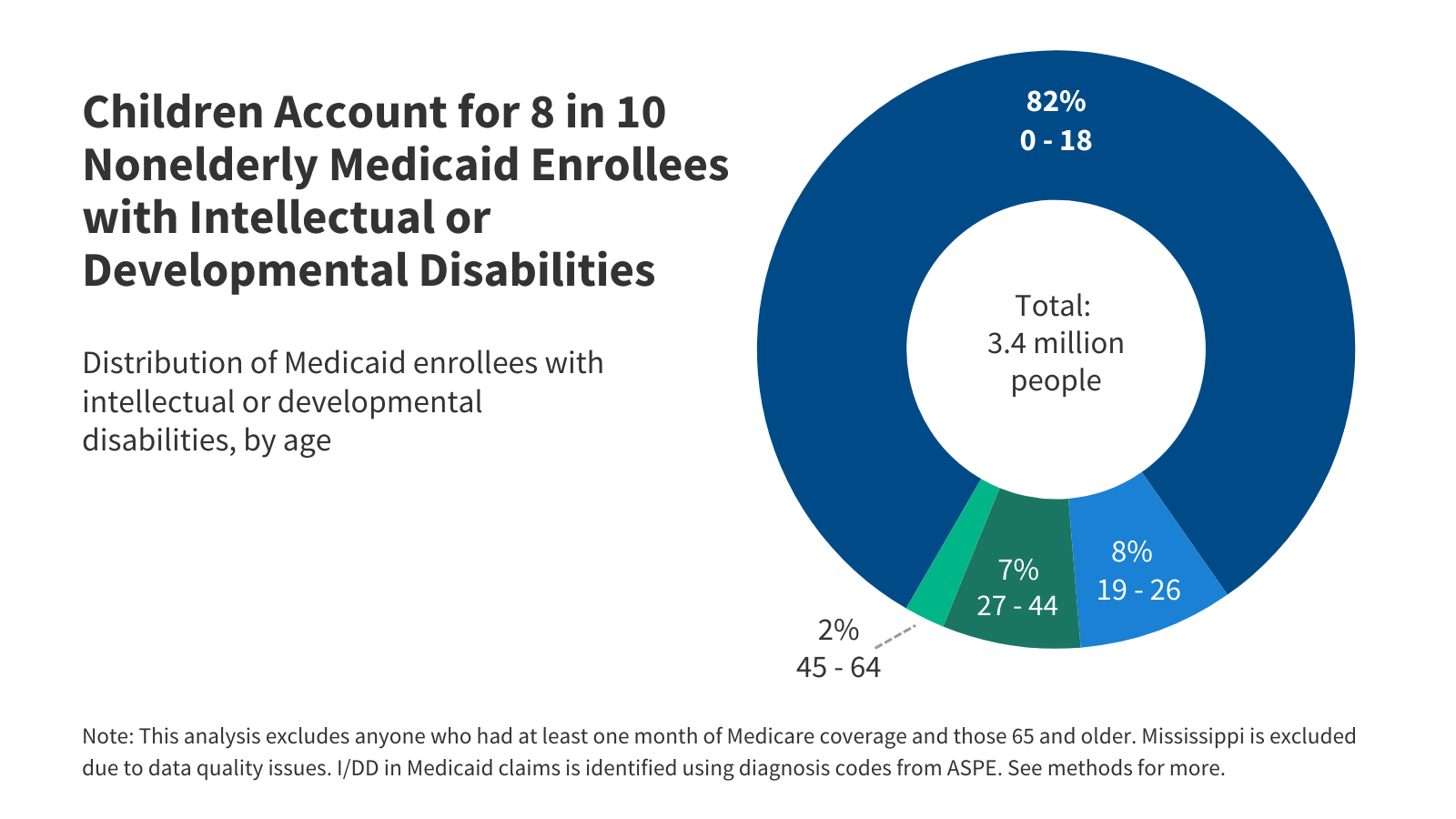
    Among the estimated 8 million people with intellectual and developmental disabilities (I/DD), over three million have Medicaid coverage.
  • Adults with Chronic Conditions

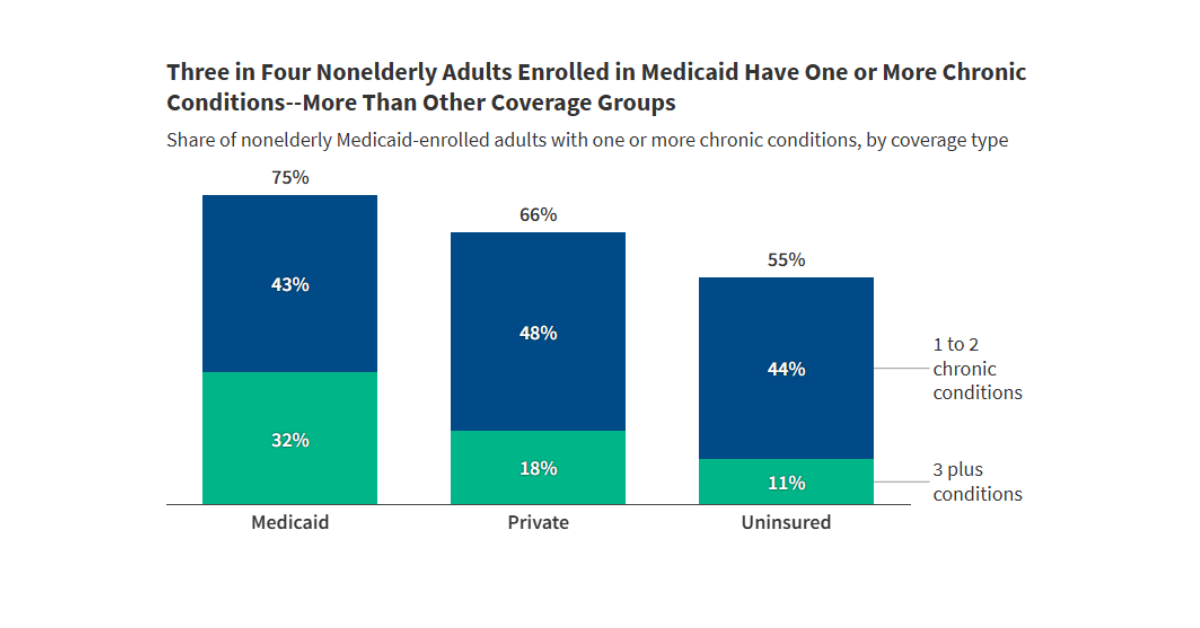
    Among working age adults enrolled in Medicaid, approximately three quarters have one or more chronic conditions, and nearly one-third have three or more.

Subscribe to KFF Emails

Choose which emails are best for you.
Sign up here
Filter

1,901 - 1,910 of 2,689 Results

  • How Will The Uninsured Be Affected By Health Reform?

    Issue Brief

    This brief examines who the uninsured are and explores how they could be affected by health reform, including estimates of how many might qualify for coverage under a Medicaid expansion, how many would be eligible for subsidies and how many would not be eligible for such help. Issue Brief (.pdf)

  • How Will Uninsured Childless Adults Be Affected By Health Reform?

    Issue Brief

    This brief examines uninsured childless adults and how they could be affected by health reform, including estimates of how many might qualify for coverage under a Medicaid expansion, how many would be eligible for subsidies and how many would not be eligible for such help. Issue Brief (.pdf)

  • How Will Uninsured Children Be Affected By Health Reform?

    Issue Brief

    This brief examines uninsured children and how they could be affected by health reform, including estimates of how many might qualify for coverage under a Medicaid expansion, how many would be eligible for subsidies and how many would not be eligible for such help. Issue Brief (.pdf)

  • Express Lane Eligibility Efforts: Lessons Learned from Early State Cross-Program Enrollment Initiatives

    Issue Brief

    The Children's Health Insurance Program Reauthorization Act of 2009 (CHIPRA) provides states new options to reach and enroll eligible but uninsured low-income children into Medicaid and CHIP. The law's Express Lane Eligibility (ELE) provisions enable state Medicaid and CHIP agencies to identify, enroll and recertify children by relying on eligibility findings from other programs, such as Head Start or Food Stamps, rather than having to re-analyze eligibility under their own rules. Further, CHIPRA authorizes greater…

  • Federal Support for Health Information Technology in Medicaid: Key Provisions in the American Recovery and Reinvestment Act

    Issue Brief

    The American Recovery and Reinvestment Act of 2009 (ARRA) includes an unprecedented nearly $47 billion federal investment in health information technology initiatives. This e-health snapshot provides an overview of the health information technology provisions in the law that have direct implications for Medicaid. Health Information Technology (HIT) offers the promise of potential improvements in quality of care as well as increased efficiencies in care and cost savings. Medicaid, which covers nearly 60 million people, can…

  • Rising Health Pressures in an Economic Recession

    Event Date:
    Event

    As millions of people lose their jobs and job-based health insurance during the recession, the Kaiser Family Foundation has several reports and a video that shed light on the rising toll on American families and the public programs that many depend on to fill the gap during times of crisis. Rising Health Pressures in an Economic Recession: A 360-Degree Look at Four Communities, and a companion video, On the Edge: Health Care in the Recession…

  • Rising Health Pressures in an Economic Recession: A 360-Degree Look at Four Communities

    Report

    This report draws on interviews and focus groups in four communities to examine at the grassroots levels the experiences of families, employers, safety-net providers and community organizations in four U.S. communities hard hit by the recession. The communities are Beloit, Wisc.; Tampa-St. Petersburg, Fla.; Long Island, N.Y.; and Sonoma, Calif. The report explores the financial and personal struggles of families who have suffered economic reversals and lost health coverage, forcing many to juggle bills and…

  • Health Reform Opportunities: Improving Policy for Dual Eligibles

    Issue Brief

    As the nation considers national health reform, this brief provides an overview of opportunities to realign federal and state policy for the dual eligibles to promote a more rational, cost-efficient system for 9 million of the poorest, sickest and highest-cost people covered by both Medicaid and Medicare. Navigating two programs with different rules and financing incentives is complex for beneficiaries and providers, impedes efforts to improve care coordination and results in cost-shifting between programs that…

  • New Option for States to Provide Federally Funded Medicaid and CHIP Coverage to Additional Immigrant Children and Pregnant Women

    Fact Sheet

    This fact sheet provides state-level data from a Kaiser survey that found that a large number of states are using state funds to provide health coverage to legal immigrant children and pregnant women through Medicaid, CHIP or another state program. Under the Children's Health Insurance Program Reauthorization Act of 2009, states now have the option to provide federally matched Medicaid or CHIP to some or all of the legal immigrants they have been covering solely…

  • Pulling it Together: Teaching An Old Dog New Tricks

    Perspective

    Way back in the eighties when I was Human Services Commissioner in New Jersey, I established something called the Garden State Health Plan (GSHP).  It was the first — and I think the only — federally qualified state-run HMO for Medicaid beneficiaries.  One goal of the GSHP was to reallocate the Medicaid dollar, giving more to primary care physicians who at the time were paid $9 for a general office visit, and a little less…