Immigrant Health

survey of immigrants

KFF-New York Times Survey: Immigrants Report Rising Fear, Negative Economic and Health Impacts, and Changing Political Views During the First Year of President Trump’s Second Term

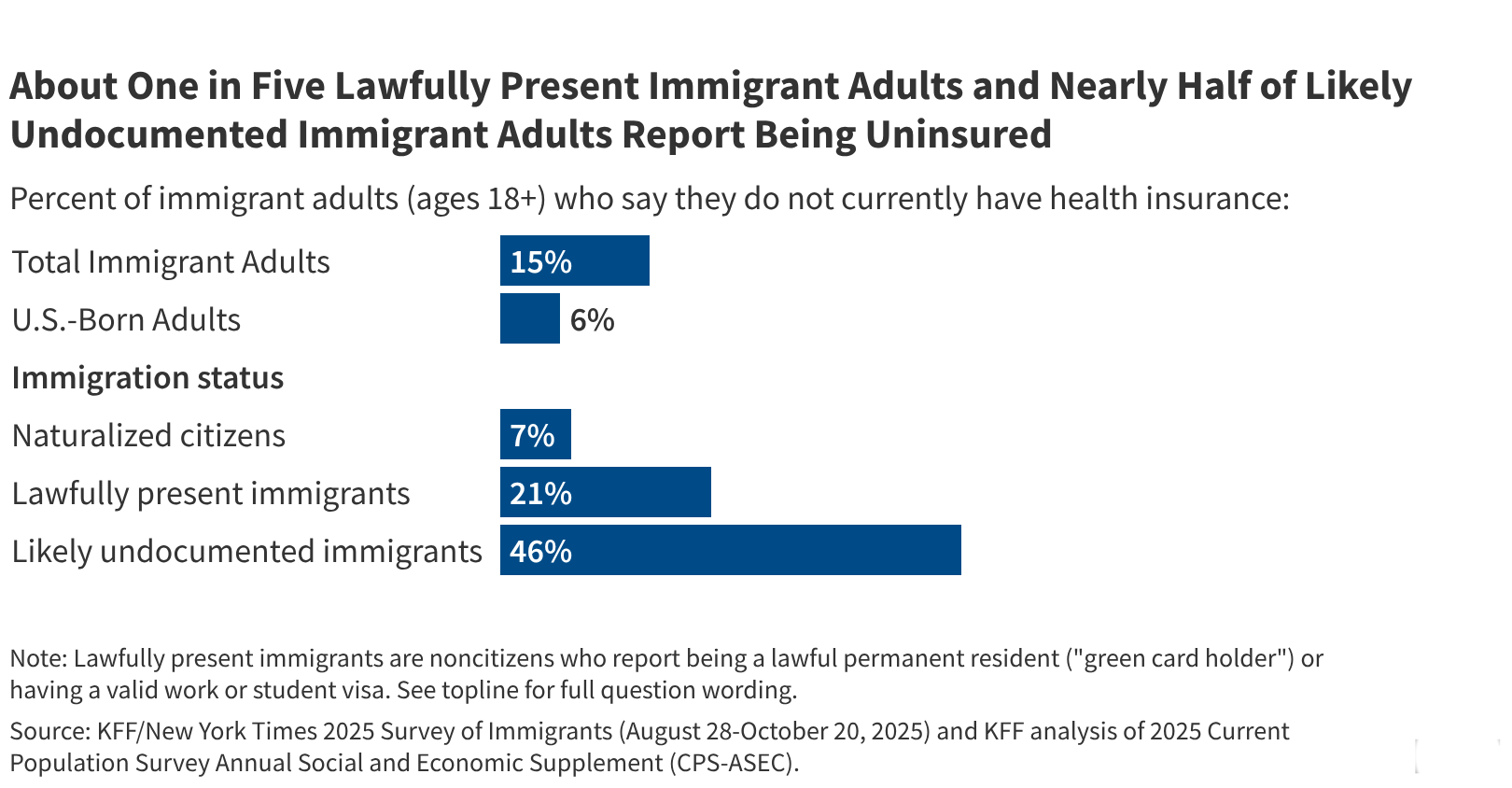
The 2025 Survey of Immigrants, a partnership between KFF and The New York Times, takes an in-depth look at the experiences of immigrants during the first year of President Trump’s second term, including their worries related to increased immigration enforcement, their health and economic wellbeing, and the political views and preferences of immigrant voters. The survey paints a portrait of families under strain — where fear of detention and economic instability are negatively impacting immigrants’ health and reshaping immigrant families’ daily lives and views of U.S. political parties.

Read the News Release | Explore The New York Times’ Reporting
Stay informed.

Stay informed.

Filter

81 - 90 of 177 Results

  • More States Are Providing Fully State-Funded Health Coverage to Some Individuals Regardless of Immigration Status

    News Release

    More states are providing fully state-funded health coverage to some individuals regardless of immigration status.  An updated KFF analysis shows that as of March 2024, 12 states and Washington D.C. provide fully state-funded coverage for income-eligible children regardless of immigration status. These states include California, Connecticut, Illinois, Maine, Massachusetts, New Jersey, New York, Oregon, Rhode Island, Utah, Vermont, and Washington.Six states -- California, Colorado, Illinois, New York, Oregon, and Washington, plus D.C. -- have also…

  • Florida’s Recent Heat Protection Preemption Law Could Disproportionately Affect Hispanic and Noncitizen Immigrant Workers

    Issue Brief

    The Florida legislation prevents city and county governments from requiring that employers, including government contractors, provide heat protections for outdoor workers outside of those required under state or federal law. These protections include requiring water breaks and other cooling measures for outdoor workers. The law could impact nearly 1.8 million nonelderly adult outdoor workers in Florida, who are disproportionately Hispanic and noncitizen immigrant workers.

  • Five Key Facts About Black Immigrants’ Experiences in the United States

    Issue Brief

    Black immigrants come to the U.S. seeking more opportunities for themselves and their children, and most report improved educational opportunities and employment and financial situations as a result of moving to the U.S. However, Black immigrants report disproportionate levels of unfair treatment and discrimination in their workplaces, communities, and when seeking health care, reflecting the intersectional impacts of racism and anti-immigrant sentiment.

  • The Symbolic Manipulation of Health Issues in Elections

    From Drew Altman

    KFF President and CEO Drew Altman explains why data and facts, policy plans and lists of accomplishments do not connect with many voters. Understanding the symbolic dimensions of politics and issues is critical for experts. We can reach a share of the public with facts and data but need additional strategies to reach everyone, including storytelling and trusted messengers.

  • Adult Children of Immigrants Make Outsized Contributions to the U.S. Health Care Workforce

    News Release

    Adult children of immigrants make up a disproportionately large share of physicians, surgeons and other health care practitioners in the U.S. -- just one reflection of their comparatively high employment, educational attainment and income levels, according to a new KFF analysis. The analysis of 2023 Current Population Survey data shows that U.S.-born nonelderly adults whose parents were both born outside the U.S. comprise 13% of physicians, surgeons, and other health care practitioners. That amounts to…

  • What Would Another Trump Presidency Mean for Health Care?

    Perspective

    In a new column in JAMA Health Forum, Larry Levitt, KFF’s executive vice president for health policy, explores what a second Trump presidency might mean for health policy based on his record and remarks, including potentially weakening the Affordable Care Act, reducing federal Medicaid costs, and restricting access to abortion.

  • La mayoría de los inmigrantes hispanos dicen que sus vidas son mejores en Estados Unidos, pero enfrentan desafíos financieros y de atención médica: Encuesta 2023 de KFF/LA Times sobre inmigrantes

    Poll Finding

    Hispanic immigrants represent the largest share of the immigrant population within the U.S.. They face unique challenges that vary across immigration status, educational attainment, and other socioeconomic factors, however, many remain optimistic about their quality of life in the U.S..

  • 3 Charts: Hispanic Immigrants’ Experiences in the United States

    News Release

    Hispanic immigrants comprise the largest group of immigrants in the United States, and one in three Hispanic or Latino adults in the U.S. are immigrants. Most report a higher quality of life in the U.S. than in their countries of birth and believe their children’s lives will be better than their own. A large majority are working, and many send money to their family living outside the U.S. Hispanic immigrants are more likely than other immigrant…