
New Ebola Quarantine Rule Bars Entry of Noncitizens, Including Green Card Holders, from Affected Countries

Following the recent Ebola outbreak impacting some African countries, the Centers for Disease Control and Prevention (CDC) issued an interim final rule (IFR) on May 27, 2026, which blocks the entry of foreign nationals, including lawful permanent residents (LPRs) or “green card” holders, from impacted countries into the United States on public health grounds. The CDC cited the logistical challenges of screening travelers for Ebola at every U.S. port of entry as a justification for the rule. Unlike the border restrictions implemented during COVID-19, which primarily targeted undocumented migrants and asylum seekers arriving at land borders, the Ebola IFR applies broadly to all foreign nationals, including LPRs or “green card” holders, who have recently been in or traveled through designated outbreak countries. Barring the entry of all foreign nationals including LPRs is highly unusual and likely to face legal challenges.
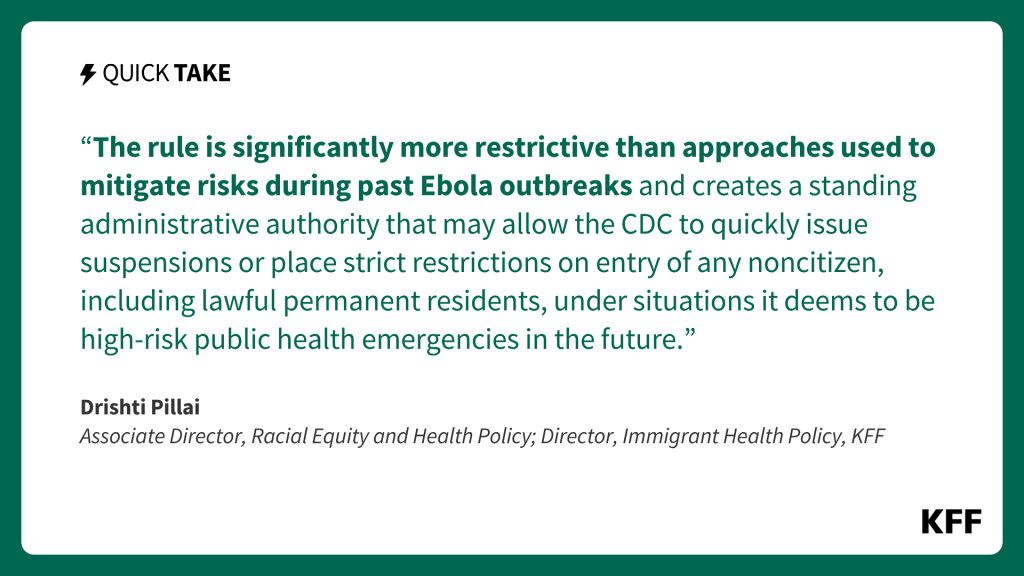
The rule applies to foreign nationals from the Democratic Republic of the Congo (DRC) and Uganda, which have identified cases of Ebola, as well as from South Sudan, which is a neighboring country but not yet directly impacted. The rule is significantly more restrictive than approaches used to mitigate risks during past Ebola outbreaks and creates a standing administrative authority that may allow the CDC to quickly issue suspensions or place strict restrictions on entry of any noncitizen, including lawful permanent residents, under situations it deems to be high-risk public health emergencies in the future. During past Ebola outbreaks, the CDC implemented enhanced screening requirements at U.S. airports for travelers from impacted countries including temperature checks, symptom questionnaires, and routing travelers from impacted countries through designated airport hubs but did not bar entry of noncitizens regardless of visa status. When Title 42 was implemented during the COVID-19 public health emergency, many public health experts argued that it was counterproductive and put the health and well-being of migrants at risk. The new IFR comes against a backdrop of the dismantlement of the U.S. Agency for International Development, which has impacted efforts to combat diseases and improve global public health, and follows a recent policy memo issued by U.S. Citizenship and Immigration Services that requires hundreds of thousands of lawfully present immigrants (including individuals on H-1B work visas) residing in the United States to leave the country in order to apply for LPR status, except under “extraordinary” circumstances. This rule follows a temporary, 30-day emergency suspension order issued by the CDC on May 18, 2026, that blocks the entry of certain foreign nationals who have been physically present in the DRC, Uganda, or South Sudan within the last 21 days. While LPRs were exempt from the May 18 suspension order, the IFR amends foreign quarantine regulations (42 CFR Part 71.40) so that LPRs are no longer exempt from suspension of entry under Title 42. The rule took effect retroactively on May 22, 2026, and is scheduled to last for six months unless extended or terminated early by the Secretary of Health and Human Services. There is a 30-day public comment period until June 26, 2026.