
States Sue CMS Over Medicaid Work Requirements Rule, Citing Departure from Earlier Guidance on Medical Frailty

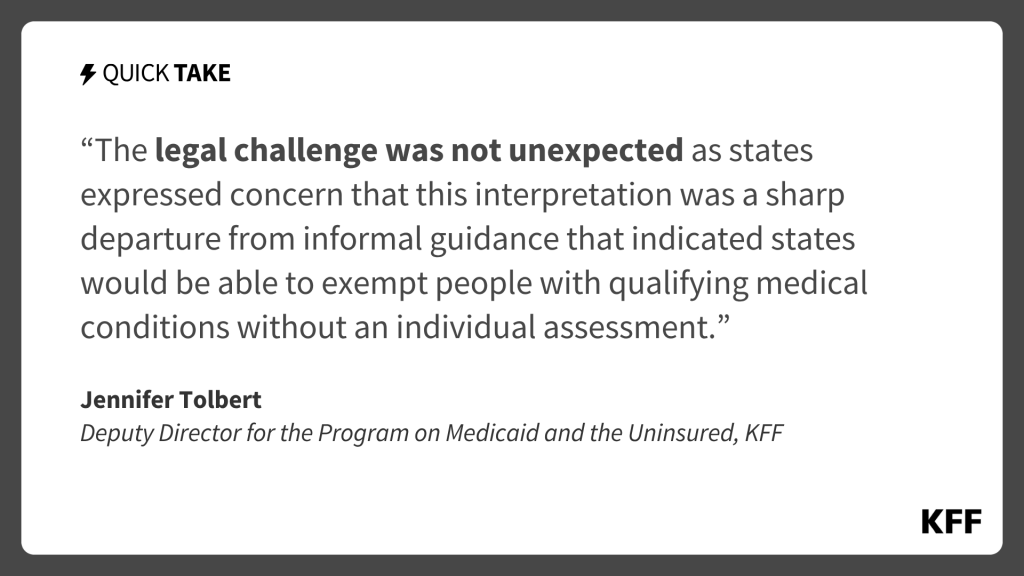
Less than a month after the Centers for Medicare and Medicaid Services (CMS) released an interim final rule implementing Medicaid work requirements, Democratic Attorneys General from 24 states including the District of Columbia and two Democratic Governors filed a lawsuit challenging aspects of the Trump administration’s interpretation of the 2025 reconciliation law’s requirements, including most notably the medical frailty exemption. When the rule was released, attention focused on the requirement that to qualify for the medical frailty exemption, an individual must have a medical condition and the condition must impair that individual’s ability to comply with community engagement requirements (Figure 1). The legal challenge was not unexpected as states expressed concern that this interpretation was a sharp departure from informal guidance that indicated states would be able to exempt people with qualifying medical conditions without an individual assessment.
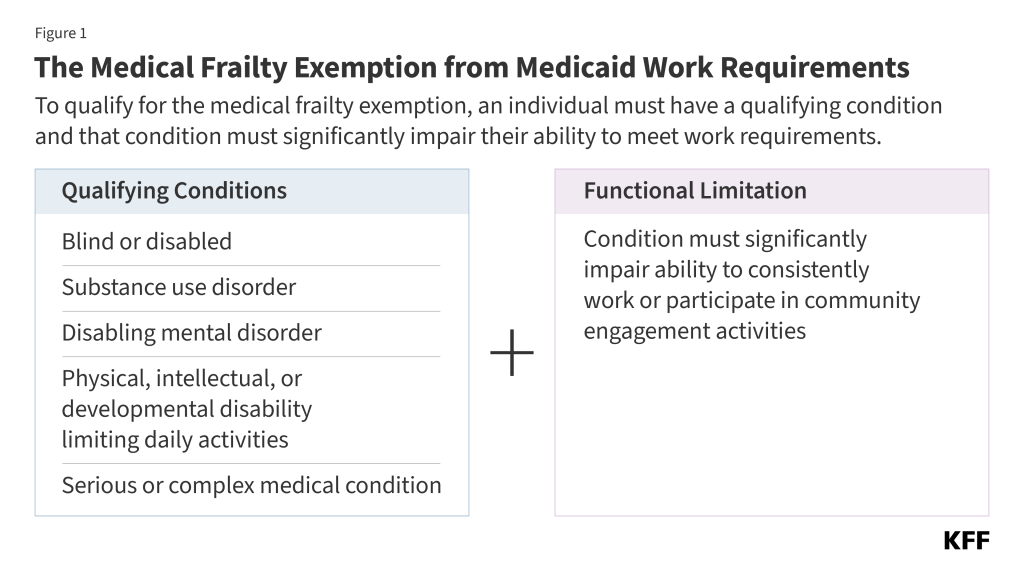
The plaintiff states argue the two-part test for medical frailty required by the rule goes beyond a plain language reading of the statute, which provides a broad rather than narrow exclusion for people who are medically frail, and puts vulnerable individuals who have significant health care needs, including those battling cancer, those with mental health conditions, and people with diabetes, HIV, or with other serious or complex illnesses, at risk of losing the coverage they need to manage their conditions. The states also claim the restrictive interpretation will have significant cost implications given the substantial investments they had already made based on informal guidance from CMS and the limited time they have to make the changes.
In asking for the court to enjoin and vacate the challenged provisions, including the medical frailty two-part test, the plaintiff states emphasized the continued absence of necessary guidance on how to assess whether an individual’s condition impairs their ability to work, and the harm to individuals who could lose coverage and face disruptions in treatment and care that would lead to worsening health conditions.
The Congressional Budget Office has estimated that the Medicaid work requirement will save the federal government $326 billion over a decade and result in 5.3 million more people uninsured. While the vast majority of Medicaid enrollees work or could qualify for an exemption, previous Medicaid work requirement pilots suggest many could fall through the cracks, unable to navigate reporting requirements.